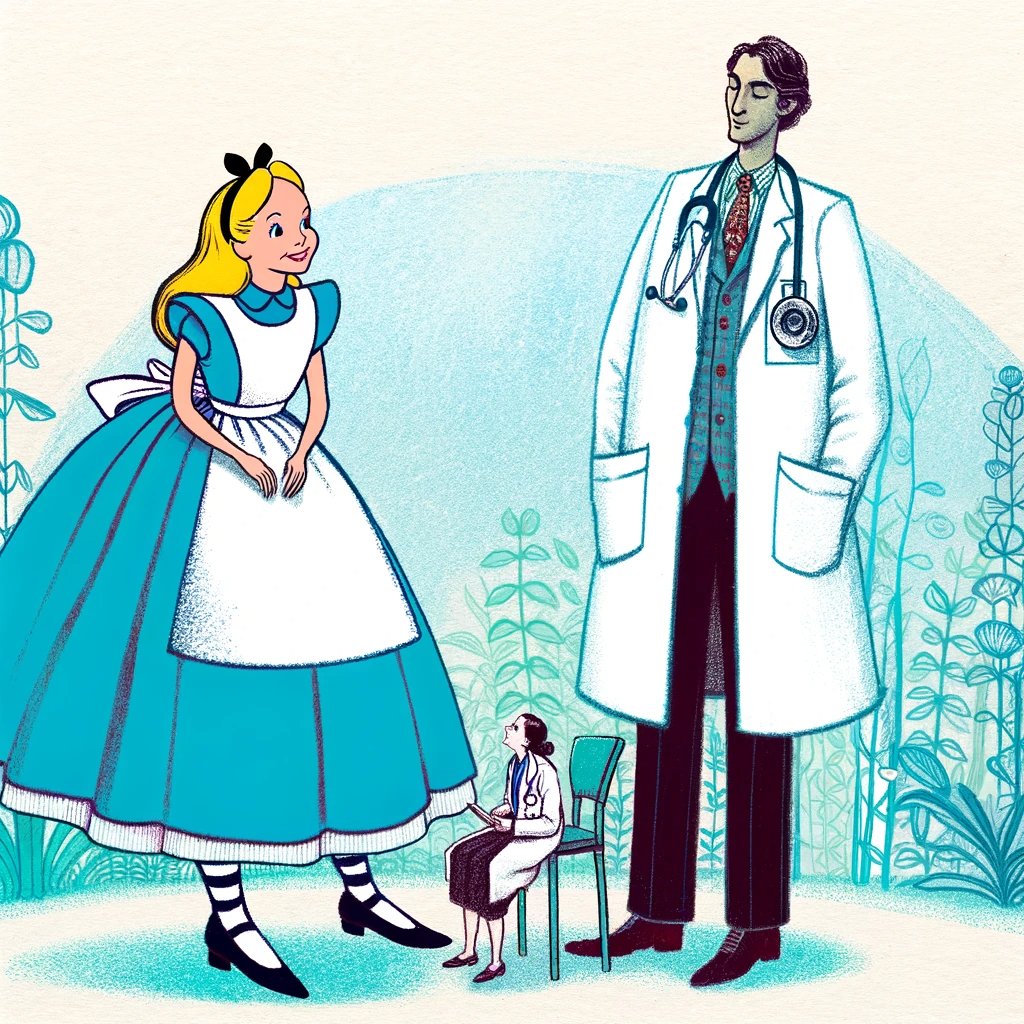
🧠1/ Have you ever felt like you're in a surreal world where sizes and scales are all warped? No, it's not a fantasy—it's a real medical condition! And our latest research dives into this mind-bending phenomenon called Alice in Wonderland Syndrome (AIWS) #Neuroscience#AIWS
I’m very grateful to share some good news, and offer a fully-funded PhD opportunity 🔥 As of January 2026, I have been appointed Scientific Attending Physician within Ulm University & Universitätsklinikum Ulm‘s joint program supporting advanced clinician scientists. /1
The position will be advertised through official university channels soon. I am very happy to hear from interested candidates or colleagues who may know someone who would be a great fit!
🔍 PhD opportunity: In this context, I am recruiting a highly motivated PhD candidate (Computer Science / Biomedical Engineering / Neuroscience) with a solid background in coding, interest in cutting edge AI/ neuroimaging methods and motivation for clinical translation.
I am thankful for the trust and support of the Medical Faculty and the University Hospital!
This marks an important step toward establishing a research group at the interface of digital motor biomarkers, computer vision, and neuroimaging at the Department of Neurology.
‘Mapping the neuroanatomy of dystonia using causal brain lesions’ – now out as a preprint! https://t.co/6vzmAGUAWz Huge thank you to @JJoutsa@foxmdphd!
We map the brain networks for the different types of dystonia, showing significant differences, somatotopy...and much more!!
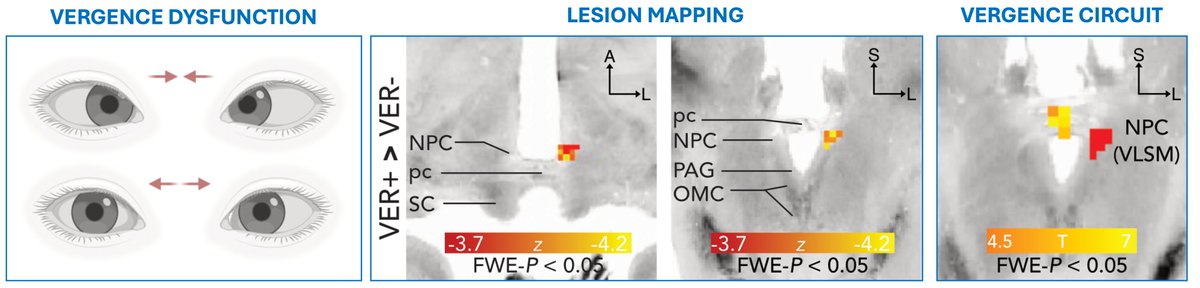
Do you see one version of this post or two? To see one screen your two eyes must move together in a coordinated way. Max Friedrich @Brain_Circuits studied lesions in monkeys and human patients to find the brain circuit responsible. Now out in @Brain1878
Friedrich et al. identify a midbrain circuit linked to vergence dysfunction in humans and monkeys, providing insights into double vision in neurological disorders. https://t.co/IM7SMHAg89
Hyposkilliacs defend their position by blaming the inaccuracy of physical signs when the true problem is that they have not bothered to master the physical examination
# BrainspottingAdventuresinNeurology
@NottingHillEds
Our lab has spent the last few years developing a fully automated tool for predicting personalized outcomes from stroke that incorporates lesion location.
Our hope is that it bridges lesion research and clinical neurology.
Check it out:
https://t.co/Tr7gop6muS
📣 We have two new fully funded MSc/PhD positions starting Fall 2025 or Winter 2026.
Join us to work on neuroimaging, epilepsy, and brain networks!
Learn more and apply 👉 https://t.co/cQHeLVl2OE
The terms conjugate gaze palsy/deviation/preference are used interchangeably for Prevost's sign which can localize an acute non-irritative frontal eye field lesion in which the patient "looks towards the side of the lesion and away from the hemiplegia"
[CT: R MCA CVA-> eyes R]
🧠 NeuroImage: Ictal Hyperperfusion Highlights the Right Mesial Parietal Heading Direction System in Roller Coaster Reflex Epilepsy https://t.co/JN3W2Yd4Ip
Is generalized epilepsy a seizure of the whole brain or a specific brain network?
In our new paper out now in @NatureComms we investigate this by combining brain abnormalities and DBS with the human connectome.
Paper: https://t.co/hlQVXigDED
A 🧵 below:
🚨 New lab paper!🚨
Dream study of mine for 20 yrs not possible until now thanks to NIH 🧠 funding & 1st-author lead @m_seeber
We tracked hippocampal activity as people walked memory-guided paths & imagined them again. Did brain patterns reappear?🧵👇
https://t.co/Nvuuct6DWP
Tract-specific white matter hyperintensities and neuropsychiatric syndromes: a multicentre memory clinic study
This study shows finds tract-syndrome specificity of WM hyperintensity burden with apathy and hyperactivity suggests disruption of strategic neuronal pathways may be a potential mechanism through which small vessel disease affects cognitive presentation
https://t.co/iCCK5fOjrG @MarcoDuering





![FredLepore's tweet photo. The terms conjugate gaze palsy/deviation/preference are used interchangeably for Prevost's sign which can localize an acute non-irritative frontal eye field lesion in which the patient "looks towards the side of the lesion and away from the hemiplegia"
[CT: R MCA CVA-> eyes R] https://t.co/YIjdLD8yVn](https://pbs.twimg.com/media/GojMh8EWoAEuR4X.jpg)


