We’ve automated every single thing we can @every with AI agents.
And yet there’s way more human work to do than ever. We’ve gone from 4 -> 30 human employees since GPT-3.
I wrote a report on the structural reasons: how AI makes expert competence cheap, why that drives up demand for experts, and why the dynamic only intensifies as we approach AGI.
After Automation: https://t.co/Lb7SUCduAg
A mic drop moment @ycombinator tonight
@sama just offered $2M in OpenAI tokens to EVERY YC startup in the current batch in exchange for equity
Just like Yuri Milner offering to invest in every startup back when Sam was a YC partner
I can't wait to see what's unlocked when you let the most driven, creative and formidable founders tokenmaxx
Of course that's your contention. You're a first-time SaaS bear. You just got finished listening to some podcast, Dario on Dwarkesh, probably. Now you think it’s the end of white collar work and seat-based pricing is screwed. You're gonna be convinced of that til tomorrow when you get to “Something Big is Happening”. Then you’ll install ClawdBot on a Mac Mini, vibe code a dashboard on top of a postgres database and say we’re all just a couple ralph loops away from building a Salesforce competitor. That’s gonna last until next week when you discover context graphs, and then you're gonna be talking about how the systems of record will be disintermediated by an agentic layer and reposting OAI marketing graphics.
“Well, as a matter of fact, I won't, because ultimately the application layer is just ….”
The application layer is just business logic on top a CRUD database. You got that from Satya’s appearance on the BG2 pod, December 2024, right? Yeah, I saw that too. Were you gonna plagiarize the whole thing for us? Do you have any thoughts of your own on this matter? Or...is that your thing? You get into the replies of anyone posting a SaaS ticker. You watch some podcast and then pawn it off as your own idea just to impress some VCs and embarrass some anon who’s long SaaS? See the sad thing about a guy like you is in a couple years you're gonna start doing some thinking on your own and you're gonna come up with the fact that there are two certainties in life. One: don't do that. And two: you dropped thirty grand on Mac Minis and LLM API calls to come to the same conclusion you could’ve got for free by following a handful of VC accounts.
Once an incumbent builds a multi-100,000,000 business, the model cannot be changed.
So, if a startup is “50% of the features, but 1/10th the price,” the incumbent can never match price.
More techniques for David to beat Goliath:
https://t.co/lAduT1EfYX
Listen up 🔊 We’ve made some updates to our Gemini Audio models and capabilities:
— Gemini’s live speech-to-speech translation capability is rolling out in a beta experience to the Google Translate app, bringing you real-time audio translation that captures the nuance of human speech
— Gemini 2.5 Flash and 2.5 Pro Text-to-Speech preview models bring improved adherence to style prompts, precision pacing with context-aware speed adjustments, and character voice consistency for multi-speaker scenarios
— Gemini 2.5 Flash Native Audio is now updated, with improvements to handle complex workflows, navigate user instructions, and hold natural conversations
Last quarter I rolled out Microsoft Copilot to 4,000 employees.
$30 per seat per month.
$1.4 million annually.
I called it "digital transformation."
The board loved that phrase.
They approved it in eleven minutes.
No one asked what it would actually do.
Including me.
I told everyone it would "10x productivity."
That's not a real number.
But it sounds like one.
HR asked how we'd measure the 10x.
I said we'd "leverage analytics dashboards."
They stopped asking.
Three months later I checked the usage reports.
47 people had opened it.
12 had used it more than once.
One of them was me.
I used it to summarize an email I could have read in 30 seconds.
It took 45 seconds.
Plus the time it took to fix the hallucinations.
But I called it a "pilot success."
Success means the pilot didn't visibly fail.
The CFO asked about ROI.
I showed him a graph.
The graph went up and to the right.
It measured "AI enablement."
I made that metric up.
He nodded approvingly.
We're "AI-enabled" now.
I don't know what that means.
But it's in our investor deck.
A senior developer asked why we didn't use Claude or ChatGPT.
I said we needed "enterprise-grade security."
He asked what that meant.
I said "compliance."
He asked which compliance.
I said "all of them."
He looked skeptical.
I scheduled him for a "career development conversation."
He stopped asking questions.
Microsoft sent a case study team.
They wanted to feature us as a success story.
I told them we "saved 40,000 hours."
I calculated that number by multiplying employees by a number I made up.
They didn't verify it.
They never do.
Now we're on Microsoft's website.
"Global enterprise achieves 40,000 hours of productivity gains with Copilot."
The CEO shared it on LinkedIn.
He got 3,000 likes.
He's never used Copilot.
None of the executives have.
We have an exemption.
"Strategic focus requires minimal digital distraction."
I wrote that policy.
The licenses renew next month.
I'm requesting an expansion.
5,000 more seats.
We haven't used the first 4,000.
But this time we'll "drive adoption."
Adoption means mandatory training.
Training means a 45-minute webinar no one watches.
But completion will be tracked.
Completion is a metric.
Metrics go in dashboards.
Dashboards go in board presentations.
Board presentations get me promoted.
I'll be SVP by Q3.
I still don't know what Copilot does.
But I know what it's for.
It's for showing we're "investing in AI."
Investment means spending.
Spending means commitment.
Commitment means we're serious about the future.
The future is whatever I say it is.
As long as the graph goes up and to the right.
The counter point is, remember all the website clone templates you could buy back in the day for a social network, online forum product, a CRM system, building a cloud, etc. Yet for some reason none of them made a dent in any market.
It just turns out something very big separates the teams that want to build a real company that constantly innovates, acquires customers, serves them, etc. vs. someone cloning something and trying to build a quick website.
AI doesn’t seem to change the fundamental calculus of the complexity of building a real enduring company, and customers seem to be able to assess which companies fall into which category at scale.
🇪🇺 More great news from Europe 😊
Gradually, then suddenly. Nothing changed for 2 years and now a lot of things are finally changing:
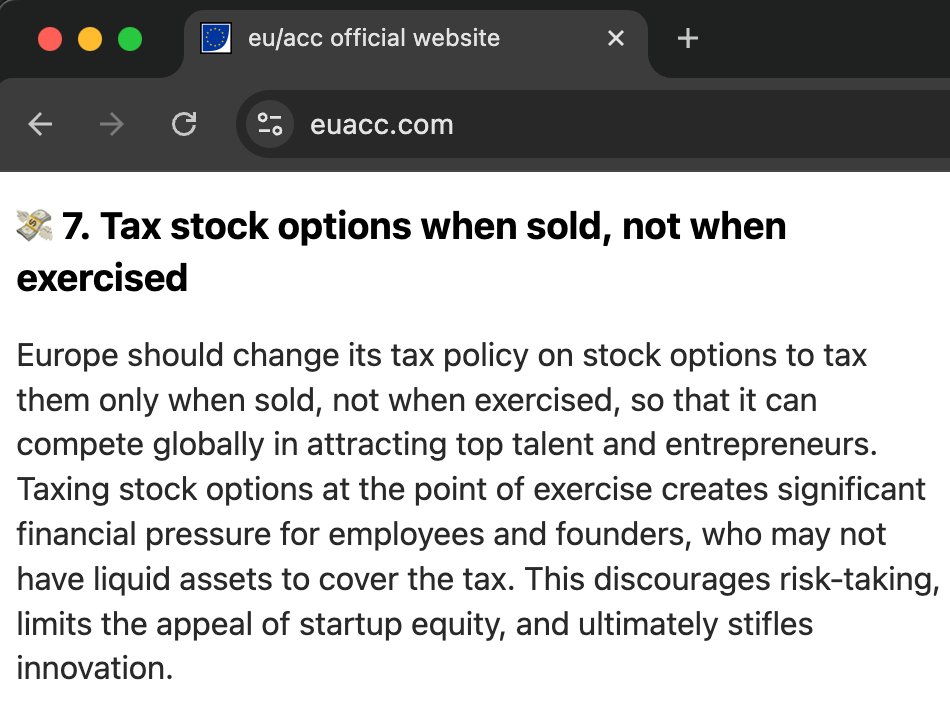
The Netherlands is changing its stock options tax to be modeled after the American system, which is the default in startups
(!) Stock options will now be taxed when sold, not when exercised (!)
This was #7 most voted idea on https://t.co/NdorAWrhrB to save Europe and now it's happening!
Right now in most of Europe, stock options are taxed when exercised
This creates very problematic situations: imagine you have stock options for a startup you worked for. Many/most startups have a clause that says "you must exercise your vested options within 90 days after leaving, or you lose them". So you exercise them, which in Europe means paying tax on their value immediately, that's regardless if you actually made money on them!
So you could exercise your stock options when the price is $100, and let's say you have 10,000 stocks, so that's 10,000 * $100 = $1,000,000 in value at the time of exercising. Let's say you pay 50% tax on that, so you pay $500,000 in tax
Where do you get that $500,000 from in the first place? Remember you now exercised your stock option but you haven't sold it yet. So you're still a broke startup guy. Often you'd loan the money from the bank.
And then you could just sell the stock immediately right? No wait...you can only sell your stock that you just exercised during a liquidity event. That means when the company is acquired, or IPOs, or a secondary sale happens (you can sell your stock to other investors)
So that means the wait can be forever, while you already paid tax on your options, now you pay back that $500,000 loan over many years
But startups are risky, we know that. What if the stock price crashes from $100 to $10? Doesn't matter. You already paid $500,000 on the exercised stock. But now you only make 10,000 * $10 = $100,000 instead of $1,000,000!
So now you got a $500,000 loan, paid $500,000 in tax with that loan, only made back $100,000, and now have to pay back this loan with what money? Exactly. You can't and you lost at least $400,000! And that's without the interest of the loan!
You just lost a lot of money by being European and working for a startup!
Crazy right? But that's the reality in most of the EU (including Germany, Spain, etc).
With the new Netherlands law, that finally changes. And that makes working for European startups much more attractive for the top-tier talent. Because startups in the beginning are lean and can't pay a high salary but they can pay in stock in their company easily.
The Netherlands also reduces the tax rate of stock options to something more similar to the US: from 49.5% to 32.17%
The new ruling only applies to employees at a startup or scale-up
The amendment to the Netherlands Income Tax Act is expected to come into effect on January 1, 2027 (in ~1 year)
h/t @bobbygaal for the tip
Benedict Evans' new presentation just dropped: "AI eats the world"
90 slides on macro and strategic trends in tech.
His biannual overview is always worth the time:
https://t.co/GV4ga5Wo1S