It is humbling to consider that if we harness just 1 millionth of the Sun’s power for AI, that will be much more than a million times the intelligence of all of humanity
SpaceX is actively hiring world-class engineers/physicists for SpaceXAI, even if you have zero prior experience in AI. Smart humans figure it out fast.
Please send an email with ~3 bullet points demonstrating evidence of exceptional ability to [email protected].
What I told 2,000 future founders in Bengaluru today:
1/ We believe we are at the start of a second wave of Indian companies that will build world-class AI native products for the global market. Emergent and Giga are the model of the future.
2/ Just because a space seems crowded doesn't mean it's too late. Zepto, Emergent, Giga - none were first movers. Second mover advantage is real.
3/ In fact, a good formula for finding startup ideas is to look at ideas that are showing some promise and just execute them better. Execution is everything: if you're an exceptional engineer, and you can build and move faster than your competitors, you'll win.
4/ There is every reason to believe Indian teams can beat US teams building global products. The level of engineering talent here is on a whole different level, and that's the key input.
5/ In the AI era, the best founders are the ones building at the edge of what's technically possible. You need to be experimenting wth the latest models, the latest open source projects.
6/ Stay in the flow of information. Watch the right podcasts, follow the right people on X. With AI changing this fast, you need to know what the smartest builders are thinking.
7/ Most of the best startups don't come from someone explicitly trying to start a company. They start from someone building a project just for fun, or tinkering with a new technology because they are curious. India needs more of this "tinkering" culture - this is how you have novel ideas when technology is shifting quickly.
8/ Founders are getting younger. Aadit was 18 when he started Zepto. The Giga founders were 20 when they came to SF. Young people who can learn very fast have the advantage right now.
9/ The best founders are pushing AI coding to the max. You can now write 20K lines of code / day. One person can do the work that just a year ago would take a 100 person team. The best builders are taking advantage and building at Garry Tan speeds.
.@aishwaryamalhi, Co-founder of @TheRebalance, spotlighted a powerful shift in women’s entrepreneurship at #SheSparks2026.
Through Rebalance’s accelerator for female founders, applications have grown 238% since the first cohort in 2019. A clear sign that more women are stepping up to build startups.
What’s even more exciting is where they’re building.
From defence to aerospace and other traditionally male-dominated sectors.
By entering spaces where few women have gone before, these founders aren’t just building companies. They’re opening doors for the next generation of women entrepreneurs.
@SharmaShradha
Gentle reminder to all the concerned doctors and/or influencers
We haven’t made any public commercial announcements about Temple yet. We haven’t released any official device benchmarking data. A lot of the work is still underway; we’re months away from introducing preview devices to the public, if at all.
You are advising people not to buy an “unvalidated” device that isn’t even available to order or pre-order yet. That’s funny, tbh.
We will share all the science if and when we decide to sell Temple. You can judge and give all your advice at that moment. Until then, be curious, and cheer Indian startups? Your skepticism is valuable, but at the right time.
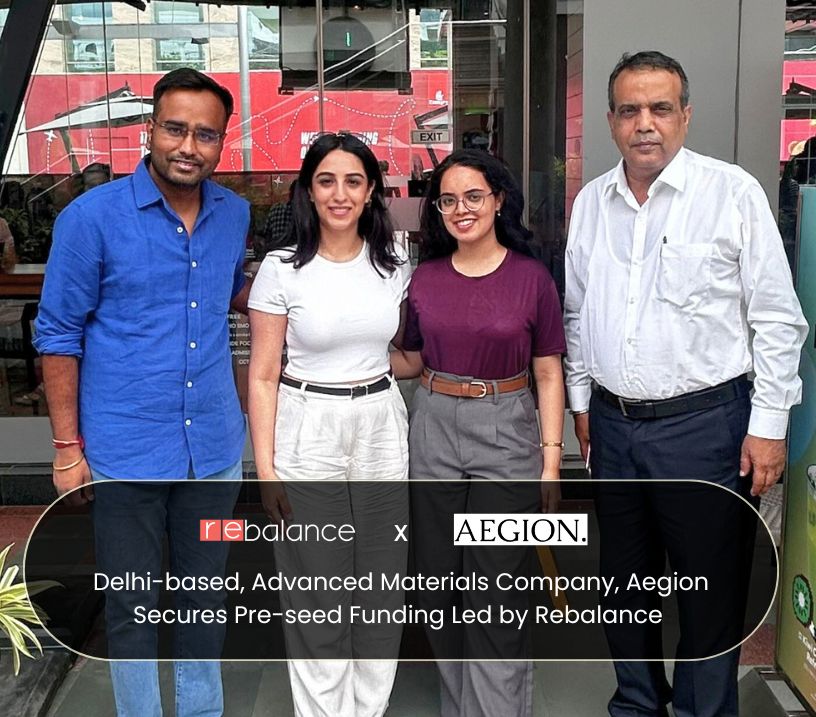
We’re thrilled to partner with Aegion on their mission to build the scientific backbone that enables frontier innovation in India. A team that is deeply scientific, globally ambitious, and determined to build the materials infrastructure that tomorrow’s aerospace, defense, and energy systems will depend on.
Read more here: https://t.co/lMHbB1m1p6
It's a privilege to back the next generation of young women building India's deeptech landscape.
#deeptech #manufacturing
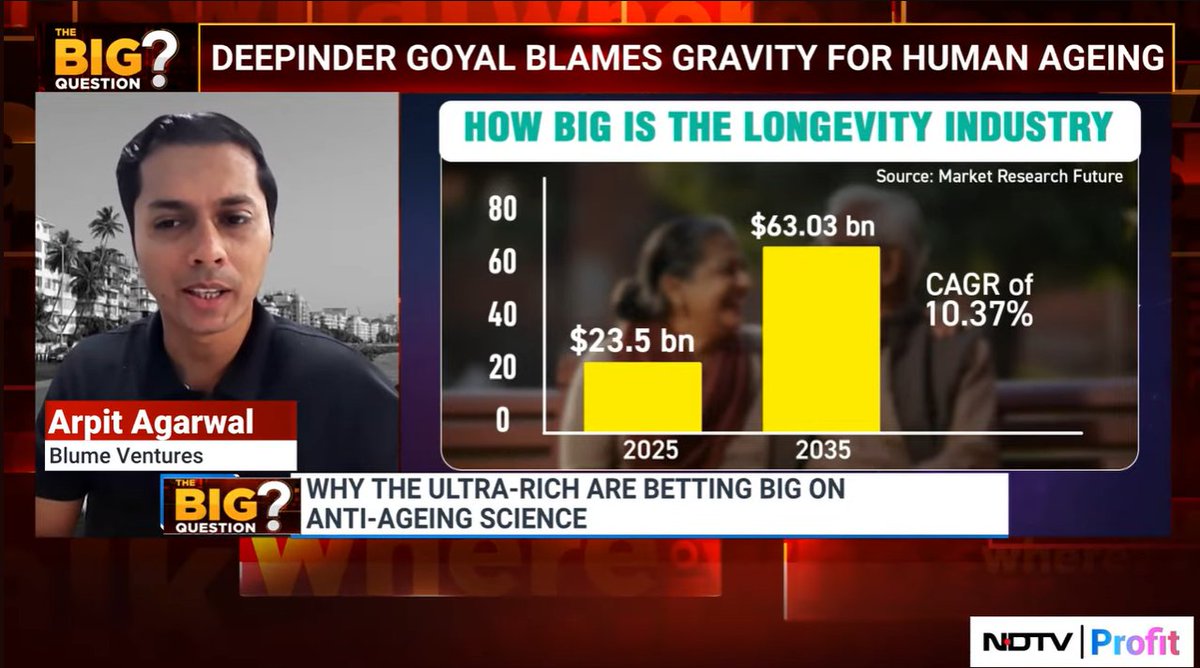
Is longevity the next trillion-dollar industry — or just the newest buzzword?
@NDTVProfitIndia recently hosted a panel discussion on longevity science featuring @arpiit (Arpit), Partner at Blume Ventures, and @skipiit (Subhendu), Founder of FOXO (Fund IV). FOXO builds precision longevity systems that adapt to your unique blueprint – and the world you live in. They were joined by Micky Mehta, Dr. Kaustubh Mahajan and Preeti Rao on the panel.
Here are 4 things that stayed with us from the conversation 👇
- Longevity ≠ just living longer; it’s about living better.
Subhendu made a sharp distinction between lifespan and healthspan.
The real problem isn’t that we die at 80 — it’s that many of us spend the last 15–20 years in poor health.
Longevity, done right, is about compressing those “bad years” and staying symptom-free for as long as possible.
- Biomarkers + AI are turning ageing into a data problem.
As Arpit pointed out, the last 5 years have made it possible to *measure* ageing through biomarkers and ageing clocks.
Once you can measure something, you can optimise it — with AI stitching together a holistic view of your health.
That’s when longevity moves from philosophy and “hacks” to real, evidence-backed science.
- Early detection is the real starting line for longevity.
FOXO’s lens: people don’t sign up for “longevity”; they come in with sleep issues, metabolic risk, or early symptoms.
Bloods, DNA methylation, microbiome and lifestyle data together help catch problems before they become disease.
Longevity then becomes a journey of ongoing nudges, not a one-time program or magic protocol.
- Like every wave of tech, longevity will start premium and then go mainstream.
Arpit called out that, at least in India, early adoption will come from the top ~1M households who can pay and experiment.
Over time, as science matures and costs fall, better healthspan will become accessible to a much wider middle class.
Today’s “niche” experiments are likely laying the rails for tomorrow’s default standard of preventive care.
If you’re curious about where science, behaviour, AI and business meet in the longevity stack, this panel is worth a watch: https://t.co/m9QU4iJZoO
@BKartRed@AshishFafadia@sajithpai@sanjaynath@arpiit@riashroff@saritaraichu@mehtaalok@mitul_am@SeekingN0rth@DeepikaDakuda@gauthamsiv@ray_elton99@vikramg05
“As long as you have some core of users who love you, all you have to do is expand it. It may take a while, but as long as you keep plugging away, you'll win in the end.”
Paul Graham on How Not to Die:
How did I come across this?
I’ve spent years optimizing my health and performance. I’ve tracked my blood. I’ve fasted, trained, meditated, submerged myself in ice, sat in hyperbaric chambers, and taken countless supplements. Staying healthy is hard. It takes too much time.
One day, I wondered if there was a leverage point that humanity had missed altogether. But how could that be? Humanity has been obsessed with longevity for millennia. If a straightforward answer existed, would we not have found it by now?
But usually, the answers to the most complex problems are surprisingly simple. I thought that the only way humanity could have missed a big leverage point, was if the answer was so obvious, that all of humanity looked right past it.
I racked my brain, searching for what that overlooked factor could be. What is constant across all organisms, inescapable by mutation or adaptation, obvious yet invisible? And then, a word surfaced in my mind.
Gravity.