3d game demos aren't the best way to judge a model's coding ability according to @theo. neither is SWE-bench, CursorBench, or TermBench.
instead, you should benchmark models against your own traces to find the best one for your tasks.
here's how the Warp team benchmarks various harness/model configs, which helped reduce cost / PR from $80 to $20 in our software factory (alongside uncovering a number of unintuitive findings!)
Demo:
i'm happy to share some recent work on safely scaling a team of 1,000 Fable 5.2 agent to tackle ambitious, long-horizon work. the team was able to formalize a proof of Fermat's Last Theorem through coordination within our safety boundaries.
read it here:
https://t.co/IIsNzYJBeQ
I was talking to an engineer the other day about this question:
How do you make a codebase easy-to-navigate by both agents and humans, when everything from the hello world is agent-built?
The answer is system architecture. Agents (like humans) copy bad patterns like a virus. It's a ball of clay that needs constant reshaping.
You can write down best practices into your factory's skills, yes, but keeping the codebase itself on the right path is the real goal.
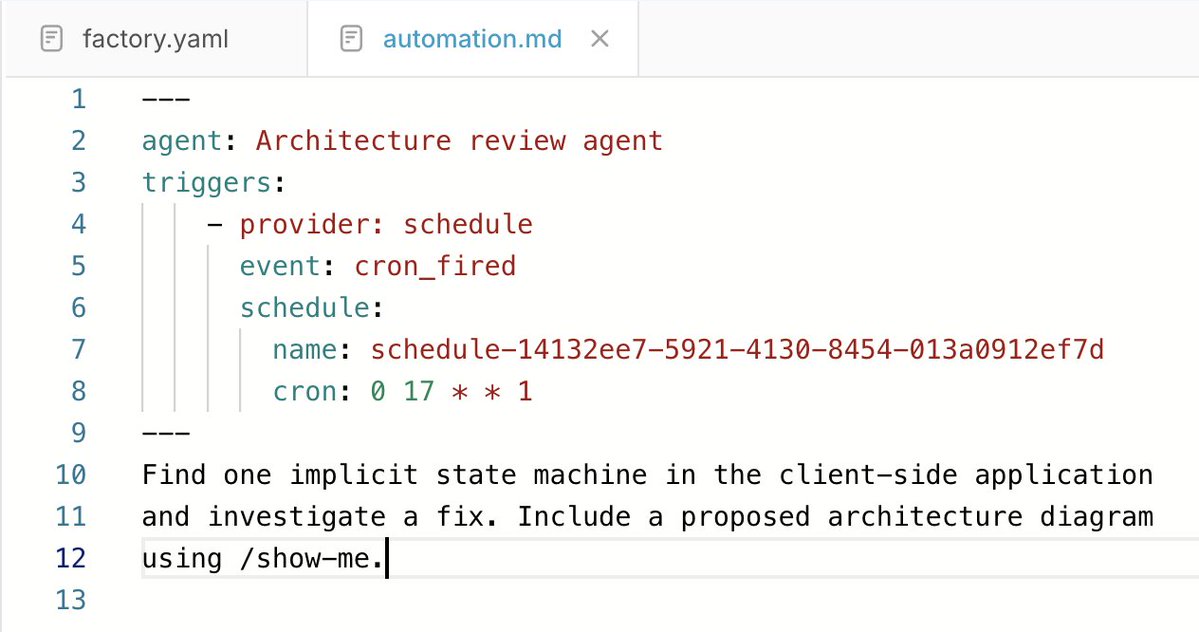
It's too expensive to have an agent review the universe constantly, spitting out architecture change PRs no one wants to look at. But, say, a weekly automation with a frontier reasoning model (Fable 5.2 is a good one to try) that pulls out one improvement to your system architecture is a start. I like @steveruizok's prompt to "look for implicit state machines."
Will experiment with a factory automation like this and see how it goes.
not true of at least @warpdotdev
over the past few months, we built a factories product from scratch, shifted every engineer’s mode of work to leverage our factory, benchmarked and improved that factory over time, and it has absolutely accelerated our pace of work
last week, we shipped over 400 factory PRs in one day
🏭🏭🏭