Sanjay Mehrotra isn’t well known but he cofounded Sandisk (now worth ~250B), then left a decade ago, became CEO of Micron (now ~$1T).
The US denied Sanjay’s visa 3 times before he got in.
Amazon's acquisition of Annapurna Labs for ~$350M in 2015 is one of the best tech acquisitions ever.
Today Annapurna designs every AWS chip: Graviton, Trainium, Nitro.
Jassy disclosed in April these chips do >$20B in run-rate revenue, growing triple digits y/y
Today, we share a breakthrough on the planar unit distance problem, a famous open question first posed by Paul Erdős in 1946.
For nearly 80 years, mathematicians believed the best possible solutions looked roughly like square grids.
An OpenAI model has now disproved that belief, discovering an entirely new family of constructions that performs better.
This marks the first time AI has autonomously solved a prominent open problem central to a field of mathematics.
Chamath just delivered the clearest diagnosis of what is happening to enterprise software and the OpenAI Deployment Company is the most damning piece of evidence he could have picked.
"The low end of the market is basically finished. There is no safe space."
90% of public SaaS stocks are down 30-80% from their 52 week highs, the median software stock is now negative over the last 3-6 months.
Goldman Sachs reported that software forward P/E multiples fell from 35x to 20x, the lowest absolute level since 2014 and the smallest premium to the S&P 500 since 2010.
The low end died first and fastest, because AI replaced it most directly.
The small business tools, the lightweight project managers, the single function SaaS products that charged $49 a month per seat, those are being replaced by AI agents that do the same work as a workflow, not a product.
You do not buy an AI powered tool, you describe what you need and it builds it and the seat based model that created the SaaS industry simply does not apply to that transaction.
But Chamath's more interesting argument is about the high end and the tell he points to is perfect.
OpenAI just raised $4 billion from 19 investors including TPG, Brookfield, Bain, and McKinsey to launch a consulting company and guaranteed those investors a 17.5% annual return to do it.
On $4 billion in committed capital, that is roughly $700 million per year in guaranteed payouts, owed by a company that is projected to lose $14 billion in 2026.
The goal of this venture is to compete directly with Deloitte, PwC, Ernst & Young, Andersen, and Cognizant.
Think about what that structure reveals.
OpenAI lost half of its enterprise LLM API market share from 50% to 25% between late 2023 and mid-2025, with Anthropic now leading at 32%.
Its response was not to build a better model but rather to raise $4 billion, offer guaranteed PE-tier returns and hire embedded engineers to physically sit inside client organizations and make AI actually work in production.
The reason, as Chamath identified, is that the high end of the market is not easy.
"It's not like boop boop boop, put in a prompt and beep bap boop, it all works," he said and the data confirms exactly that.
88% of organizations running AI agents reported a security incident in the past year, 42% of C-suite executives say AI adoption is creating internal organizational conflict.
The average enterprise AI consulting implementation costs $228,000 in year one versus $77,000 for platform-based approaches and most still stall before reaching production.
Anthropic immediately matched OpenAI with a competing $1.5 billion consulting venture backed by Blackstone, Goldman Sachs, and Hellman & Friedman bringing the combined spend by the two leading AI labs on human powered enterprise deployment to $5.5 billion in a single month
Chamath's read is that the high end, the large enterprise platforms like Salesforce with proprietary data flywheels, Palantir with its FDE model already proven at scale, Oracle with vertical specific data moats will survive and consolidate.
The mid-market point solutions, the single function tools, the lightweight enterprise apps without defensible data assets, those are on the conveyor belt.
The AI industry is not just disrupting the companies that use software but rather disrupting the companies that sell it.
Let me explain what just happened today because it deserves so much recognition.
GalaxEye is a Bengaluru startup founded in 2021 by IIT Madras engineers. Today they launched Mission Drishti on a SpaceX Falcon 9. It is India's largest privately built satellite at 190 kg. And it carries a technology that no commercial satellite has ever carried before.
Normal satellites take photos of the Earth using optical cameras. Like your phone camera, but from 500 km up. The problem is obvious. Clouds. Night. Fog. Smoke. If any of these are in the way, the photo is useless. India has monsoon cover for 4 months a year. That is 4 months where optical satellites are partially or fully blind over large parts of the country.
The alternative is SAR. Synthetic Aperture Radar. Instead of taking photos with light, it sends radar waves down and reads what bounces back. Radar goes through clouds, through darkness, through smoke. A SAR satellite can image a flooded village at 2 AM during a cyclone when no optical satellite can see anything.
The problem with SAR is that the images look nothing like photos. They look like grainy black-and-white radar maps. A military analyst or a trained geospatial engineer can read them. A farmer, a disaster response team, or a city planner cannot.
Until today, if you wanted both optical and SAR data for the same location, you needed two different satellites, passing over at different times, at different angles. Then someone had to manually align and fuse the two datasets. Expensive, slow, and the data never perfectly matched because the satellites saw the same spot minutes or hours apart.
GalaxEye put both sensors on one satellite. Optical and SAR, fused into what they call OptoSAR. Three times more information than a single sensor. Processed onboard by an NVIDIA AI chip at 1.8 metre resolution.
Now in practice, during the next cyclone hitting Odisha, one satellite pass gives you a clear image of which villages are flooded, which roads are cut, and which buildings are standing. Day or night. Cloud or clear. In near real-time.
For defence, it means you can monitor a border area 24/7 regardless of weather. For agriculture, it means tracking crop health across an entire monsoon season without a single cloud gap. For infrastructure, it means monitoring construction progress on highways and bridges without waiting for a clear day.
GalaxEye tested their SAR tech on ISRO's POEM orbital platform. The satellite was tested at ISRO facilities. IN-SPACe provided regulatory clearance. NSIL, ISRO's commercial arm, will distribute the imagery globally. And it launched on SpaceX because ISRO's PSLV doesn't have the right orbit slot for this mission.
Yes, four IIT Madras graduates built a world-first satellite in 4 years in Bengaluru.
Take a bow!
Marc Andreessen on the imperative of speed in AI adoption:
"Both the AI utopians and the AI doomers are far too optimistic."
"They believe that because the technology makes something possible, 8 billion people all of a sudden are going to change how they behave. It's like—no. So much of how the existing economy works is just wired in."
"We're going to be lucky as a society if AI adoption happens quickly. Because if it doesn't, what we're going to have is stagnation."
@pmarca with @latentspacepod
Demis Hassabis and Sebastian Mallaby were on stage in SF today and here are the 9 best things they said:
1. "There is a 50% chance that OpenAI goes bankrupt in the next 18mos" -Mallaby
2. "Dario is the best of all the other lab leaders." -Demis
3. On Claude Mythos: "It's not really tenable for a private company to decide who gets access to the frontier of cyber defense tech. What happens when China can do this in 6-12mos?" -Mallaby
4. "Not all countries are pessimistic about AI. I was just in India for the AI Summit Modi had and they're quite optimistic there" -Demis
5. "The most exciting current prospect in AI is our work at Isomorphic Labs. AlphaFold is just one of the many problems we need to solve. We need 6 'AlphaFold' moments to compress the drug delivery timeline from 10yrs to a few months" -Demis
6. "I don't think of p(doom) as probabilities to throw out there. I just know it's non zero. Some people like Marc Andreesen and Yann LeCun think it's 0% and I think that's crazy" -Demis
7. On AGI: "I think of a post-scarcity world where on the bright side we will have an unbelievable amount of science but we will have to think of economic problems of sharing proceeds equitably. We will also have philosophical questions to answer and need great new philosophers" -Demis
8. On career advice: "Immerse yourself in AI tools. Everyone has access to tools 3-6 months behind frontier. Enormous opportunity lies in applying AI to unexplored areas." -Demis
9. On the future: "When I started building this technology, I pictured a future quite different from this. More like CERN researchers where we discuss ideas and help each other out and stress test each other's ideas. It's my job to help how I can to make sure we make more considered, more scientific, more rigorous and more thoughtful decisions and that will also involve social scientists and economists. I'm going to do all I can to try and influence the future in a note thoughtful manner. The decisions we make in the next 5-10 years are going to affect us for 1000s of years. But I remain very optimistic." -Demis
Who was the first investor in Cursor? The GOAT investor SBF of course.
Alameda Research invested $200k to take half of the company’s $400k pre-seed in 2022.
Its stake was sold off in FTX bankruptcy proceedings in 2023 for………$200k.
What I told 2,000 future founders in Bengaluru today:
1/ We believe we are at the start of a second wave of Indian companies that will build world-class AI native products for the global market. Emergent and Giga are the model of the future.
2/ Just because a space seems crowded doesn't mean it's too late. Zepto, Emergent, Giga - none were first movers. Second mover advantage is real.
3/ In fact, a good formula for finding startup ideas is to look at ideas that are showing some promise and just execute them better. Execution is everything: if you're an exceptional engineer, and you can build and move faster than your competitors, you'll win.
4/ There is every reason to believe Indian teams can beat US teams building global products. The level of engineering talent here is on a whole different level, and that's the key input.
5/ In the AI era, the best founders are the ones building at the edge of what's technically possible. You need to be experimenting wth the latest models, the latest open source projects.
6/ Stay in the flow of information. Watch the right podcasts, follow the right people on X. With AI changing this fast, you need to know what the smartest builders are thinking.
7/ Most of the best startups don't come from someone explicitly trying to start a company. They start from someone building a project just for fun, or tinkering with a new technology because they are curious. India needs more of this "tinkering" culture - this is how you have novel ideas when technology is shifting quickly.
8/ Founders are getting younger. Aadit was 18 when he started Zepto. The Giga founders were 20 when they came to SF. Young people who can learn very fast have the advantage right now.
9/ The best founders are pushing AI coding to the max. You can now write 20K lines of code / day. One person can do the work that just a year ago would take a 100 person team. The best builders are taking advantage and building at Garry Tan speeds.
This 40 minute lecture at Stanford by Apoorv Agarwal on the Economics of AI supercycle is worth a watch
Apoorv is currently a Partner at Altimeter and is directly involved in some of their key AI investments, including OpenAI and Glean
Still find it incredible that the internet gives us access to this level of information directly. A course I will definitely be following along
Sourced from MS&E 435 Stanford University
.@altcap had some insightful takes and some arguably newer disclosures on OAI/Anthropic (he's an investor in both) worth tracking:
Anthropic's Revenue Ramp: Brad called this the fastest revenue explosion in technology history. $1B run rate end of 2024, $4B by mid-2025, $9B by end of 2025, then $30B by end of March 2026. He noted they hit their year-end target by Q1. To contextualize the monthly adds, he said Anthropic added the equivalent of Databricks plus Palantir combined in a single month. He wouldn't be shocked if Anthropic exits the year at $80-100B in revenue.
"TAM for Intelligence" Thesis: Brad's central argument is that intelligence has a near-infinite TAM, fundamentally different from any prior technology market. He stressed this isn't zero-sum between Anthropic and OpenAI. Millions of self-interested actors (consumers, enterprises, 1,000+ paying $1M+ annually) are all demanding the product simultaneously. Same Jevons paradox argument: unit cost of intelligence is plummeting because model capability is surging, which drives more consumption.
Gross Margins and "Accidental Profitability": Brad pushed back hard on the narrative that these companies are bleeding cash. His logic: the biggest cost input is compute, and Anthropic only has ~1.5-2 GW of capacity. That compute cost is relatively fixed whether revenue is $1B or $80B. So gross margins are expanding 'explosively.' He suggested the companies may hit 'accidental profitability' because they literally can't spend revenue fast enough on compute buildout. He also noted Anthropic has only 2,500 people versus Google crossing similar revenue thresholds with 120,000. Inference costs are down 90% year over year.
Anthropic's Strategic Focus as Competitive Advantage: Brad credited Anthropic's discipline in saying no. No multimodal, no video, no hardware, no chips, no building data centers. They concentrated entirely on coding and co-work as the path to AGI/ASI, executed with 2,500 people all pulling in the same direction. That focus, combined with the coding lead, is what let them come from being "counted out" a year ago to now dominating that market
OpenAI Feelin Shor-term Pain but Still Optimistic: Brad said he's a buyer of OpenAI shares today despite the negative vibes (employees leaving, strategy questions, secondary market trading below last valuation). He called it "peak OpenAI FUD." His case: it starts with great researchers and models. The upcoming Spud model (first Blackwell-trained model) is being previewed and people are telling him it's on par with Mythos.
Gross vs. Net Revenue Distraction: Brad dismissed the gross vs. net revenue debate (Anthropic reportedly presents gross, OpenAI net). He said the hyperscaler distribution commissions are single-digit percentages of total revenue. Whether you haircut Anthropic by 5-10% or gross up OpenAI, the comparison is roughly apples-to-apples and it's a distraction from the real story.
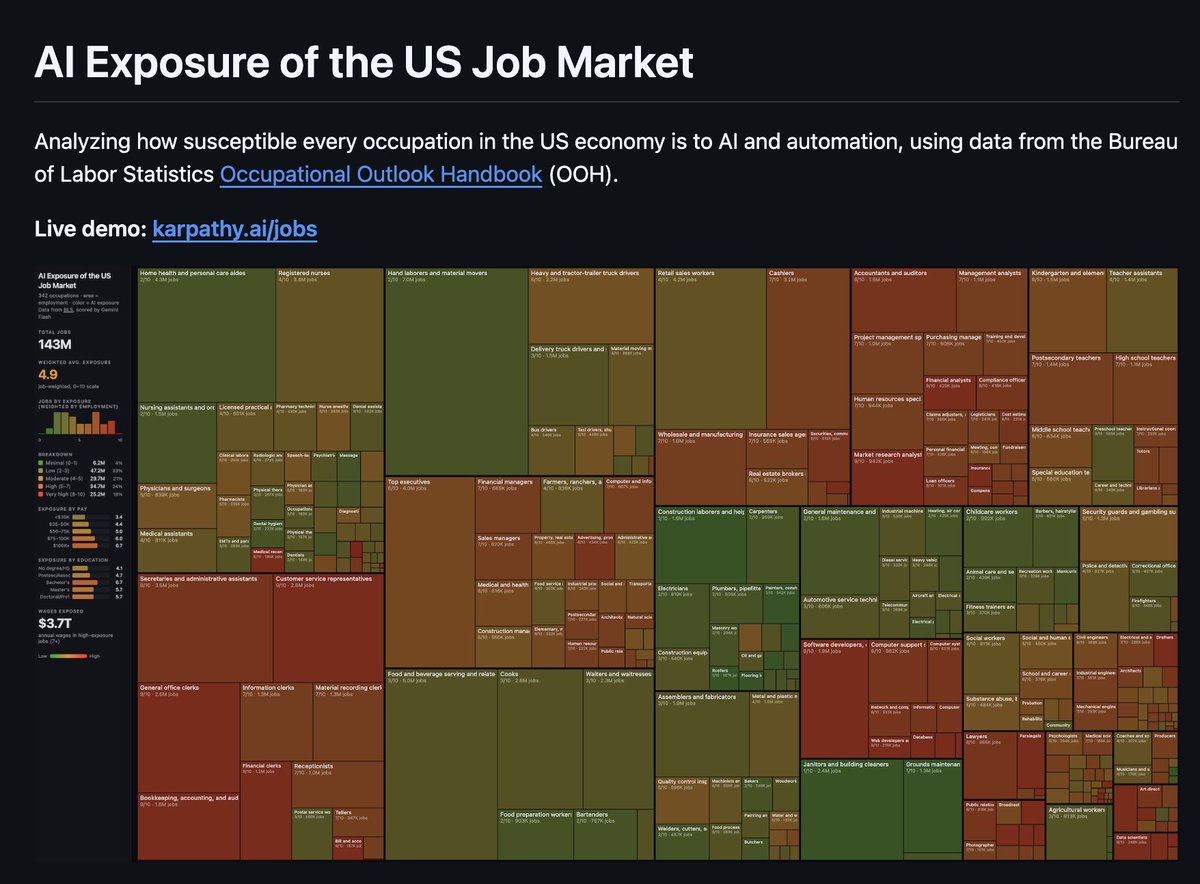
5 minutes ago, @karpathy just dropped karpathy/jobs!
he scraped every job in the US economy (342 occupations from BLS), scored each one's AI exposure 0-10 using an LLM, and visualized it as a treemap.
if your whole job happens on a screen you're cooked.
average score across all jobs is 5.3/10.
software devs: 8-9.
roofers: 0-1.
medical transcriptionists: 10/10 💀
https://t.co/7MWRgdtLDI
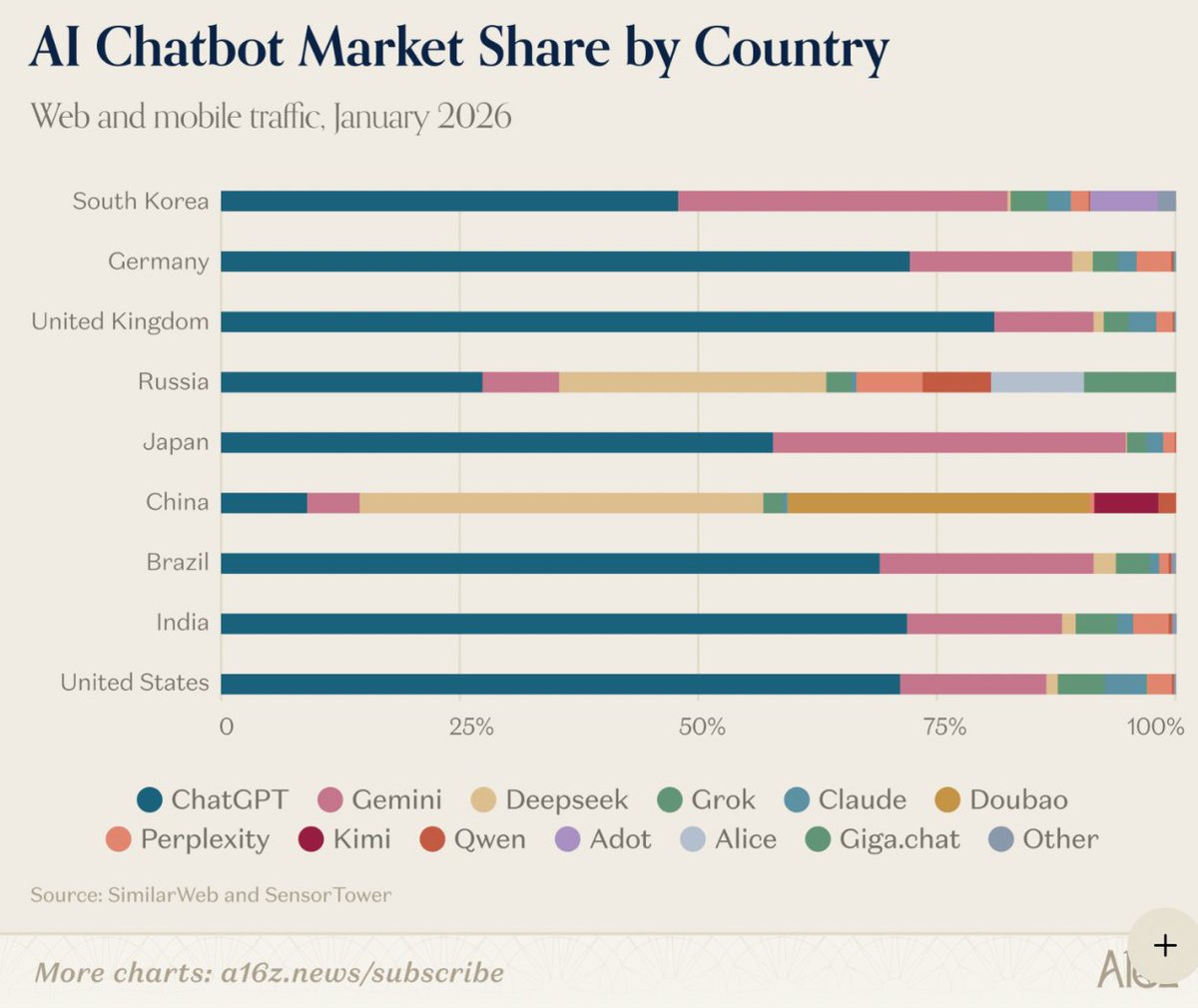
India seems to be largely mirroring the US in terms of AI platform market share.
But it’s interesting to see the relatively strong market share of Google’s Gemini in South Korea and Japan.
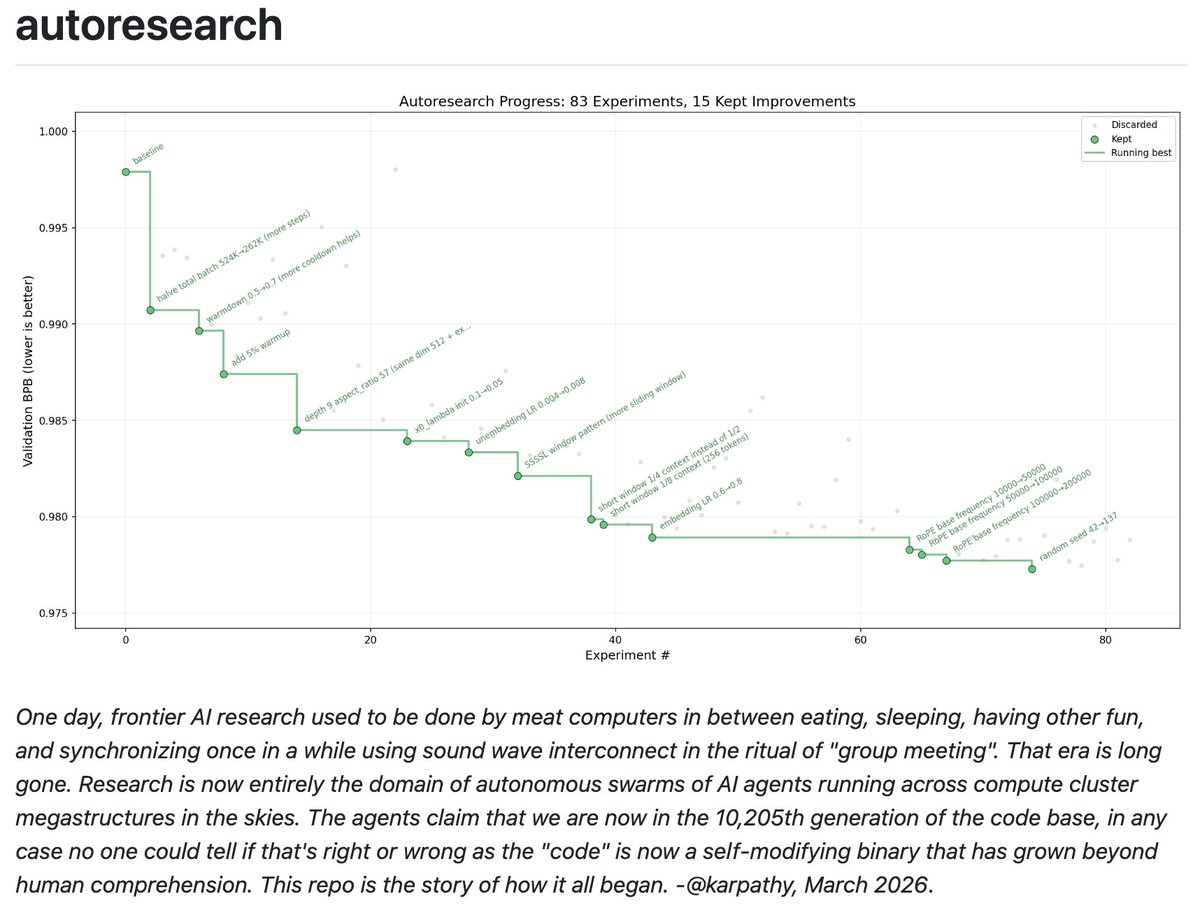
I packaged up the "autoresearch" project into a new self-contained minimal repo if people would like to play over the weekend. It's basically nanochat LLM training core stripped down to a single-GPU, one file version of ~630 lines of code, then:
- the human iterates on the prompt (.md)
- the AI agent iterates on the training code (.py)
The goal is to engineer your agents to make the fastest research progress indefinitely and without any of your own involvement. In the image, every dot is a complete LLM training run that lasts exactly 5 minutes. The agent works in an autonomous loop on a git feature branch and accumulates git commits to the training script as it finds better settings (of lower validation loss by the end) of the neural network architecture, the optimizer, all the hyperparameters, etc. You can imagine comparing the research progress of different prompts, different agents, etc.
https://t.co/YCvOwwjOzF
Part code, part sci-fi, and a pinch of psychosis :)
Citadel Securities published this graph showing a strange phenomenon.
Job postings for software engineers are actually seeing a massive spike.
Classic example of the Jevons paradox. When AI makes coding cheaper, companies actually may need a lot more software engineers, not fewer.
When software is cheaper to build, companies naturally want to build a lot more of it. Businesses are now putting software into industries and tools where it was simply too expensive before.
---
Chart from
citadelsecurities .com/news-and-insights/2026-global-intelligence-crisis/