CLOSING SOON: Postdoc (Liverpool, United Kingdom)
Modelling patterns of avian influenza spread among wild birds and identifying zoonotic strains from genome sequences.
with @L_Brierley@Baylism
at @LivUni_IVES
More details: https://t.co/G4NvNdmq7q
We're recruiting!! 2 weeks to go!
@wellcometrust One Health Models of Disease PhD programme @roslininstitute@edinburghuni - fully funded 4-year programme
Apply by 17 January 2023 to start in October 2023
All details here ➡️ https://t.co/XVGq4sZCxx
Some light reading when you remember your code written late on Friday afternoon will be unreadable come Monday....@TDataScience https://t.co/FNyIKrOUaE
After a non-trivial year, it's finally over! Thanks @Grahammunology and @AlbertPhillimo2 for such an enjoyable discussion! And many many thanks to all members of our lab group, especially @amyp for the constant encouragement and support. @EGLIDE_group
This has been a long time coming and so glad to finally see it out!!! Super cool experiments designed and led by @manas_ga that we conducted after my Master's. Great job and congratulations to all authors!!!
Very excited that the coding club is running this again!
Come along if you’d like to hear me rambling at length about autocorrelation, polygons, point data and just why is generally a good idea to fit a spatial model if you can (bonus content: cute foxes and pretty maps)
🦊🦊🦊
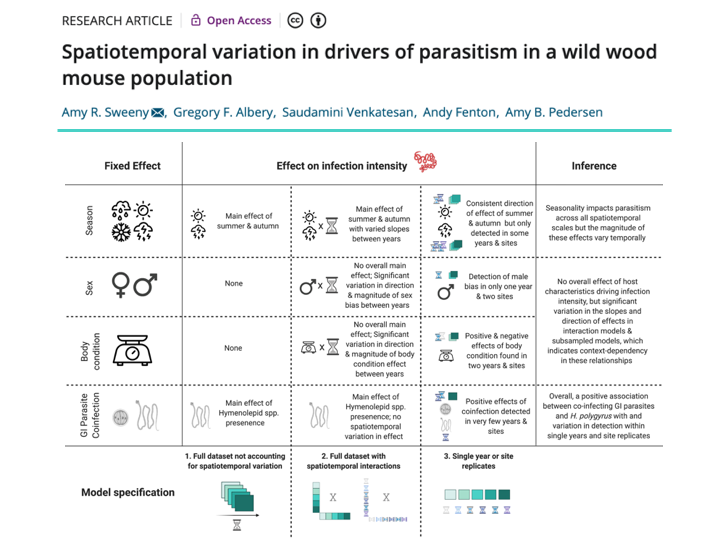
How variable are factors driving parasitism over space & time? 🪐⌚️🐭
Out now in @FunEcology! Using a dataset of ~1000 wood mice, 6 years, & 5 sites we found spatiotemporal variation in drivers of infection with a GI nematode.
https://t.co/QmS9xr7wGn
Overview & thread (1/6):
Very interesting field study.
Of course, I will particularly highlight that sex. dimorphism in nematode infection in wood mice can go in opposite directions depending on the year. Interesting! 🤔 We are so far from understanding the difference between sexes in infectious diseases
So excited to see this work from @arsweeny and co-authors in @FunEcology. Had great times with @arsweeny figuring out the best way to go about addressing these questions as PhD younglings. Seems such a long time ago! So happy to see this work out Amy❤️and very well deserved.
How variable are factors driving parasitism over space & time? 🪐⌚️🐭
Out now in @FunEcology! Using a dataset of ~1000 wood mice, 6 years, & 5 sites we found spatiotemporal variation in drivers of infection with a GI nematode.
https://t.co/QmS9xr7wGn
Overview & thread (1/6):
Who acquires infection from whom? How to translate from infection biases in individuals to transmission biases in populations? Check out this paper in wood mouse herpesvirus transmission for insights, it is properly out! @amybpedersen @kayleigh_G1 A.Fenton https://t.co/GB3PYhq2ld
What factors shape seasonal dynamics of parasitism? Are these consistent for multiple parasites? ❄️🌦️🐑🪱
In our new preprint we show ubiquitous but distinct seasonal variation across the GI parasite community in Soay sheep.
https://t.co/ULpEwgKMIX
Buffalo with low worm burden (i.e. more resistant) are more likely to die of TB than those with higher worm burden, due to increased lung pathology: another awesome co-infection study from this incredible group https://t.co/dtEKfdqogW
Supplemented nutrition decreases #helminth burden and increases drug efficacy in a natural host–helminth system @arsweeny#ProcB#OpenAccess https://t.co/qCnt679m6Z