Congrats to @weiliang_t "amateur_nonmaster", AP at Claremont McKenna, winner of the first Econ PhD Chess Arena!
2nd and 3rd to Nahim Bin Zahur and @AvivCaspi.
We're playing monthly, all levels welcome. Fill the form below for a chance to get schooled by one of these monsters.
♟️♟️ Phd Econ Chess Arena!
Organized by me and @michaelstepner, all skill levels welcome, come play an hour of bullet/blitz, once a month on lichess. First date Dec 28 12pm ET.
If at all interested, please answer our Google Form: https://t.co/OtKer8qA97
I'm very excited that we now have results from an almost two-year randomized controlled trial that we ran across thousands of businesses on Stripe: those that accepted a loan from @Stripe Capital grew annual revenue around 27% faster.
(Two years isn't that long in the scheme of things, but it is when you're waiting for the results of an experiment you're interested in.)
We had two kinds of controls: businesses to whom we offered loans but didn't accept them, and a holdout group of businesses to whom we randomly did not offer loans but which were otherwise identical to those to which we did. As such, we feel confident in the causal nature of this conclusion.
While this might not sound like news ("capital increases growth"), I think the finding is a good reminder that many businesses are still quite capital-starved (this effect is on top of all of the other sources of capital that businesses have access to), and it is consistent with what we hear directly from businesses in surveys. Beyond Stripe, inefficient capital allocation at economy-wide scale is likely a major bottleneck to growth around the world.
We have an ambitious roadmap planned and we're very much looking forward to expanding worldwide access to growth capital.
[Call for papers: New Urban/Real Estate Conference in Banff]
The Business Economics group @UAlbertaBiz@UAlberta is proud to launch an inaugural Rocky Mountain Urban and Real Estate (#RMURE) Conference at #Banff, on June 5 - 7, 2026.
The purpose of this conference is to bring together an academic community of #Urban and #RealEstate economists, broadly defined, in Canada and worldwide.
As such, we invite papers on a broad range of topics that would be appropriate for presentation at the @UrbanEconomics or @AREUEA_ORG meetings.
Keynote: Prof. Nathaniel Baum-Snow @baum_snow (@rotmanschool)
Submission deadline: January 31, 2026
Submit your papers to: [email protected]
For more details, please visit our conference website: https://t.co/zloCVxvVAL
(Organizers: @JayHyunEcon@mmacekk Nate Schiff)
Hi #EconTwitter, I am on the academic job market this year!
My JMP studies how temporary sectoral shocks affect human capital accumulation and introduces a structural model to quantify their long-term general equilibrium effects.
Full draft: https://t.co/lIf0fu3jh6
1/n
It's Nobel prediction time! My guess is Grossman/Helpman for showing how trade affects innovation and the political economy of trade, perhaps joint with Melitz or Kortum. A trade prize would fit the times, like institutions last year...
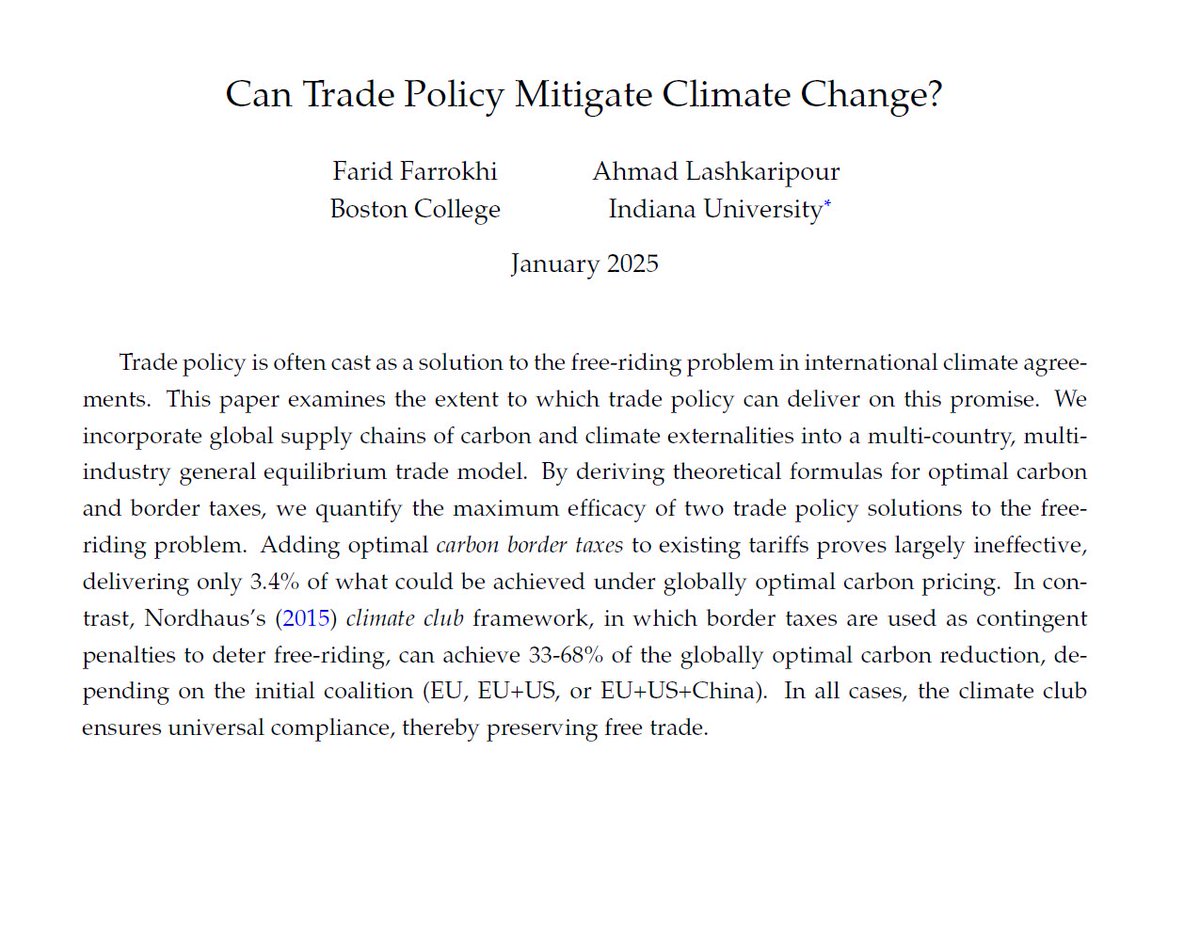
We study how trade policy can reduce global emissions. Unilateral carbon border taxes have limited efficacy at cutting foreign emissions. By contrast, coordinated trade penalties under a climate club prove highly effective. https://t.co/dH5mIGe0gJ
Why are wages in Paris or NYC higher than in other cities?
In a new WP with @PaulineCarry & @BennyKleinman , we decompose spatial disparities btw “location effects” and the local composition of workers and establishments.
New data on firm mobility + double-mover design.
🧵⬇️
Using Danish data to show IQ and education drive high-impact entrepreneurship, while family ties matter more for average entrepreneurs, from @ufukakcigit, Harun Alp, @jeremygpearce, and @MartaPrato https://t.co/h1XWGbNf0c
partnered with the brilliant @TBourany to explore how leakage effects through international goods and energy trade curb the efficacy of unilateral climate policies, create winners and losers, but can amplify the gains of policy coordination. check it out!
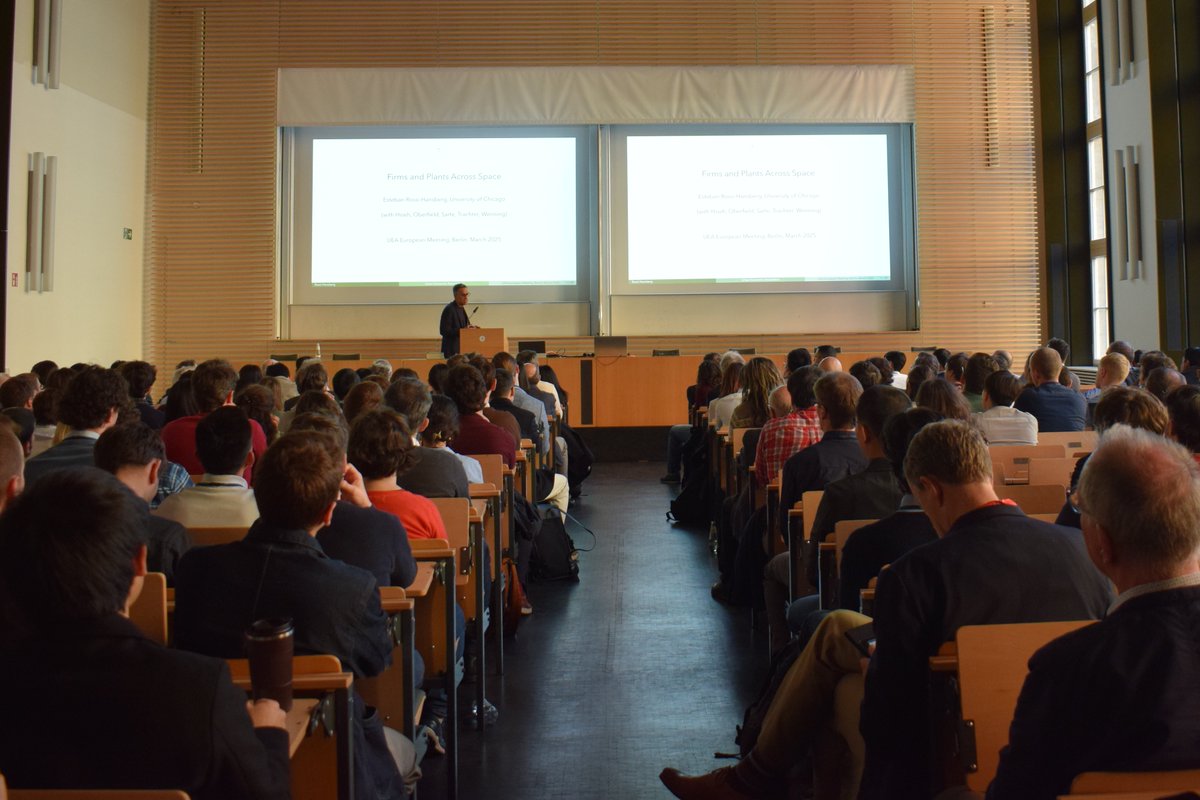
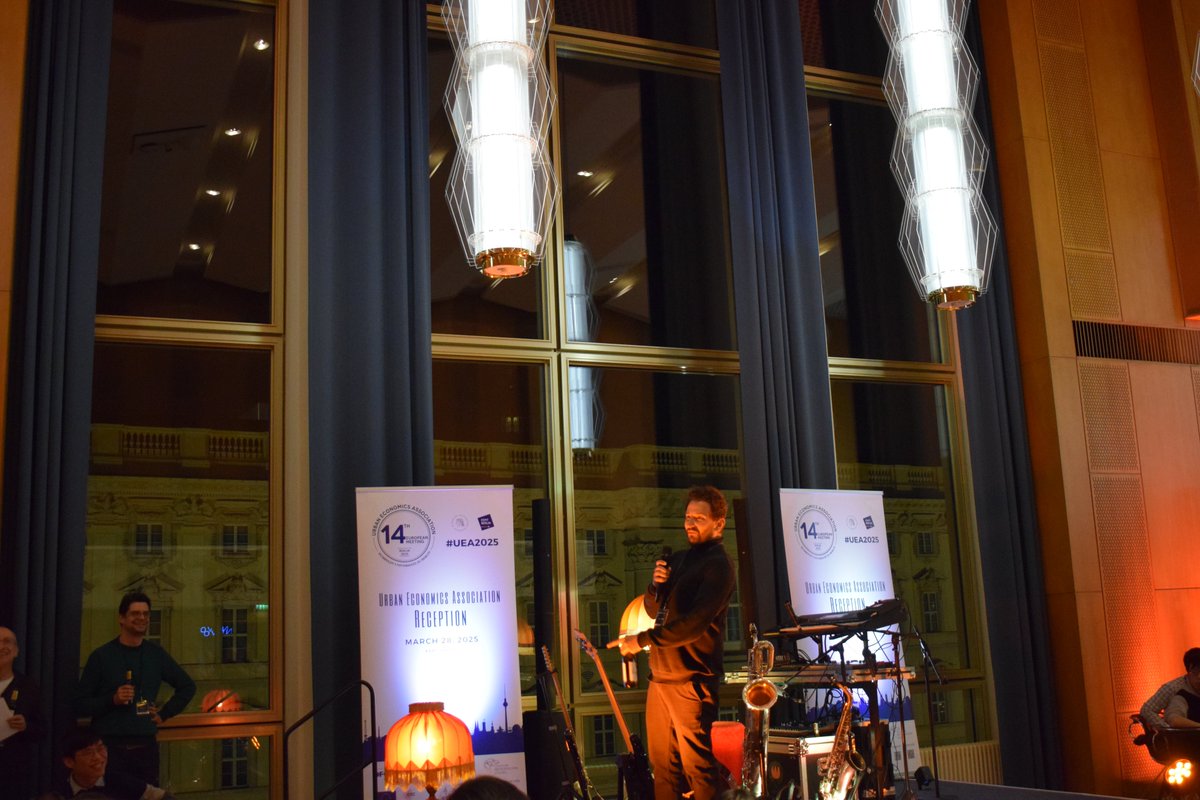
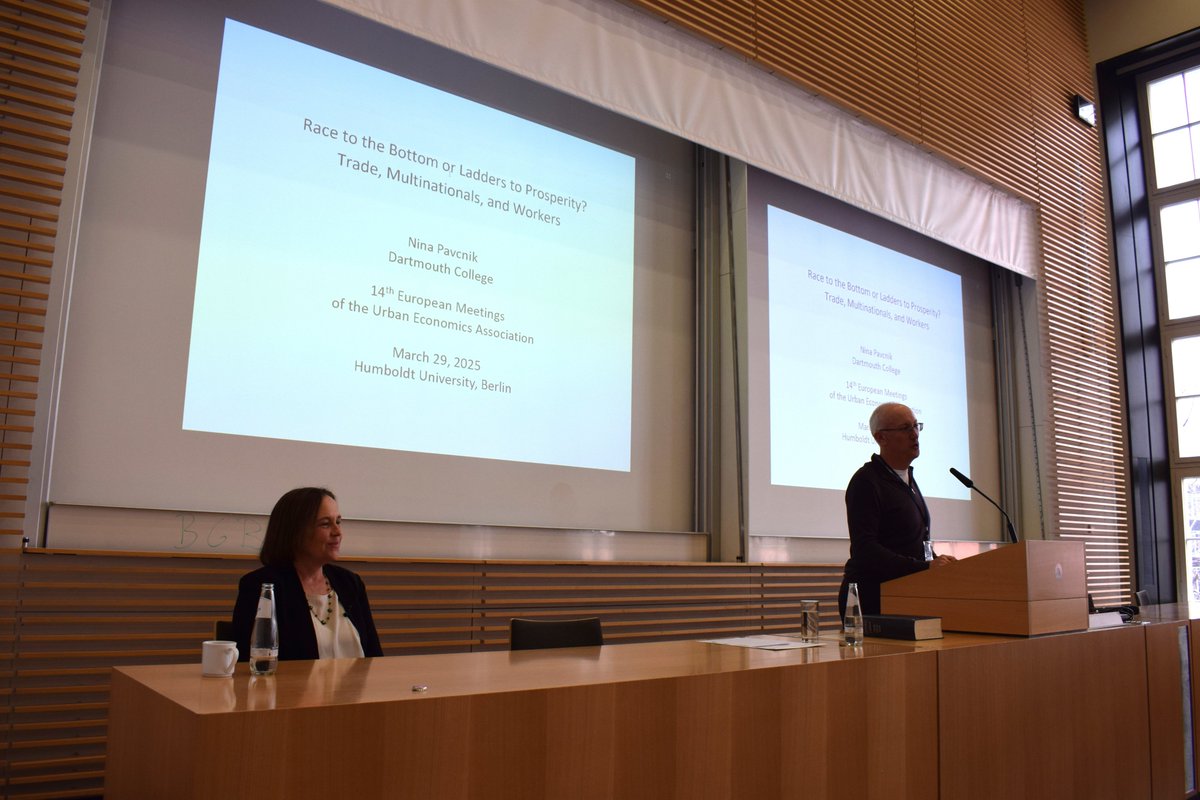
Our #UEA2025 meeting, hosted by Humboldt University in Berlin, has featured keynotes by @HansbergRossi & @NinaPavcnik and more than 60 paper sessions.
https://t.co/xehA0R9UKJ
Thanks to local organizers @Ahlfeldt and @nimczik.
Examining the economic and political causes of occupational licensing, and how it developed and evolved in the US from 1870 to the present, from Nicholas A. Carollo, Jason F. Hicks, Andrew Karch, and Morris M. Kleiner https://t.co/eInE1pb75J
Most trade policy changes are anticipated biasing trade elasticities. Examining US imports from China and Vietnam finds that a long-run trade elasticity of 14 and short-run of 3 to a permanent reform, from George A. Alessandria, @ShafaatYKhan, Armen Khederlarian, @virtual_macro, and @jbsteinberg https://t.co/q51clZnmnR
You can access the data on pair-wise export similarity (how well one country's exports match another's imports) and partner similarity (measures compatibility between export and import patterns) for 44 countries between 1962-2023 here: https://t.co/REzo9hRXN2
People's creativity hinges on the collective brain into which they are enmeshed. It's about the population size, interconnectedness and cognitive diversity. E.g., we've shown how the low innovation rates in the U.S. South arise (in part) from a lack of cultural diversity.
“Put (in) the hours. Unless you put a lot of effort, hours, sometimes sleepless nights. Because you are passionate about something.”
Love that @DAcemogluMIT emphasized this. As a grad student, I tried to work no less than my own advisors, and then more.
https://t.co/Zg3ONZBO77
THURSDAY at 4pm: Join us for our annual Kuznets Lecture ft. Oriana Bandiera (@orianabandiera) of @LSEnews
Live at @yale and online: https://t.co/bcnnMZ3N4K
New at JIE: "Optimal trade policy with international technology diffusion", by Yan Bai (@YANBAI25157736), Keyu Jin (@KeyuJin ), Dan Lu, Hanxi Wang
https://t.co/PWM0DV5i8l
This handbook chapter presents the major advances made in the field of economic geography over the past decade.
NEW in @nberpubs, by @TrebAllen (@DartmouthEcon) & Costas Arkolakis (@Yale): https://t.co/WPtrqMIBXB
Worth reading!
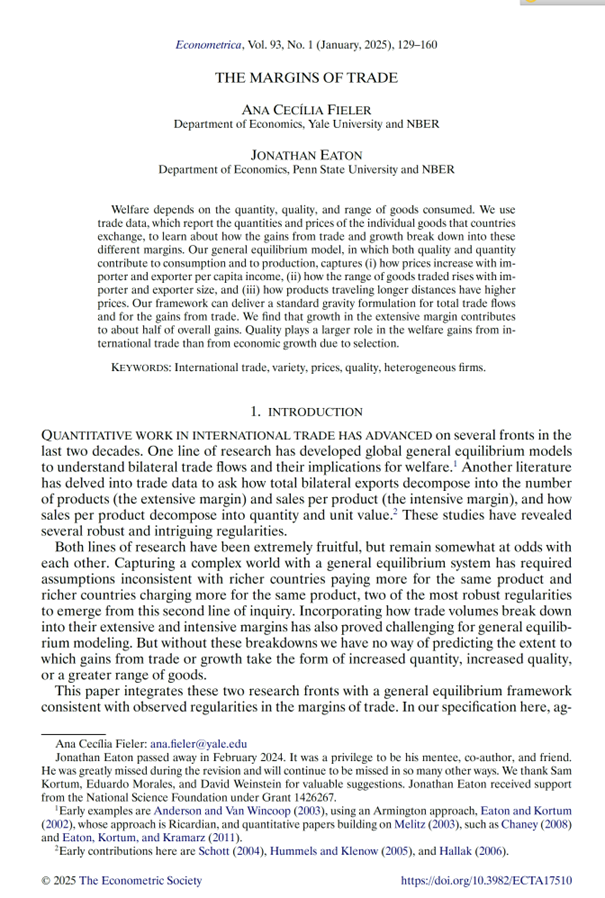
"The Margins of Trade" by Fieler and Eaton
"Welfare depends on the quantity, quality, and range of goods consumed. We use trade data...to learn about how the gains from trade and growth break down into these different margins."
https://t.co/Hb8ykfuMGm


![JayHyunEcon's tweet photo. [Call for papers: New Urban/Real Estate Conference in Banff]
The Business Economics group @UAlbertaBiz @UAlberta is proud to launch an inaugural Rocky Mountain Urban and Real Estate (#RMURE) Conference at #Banff, on June 5 - 7, 2026.
The purpose of this conference is to bring together an academic community of #Urban and #RealEstate economists, broadly defined, in Canada and worldwide.
As such, we invite papers on a broad range of topics that would be appropriate for presentation at the @UrbanEconomics or @AREUEA_ORG meetings.
Keynote: Prof. Nathaniel Baum-Snow @baum_snow (@rotmanschool)
Submission deadline: January 31, 2026
Submit your papers to: buec.workshop@ualberta.ca
For more details, please visit our conference website: https://t.co/zloCVxvVAL
(Organizers: @JayHyunEcon @mmacekk Nate Schiff)](https://pbs.twimg.com/media/G5ajHgbagAA2xQK.jpg)
![JayHyunEcon's tweet photo. [Call for papers: New Urban/Real Estate Conference in Banff]
The Business Economics group @UAlbertaBiz @UAlberta is proud to launch an inaugural Rocky Mountain Urban and Real Estate (#RMURE) Conference at #Banff, on June 5 - 7, 2026.
The purpose of this conference is to bring together an academic community of #Urban and #RealEstate economists, broadly defined, in Canada and worldwide.
As such, we invite papers on a broad range of topics that would be appropriate for presentation at the @UrbanEconomics or @AREUEA_ORG meetings.
Keynote: Prof. Nathaniel Baum-Snow @baum_snow (@rotmanschool)
Submission deadline: January 31, 2026
Submit your papers to: buec.workshop@ualberta.ca
For more details, please visit our conference website: https://t.co/zloCVxvVAL
(Organizers: @JayHyunEcon @mmacekk Nate Schiff)](https://pbs.twimg.com/media/G5ajF5zaEAAUuzQ.jpg)
![JayHyunEcon's tweet photo. [Call for papers: New Urban/Real Estate Conference in Banff]
The Business Economics group @UAlbertaBiz @UAlberta is proud to launch an inaugural Rocky Mountain Urban and Real Estate (#RMURE) Conference at #Banff, on June 5 - 7, 2026.
The purpose of this conference is to bring together an academic community of #Urban and #RealEstate economists, broadly defined, in Canada and worldwide.
As such, we invite papers on a broad range of topics that would be appropriate for presentation at the @UrbanEconomics or @AREUEA_ORG meetings.
Keynote: Prof. Nathaniel Baum-Snow @baum_snow (@rotmanschool)
Submission deadline: January 31, 2026
Submit your papers to: buec.workshop@ualberta.ca
For more details, please visit our conference website: https://t.co/zloCVxvVAL
(Organizers: @JayHyunEcon @mmacekk Nate Schiff)](https://pbs.twimg.com/media/G5ajEGZbUAAAqbg.jpg)




![JayHyunEcon's tweet photo. [Call for papers: New Urban/Real Estate Conference in Banff]
The Business Economics group @UAlbertaBiz @UAlberta is proud to launch an inaugural Rocky Mountain Urban and Real Estate (#RMURE) Conference at #Banff, on June 5 - 7, 2026.
The purpose of this conference is to bring together an academic community of #Urban and #RealEstate economists, broadly defined, in Canada and worldwide.
As such, we invite papers on a broad range of topics that would be appropriate for presentation at the @UrbanEconomics or @AREUEA_ORG meetings.
Keynote: Prof. Nathaniel Baum-Snow @baum_snow (@rotmanschool)
Submission deadline: January 31, 2026
Submit your papers to: buec.workshop@ualberta.ca
For more details, please visit our conference website: https://t.co/zloCVxvVAL
(Organizers: @JayHyunEcon @mmacekk Nate Schiff)](https://pbs.twimg.com/media/G5ajuKxbcAAeWrI.jpg)