Thoughts About Scaling Law
Scaling, but not only of parameters. Every model release now ends with the same question: how many parameters? It isn't a question that can be answered on its own. Parameter count is only meaningful alongside three others — how much data you have, where you intend to spend your compute, and who will run the model, under what conditions.
The field learned this the hard way. Kaplan et al. (2020) fit an exponent that told everyone to grow parameters faster than data — roughly 2.7:1 — and the industry complied: GPT-3, Gopher, MT-NLG. Hoffmann et al. (2022) redid the experiment across four hundred models and found the compute-optimal split is closer to 20 tokens per parameter, and that with sufficient compute the two should grow at the same rate rather than drifting apart. The error in the earlier fit compounded with every order of magnitude of compute, which is why the largest models of that generation were the most misallocated. The trillion-parameter round was, in retrospect, a detour the whole field took together and then reversed.
Chinchilla wasn't the end either. It optimized training compute for models that would be trained once and evaluated. Today a model is called billions of times a day and inference dominates lifetime cost. Put inference into the objective and the optimum moves toward smaller models trained far longer — deliberate over-training, which is what Llama-2-7B and Gemma-2-9B were doing at roughly 290 and 889 tokens per parameter.
Sparsity moved the target again. In a MoE model two quantities have to be kept apart: total parameters govern roughly how much the model can hold — knowledge, facts, the long tail — while activated parameters and effective depth govern roughly how far it can think, how many steps of a causal chain it can carry before it comes apart. A dense 20:1 ratio does not transfer. And the ratio isn't a single number at all: Roberts et al. (2025) find the optimal tokens-per-parameter is task-dependent, with memorization favoring more parameters and reasoning favoring more data. Follow-up work on MoE observes that at fixed TPP, pushing total parameters higher actually degrades reasoning, while activating more experts reliably helps it.
This matters for what we are building toward. Finding a vulnerability is not a retrieval problem. It doesn't come from having memorized more CVEs; it comes from carrying a twenty-step chain of inference to the end without losing the thread. That capability does not live in total parameter count.
Which brings us to this release. Total parameters appear to matter up to a threshold — enough to hold the world — after which additional capability comes from scaling elsewhere: effective depth per forward pass, and above all post-training. GLM-5.3 is our controlled experiment on that claim. Same base, same architecture, same total and activated parameters as GLM-5.2. One month of scaling long-horizon environments and RL. The gains are not marginal. Well, scaling has more than one dial. We turned the post-training one this time because it had the most slack left in it — not because the others are finished. Base model size, pretraining data, compute spent per forward pass: all of them are still on the table, and we will come back to each. What this experiment taught us is that the dials do not have to be turned together, and that the one worth turning next is rarely the one that was worth turning last. We are not done scaling. Next time, maybe mid-training, pre-training, and even more.
This is actually cool - I tried the same prompt for the new Interactive Playwright skill in Codex & GPT-5.4 xHigh - the one above is with the skill and the one below is without. What the skill does is uses the computer use capability of GPT-5.4 to look and navigate the UI. This never worked for me before, but with GPT-5.4 this is the first time I can actually see a massive difference.
You can see how the first scene is much more coherent, higher fidelity and complete. The one below is missing a lot of elements and isn't as rich in detail. I'll keep using it for any UI work now.
Nano Banana Pro
Prompt:
A street-style map of {CITY_NAME} placed on a {MAP_SURFACE}, with a photorealistic miniature version of {CITY_NAME} emerging from it {LANDMARK_1},{LANDMARK_2},{LANDMARK_3}, {NATURE_ELEMENT}, {URBAN_LIFE_ELEMENT}, {ICONIC_TRANSPORT},and {EXTRA_DETAIL}.All elements grow from the map like a 3D urban diorama. Studio soft lighting, cinematic depth, 2:3 format
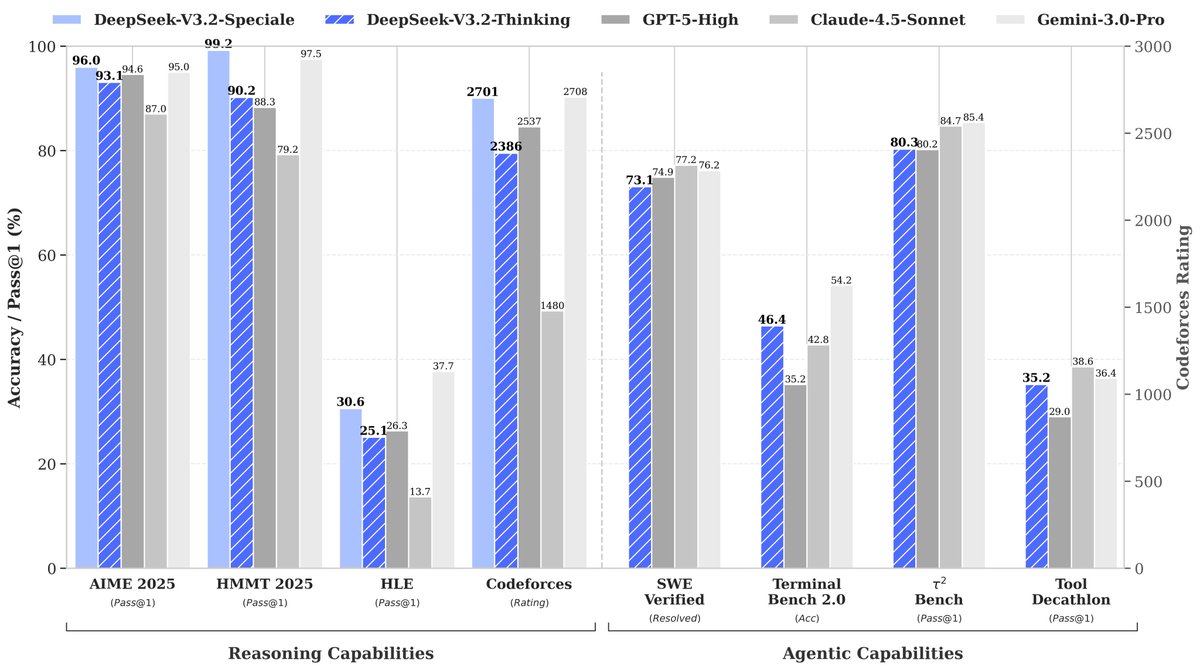
🚀 Launching DeepSeek-V3.2 & DeepSeek-V3.2-Speciale — Reasoning-first models built for agents!
🔹 DeepSeek-V3.2: Official successor to V3.2-Exp. Now live on App, Web & API.
🔹 DeepSeek-V3.2-Speciale: Pushing the boundaries of reasoning capabilities. API-only for now.
📄 Tech report: https://t.co/7EyydyNuG0
1/n
Microdispensing at the picoliter scale is redefining precision in science enabling ultra-accurate droplet placement for biotech, diagnostics and electronics.
A raindrop ≈ 50 µL is 50 million× larger than a picoliter.
When you throw a ball at a wall, you can be sure it will bounce back at you.
You would be extremely surprised if the ball suddenly appeared on the other side of the wall. In quantum mechanics this type of phenomenon is called tunnelling and is exactly the type of phenomenon that has given it a reputation for being bizarre and unintuitive.
The 2025 #NobelPrize laureates in physics John Clarke, Michel H. Devoret and John M. Martinis, used a series of experiments to demonstrate that the bizarre properties of the quantum world can be made concrete in a system big enough to be held in the hand. Their superconducting electrical system could tunnel from one state to another, as if it were passing straight through a wall. They also showed that the system absorbed and emitted energy in doses of specific sizes, just as predicted by quantum mechanics.
Worried about unstable conformations derailing your candidates?
A DFT-level torsion scan could be the safety net you need. 🧵
#MolecularConformations#DrugDesign
Analyzing ligand–protein dynamics is critical for validating designs.
But MD analysis can be messy—multiple tools, manual checks, scattered data.
So how do you approach it today?
#MolecularDynamics#DrugDiscovery
Our CEO @demishassabis, Chief AI Officer @maxjaderberg, and Head of Medicinal Drug Design @_rebecca_paul were featured on the latest episode of Bloomberg Tech Europe (@technology) to share how we're leveraging frontier AI in groundbreaking ways to reimagine drug discovery and advance human health
Follow the link learn more about what Iso does and our progress towards solving all disease: https://t.co/udCOQflCFD
🧬La-Proteina🧬
The first generative model demonstrating accurate co-design of fully atomistic protein structures (sequence + side-chains + backbone) at scale, up to 800 residues, with state-of-the-art atomistic motif scaffolding performance - has just made its code open-source!
Learn more 🧵
The moment is right to push forward into a new frontier for AI — one that is as fundamental as language, says @drfeifei.
That frontier is visual spatial intelligence.
With Justin Johnson (@jcjohnss), her cofounder at @theworldlabs, and a16z's @martin_casado, Fei-Fei explains what unlocking this technology could mean, and why we’re in the midst of a “Cambrian explosion”:
Benchmarking GPT-5 for biomedical natural language processing
1. GPT-5 has achieved remarkable performance in biomedical question answering, reaching 94.1% accuracy on MedQA, surpassing previous supervised state-of-the-art models by over fifty percentage points. This indicates that general-purpose LLMs like GPT-5 can now effectively handle knowledge-intensive biomedical QA tasks without task-specific training.
2. In addition to QA, GPT-5 also made significant progress in other biomedical NLP tasks such as named entity recognition and relation extraction. For example, it achieved an F1 score of 0.886 in chemical NER and 0.616 F1 in ChemProt relation extraction, outperforming GPT-4 and GPT-4o.
3. However, GPT-5 still faces challenges in tasks that require strict boundary precision and exhaustive recall, such as disease NER, as well as in text summarization and multi-label document classification. This suggests that domain-specific systems remain indispensable for certain precision-critical extraction and evidence-dense summarization tasks.
4. The study also found that few-shot prompting produces diminishing returns for large models like GPT-5 and GPT-4o, with only modest improvements observed. This implies that more sophisticated prompt engineering strategies may be needed to further enhance the performance of these models.
5. The benchmarking results provide valuable insights into the strengths and limitations of general-purpose LLMs in biomedical NLP, offering actionable guidance for system design and model selection in this field. Future work should focus on addressing the remaining challenges and exploring hybrid approaches that combine the adaptability of LLMs with the precision of domain-tuned models.
📜Paper: https://t.co/zmBiXydHYp
#GPT5 #BiomedicalNLP #LanguageModel #Benchmarking #NaturalLanguageProcessing
Streamline Conformation Analysis: Molvado’s 3D Interface Tools
💻Save Hours on 3D Analysis—Molvado’s Hidden Interface Features
Analyzing molecular conformations and ligand-protein alignment usually requires switching between tools. Molvado’s 3D Result Interface streamlines everything into one place:
✅ One-click residue labeling: Tag amino acids (e.g., ARG140, LEU143) instantly—no manual annotation.
✅ Built-in measurement tools: Quickly calculate distances, angles, and dihedral angles—perfect for checking interactions.
✅ Multi-screen comparison:
Dual-screen: Fix a reference on the left, flip through others on the right.
Four-screen: Compare multiple designs with easy navigation.
✅ Reference superimposition: Overlay reference ligands with designs to spot alignment gaps or improvements.
These tools cut down on tool-switching and speed up conformation checks.
Which 3D analysis task takes up most of your time—residue labeling or distance checks?
#3DInterface #ConformationAnalysis #MolecularVisualization #Molvado #CADDEfficiency