”Suomen oikeusjärjestelmä ei lähde siitä, että sen pitää suojella vähävaraisen, heikossa asemassa olevan ihmisen oikeuksia. Täällä on itäeurooppalainen oikeuskulttuuri, jossa tuomari on virkamies ja hallinnon puolella sen sijaan, että olisi yksilön puolella.”
Varsin rohkeaa professorilta sanoa tämä ääneen, ja näin asia todellakin on.
https://t.co/CYqmOULOTE
Europe writes into law how unstable a fat may be before it is allowed near a diesel engine. Soybean oil fails it. Sunflower fails it. Rapeseed fails it.
The measure is the iodine value, and it counts double bonds. Every one is a place oxygen can get in.
- Butter: 25 to 42
- Beef tallow: 42 to 51
- Lard: 58 to 65
- Olive: 75 to 94
- Peanut: 86 to 107
- Rice bran: 99 to 108
- Cottonseed: 100 to 123
- Corn: 103 to 135
- Rapeseed: 105 to 126
- Sunflower: 118 to 141
- Soybean: 124 to 139
- Grapeseed: 128 to 150
- Safflower: 136 to 148
- Linseed: 155 to 205
The top four rows are what the British and American kitchen ran on for a thousand years. Everything under them arrived after 1900 and was sold to your mother as the improvement.
Linseed at 200 gets spread on jute and sold as flooring.
The fuel standard, EN 14214, stops at 120.
Nobody has ever written one of those for a human being.
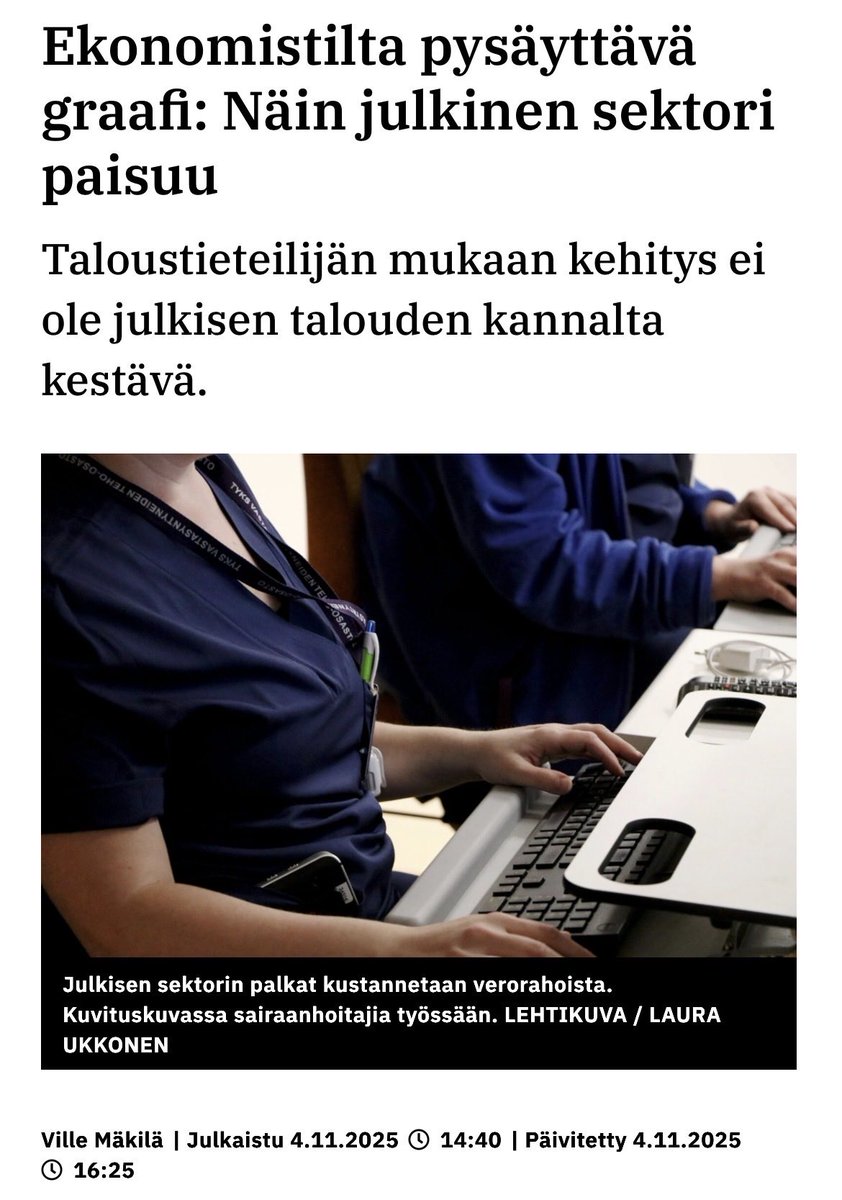
Poliitikot ovat vuosikymmenten saatossa paisuttaneet julkisesta sektorista itselleen hillotolppien valtakunnan:
loputtomasti virastoja, järjestöjä & korkeapalkkaisia tehtäviä, joihin heidän meriiteillään ei muuten olisi asiaa.
Järjestelmä on tiensä päässä. Muutos välttämätön.
Sunburn is a fat going rancid inside you, and the compound it produces has a name.
4-hydroxynonenal. An aldehyde. Measurable, published, sitting in the literature for forty years.
It does not come from nowhere. It is a breakdown product of omega-6.
Specifically linoleic acid and the arachidonic acid your body makes from it.
Linoleic acid has two double bonds. Every double bond is a weak point where oxygen gets in.
Saturated fat has none. Monounsaturated has one and it is hard to reach.
Your cell membranes are built from whatever fat you have been eating, on a turnover of roughly two years.
Ultraviolet light hits the skin and strips a hydrogen off one of those weak points.
That starts a chain reaction called lipid peroxidation, and a chain reaction does not need more light to continue. It propagates on its own.
The chain breaks the fatty acid apart. Out come 4-hydroxynonenal and malondialdehyde.
Those aldehydes cross-link proteins, damage DNA and trigger the inflammatory cascade.
The redness, the heat, the swelling, the peeling. That is the immune response to the wreckage, not the sunlight itself.
More linoleic acid in the membrane means more fuel in the fire.
Linoleic acid in American body fat ran at about 9 per cent in 1959 and reached 21 per cent by 2008.
Your grandfather worked outdoors all day in a vest and came home brown, on membranes built from lard, butter and dripping.
He was less flammable, and nobody had told him he was doing anything brave.
Four grams of omega-3 a day let volunteers take 36 per cent more UV before burning. Fish oil cut the inflammatory signal in irradiated human skin by more than 60 per cent.
Sunlight is not the accelerant. It is the ignition.
Fifty years of advice about what to spread on your skin, and not one word about what you built it out of.
India is the world's largest real-life trial of the diet you've been told is healthy.
Low red meat. Low saturated fat. Lots of grains. Plenty of vegetable oil. Hundreds of millions vegetarian.
A billion people. Decades in.
How's it going?
- 101 million diabetics, the most on Earth
- Another 136 million on the starting line
- Heart attacks arriving a decade early
- Among the highest coronary disease rates in the world
- Industrial leaders in the thin-sick physique
- Traditional ghee swapped for seed oils in the name of "progress"
- A third of children stunted despite mountains of grain
- Widespread protein deficiency in a nation told plants were enough
Even India's own diabetes survey pointed to the problem: too many cheap refined carbohydrates, too little protein.
This isn't a warning about the future.
It's what happens when the dietary advice becomes the national menu.
They call India the diabetes capital of the world.
Your doctor's poster still calls that diet "healthy."
Ukraine's Unmanned Systems Forces commander Madyar:
First, NATO should build a buffer zone along every border.
Call it a drone work zone, not a kill zone. From 0 to 5 km, enemy movement must become impossible under a drone shield.
1/
The problem with seed oil is that, as with ultraprocessed foods, the taste doesn't match the nutrients, creating an internal dissonance.
DISCLAIMER: I am a tiny olive oil producer (small time farmer, planted 750 trees, only for friends & family).
“@elonmusk is probably doing more for America than any other American.”
“He's single-handedly bringing manufacturing back to America.”
“He's revived defense tech.”
“SpaceX is in some ways the most important defense contractor in America.”
“What he's doing with Starlink is amazing for the world.”
“He's creating all these blue collar manufacturing jobs.
“He's done more than any living human to de-carbonize the world.”
“And if you’re upset about data centers on Earth—here you go!”
@GavinSBaker with @patrick_oshag on @InvestLikeBest
We open-sourced a PyMC-to-Rust compiler.
What's interesting is that the compilation is done 100% by a claude code agent in a validation loop.
Output runs 3-7x faster than highly optimized PyMC code.
https://t.co/ZiAEjHN0fh
We implemented @karpathy 's MicroGPT fully on FPGA fabric.
No GPU.
No PyTorch.
No CPU inference loop.
Just a transformer burned into hardware, generating 50,000+ tokens/sec.
The model is small, but the idea is not: inference does not have to live only in software 👇
Some thoughts on destruction of oil and gas infrastructure in the Gulf.
It is not exactly a new insight that modern economies operate on oil. Oil access, synthesis, and interdiction was a major theater of WW2. 100 years ago oil-poor nations spent heavily and participated in terrible wars over oil. See, for example, the Combined Bombing Offensive, Operation Tidal Wave, and the destruction of the Leuna synthetic fuel plants, not to mention the effectiveness of the submarine war in the waters around Japan.
In 2022, energy producer Russia invaded Ukraine, instantly throwing into stark relief the idiocy of European energy policy, where an unholy alliance of heavily regulated energy contractors and astroturfed "green" activists managed to get Germany to shut down their nuclear industry. Even as solar panel production, largely initially developed and funded in the West, grew to overwhelming proportions, Europe insisted on sending roughly $1b *per day* to Russia for access to their oil and gas.
If Europe had adjusted course in early 2022, then they would be able to support their power grids and probably some synthetic fuel production by now. The US built nuclear weapons from scratch in 2.5 years in the 1940s in competition with other national priorities at the same time. It's been more than four years since Ukraine's invasion.
But no, they did sweet fuck all about ensuring energy sovereignty. Indeed, they even went in the other direction. Britain concentrated government resources on cracking down on free speech and stopped drilling for oil. The continent continued their ill-informed blanket ban on fracking, and working age people continued to pay the price, in the form of ever higher costs, ever higher taxes, ever poorer public services, ever dropping fertility.
What about the rest of the oil importing developed world? France and Japan maintained their nuclear industry, their navies, their shipping industries and the fungibility of their supply - to an extent - even as they continued to actively burn up their economies in other more insidious ways.
New Zealand shut down their last refinery. Australia exports a lot of crude and gas but mostly lacks the ability to close their supply chain in their own borders, and fuel prices have almost doubled. California continued to ban new drilling and continues to wage open regulatory warfare against their oil refineries, perversely increasing oil-related air pollution in the state from foreign oil tanker imports and pushing gasoline prices ever higher.
More of the world has attempted to switch to natural gas supply, with investments exceeding $1t on gas import and export terminals, as though it's some fundamental law of nature that hydrocarbons must cross an ocean before they're used. As though the US fracking boom will last forever, or Asian demand growth won't see European prices continue to increase, further crushing their economic dynamism.
I have been in the room with various Asian and European energy ministers and have asked them point blank: What's your plan? I have never gotten a better answer than a shrug, as though they'll muddle through and soon it'll be someone else's problem.
The best time to get serious about domestic energy supply chains was four years ago. The second best time is today. The pain will ease just as soon as you say the magic words: I must increase my own energy supply!
And yes, it is totally possible to produce synthetic oil and gas pretty much anywhere that people live with a solar-based process we've spent four years developing at @TerraformIndies, it is future proof, it is strategically robust, it is price-linked to solar manufacturing cost, which continues to fall like a rock. It's not entirely trivial to do but, given that Europe spends about 100,000x more on Russian oil and gas imports than they do on (privately funded) synthetic fuel development, I am on safe ground when I accuse Europe's leaders of committing gross capital misallocation. Imagine what the synthetic fuel industry could achieve with $1b/day!
If you are an energy minister, now is a good time to reflect on fates worse than losing an election. Get back to work!
Esimerkki siitä, miten ei tarvitse olla rähmällään EU:n suuntaan, vaan laittaa oma maa etusijalle.
Ihan hyväksyttävää näin kriittisen EU:n kannattajan silmin 🤷♂️
Tähän ei oikeasti liity mitään mysteeriä.
Suomi ei ole ajautunut lähes kaksi vuosikymmentä jatkuneeseen kurimukseen siksi, että hallitukset olisivat hetkellisesti epäonnistuneet "vakauttamisessa", vaan siksi, että rakenteellinen heikkous on yritetty paikata veroilla, leikkauksilla ja kirjanpidollisilla tempuilla samalla kun reaalitalouden perusta on rapautunut ja suomalaiset jatkuvasti köyhtyneet.
Demarit kehittelevät uusia menoja, vaaditaan lisää resursseja, organisaatioita, etuuksia ja hallinnollisia kerroksia, joista syntyy pysyviä intressiryhmiä. Kokoomus saapuu "vastuullistamaan" ja "vakauttamaan" järjestelmää, mutta ei pura rakennetta (korkeintaan marginaalisesti hidastaa sen kasvua). Rakenteeseen lisätään vähän markkinamekanismia, himmeleitä ja veroja säädetään jostain kulmasta. Lopputulos on joka tapauksessa aina sama: julkinen kone paisuu, rakenne monimutkaistuu, tuottavan sektorin sitruunoista puristetaan muutama tippa lisää mehua ja julkinen velka nousee. Räikkä liikkuu vain yhteen suuntaan.
Jos talous ei kasva, väestö vanhenee, julkiset menot eivät juurikaan jousta ja tuottavuus ei nouse, velkasuhde nousee automaattisesti.
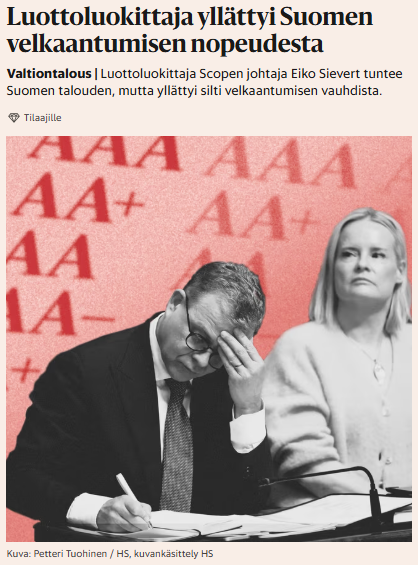
Luottoluokittajan "yllättyminen" kertoo enemmän eurooppalaisesta teknokraattisesta ajattelutavasta kuin Suomesta. Kuvittelemme yhä, että kunhan tehdään "vastuullista finanssipolitiikkaa", numerot muuttuvat todeksi. Talous ei kasva, joten numerot eivät toimi.
Suomessa on jo eletty vuosikymmeniä todeksi mallia, jossa työn, investointien ja riskinoton päälle kasataan veroja, sääntelyä ja räikkä, ja sitten ihmetellään, miksi yksityinen sektori ei hoida tehtäväänsä. Jatkuva julkinen velkaantuminen on Suomen degrowth-mallin looginen lopputulos. Ei Suomi näivety siksi, että Orpon, Marinin ja/tai Vanhasen hallitus olisi "mokannut", vaan siksi, että koko järjestelmä on rakennettu kuluttamaan enemmän kuin rapautuva reaalitalous pystyy sille antamaan.
Keskustelu esimerkiksi veronkevennysten "oudosta ajoituksesta" on erikoista. Ongelma ei ole edes yksittäinen ajoitusvirhe, vaan se, että Suomessa tehdään edelleen linjauksia täysin merkityksettömillä systeemikyberneettisillä säädöillä tilanteessa, jossa tarvittaisiin paljon suurempia korjausliikkeitä. VER:n miljardi tai pari veroprosentin kymmenystä sinne tänne ei muuta sitä tosiasiaa, että Suomi on jumissa matalan kasvun, korkean (ja automaattisesti kasvavan) menotason ja heikon tuottavuuden ansassa. Kyse on siis lähinnä kiihtyneen alamäen hallinnasta, koska kukaan ei ole aidosti valmis pienentämään julkista puolta tai tarttumaan menoautomaatteihin. Järjestelmä ei selvästi kykene tähän, koska jokaisella on jotain saatavaa paisuneelta koneistolta.
Markkinat eivät pakota nopeaan korjausliikkeeseen, koska monet seikat pehmentävät tilannetta. Poliitikkojen tehtävä on hallita köyhtymistä ja näivettymistä, joten vaikeita ratkaisuja lykätään jatkuvasti. Ulkomaailma ei pakota (vielä), joten sisäinen rapautuminen jatkuu.
Suomessa on yritetty jo aika kauan jatkuvasti verottaa, säädellä ja hallinnoida itsemme talouskasvun taikamaton kyytiin. Rakenteellinen heikkous katoaa, kun uskomme itseemme, rohkaistumme kuluttamaan ja lähdemme asuntokaupoille.
Entä jos kyse ei olekaan mistään massapsykologisesta häiriötilasta, vaan siitä, että tilanne on oikeasti aika paha?
Perimmäiset syyt Suomen pysähtyneisyydelle:
Kokoomus ei halua koskea maahanmuuttoon, koska heille maahanmuutto tarkoittaa halpaa työvoimaa. SDP, vihreät ja vasemmistoliitto eivät halua koskea maahanmuuttoon, koska heille maahanmuutto tarkoittaa äänestäjiä.
Keskusta, SDP, kokoomus, vihreät ja vasemmistoliitto eivät halua koskea kolmanteen sektoriin, koska nämä ovat vuosikymmeniä ulottaneet lonkeronsa kyseisen hillotolppaviidakon uumeniin.
Keskusta ei halua koskea aluehallinnon rakenteisiin, koska puolueen valta on perinteisesti rakentunut maakunnallisen hallinnon varaan.
SDP ja vasemmistoliitto eivät halua koskea julkisen sektorin kokoon, koska näiden tukipohja on vahvasti sidoksissa julkisen sektorin työntekijöihin.
Kokoomus ei halua koskea yritystukijärjestelmään, koska se osuisi puolueen perinteisiin rahoittajiin ja taustavaikuttajiin.
SDP ja vasemmistoliitto eivät halua koskea ay-liikkeen asemaan, koska ay-liike on näiden puolueiden keskeinen liittolainen.
Kokoomus, SDP, RKP, vasemmistoliitto, keskusta ja vihreät eivät halua koskea kehitysapuun, koska heille kehitysapu tarkoittaa hyvesignalointipääomaa.
RKP jättää koskematta mihin tahansa, kunhan pakkoruotsi säilyy ennallaan.
Liike Nytiltä ei edes kysytä halukkuutta koskea mihinkään.
1/4 LLMs solve research grade math problems but struggle with basic calculations. We bridge this gap by turning them to computers.
We built a computer INSIDE a transformer that can run programs for millions of steps in seconds solving even the hardest Sudokus with 100% accuracy