The most important trick to be happy is to realize that happiness is a choice that you make and a skill set that you develop. You choose to be happy, and then you work at it. It's just like building muscles. - @naval
Databricks CEO Ali Ghodsi says if frontier models stopped advancing, it wouldn't matter for most orgs because enterprise AI is bottlenecked on context, not intelligence:
"There's no agentic work that's automated the whole enterprise. That has just not happened. Why is that? The real reason is the models are smart enough, but they just don't have the context that exists inside of any organization."
"They have not been in every meeting. They don't know what's in everybody's heads. They don't know all the processes. There's always a couple of employees who know everything in every organization. You go tap on their shoulder, and everybody's like, 'Oh my God, what would happen if he or she quits?'"
"If you just fused that and gave that context into the AI models, just the frontier today, I think there's so much productivity gains you could get for any organization on the planet."
"For that, we actually don't need smarter models... If the frontier doesn't advance, it doesn't actually matter for the vast majority of organizations on the planet. They're just so far behind in the adoption curve of actually automating things and getting value out of this stuff."
@alighodsi
Read the latest Profiles of the Future by @bhorowitz and @mikemcg0 on Databricks & the Future of the Firm: https://t.co/rXjUDb7Oqw
1% of companies represent 90% of AI spending.
Of that 90%, 80% of this spend are from unprofitable VC backed companies.
So, roughly, $0.70-75 of every dollar of AI spending right now comes from AI companies spending VC investment dollars.
As a result, the revenue quality in AI is currently poor. This happened in previous cycles as well, like cloud when early users of AWS were mostly venture backed startups.
The thing, though, is that before AWS could scale and pull thru GCP and others as legitimate cash machines, there were a few clearing events to sort out these brittle revenues.
This is the extrapolation of Ken’s point. We will need to transition from speculative AI spending to consistent, reliable spend that shows up in public market earnings reports.
This hasn’t happened yet because most of the breathtaking revenue growth comes from LPs investing in VC funds who then send it to startups.
Kozhikode-based Altersage (@Altersage_Inno) has developed a tree-climbing robot called Cocobot, the world’s first commercially viable coconut harvesting robot.
Cocobot's patented design adapts to multiple vertical plantation crops such as arecanut, peach palm and jucara palm.
.@joshwoodward: "Every company right now needs a set of people who's job is to be at the frontier.
You want people plugged into the hive mind.
They're the people who have eight $200/month subscriptions on everything.
You have to architect your organization where this can exist."
Where does work happen - AI should listen understand and figure it out, not a new dashboard - but embedding AI to get context from existing workflows - to add value - without any extra steps from you. Adoption will skyrocket from there.
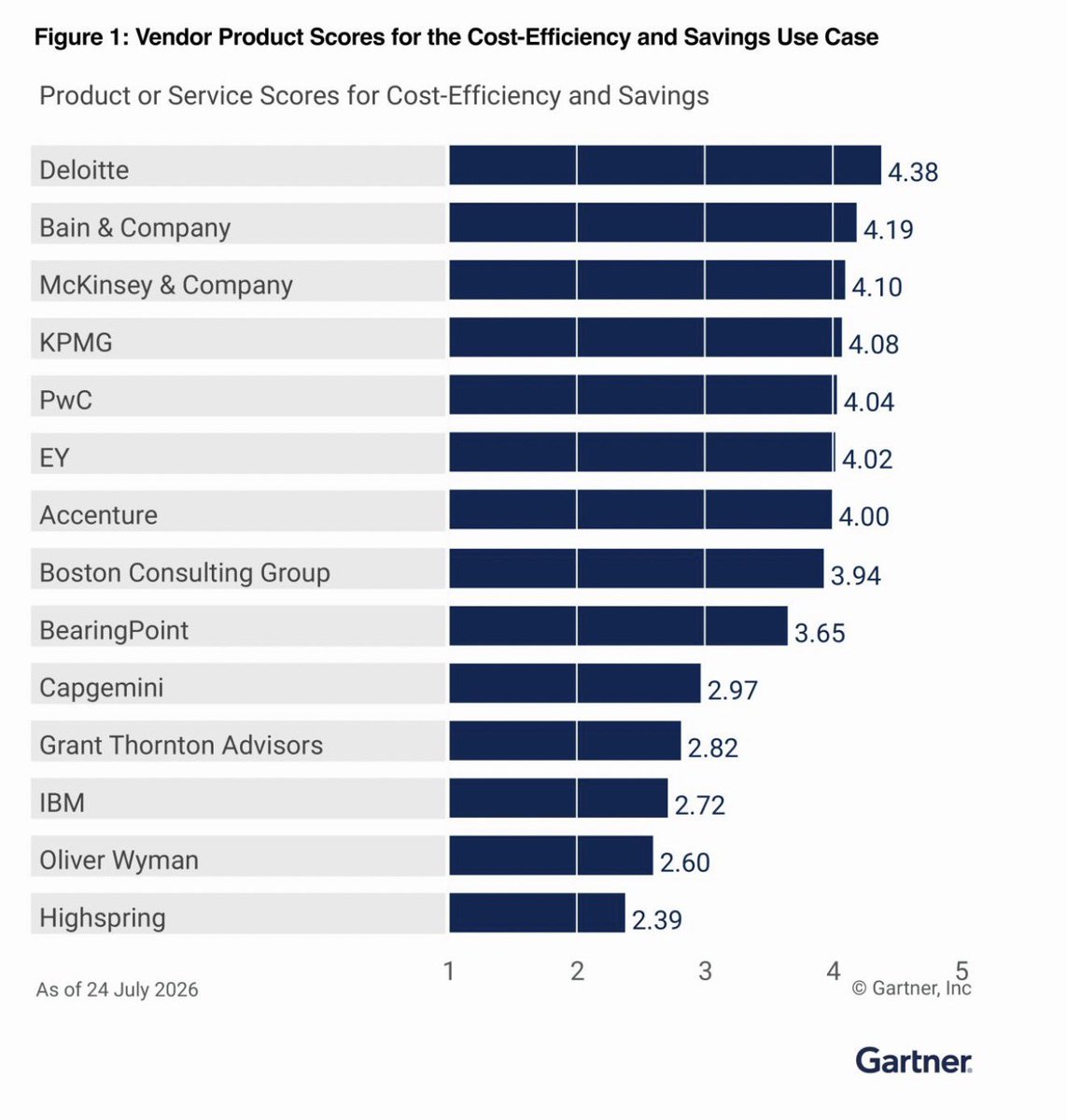
By focusing on how work gets done, how people interact, what experiences customers want, and disciplined execution … we can drive superior savings and efficiency.
The goal is giving time back so people can go from data entry and coordination to managing ambiguity, complexity, risk, and relationships. The things we hired them for in the first place🥇
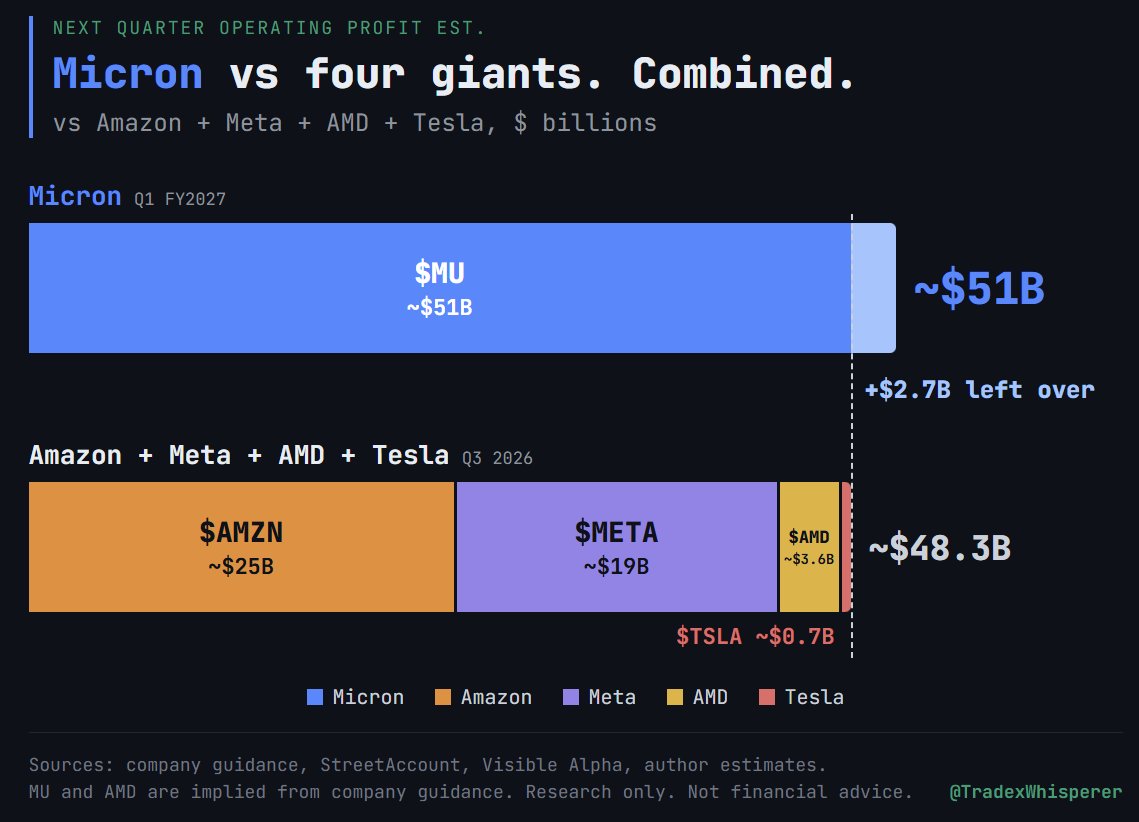
$MU This should NOT be possible.
Micron is about to make more profit than $AMZN $META $AMD & $TSLA combined.
Combined market cap? $7 Trillion.
Micron? $1.2T.
82% cheaper in valuation but more operating profit.
SCAs now extend into 2031. $DRAM supply gets even tighter in 2028.
@Meta I have very simple idea for you, why don’t you have meta ai as part of every instagram post, similar to grok, to fact check and mainly to save and categorize what one likes - export that to other apps, monetize it.. I’m tired of unorganized bookmarks - seems like obvious
"The engineering job used to be rowing, and now it's steering. There's a lot of people out in the world right now that are like, I don't want to f*cking steer. I want a row. I liked rowing." — @molly_g
Google is launching early access to a new MCP server for Google Home, allowing AI agents like Claude, ChatGPT and others to control connected devices, review camera summaries and access smart home activity using natural language.
https://t.co/YwlMkYfRI7
More on AI pacing:
Sarah Friar CFO of OpenAI yesterday on CNBC: “from where I sit today there is so much opportunity to drive growth that I am still highly focused on getting more compute to keep that flywheel going.”
Sachin Katti VP of Compute Strategy at OpenAI @sk7037 yesterday: “The way we will make sure frontier models are safe and aligned is by spending compute. So the counterintuitive point is that we’ll need even more compute to make sure future models are more safe and aligned.”
If you thought “pacing” was negative for AI infrastructure demand, think again. Almost as bullish as open-weight AI taking share but not quite.
Good post on what the applied AI strategy looks like at scale. It’s clear that there’s a wide gap between the AI models and the underlying workflows of an enterprise, which leaves a ton of opportunity for applied AI companies.
“The world doesn’t just want raw models and agents; it wants problems resolved and outcomes achieved. The premium will sit with the companies that can diffuse this intelligence through every aspect of civilization, converting raw tokens into real world outcomes, transforming industries, and creating economies in the process.”
This requires understanding the context, driving the change management, having a harness that can route to various models, connecting to the critical business systems in that vertical, solving the UX challenges of connecting users to agents in the right way in a workflow, understanding the evals in the space, and so on.
That’s a ton of value that goes beyond just the model intelligence itself. And there’s a window of opportunity right now to build the defining companies that can bring intelligence to the critical domains in an enterprise.