What's coming next? The future isn't arriving all at once. Let's explore it together.
Exploring AI, energy, climate, robotics, and the trends shaping tomorrow.
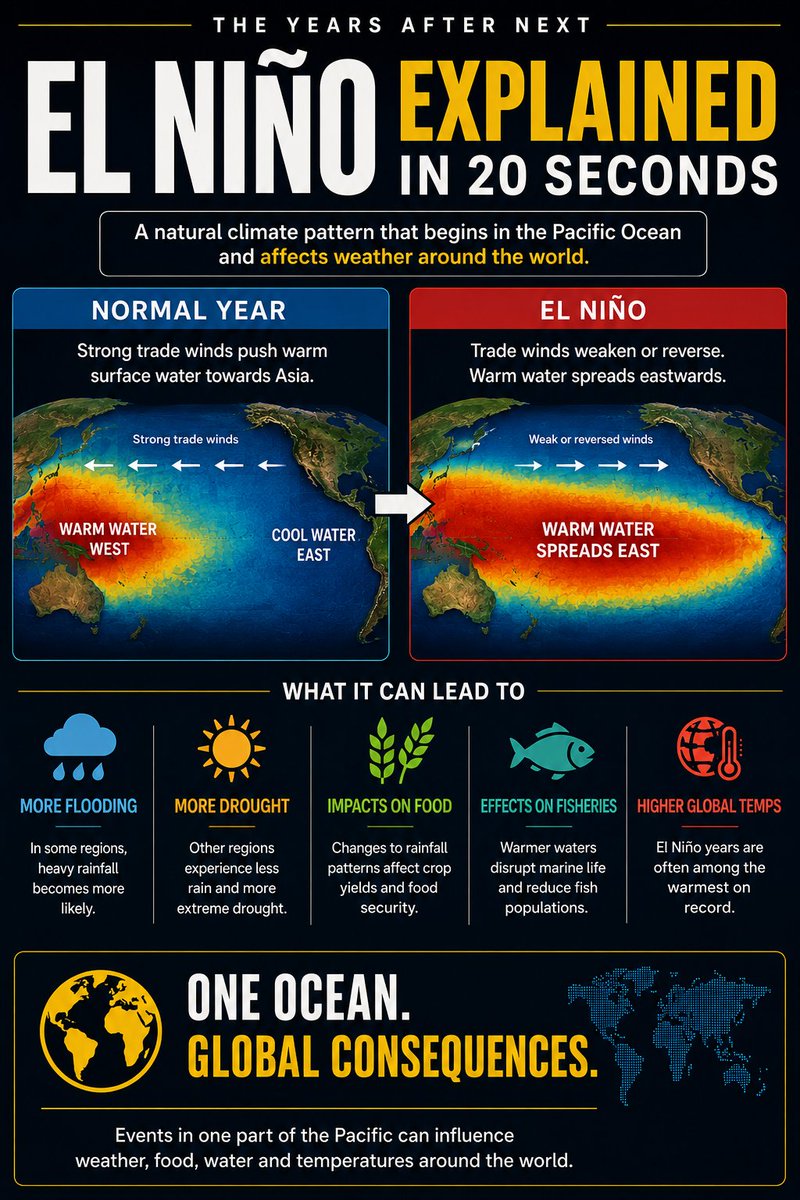
🌊 El Niño explained in 20 seconds.
El Niño isn't a storm, a hurricane, or caused by climate change.
El Niño is a natural climate pattern that begins in the Pacific Ocean.
Normally, strong trade winds push warm surface water towards Asia and Australia.
This leaves cooler water near the west coast of South America.
During an El Niño event, those winds weaken.
The warm water spreads back across the Pacific, releasing more heat into the atmosphere and changing weather patterns around the world.
The effects can include:
☔ More flooding in some regions
🔥 More drought in others
🌾 Changes to crop yields and food production
🐟 Disruption to fisheries and marine ecosystems
🌍 Higher global temperatures
El Niño doesn't cause every extreme weather event.
But it can increase the likelihood of certain weather patterns occurring worldwide.
One of the most important forces shaping global weather starts with a change in ocean temperatures thousands of miles away.
🌎 One ocean. Global consequences.
Incredible real footage: A flight attendant captured a bright green fireball meteor from her plane window over European Russia.
On the night of October 27, 2025, Alexandra Spasskaya was working a Ulyanovsk–Moscow flight at ~10,000 meters when this brilliant bolide streaked across the sky near Moscow.
The green glow and fragmentation were also seen by many people on the ground.
A rare high-altitude perspective of a natural meteoroid entering Earth’s atmosphere
Pure cosmic fireworks. 🌠
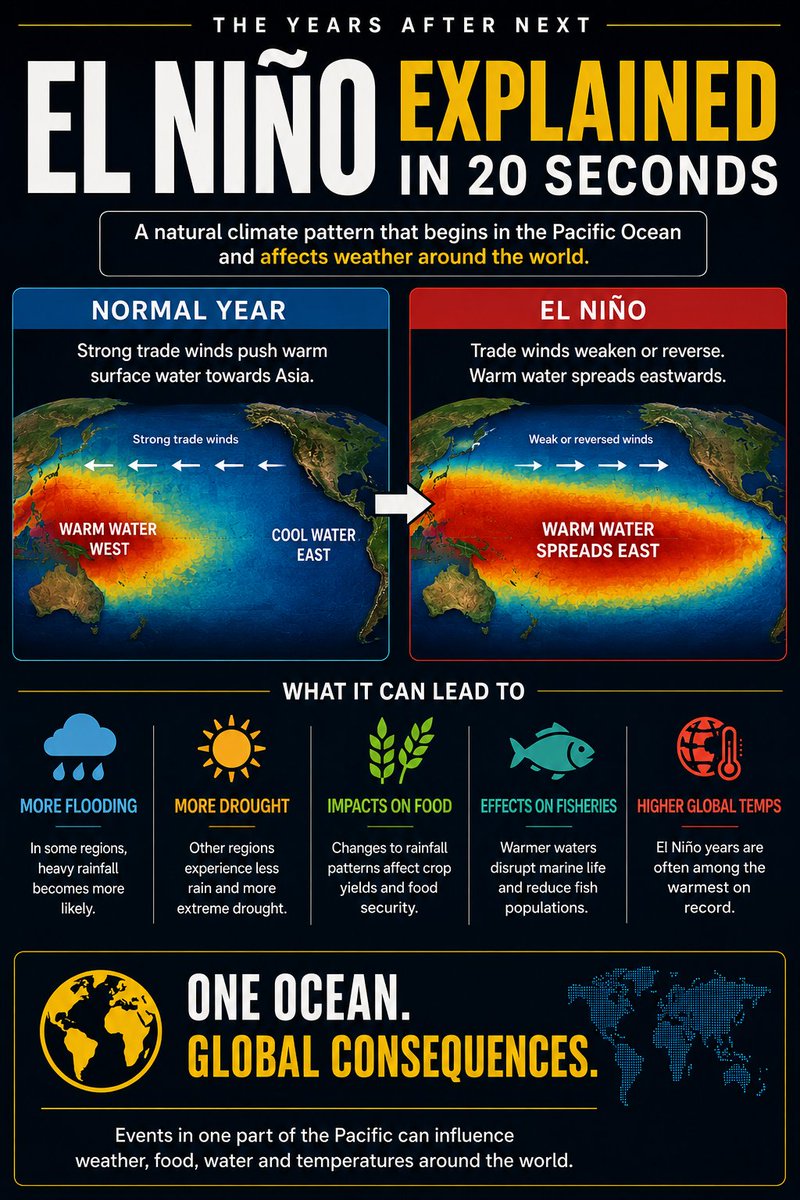
🌊 El Niño explained in 20 seconds.
El Niño isn't a storm, a hurricane, or caused by climate change.
El Niño is a natural climate pattern that begins in the Pacific Ocean.
Normally, strong trade winds push warm surface water towards Asia and Australia.
This leaves cooler water near the west coast of South America.
During an El Niño event, those winds weaken.
The warm water spreads back across the Pacific, releasing more heat into the atmosphere and changing weather patterns around the world.
The effects can include:
☔ More flooding in some regions
🔥 More drought in others
🌾 Changes to crop yields and food production
🐟 Disruption to fisheries and marine ecosystems
🌍 Higher global temperatures
El Niño doesn't cause every extreme weather event.
But it can increase the likelihood of certain weather patterns occurring worldwide.
One of the most important forces shaping global weather starts with a change in ocean temperatures thousands of miles away.
🌎 One ocean. Global consequences.
🌊 El Niño explained in 20 seconds.
El Niño isn't a storm, a hurricane, or caused by climate change.
El Niño is a natural climate pattern that begins in the Pacific Ocean.
Normally, strong trade winds push warm surface water towards Asia and Australia.
This leaves cooler water near the west coast of South America.
During an El Niño event, those winds weaken.
The warm water spreads back across the Pacific, releasing more heat into the atmosphere and changing weather patterns around the world.
The effects can include:
☔ More flooding in some regions
🔥 More drought in others
🌾 Changes to crop yields and food production
🐟 Disruption to fisheries and marine ecosystems
🌍 Higher global temperatures
El Niño doesn't cause every extreme weather event.
But it can increase the likelihood of certain weather patterns occurring worldwide.
One of the most important forces shaping global weather starts with a change in ocean temperatures thousands of miles away.
🌎 One ocean. Global consequences.