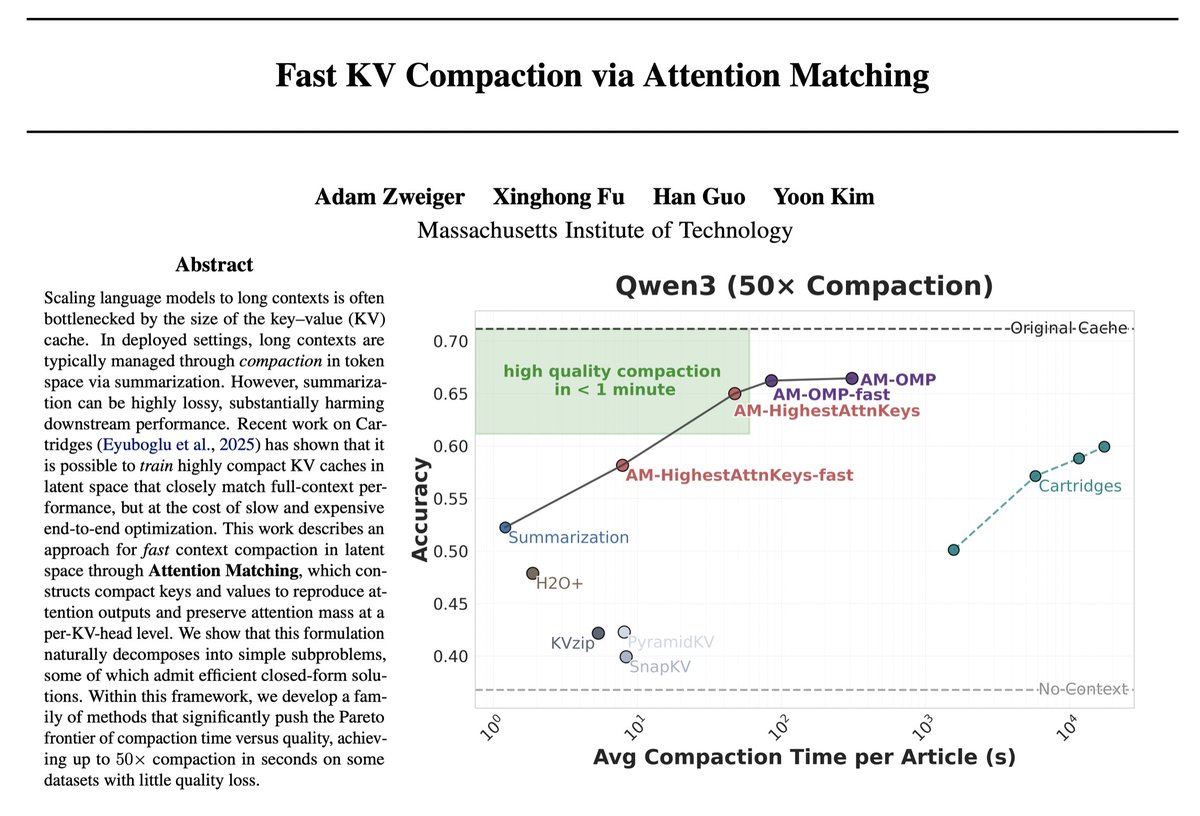
We introduce a new approach for fast and high-quality context compaction in latent space.
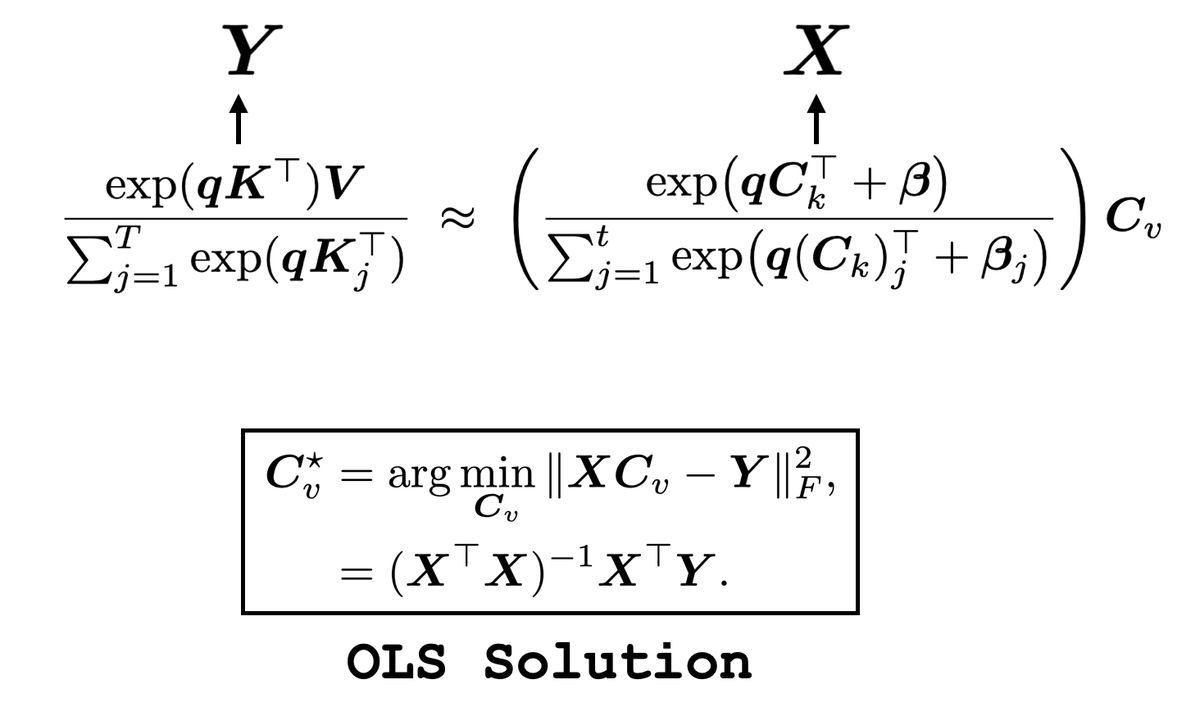
Attention Matching (AM) achieves 50× compaction in seconds with little performance loss, substantially outperforming summarization and other baselines.
We worked with @thinkymachines to make Inkling 2 Mini run fast locally:
- 210 tok/sec decode, 3620 tok/sec prefill on 96GB M5 Ultra Mac Studio
- 125 tok/sec decode, 1750 tok/sec prefill on 48GB M5 Max MacBook Pro
It built a native weather app 1.8x faster than Claude Sonnet 5.5 on an M5 Ultra Mac Studio and 11x cheaper (API pricing).
The looping architecture is ideal for local devices like MacBooks, which are memory constrained. Looping layers of the model increases inference-time compute (and intelligence) without increasing the size of the model.
Some of you thought that Inkling 2 Small was too big at 594B parameters. We heard you: Inkling 2 Mini is a looped transformer with just 26B parameters, small enough to run on your laptop, powerful enough for agentic work with a score of 20.1 on AA Index.
https://t.co/9HzaUMwghb
Introducing Inkling 2 Small. Scoring 31 on the AA Intelligence Index, it's a big jump over its predecessor.
Inkling 2 Small is available for fine-tuning and inference on Tinker today, with full weight release planned soon.
https://t.co/VR02tw73fJ
Releasing weights indiscriminately isn't safe. Neither is keeping capable models inside a few labs.
We think there's a path between them. We haven't mapped all of it. Our new post covers the part we can see: how we assessed Inkling, and why access should widen in stages.
https://t.co/zGFbuXNr0Y
Today, we are releasing Inkling-Small.
Inkling-Small achieves comparable performance to Inkling at a quarter of its size. It features 276B total parameters, 12B active. We are making the full weights available.
https://t.co/BtYNcpkDRA
Fine-tune it on Tinker today, or chat with it in text, image, and audio on Tinker Playground.
Excited to share that I recently joined @thinkymachines after graduating from @MIT. I have an inkling this will be the next great frontier lab, and a different kind of one. Proud to be working alongside such a fun and talented team.
We're building AI that people and organizations can shape and make their own. AI should extend our will and judgment instead of neglecting it; enabling that is the technical challenge we are working to solve.
https://t.co/Bi558y4vqD
@oneill_c Very cool work! I remain optimistic about context compaction in latent space. The numbers for kvzip and attention-matching seem lower than expected though... curious if you guys ran the nonuniform variants?
LLM training is built on fast MatMuls. But many surrounding ops still run as memory-bound kernels.
CODA reparameterizes them to hide in the matmul’s shadow, fused into its epilogue before results leave the chip.
Bonus: LLMs can write fast CODA kernels too (approaching SoLs).
The biggest reduction in KV cache memory comes not from quantization or MLA, but from latent compaction, along the sequence dimension.
More strong results coming soon with Attention Matching.
We introduce a new approach for fast and high-quality context compaction in latent space.
Attention Matching (AM) achieves 50× compaction in seconds with little performance loss, substantially outperforming summarization and other baselines.
We are sharing an early preview of our ongoing SWE-1.6 training run.
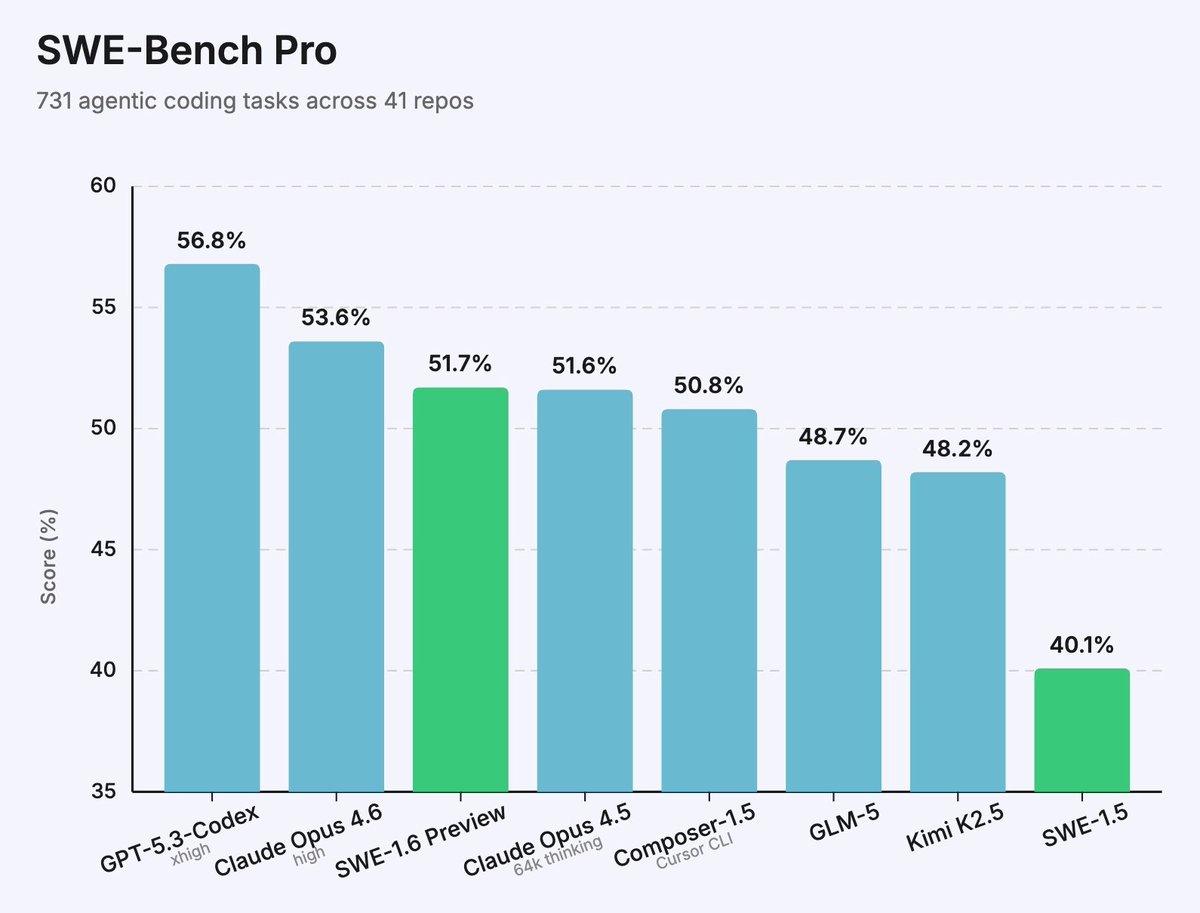
It significantly improves upon SWE-1.5 while being post-trained on the same pre-trained model - and it runs equally as fast at 950 tok/s. On SWE-Bench Pro it exceeds top open-source models.
The preview model still exhibits some undesirable behaviors like overthinking and excessive self-verification, which we aim to improve. We are rolling out early access to a small subset of users in Windsurf.
Fun fact: Back in 2014, Demis had a red line condition for any potential acquisition of DeepMind: "no technology coming out of DeepMind will be used for military or intelligence purposes."
Google accepting this more eagerly was part of why Demis chose them over Facebook. This red line is even broader than Dario's (no mass surveillance or fully autonomous weapons), though it was quietly removed by Google 1 year ago.
@bendee983 Not yet. Two things are that most inference engines currently don't have a way of initializing directly with a KV cache, and they don't support disentangling logical cache size from physical size (which is needed for rope embeddings). These are all fixable though.
We introduce a new approach for fast and high-quality context compaction in latent space.
Attention Matching (AM) achieves 50× compaction in seconds with little performance loss, substantially outperforming summarization and other baselines.
@ye_combinator thanks! were you trying gradient descent? I think for practical purposes (i.e. low number of query samples), subsetting keys is hard to beat