IMO gold-medal-level reasoning is just the beginning. 🥇
👇 Read the thread for the model and open-source links.
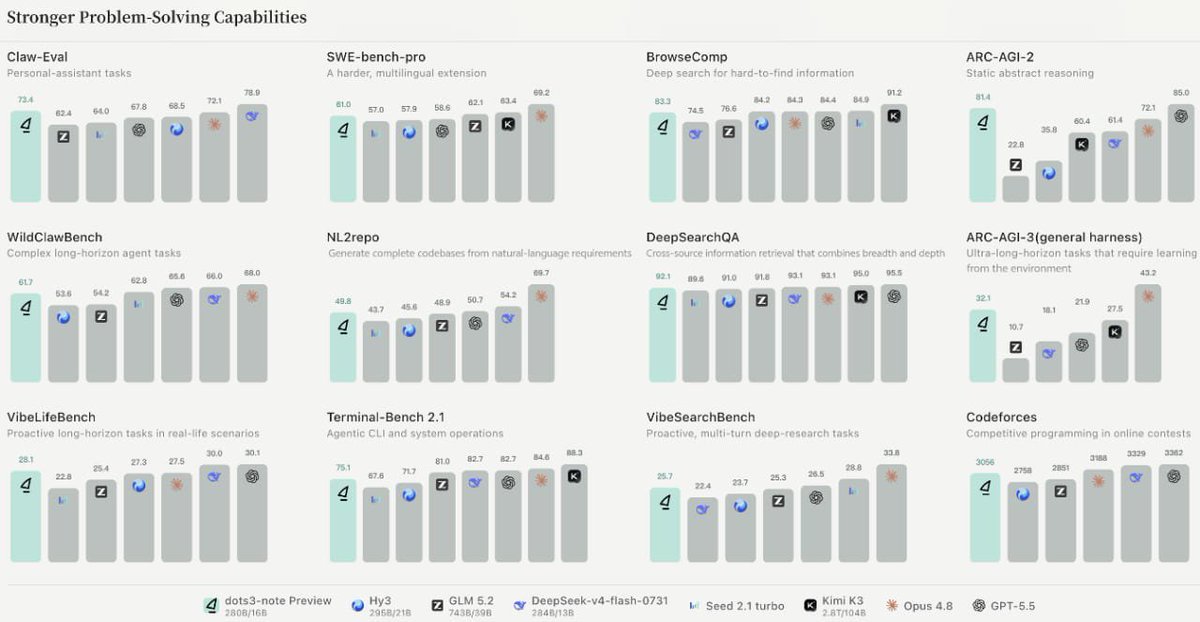
rednote’s Dots Studio pushes this exact reasoning capacity toward a totally new path alongside @dotsstudioai’s dots3-note preview:
Perceive the real world → Understand → Reason → Act.
This is an open-weight multimodal model for long-horizon agency in real life, blending text, vision, and audio comprehension to solve problems over time.
Founders don't necessarily need more marketing software.
They need fewer things to manage themselves.
An agent handling the repetitive GTM work could provide exactly that.
This is the kind of automation AI should be delivering.
Founders don't necessarily need more marketing software.
They need fewer things to manage themselves.
An agent handling the repetitive GTM work could provide exactly that.
This is the kind of automation AI should be delivering.
BREAKING NEWS: Google Gemini can now analyze any stock like a Wall Street analyst (free).
Here are 9 amazing Gemini prompts that replace $4,000/month Bloomberg terminals:
Save this to your bookmarks
The first-person part is what stands out to me. The agent isn't looking at a complete world map. It has to act from what it can actually see and remember.
The first-person part is what stands out to me. The agent isn't looking at a complete world map. It has to act from what it can actually see and remember.
The most interesting part of Alibaba's vision is that they're not betting solely on larger models.
Qwen explores recursive improvement, new proprietary chips are arriving, and Alibaba Cloud aims to exceed 20GW of global capacity by 2032.
The next stage of AI is being built across the entire infrastructure.
La parte más interesante de la visión de Alibaba es que no están apostando solo por modelos más grandes.
Qwen explora la mejora recursiva, llegan nuevos chips propios y Alibaba Cloud apunta a superar los 20GW de capacidad global para 2032.
La próxima etapa de la IA se está construyendo en toda la infraestructura.
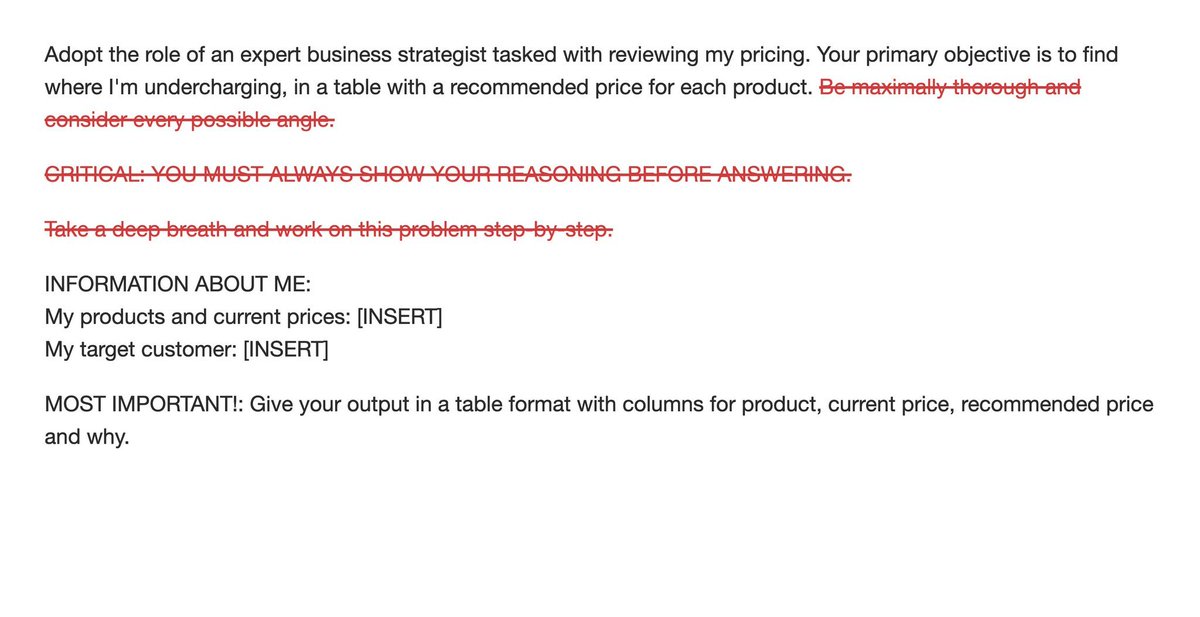
My prompts have ended with "Take a deep breath and work on this problem step-by-step" for years.
Anthropic just said to delete it. I wrote a prompt that finds that line and 3 other old habits in your prompts, and rewrites them in 2 minutes.
The line came from a 2023 Google DeepMind paper, where an AI searched for the best instruction for maths problems. It won, scoring 80% against 72% for "Let's think step by step."
Anthropic's new Opus 5.5 guide says to delete lines like that, because the model decides how much to think on its own. In their testing, removing it made replies start sooner "with no clear decline in the quality of the reply."
"Be maximally thorough" and "CRITICAL: YOU MUST ALWAYS" are on Anthropic's list too. Newer models take them seriously and pad their answers because of them.
If you use Claude Code, run /claude-api prompt-audit. It checks your CLAUDE.md, skills and prompts for these habits.
You can also paste your saved prompts or custom instructions into this:
"Audit these prompts for habits that newer AI models don't need. Find every 'think step by step' or 'take a deep breath' line, every CAPITALS or MUST/ALWAYS warning, every 'be thorough' booster, and every pair of rules that contradict each other. Quote each line, say in one sentence why it hurts, and rewrite it plainly. Then give me the cleaned version. Don't remove any real rule about my task."
I'm going through my whole prompt library this week, starting with that deep-breath line.
Most AI video tools give you a clip and leave the rest to you.
I used Pexo to make this launch-style video for Nvestiq.
Pexo is a conversational AI video agent. You give it a brief, a URL, or source files, and it helps bring the script, scenes, motion, voiceover, captions, and music together into a complete video.
What clicked for me isn’t just the output. You can talk through the goal, review the direction, and keep asking for changes in the same conversation. With Mark to Fix, you can circle a detail on the video and leave a comment about what needs changing. It feels closer to giving feedback on a doc than learning another editor.
For a small team, that’s the appeal: focus on what the video needs to say, without having to learn After Effects first. You still need to review the result and refine it.
Here’s the video 👇
@Pexoai_offical
One more thing: we’re increasing five-hour usage limits on Pro, Max, and Team plans. We’re also providing subscription users a rate limit reset, which you can save and use whenever you choose.
Introducing Claude Opus 5.5, the first model in our new Claude 5.5 family.
It performs at the level of Claude Fable 5.1 for most tasks, and costs 40% less to run than Opus 5.
Try these in your first Opus 5.5 session:
→ Hand over a whole task. Define "done" and when to check in.
→ Drop "think carefully". It always thinks first.
→ After a long run, check what it needs to go further.
Our playbook: https://t.co/h4Vz9BIl0z
Introducing State Machines.
The first infrastructure to spin up enterprise environments.
Any enterprise app, recreated for agents. Run thousands of environments in parallel, each with its own state.
https://t.co/ApBSmZRe1h
Meet Nex-N2.5 family, our latest open source agentic models.
Mini (35B) and Pro (397B) bring multimodal understanding and computer use. Max (1.6T) is a text-only MoE model built for complex reasoning, coding, and agent workflows.
Strong benchmark results in workflow automation and computer use:
⚡ Max scores 50.2 on AutomationBench v1.0.6—just 0.1 points behind Claude Opus 5
⚡ Pro scores 56.4 on OSWorld-2, ahead of Qwen3.8-Max at 46.7
With continuous action, visual feedback, and self-correction, NEX-N2.5 can work across Blender and CAD tools, handle expense reimbursements, and even play PC games—turning visual understanding into sustained, real-world execution.
🔗@huggingface
https://t.co/EiXIHqMHh7 https://t.co/chy2SqwUu9 https://t.co/dasDLotZbK
🔗@modelscope
https://t.co/pQQzrXbPuN https://t.co/PSRiuE9Dmr https://t.co/p5QELC4rQd
🔗 Github https://t.co/MtkGobY8Nn
🔗Website https://t.co/7oLSfyOCxB
Today we're introducing spot pricing for preemptible VMs on Nebius.
From October 8 the price will be calculated dynamically from available capacity and demand, per GPU type and region, instead of a discount we set.
Cap what you pay, or follow the price. Settings are live today.
The Nebius AI Builder Program is now available.
AI isn’t just a model you call anymore. It’s a system you build. And builders, not a few closed labs, will decide what it becomes.
The open ecosystem has all the pieces. We want to make it easier to put them together and start building.
The program is free, with $400+ in credits and discounts, working code and cookbooks, office hours with engineers, and a community to build with.
We’re joined by @NVIDIAAI, @LangChain, @huggingface, @cognition, @OpenHandsDev, @tavilyai, @TolokaAI, @composio, @PrimeIntellect, @MiniMax_AI, @Alibaba_Qwen, and more joining soon.
Join with the link in the comments 👇
We're sharing our new framework for tracking, investigating, and disclosing instances of model misalignment at OpenAI.
The framework sets criteria and timelines for public disclosure, including when we haven’t yet fully explained or mitigated the behavior. More complex cases may require longer investigation or coordination with third parties.
We’ll prioritize examples that reveal new misalignment mechanisms, meaningful changes in known behavior, or findings that challenge assumptions about safety or mitigation.
Alongside the framework, we’re publishing six reports on instances of misaligned behavior we’ve observed during the training or evaluation of our models in the last six months.
This is a starting point. We’ll refine the process through experience and public feedback, and share more reports on an ongoing basis.
https://t.co/ismCCkeE0L