Super fun chatting with @micoolcho and @DJiafei!
I'll also be presenting this work at the CoRL Late-Breaking Results today from 12:30 to 1:30! Come and chat if you want to know more about it!
Found a lost Honor phone in the Hilton area and thought the best way to find the owner would be to post it on here. I’ll turn it at the registration and you can find it there if it belongs to you.
#CoRL2026
Heading 20 minutes from my dorm to #CoRL2026!
Will be helping out as a volunteer alongside my wonderful LARG labmates @JefferyXu4, @JiahengHu1, and more!
Happy to chat + feel free to DM me about robot learning, auto-research, VLA, or anything else.
Full episode dropping soon!
Geeking out with @JiahengHu1 and @SteveTod1998 on “SimEX: Simulation-Integrated Robotics AutoResearch.”
https://t.co/SiUXjTNRWx
Co-hosted by @micoolcho and @DJiafei
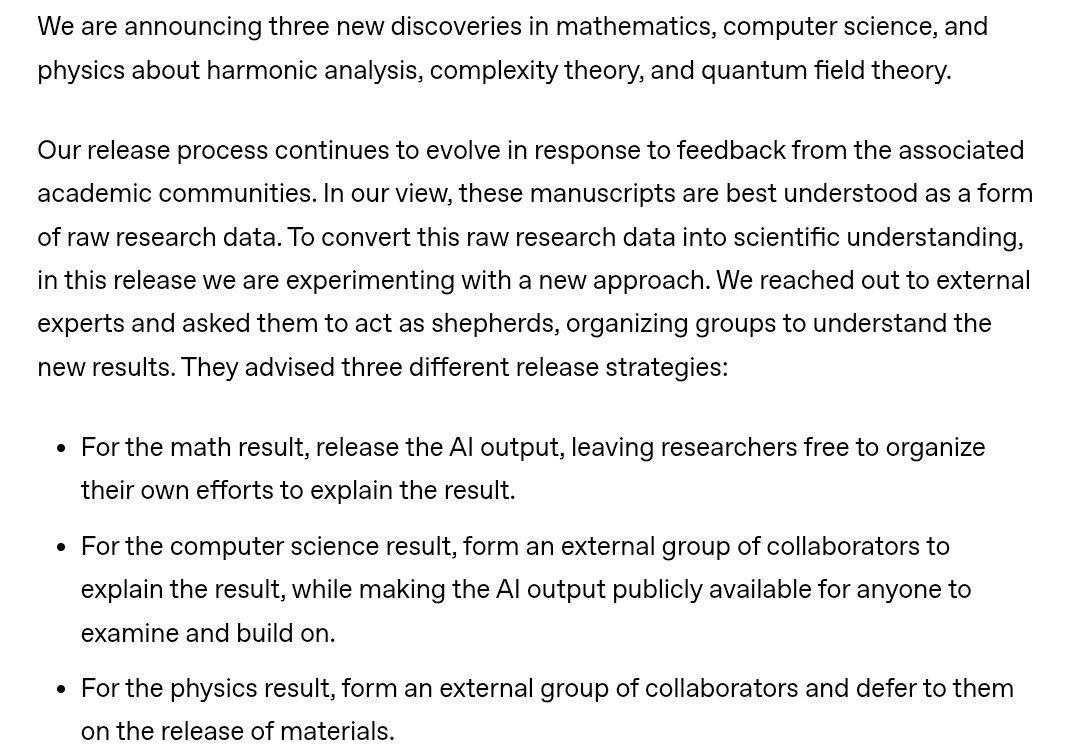
OpenAI has announced to three new discoveries in mathematics, computer science, and physics:
- Local smoothing and the Kakeya conjecture
- The Exponential Time Hypothesis is false
- Existence of quantum chromodynamics and completions of the Standard Model
Introducing Flint, @Recursive_SI’s first model: a fast local coding model built with our automated research system, the Eureka Machine.
• Best-in-class fast local coding
• Up to 2x faster than comparable models: 125+ tokens/sec on a MacBook Pro, 150+ on RTX Spark
• Built from scratch in under 4 months
Private, unmetered intelligence on your own machine. Open weights available now on @huggingface, run it locally on your favorite framework or try it for free on @opencode or @pidotdev.
Another banger from Alan again. Latent forcing was already super cool!
Always wondered if there was a more efficient way to approach tokenization, excited to see this direction be explored.
1/ The tokenizer is a new scaling axis!
We introduce an approach for diffusable representation learning that's principled, scalable, and works when DINO/LeJEPA collapse.
We get joint tokenizer+diffusion scaling laws and it's compute-optimal vs raw diffusion
w/ @drfeifei@GordonWetzstein@jcjohnss@ericryanchan@vincesitzmann@KyleSargentAI
Thread, Paper, and Blogpost below
While exploring diffusion language models (DLMs), we kept asking ourselves: given speculative decoding, a lossless acceleration technique, why do we still need DLMs? 🤔 Our latest work, ORL, tries to answer this question: AR optimizes intelligence 👆, speculative decoding optimizes speed 👉, and DLMs optimize the Pareto frontier of speed and intelligence 🚀. Through co-design across the algorithms, the training and inference engine, and the kernels, ORL pushes out a new Pareto frontier of intelligence and speed. Similar performance, much faster than speculative decoding. You say lossy spec? ORL-DLM is better too! 😎
🌐 Project + live demos: https://t.co/pi87MopVSc
[1/4] I’m pleased to share that the JaxAHT paper has finally been released, and the library has received a v1.1 update! I wish I had a tool like this in the beginning of my PhD.
What’s new 👇
Codebase: https://t.co/5UyOY4NUYV
Preprint: https://t.co/Bs5db0rMO7
@BetaTomorrow great post! There's so many cool challenges such as knowing what info is useful to sample/adapt, how we quantify what is better and w/ efficency (a powerful sim may approximate reality but doesn't matter if not slow and expensive), how deep an agent should investigate (RLM), etc