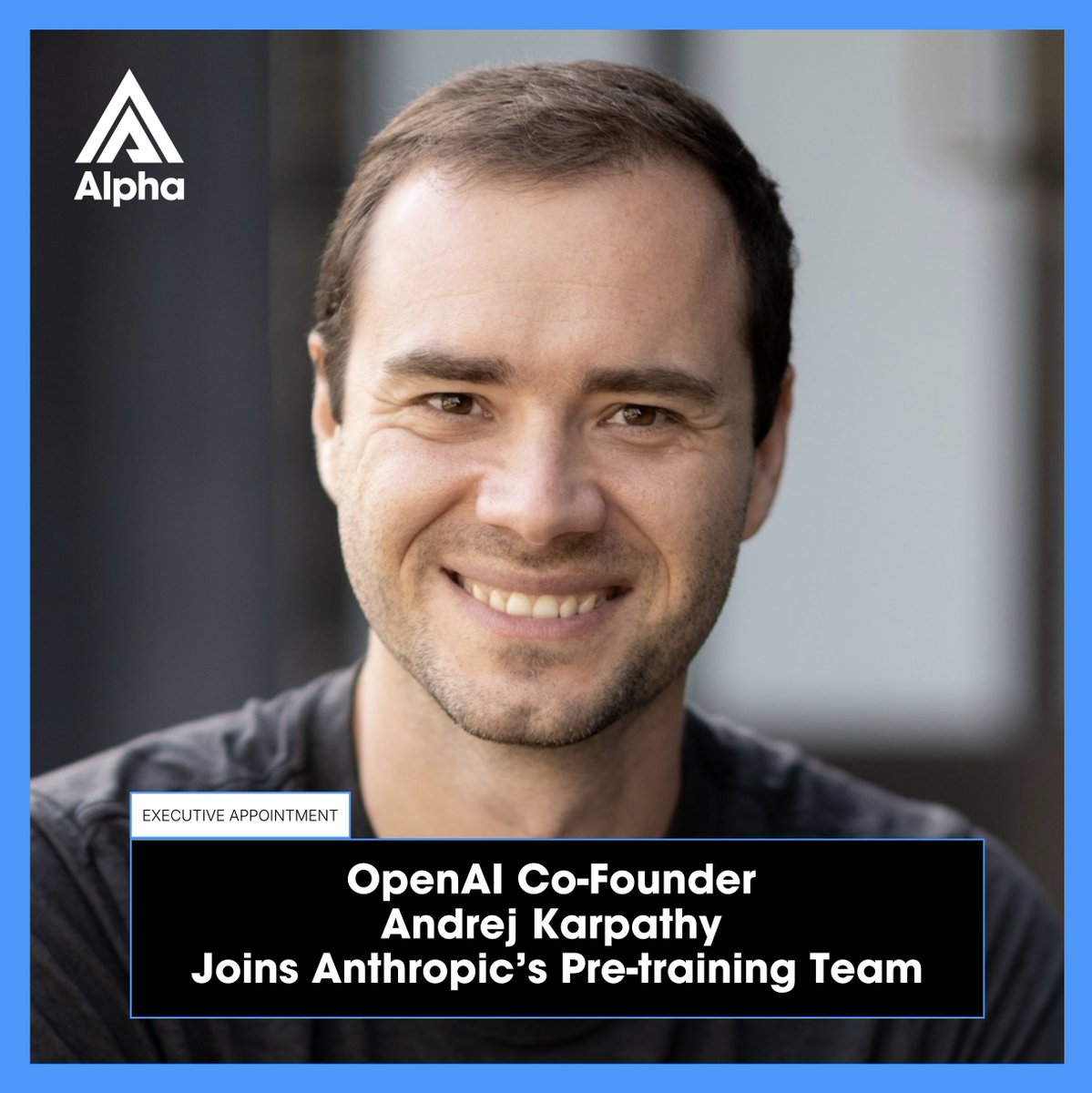
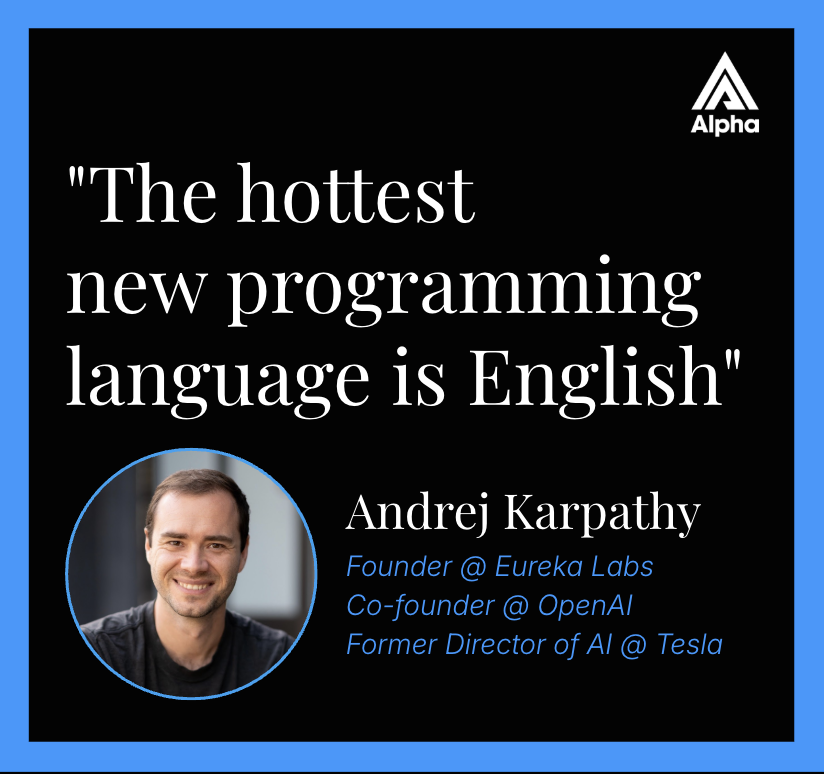
@karpathy, one of the most recognized names in AI research, has joined @AnthropicAI to work on pre-training under team lead @nickevanjoseph.
"I think the next few years at the frontier of LLMs will be especially formative," Karpathy posted on X. "I am very excited to join the team here and get back to R&D."
Karpathy will build a team focused on using @claudeai to accelerate pre-training research. That's a signal worth noting: Anthropic is betting that AI-assisted research, not just raw compute, is how it stays competitive with @OpenAI and @Google.
Few researchers bridge LLM theory and large-scale training practice the way Karpathy does. He co-founded OpenAI, led @Tesla's Full Self-Driving and Autopilot programs, and most recently started @EurekaLabsAI, an AI education venture. His YouTube lectures and Neural Networks: Zero to Hero course have trained a generation of AI practitioners.
Also worth watching: Anthropic simultaneously brought on Chris Rohlfs to its frontier red team, which stress-tests advanced models against severe threats. Rohlf spent six years at Meta and previously worked on Yahoo's legendary "Paranoids" security team.
Capability and safety hiring in parallel.
That's the pattern boards should look for in AI companies.
Congrats, Andrej!
#AI
#AIGovernance
#AgenticEnterprise
How well do the security community's techniques hold up against AI-enabled cyberattacks?
We examined 832 malicious accounts and mapped their activity onto a longstanding database of tactics and techniques used by threat actors.
Here's what we learned:https://t.co/fgOqJRh2rx
Most of the agentic enterprise conversation is about the machines. The people who have actually governed at scale know the harder problem is human.
@NickTzitzon has governed at scale from both sides of the table.
At the U.S. Department of Justice, he ran a $3 billion programs division. He served two U.S. Secretaries of Health and Human Services and two Massachusetts governors. Then he built a career in enterprise technology, rising to the Global Leadership Team at @SAP (NYSE: SAP) before becoming Vice Chairman of @ServiceNow (NYSE: NOW), where he advises Chairman and CEO @BillRMcDermott and leads the company's AI Institute.
That combination is rare. Most people who understand AI capability have never sat inside a government accountability structure. Most people who have governed public programs have never operated at the frontier of enterprise AI. Nick has done both.
We're proud to have Nick join us at the @Alpha_AIGov | @NYSE Summit on the Agentic Enterprise on June 12.
The question every board should be asking as agents move from pilot to production: are you governing the technology, or are you governing the organization the technology is reshaping? Nick is one of the few who can answer both.
https://t.co/BIQygX7XiF
#AIGovernance
#BoardLeadership
#AgenticEnterprise
This is wild.
OpenAI just dropped Codex Sites.
Now anyone can give it a plan, dashboard, launch doc or idea, and turn it into an interactive app with a URL.
5 wild examples:
Daily Brief is a new personalized digest that’s designed to be your first stop every morning.
It gathers info from your inbox, calendar, and tasks to prioritize, organize, and suggest the next steps for you in a super concise morning digest that's built for skimming. #GoogleIO
Just off stage at #GoogleIO, some highlights from this morning 🧵
Gemini 3.5 Flash is available today for everyone in @antigravity and across our products and APIs.
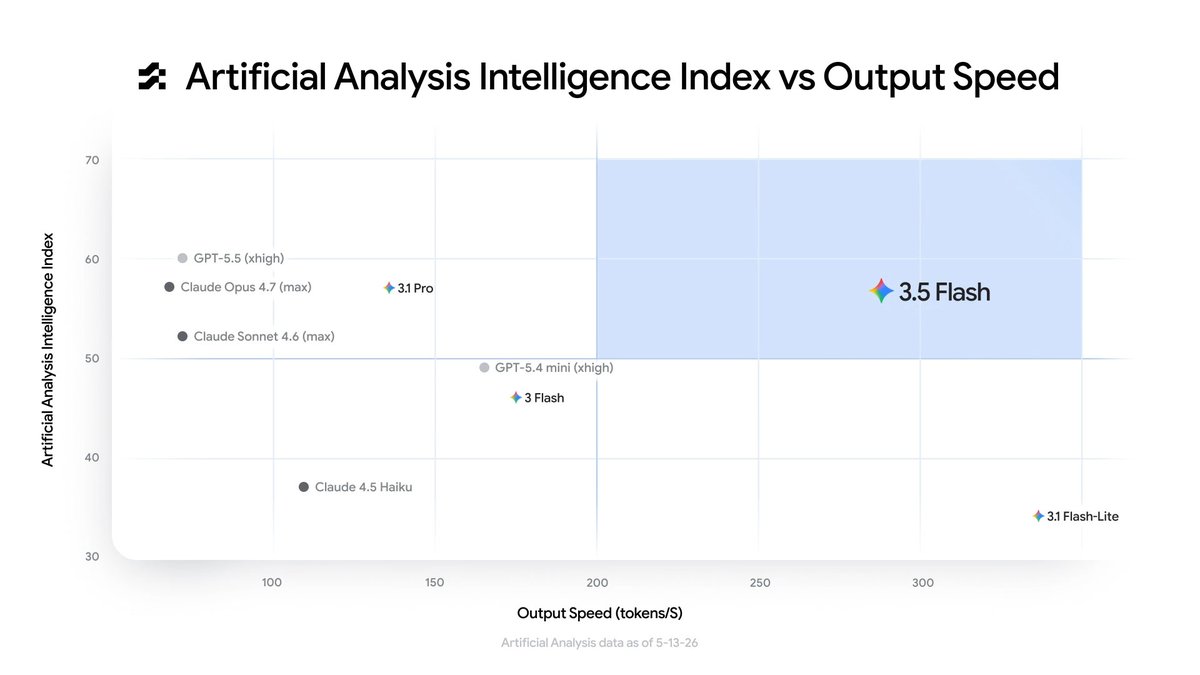
Compared to 3.1 Pro, 3.5 Flash is better across almost all benchmarks with huge progress in coding. It’s also comparable to the best models but very fast (4x faster tokens/ second than other frontier models). And when looking at the intelligence versus output speed, it’s in a league of its own in the top right quadrant.
Gemini Omni is coming to the Gemini app for paid subscribers today.
It lets you bring your ideas to life using any combination of text, images, and video inputs. Just open up Gemini, attach a video from your camera roll, and change it around. It’s that simple. #GoogleIO
Personal update: I've joined Anthropic. I think the next few years at the frontier of LLMs will be especially formative. I am very excited to join the team here and get back to R&D. I remain deeply passionate about education and plan to resume my work on it in time.
Who won the week in AI?
@GabeStengel
✅$160M new financing for @RogoAI led by @kleinerperkins, with participation from @sequoia, @ThriveCapital, @jpmorgan, and @khoslaventures.
✅ Launched Felix (https://t.co/xPBvZR5xPd), a purpose-built agent for high finance, designed for long, complex workflows, capable of producing complete decks, models, and documents.
✅ Rogo is now deployed across many of the world's top investment banks, asset managers and PE firms, used by 35,000+ financial professionals and 250+ institutions.
✅ It's expanding into EMEA and Asia with forward-deployed bankers and engineers embedded inside customer firms.
In a market built on demos and decks, the founders who win are the ones who understand the domain, identify the customer pain and own the workflow.
Who won the week in AI?
@Garrytan.
✅ GStack: 83K+ GitHub stars.
✅A @demishassabis interview on GBrain
✅ YC Startup School class on GStack.
✅ And a very YC reminder on revenue:
• Pilot ≠ booking
• Booking ≠ revenue
• Revenue ≠ recurring revenue
In a market built on demos and decks, the leaders who win are the ones who refuse to confuse motion with progress.
@gdb wrote something this week that everyone should read, not for what it says about @OpenAI per se, but for what it implies about fiduciary duty.
His core claim: the amount of compute you have access to will determine the rate, scale, and sophistication of problems you can solve.
Intent becomes output. Friction disappears. Small teams do what large ones once required.
He's describing a capability curve.
What he's not describing, because that's not his job, is the governance gap running alongside it.
When the machine does the work, who authorized the delegation?
When a small team builds what used to require a large one, which committee reviewed the risk framework those two people skipped?
When "nearly a billion people" use these systems every week in work contexts, which of those deployments went through a procurement review, a bias audit, or a vendor concentration assessment?
Greg's right that this is the most empowering shift in how people work in a generation. The joy he describes is real. I feel it too.
But "empowering for everyone" requires something boards haven't built yet.
Governance Debt compounds quietly while capability velocity accelerates loudly. The gap between those two lines is the largest unaddressed risk on most boardroom agendas right now.
Which committee at your company owns the question Greg just raised?
#AIGovernance
#BoardLeadership
#FiduciaryDuty
https://t.co/oxH4Mhdw9s
The world is transitioning to a compute-powered economy.
The field of software engineering is currently undergoing a renaissance, with AI having dramatically sped up software engineering even over just the past six months. AI is now on track to bring this same transformation to every other kind of work that people do with a computer.
Using a computer has always been about contorting yourself to the machine. You take a goal and break it down into smaller goals. You translate intent into instructions. We are moving into a world where you no longer have to micromanage the computer. More and more, it adapts to what you want. Rather doing work with a computer, the computer does work for you. The rate, scale, and sophistication of problem solving it will do for you will be bound by the amount of compute you have access to.
Friction is starting to disappear. You can try ideas faster. You can build things you would not have attempted before. Small teams can do what used to require much larger ones, and larger ones may be capable of unprecedented feats. More and more, people can turn intent into software, spreadsheets, presentations, workflows, science, and companies.
People are spending less energy managing the tool and more energy focusing on what they are actually trying to create. That shift brings a kind of joy back into work that many people haven’t felt in a long time. Everyone can just build things with these tools.
This is disruptive. Institutions will change, and the paths and jobs that people assumed were stable may not hold. We don’t know exactly how it will play out and we need to take mitigating downsides very seriously, as well as figuring out how to support each other as a society and world through this time. But there is something very freeing about this moment. For the first time, far more people can become who they want to become, with fewer barriers between an idea and a reality. OpenAI’s mission implies making sure that, as the tools do more, humans are the ones who set their intent and that the benefits are broadly distributed, rather than empowering just one or a small set of people.
We're already seeing this in practice with ChatGPT and Codex. Nearly a billion people are using these systems every week in their personal and work lives. Token usage is growing quickly on many use-cases, as the surface of ways people are getting value from these models keeps expanding.
Ten years ago, when we started OpenAI, we thought this moment might be possible. It’s happening on the earlier side, and happening in a much more interesting and empowering way for everyone than we’d anticipated (for example, we are seeing an emerging wave of entrepreneurship that we hadn’t previously been anticipating). And at the same time, we are still so early, and there is so much for everyone to define about how these systems get deployed and used in the world.
The next phase will be defined by systems that can do more — reason better, use tools better, plan over longer horizons, and take more useful actions on your behalf. And there are horizons beyond, as AI starts to accelerate science and technology development, which have the potential to truly lift up quality of life for everyone. All of this is starting to happen, in small ways and large, today, and everyone can participate. I feel this shift in my own work every day, and see a roadmap to much more useful and beneficial systems. These systems can truly benefit all of humanity.
Today, we're taking Manus out of the cloud and putting it on your desktop.
Introducing My Computer, the core feature of the new Manus Desktop app. It’s your AI agent, now on your local machine.
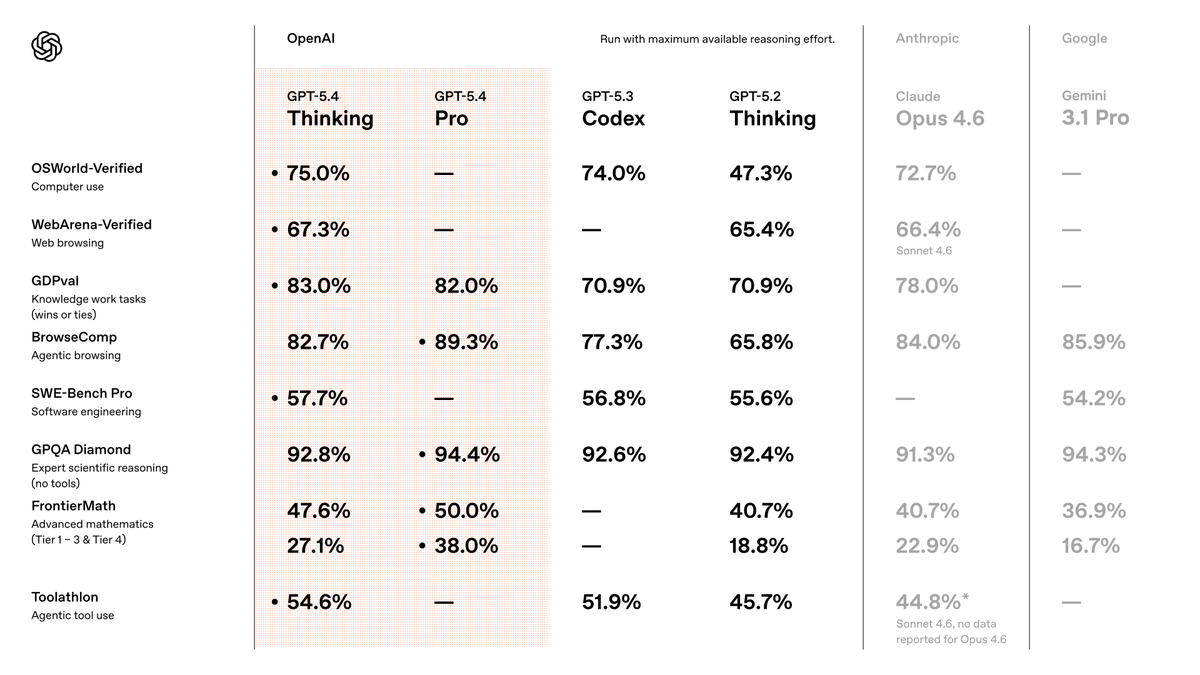
@OpenAI just raised the stakes by releasing GPT-5.4 today.
And while the tech benchmarks are impressive, what matters to board directors and executives is simpler: AI just got dramatically more capable at the exact tasks your employees do every day.
83% win rate against industry professionals on real knowledge work. Legal analysis. Financial modeling. Spreadsheets. Presentations. Documents.
This is not a research demo. This is your workforce.
Three questions your board should be asking right now:
1. Does our AI policy cover agentic systems? GPT-5.4 can now operate computers, navigate software, and execute multi-step workflows autonomously. Most governance frameworks weren't written for AI that acts, not just advises.
2. Who owns the risk when AI completes the task? Computer use capabilities mean AI is no longer just a tool. It's a decision-maker. Your Audit and Risk Committees need clear accountability mapping before deployment scales.
3. Are we governing velocity or just monitoring it? AI development cycles are 4-6 weeks. Board cycles are quarterly. That gap is your governance debt.
The companies that treat this as a technology update will fall behind.
The ones that treat it as a governance moment will pull ahead.
Governance is the accelerant. Not the brake.
What is your board doing differently in Q2?
#Alpha
#AIGovernance
#BoardLeadership
#CorporateGovernance
https://t.co/yr42d5FoAf
Every technology gets a honeymoon. AI's ended in 2025.
Every company is investing in AI. Few have established AI governance frameworks.
This is the largest governance failure in modern corporate history.
And 2026 is when consequences arrive.
After hundreds of conversations with board directors, C-suite executives, and AI founders this year, I've compiled 12 predictions:
The Money Shots (where value accelerates)
📉 1. The Great Token Deflation
🤖 2. The Rise of the Agent Economy
📊 3. The AI Productivity Gap Widens
🚔 4. Wall Street Becomes the "AI Police"
The Reality Check (where assumptions break)
🧾 5. The AI ROI Reckoning
🔒 6. AI Vendor Lock-In Becomes Real
👥 7. The End of the 100% Human Workforce
💔 8. The Decoupling of Labor & Capital
The Backlash (where consequences compound)
🤬 9. The AI-Lash Is Coming
⚠️ 10. The Compliance Collision
💣 11. The AI "Enron" Moment
🚪 12. Shareholder Activists at the Gate
"We're learning" is no longer an acceptable answer.
Which side of the AI governance divide will you be on?
Read the latest article by our CEO @wolfepereira in @Forbes: https://t.co/Y3uraJQuYd
#AI
#AIGovernance
#BoardDirectors
#2026Predictions
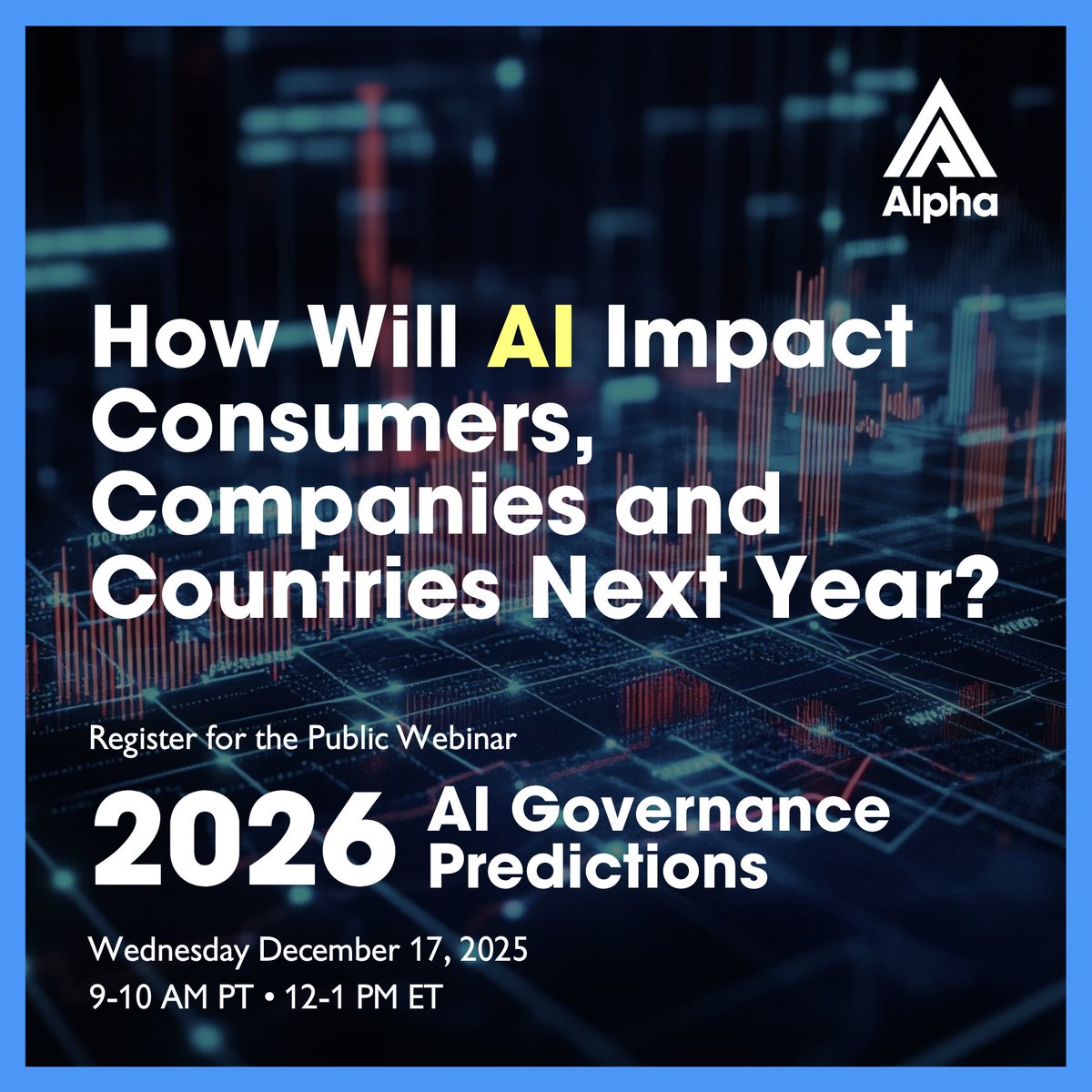
How Will AI Impact Consumers, Companies, and Countries in 2026?
AI personalization has become table stakes.
AI agents will anticipate needs before you articulate them.
Companies won't just automate tasks. They'll redesign how work happens.
Countries won't just compete on innovation. They'll compete on regulation.
The bottom line: 2026 is when governance separates winners from laggards.
Move fast, but ungoverned speed creates existential risk.
Do you have the frameworks to match the technology's velocity?
Tune in to our webinar tomorrow to share our 2026 predictions on AI governance.
Register here: https://t.co/uAGNgVcJK1
#AI
#AIGovernance
#BoardDirectors