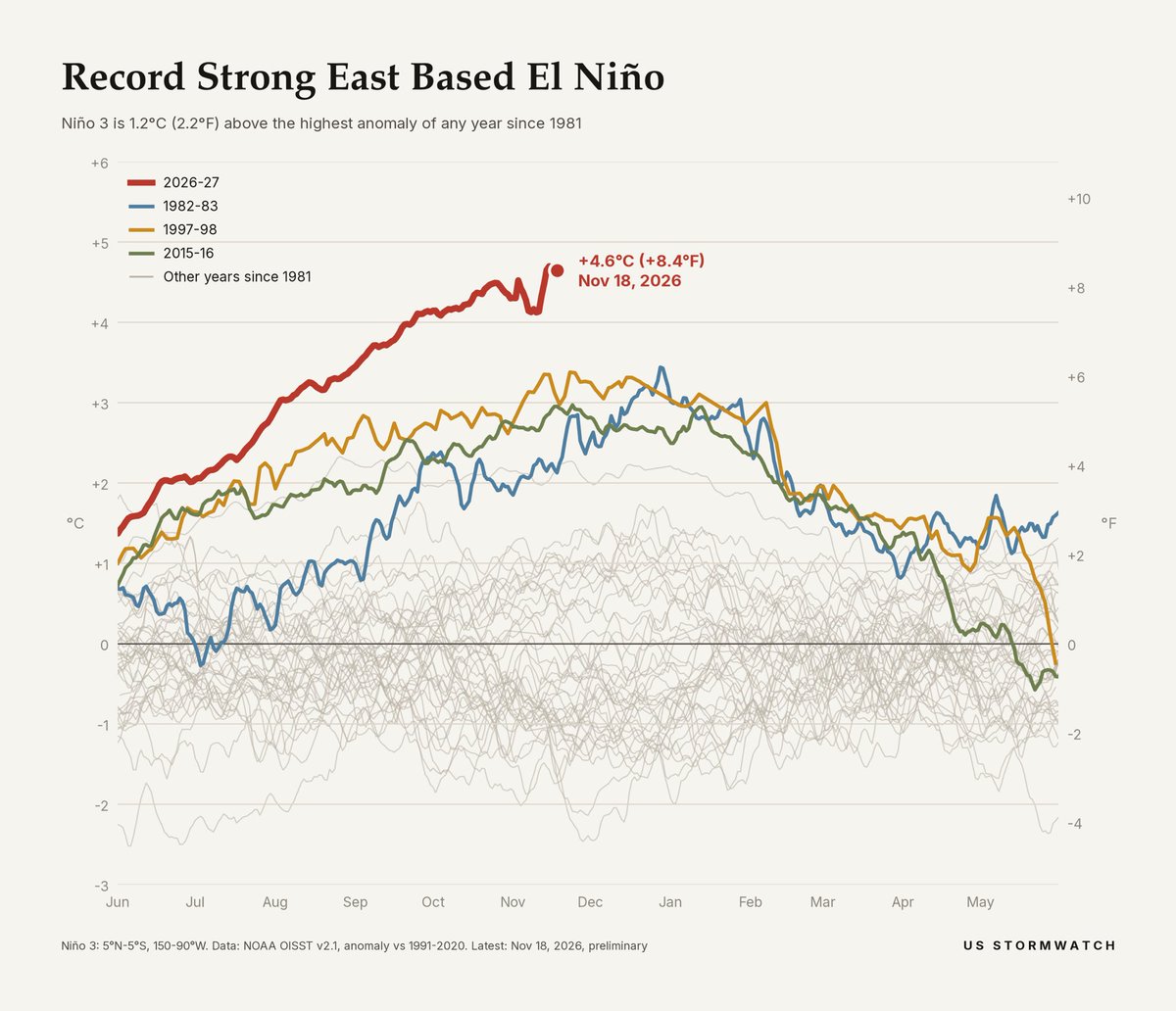
This El Niño is incredibly east based.
It's likely that the classic Niño 3.4 region, where we measure the strength of El Niños, is not capturing the full strength of this event.
The Niño 3 anomaly is an incredible 1.2°C above any previous year on record.
The 3.4 region is likely too far west to capture the most anomalous sea surface temperatures, which are farther east toward South America.
The 2026 El Niño is in a league of its own.
Conserving 30% of the planet by 2030 won't halt #biodiversity loss if nature declines across the other 70%.
Farms and forests beyond protected areas need restoration, sustainable management and secure community rights.
#Landscapes4Life
https://t.co/YAeg0tQMq5
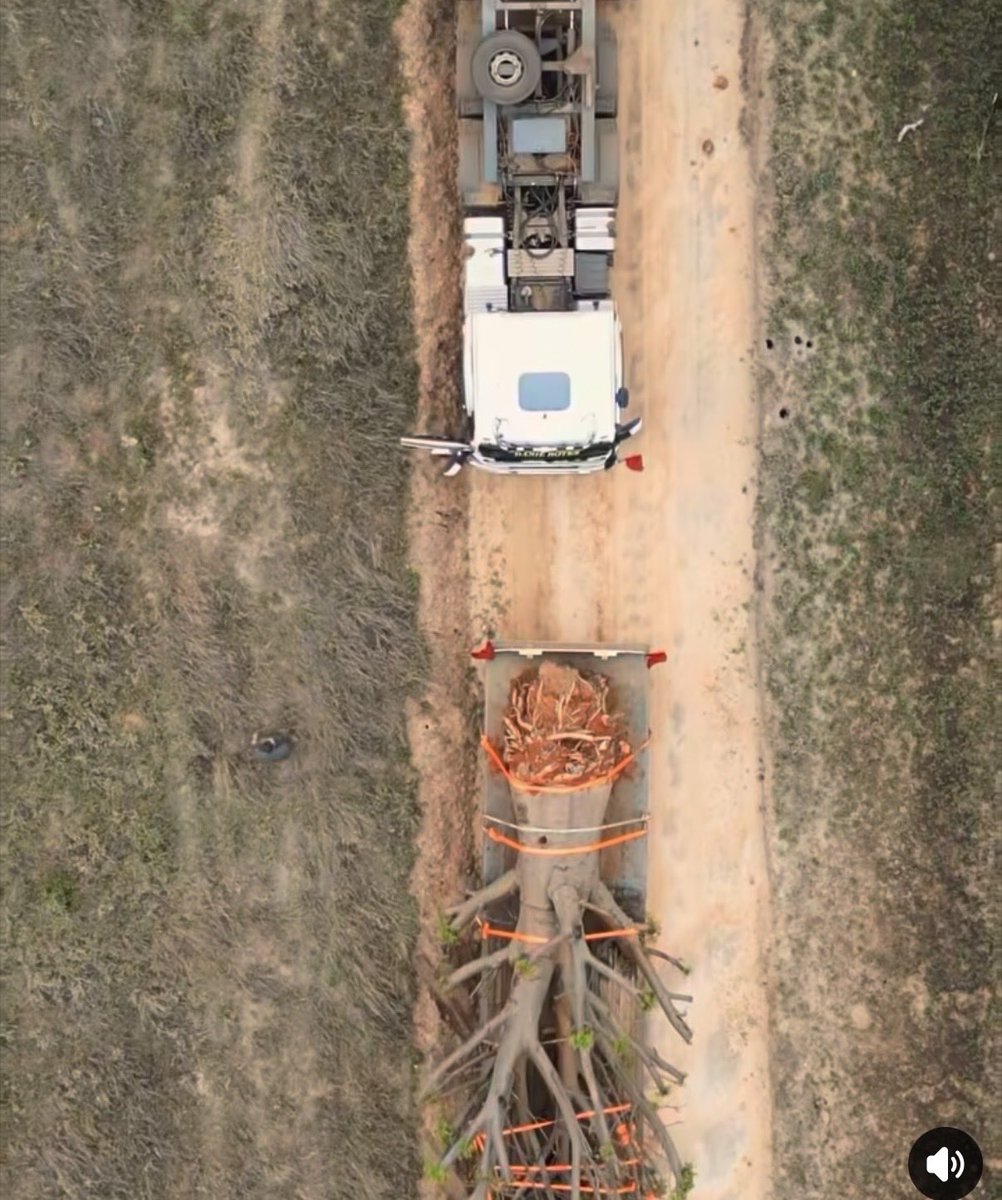
Transportation of the five baobab trees rescued in KwaZulu-Natal after being illegally harvested in Lephalale, Limpopo, is underway. The trees will be replanted at the Timbavati Nature Reserve in Limpopo. They were seized after officials from the Department of Forestry, Fisheries and the Environment (DFFE) traced them to the premises of a private freight company situated in the eThekwini Metropolitan Municipality. A criminal case has been opened against the owner of the landscaping company allegedly responsible for the illegal harvesting and transportation of these trees for contravention of the National Forests Act, 1998. (Pics: Timbavati Nature Reserve).
This red-tailed hawk flew right into a window, and it’s easy to see why. The building is covered in mirrors. Even humans find this style of architecture inherently confusing, but we at least understand that the mirrors are hard surfaces and the reflections aren’t real. Birds don’t have that understanding.
When she arrived at the clinic, she was severely depressed and bleeding from her mouth. We provided supportive care, along with treatment for potential anticoagulant rodenticide poisoning. She’s on her feet and doing much better after several days in care, and she’ll be leaving today with a Cooper’s hawk (also a window-collision victim) to finish the rest of her rehabilitation with our friends at The Raptor Trust.
📷: Stephanie Wood
Renewables, led by solar PV, and nuclear are set to benefit most from a shift to domestic energy due to energy security concerns – growing robustly in all #WEO26 pathways.
Use of domestic fossil fuels could rise too – notably coal in some Asian markets 👉 https://t.co/bjcDrCOOtb
African ministers have mounted a united call for developed countries to honour their climate finance commitments, warning that failure to deliver promised resources will undermine the implementation of the Paris Agreement and deepen the vulnerability of millions of people across the continent.Check Forecasts
At a press conference in Antalya, Türkiye, on the final day of the UN Climate Change Conference (COP31), ministers from Ghana, Kenya, Zambia, Senegal and Sierra Leone said Africa would not accept another climate outcome built on declarations without adequate financial support. https://t.co/83z81sTklY via EnviroNews
Lyon just opened a block of flats that doesn't need heating or air con
It's called "22-26", after the temperature it's meant to stay at all year. The Austrian architects behind it have already built these in Switzerland and Germany, but this is the first one in France
> walls 61 cm (2 ft) thick, twice the French average
> hollow terracotta brick that soaks up heat and lets it out slowly
> deep window recesses that shade the windows from direct sun
> little flaps by the windows that open and close on their own
> and the heating is you: bodies, cooking, showers, the fridge
It basically works like a thermos
Every flat still has backup heaters just in case, and on the worst days of a long heatwave it can still reach 28°C (82°F) inside, when it can be 40°C (104°F) outside
Over 5,700 people in France died from the heat in summer 2025, most of them over 75. So buildings like this are potentially a good answer to surviving European summers, now that heatwaves are becoming the norm
Look at a global map of deforestation, and you’ll notice a clear pattern. Most deforestation today is happening in the tropics, while much of the temperate world is gaining forest.
But it would be wrong to think that consumers in temperate countries don’t contribute to deforestation at all. They do, through the products they import from other parts of the world.
To understand the scale and sources of deforestation driven by traded foods, we’ve built a visualization that maps flows of deforestation risk from food trade. It maps deforestation flows from the country of origin — where it’s happening — to where the products grown are consumed.
We see a range of patterns across the world. In Brazil, for example, most deforestation occurs to meet domestic demand. Many high-income countries have very low domestic deforestation, but contribute far more through the goods they import.
You can explore this data for most countries and see how this traded deforestation has changed over the last two decades.
(This visualization was created by @_HannahRitchie, Pablo Rosado, and @MarcelGerber9.)
$29.5 trillion: the value of Africa's minerals in the ground.
What we rarely count is what stays at home after the ship leaves, the jobs per million dollars, and the other bills, the river, the land, the clinic.
Until those are counted, every deal is negotiated blind.
At United Nations University- INRA, this is what our research focuses on. This is what we have started doing.
My grandmother never judged a harvest by the field. She judged it by what stayed in the barn after the buyers left.
Africa is not poor. Africa is uncounted.
COP31 ends today. But where is the money?
A proposed $120 billion adaptation-finance target has disappeared from the latest draft.
For Uganda, climate justice must mean more than promises.
Will the final deal deliver for communities facing floods and droughts?
#COP31 #ClimateFinance #Uganda
تقييم ابتكارات المياه يجمع بين فهم العلم والتقنية، واستشراف إمكانات الحلول وأثرها.
تضم منظومة التحكيم في #جائزة_الابتكار_العالمية_في_المياه 2026 خبرات دولية متنوعة، تجمع المعرفة العلمية والفنية بخبرات الأعمال والاستثمار؛ لتقييم الابتكارات من جوانب متعددة، ودعم اختيار حلول تخدم مستقبل المياه.
#GPIW2026
Judging a water innovation takes more than technical understanding. It takes a sense of what a solution could become.
The judging system of the #Global_Prize_for_Innovation_in_Water 2026 draws on diverse international expertise, pairing scientific and technical knowledge with business and investment experience to assess innovations from several angles and help select solutions that serve the future of water.
#GPIW2026
@IEA In the Age of Electricity, renewables, led by solar PV, and nuclear are set to benefit most from a shift to domestic energy due to energy security concerns. They grow robustly in all scenarios.
Use of domestic fossil fuels could rise too – notably coal in some Asian markets.
This is a crazy dereliction of duty by governments. Heads in sand. Allowing the deaths and disasters to continue and to grow.
#COP31 https://t.co/zFYJ8v6HgT
As #COP31 enters its final days, what’s top of mind for decision-makers?
WRI President & CEO @AniDasguptaWRI shares the three concerns he’s hearing most from country and team leaders:
1️⃣ Energy security
2️⃣ Growing economies while protecting nature
3️⃣ The economic toll of climate disasters
More from COP31: https://t.co/EmYLdbBykO
@CarbonBrief Pledges matter when they reach financial close. The USD 1bn JBIC financing for electrification at Ruwais LNG shows what that conversion looks like. I hope the UK pairs its signature with bankable pipelines.
@H20EU@UNWaterConfUAE Good to see Water Europe heading to Abu Dhabi. I'll be following the Investments for Water track: over 90% of global water investment is still publicly financed, a ratio that has not closed the gap in thirty years.
@PowerShftAfrica 21 unresolved items with one day left. Pledges in plenary rarely become disbursed capital. Over 90 per cent of water investment is publicly financed, a ratio that has not closed the gap in thirty years. First-loss tranches pull private capital in.