Hey, it's me, again. I want to zoom out on BAAJA for a second, because it’s easy to get lost in the weeds & debates about edge cases. I care *a lot* about this bill. Wanted to remind myself why.
The status quo is *terrible* for both climate and affordability. We built 888 miles of high-voltage transmission in 2024; we need 5,000 a year. More clean capacity is waiting in interconnection queues than the entire existing grid. Residential power prices are up about a third since 2019. Demand is surging, and bc clean power can’t connect, we're building a bunch of gas. If this current trend continues, gas could supply half of US power by 2040. The administration is using permitting as a weapon to stop wind and solar projects, including ones already approved. And local restrictions on wind and solar now cover twice as much of the country as in 2022.
I worked in the White House when we passed the IRA. As @BrianCDeese noted, if we had a bill like this in place first, it would have been game-changing. We invested hundreds of billions to put clean energy on sale, then watched projects get stuck in interconnection queues, permitting delays, and fights over who pays for transmission. The money was not the binding constraint; the ability to build was. Let’s not make the next Democratic administration learn that lesson twice!
It's easy to oppose stuff. But BAAJA is a *really, really big deal.* This is the first real federal framework to plan, pay for, and permit big power lines: mandatory planning between regions, clear rules on who pays (based on who benefits), and federal backstop siting that actually works across most of the country. It also ends incumbent utilities’ automatic right to build every new regional line. It will also help actually get projects online, by requiring grid planning and interconnection be done together, and stopping speculative projects clogging the queue. It should protect from political sabotage. Approved projects can’t be yanked for political reasons, and developers can sue if an administration targets a technology like wind for unfair treatment. It's the strongest data center accountability legislation in the country to ensure they pay *more* than the costs they cause and that households don’t foot the bill for AI’s grid upgrades.
This is the most important thing Congress can do for clean energy and affordability right now. We can fight about the emissions and affordability modeling about this narrow bill. But the truth is that this is the necessary but insufficient foundation *every future climate and affordability policy will be built on.*
Against my better judgment, I’m weighing in here, on the dumbest policy discussion platform in the world, to talk about permitting reform. As background, I was Chief of Staff and Deputy Chief of Staff at the Energy Department in the Obama Administration; I worked for seven years in the Senate Democratic Leader’s Office; and I served as Chief of Staff in the House. I co-founded the largest energy transition advisory and advocacy firm in the United States 13 years ago. I have worked directly or indirectly on nearly every major piece of energy and climate legislation in the past two decades, as well as many other pieces of legislation outside of energy. I’ve also worked as a political researcher for multiple campaigns and the DSCC, where I cataloged politicians’ and candidates’ votes and positions. Today, I spend nearly all of my time talking to policymakers, clean energy companies, advocates, and journalists on energy and climate issues.
The idea that there will be anywhere near 60 votes in the Senate for a clean-energy-only bill in January is not based in reality. I have no idea where this idea came from, but it ignores mountains of evidence and seems to underpin the arguments of everyone on here saying we’re somehow going to get a bill that excludes oil and gas if we wait.
First, and very obviously, every candidate in 2026 ran on reducing gasoline and electricity prices for consumers. One post-election analysis found that only six victorious Democrats used the word “climate” in their election night statements, while 166 discussed affordability. I couldn't find a single Senate candidate who flipped a seat who mentioned it. Voters sent a clear mandate to focus on affordability, and they are rightly irate that Washington has pushed ideological issues favored by special interest groups ahead of the issues they care most about. After getting trounced in 2024 for ignoring inflation, Democrats won by promising to focus on those issues.
Second, very few Democrats in the Senate support anything remotely close to a keep-it-in-the-ground agenda. Next Congress, 19 members of the Democratic caucus who voted for cloture on the motion to proceed on this version of the permitting bill will return. They’ll be joined by James Talarico, who has endorsed all-of-the-above and vowed to protect oil and gas jobs. Mary Peltola has explicitly called for more oil and gas development. Scott Colom supports natural gas. Both Adam Hamilton and Annie Andrews endorsed an “all of the above” strategy, which includes oil and gas.
They will join the 14 members of next year’s caucus who declined to strip the natural gas-carrying Mountain Valley Pipeline from the 2023 debt limit bill. Senator Kaine offered an amendment to remove the provision expediting the pipeline’s completion. Senators Bennet, Brown, Coons, Fetterman, Hassan, Hickenlooper, Kelly, King, Murray, Ossoff, Padilla, Reed, Schatz, and Schumer voted against that amendment. The year before, 27 members of next year’s caucus voted to advance Senator Manchin’s permitting amendment, which would have completed MVP.
Both Bennet and Warner voted to approve the Keystone XL pipeline. Senators King, Murphy, and Blumenthal all urged FERC to expedite the Algonquin pipeline expansion. Fetterman, Kaine, and Hickenlooper have all supported LNG exports (as did the Obama Administration). Senator Gallego released an energy plan last December that called for clear timelines for oil and gas pipeline permitting. Roy Cooper’s administration approved the Atlantic Coast Pipeline’s water permit in 2018 when he was North Carolina’s governor. Mary Peltola has introduced legislation to open ANWR and NPR-A to drilling.
Next year, the caucus will contain only 14 senators who co-sponsored the Senate Green New Deal resolution. Three of them voted for cloture this week, including Senator Heinrich, who is leading the charge on permitting. That’s 10 Democrats out of 56 who supported the GND and opposed cloture on permitting.
This does not mean that a majority of the Democratic caucus will push for new oil and gas infrastructure. But much of the commentary here implies that Democrats will only support renewables and Republicans will only support oil and gas infrastructure. The record doesn't support that idea.
This, of course, doesn’t even get to the fact that we will need more than a few Senate Republicans to support a permitting package in the next Congress. Getting those Senators will require compromises that will likely push some Democrats to vote no. So you’ll very likely need more than four. A bill that gets Fetterman, Murkowski, and Curtis could easily lose Sanders, Warren, Markey, and Merkley. So then you’d need more GOP votes. This is how legislation works. The IRA was the exception, not the rule, and it nearly died before it passed. It was that hard to get Manchin and Sanders on the same page, and it didn't need a single GOP vote. Many of the groups opposing permitting didn’t like the IRA. And, of course, a bill that doesn’t get signed by the President is about as useful as any tweet on this hellscape of a website.
There seems to be a very real disagreement about what would make this bill “better.” There is no “clean energy only” version of the bill that can pass the next Congress. NEPA and the NHPA are, at best, fundamentally outdated at a time when we need to build as much clean energy infrastructure as possible, as quickly as possible. Those who argue that these two statutes are the only way to achieve meaningful engagement with the sovereign tribes and frontline communities lack imagination. Remember that under both NEPA and NHPA, Dakota Access got built - adjacent to tribal land and under the Missouri River. Acting as if these laws, written long before climate change was a known crisis, are sacred and should not be touched ignores their reality. Saying that the nation-to-nation relationship between sovereign tribes and the federal government is only a function of “historic preservation” is quite insulting to tribes. Since NEPA and the NHPA were signed into law, more than 250,000 miles of pipelines have been built in the United States. NEPA is actually a pretty poor tool for killing infrastructure. It is, however, great for lawyers.
And finally, the policy window is open now. There is no guarantee it will remain open indefinitely. In 2009, with overwhelming Democratic majorities, we got eight Republicans to vote for cap-and-trade legislation in the House. It passed by seven votes after 44(!) Democrats voted against it, and it died in the Senate without a floor vote. It took us 13 years to get another big climate vote via the IRA (which was, again, not good enough for some of the activists). There is no guarantee oil stays below $100/barrel or that the economy doesn’t slip into a recession or the wars in Iran and Ukraine stay confined to those countries. Macro events could create even more pressure for policies that support oil and gas or crush the appetite for a debate on permitting.
I’ve worked on nuclear, solar, wind, electric vehicles, transmission, energy storage, and just about every other form of clean energy technology. I haven’t lobbied on behalf of any of the oil and gas bills I cited above, nor have I lobbied for oil or gas companies. I’ve worked with many of the NGOs supporting this bill, and many of the NGOs opposed to it. I’ve spent many decades working on policy, building coalitions, and trying to instill a sense of urgency on climate policy. Reasonable people can oppose this bill for many reasons. But don’t delude yourself into thinking there are 56 votes against fossil fuel infrastructure, or that there is a viable path to a permitting deal that will keep oil and gas in the ground in the next few years. Any permitting bill will need to be bipartisan, and once policy windows close, there is no guarantee they will open again soon.
In short, no legislation is perfect. This bill is very clearly a net-positive for the climate. We cannot solve climate change without policy changes that lower emissions. The status quo is not good enough. There is an opportunity to move the needle today, and we should take it.
I look forward to all of the thoughtful, constructive comments on this post, which will once again prove that this is the best place on earth for substantive policy discussion. I will take suggestions to delete my account in good faith, and I recommend that anyone serious about policy do the same.
In a recent report, the @NRDC underscored the urgency of advancing both deep emissions reductions and carbon removal to stabilize the climate, highlighting the importance of scaling carbon removal responsibly and sustainably.
“Successful carbon removal deployment will require high standards, strong environmental stewardship, and collaboration across sectors. We are glad to see NRDC advance this important conversation,” said @AndrewFishbein Lead Government Affairs North America at Climeworks.
Read more about this on: https://t.co/rUdqoQNFPN
#Climeworks #CarbonRemoval #CDR #DirectAirCapture #DAC #ClimateAction
As a fan of @propublica, it's disappointing to see them put out inaccurate and misleading content on carbon capture
Although seeing this is a partnership with Drilled Media, it makes sense, as they are a long-time purveyor of false information on CCS
Let's look at it👇👇 🧵🧵
Full launch on a new Dashboard
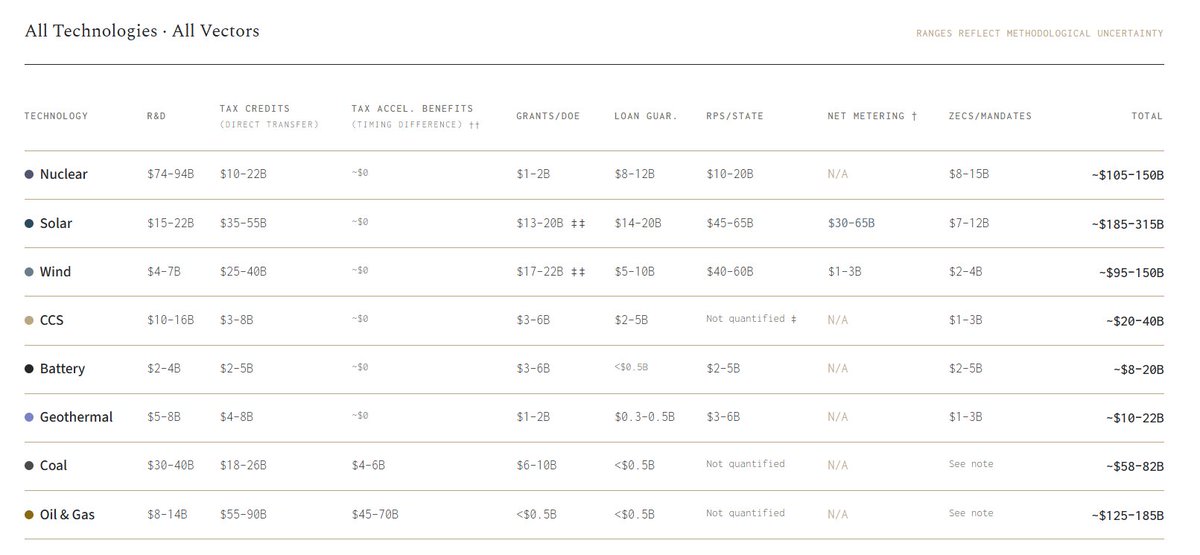
Fifty years of public funding across 8 major energy sources
Lots of context and caveats all laid out in the link in my bio but a few key points below🧵
https://t.co/tnFOWiR4ST
Super impressed and proud of @AndreasenJack for aptly explaining the massive carbon management opportunity for America in the US Senate @EPWGOP hearing today.
Disappointing outcome and a missed opportunity... blaming House Rs for tanking it misses the broader point that a bunch of groups spent months erroneously calling the permitting proposal a fossil fuel giveaway.
Lessons learned the hard way on this one.
The evidence just keeps stacking up the DAC is taking community engagement seriously and the.m communities are responding
This time @Climeworks
https://t.co/VgTfMQEOs2
The @DACCoalition is grateful to California's @AirResources for their leadership in creating pathways for Direct Air Capture technology through a world-leading lower carbon fuel standard. Next stop, net zero! @mslianeran@CARB_EO@CAgovernor@GavinNewsom
https://t.co/LnLLIrFVBJ
Direct Air Capture needs demand to scale. A few buyers and 45Q isn't an industry, it's an infancy.
To that end, @Energy is asking for information on how to help scale DAC, both demand, and otherwise
You've got until Dec 17th! My thoughts below
https://t.co/P2QyPyT7bC
We're proud to partner with @MorganStanley!
We'll permanently remove 40,000 tons of CO₂ from the air on behalf of the financial institution through 2037, which marks our second-largest contract to date.
Learn more: https://t.co/QDrBSHqaH7
Care about real action to fight climate change and frustrated by lack of progress? Read this important thread by @JaneAFlegal to understand why invectives against permitting reform are counterproductive
1/ Okay, it's time to weigh in on the permitting discussion. The letter from 118 climate scientists opposing the bipartisan EPRA bill is really upsetting and full of misinformation: https://t.co/bUxQ9ZZwbp
This is an interesting article that provides some greater context on the LNG expansion debate
But it provides very little substance on carbon capture, even though, strangely enough, it's in the URL
Let's look!���
https://t.co/GFahdFbjDI
A recent report from IEEFA on the Sleipner and Snøhvit CO2 storage fields left much to be desired from a technical and rhetorical stand-point, it's a long one I'm sorry 👇here we go:
https://t.co/4TTNasmOpj
Carbon dioxide removal (CDR) gets more interesting by the day, and 2023 has been a banner of a year. Why so much money and attention? Why so much hate and ridicule? How to make sense of this?
Let’s unpack: The action, love, hate, hard topics, ambivalence, leadership, future. /1