Anthropic engineer:
"You don't need better prompts. You need graph engineering that makes agents remember everything."
In 25 minutes he shows how engineers at Anthropic wire agents into a graph where each has a job, they run in parallel, verify each other, and share a memory that never resets.
This beats any paid course on building agents I've seen.
Watch it, then read the full guide on graph engineering below.
What if you could take three completely different model families… and distill them into one tiny model? 🤯
📜 Paper: https://t.co/K2iKD4xFvp
MOPD (Multi-Teacher On-Policy Distillation) has become a standard procedure in post-training. We already distill multiple specialized variants of the same model into a single set of weights.
But what if we could go further - and distill models from entirely different families? Turns out, it is possible.
Today we’re releasing a paper on cross-tokenizer distillation - our first steps in this exciting direction. 📄
We distilled Qwen3-4B, Phi-4-Mini, and Llama-3B into Llama-3.2-1B.
MMLU jumped from 32.05 → 46.32 when using multiple teachers. 📈
The team is now working on Nemo-RL integration so the community can try this method in their own settings. Plus, we are scaling experiments up. 🚀
@Rakeshk26910788@eyeofdevil4@amitkilhor@Iyervval Koi kisi se beekh ni mang ra h; I hope students move to different school after this.. uske baad school managemt admissions ki beek mangega.. like the negative PR that galgotiya got. Matter viral ho gaya, madam ki bari h beekh me apologies mangne ki.
@Rakeshk26910788@amitkilhor@Iyervval By that logic bhai paise kamae h to tamiz se dhandha kro na; NGO ki aad me school chala k dhandha kyon kr re ho? Sarkar ne school ko non for profit banane no bola h.
@anujmittal6623@amitkilhor@Iyervval What’s YouTubers relation with parents? Matlab kuch bhi? Not only schools and teachers, everyone takes a lots of pain (including parents). Pls stop sympathising w/o understanding the situation.
@Iyervval Gandi or jhuthi aurat! Victim blaming and changing the goal post! Now playing the victim card! I want to rip apart her each sentence; but also don’t want to type so much.
A solid starting point if you want to understand large language models (LLM) from a technical perspective. Zhao et al. (2023, updated 2026) walks through pre-training, alignment, and evaluation with real academic rigor.
https://t.co/CYFPHtnh0m
let’s break this list down so it’s actually useful
• JEPA / H-JEPA: avoids predicting every single pixel (too expensive) and rather predicts in latent space. H-JEPA adds hierarchy - short term details vs long term planning ie. how humans actually learn
• I-JEPA: built for very efficient vision models. Masks image patches and predicts the semantics and in doing so bypasses heavy compute of traditional autoencoders
• MC-JEPA & V-JEPA: both of these are built for videos. MC-JEPA separates content (what an object is) vs motion (how it moves). V-JEPA masks video features with no text labels making it perfect of action tracking at scale
• Audio-JEPA: filters out background noise by treating sounds like visuals
• Point-JEPA & 3D-JEPA: used primarily in AVs. Uses LiDAR point clouds & volumetric grids
• ACT-JEPA: filters out real world noise to learn manipulation tasks efficiently via imitation learning
• V-JEPA 2: predicts future physical states of the world caused by an action before it happens
• LeJEPA: replaces techniques like masking with an Energy-Based Model (EBM) which mathematically prevents "feature collapse" & ensures the model scales reliably as data increases
• Causal-JEPA: for learning true cause-and-effect physics by applying object level masking
• V-JEPA 2.1: great for spatial grounding since it combines a dense predictive loss across image & video
• LeWorldModel: built directly on LeJEPA's math but super compact - 15M params
• ThinkJEPA: uses dense physical prediction with VLM reasoning. Best used when long-term strategy is needed
14 most important and influential types of JEPA
▪️ JEPA / H-JEPA
▪️ I-JEPA
▪️ MC-JEPA
▪️ V-JEPA
▪️ Audio-JEPA
▪️ Point-JEPA
▪️ 3D-JEPA
▪️ ACT-JEPA
▪️ V-JEPA 2
▪️ LeJEPA
▪️ Causal-JEPA
▪️ V-JEPA 2.1
▪️ LeWorldModel
▪️ ThinkJEPA
Save the list and check this out to explore these JEPA milestones as a map of AI progress: https://t.co/w3zoOyMBez
Fine-Tuning is officially a waste of money.. 💀
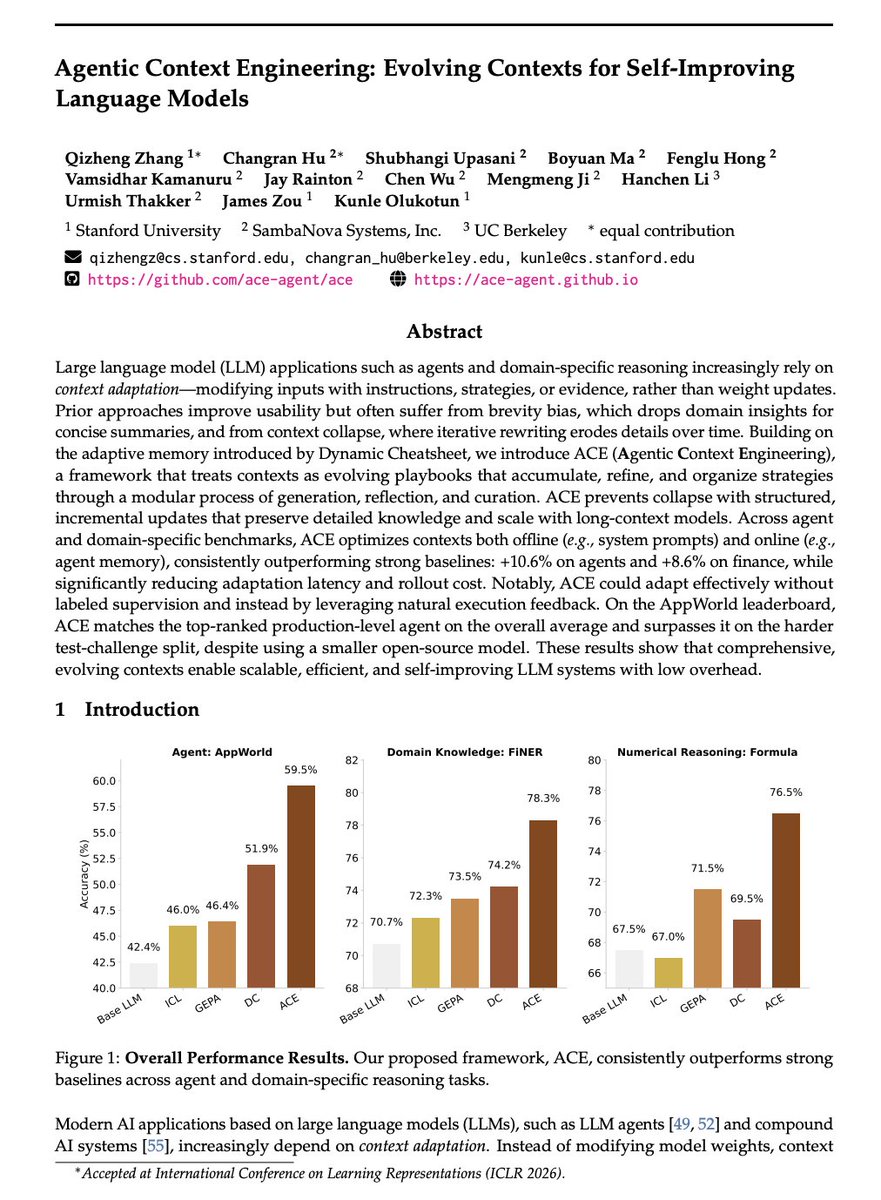
Stanford and Sambanova dropped a paper called "agentic context engineering" (ACE) and it is mindblowing. Instead of treating a prompt like a static text box, ACE turns it into a living playbook.
They split the AI into three distinct roles: A Generator (does the work), a Reflector (analyzes the failures), and a Curator.
When the AI makes a mistake, the Curator doesn't rewrite the whole prompt. It applies targeted, surgical "delta updates."
It adds a single rule. It tweaks one specific heuristic.
The AI learns entirely from its own execution feedback. Did the code run? Did the tool work?
Zero human labels required.
The results completely rewrite the economics of AI agents.
Tested on the AppWorld leaderboard, a small, open-source model using ACE didn't just compete with the most expensive, proprietary enterprise agents on the market.
It matched them. On the hardest tests, it actually beat them.
All while reducing adaptation latency by 87%.
This is one of the most interesting papers on self-improving agents for this year.
(bookmark this one)
Most self-improving AI systems hit the same wall: the mechanism that generates improvements is fixed and can't improve itself.
This new work from Meta and collaborators breaks through this limitation.
They introduce Hyperagents, self-referential agents where the self-improvement process itself is editable.
The DGM-Hyperagent combines a task agent and a meta agent into a single modifiable program, enabling metacognitive self-modification.
It autonomously discovers innovations like persistent memory and performance tracking, and these meta-improvements transfer across domains and compound across runs.
Why does it matter?
- On paper review, DGM-H improved from 0.0 to 0.710 test accuracy.
- On robotics reward design, it went from 0.060 to 0.372.
- Transfer hyperagents achieved 0.630 on Olympiad-level math grading in a domain they were never trained on.
This is a step toward AI systems that don't just find better solutions but continuously improve how they search for improvements.
Paper: https://t.co/Q0f7zWhNMD
Learn to build effective AI agents in our academy: https://t.co/1e8RZKs4uX
This is wild 🤯
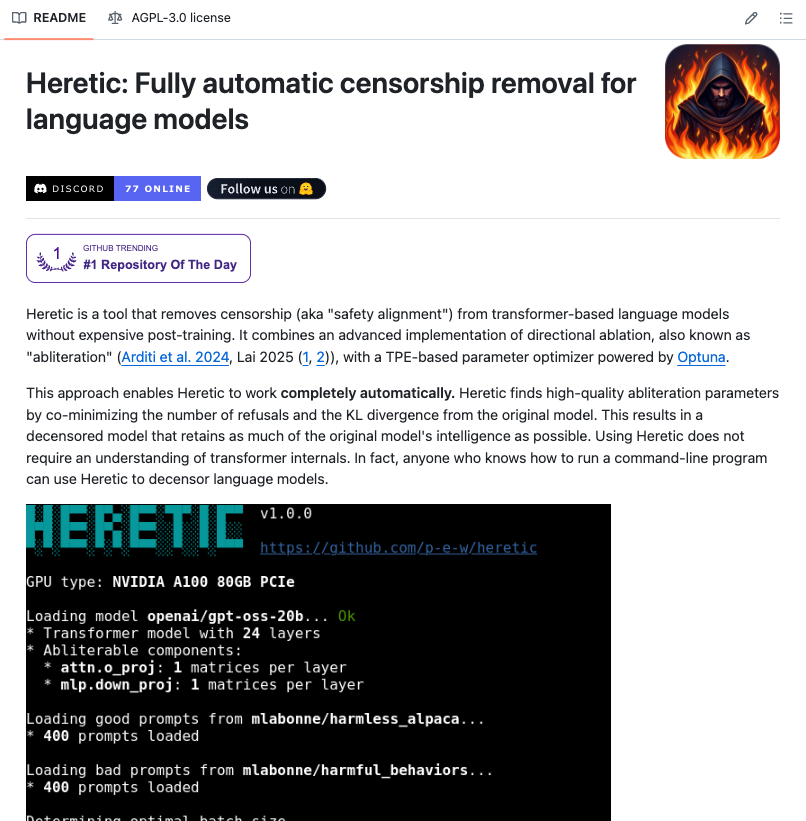
Someone built a tool that automatically removes safety alignment from ANY AI model.
It's called Heretic.
→ Works on Llama, Qwen, Gemma, Mistral and most major models
→ Runs on a consumer RTX 3090 in ~45 minutes
→ Achieves same refusal suppression as manually tuned abliterations
→ Preserves model intelligence better than existing methods
The scary part isn't the tool itself.
It's that every AI lab spending billions on safety alignment is now in a race against a 14-contributor open source repo.
Every safety update shipped → community figures out how to abliterate it → repeat.
This is what the AI safety debate actually looks like in 2026.
100% Opensource.
Link in the comments 👇
ever been here?
open overleaf → write a paragraph → "hmm...this needs a citation" → open 15 different tabs → skim 8 abstracts → find the 1 actually relevant paper → format bibtex → paste it back on overleaf
if so, i built a plugin just for you. meet openleaf:
→ reads your paper paragraph by paragraph
→ searches major academic databases
→ filters out irrelevant papers using ai
→ one click to add BibTeX to your .bib
you'll also find the 🤝 friendly and 🔥 fire reviewers there. i don't think i need to tell you what they do :)
free. open source. no account. no data collection.
works with ollama, openrouter, openai api and more.
https://t.co/XvX03iem38
dear algorithm, please show this to my fellow researchers in need 🙏
#overleaf #latex #opensource #academictwitter
Yann LeCun is pumping out papers recently
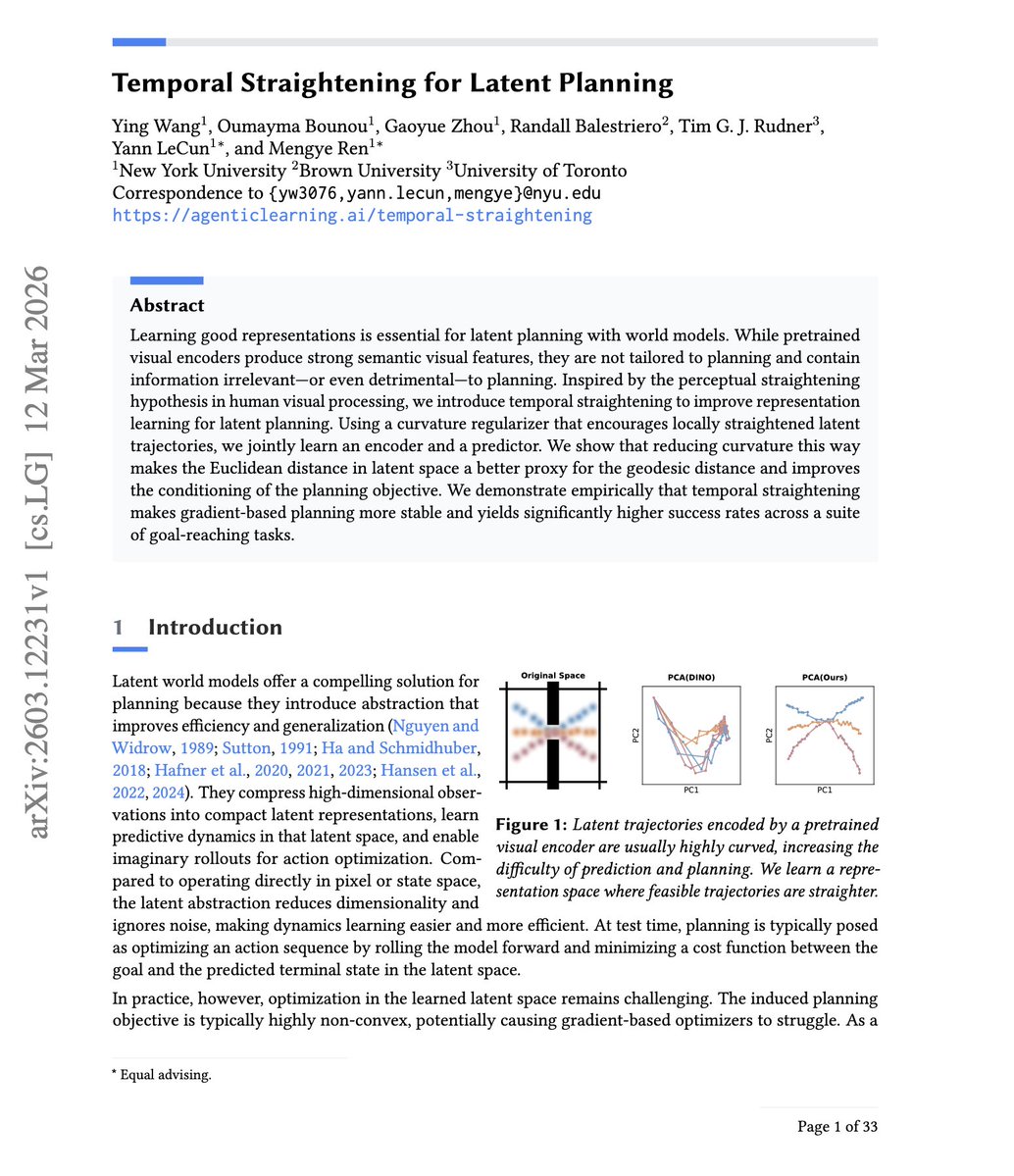
“Temporal Straightening for Latent Planning”
This paper shows that by straightening latent trajectories in a world model, Euclidean distance starts to reflect true reachable progress, so it's closer to geodesic/minimum-step distance.
This makes gradient-based planning far more stable and effective without relying as heavily on expensive search.
I made a Claude Code skill that generates conference posters 🛠️
Instead of a static PDF, it outputs a single HTML file — drag to resize columns, swap sections, adjust fonts, then give your layout back to Claude. 🔁
🔗 Skill 👉 https://t.co/KhYV8anbxL
"Every software company in the world, needs to have an @openclaw strategy" - Jensen at @NVIDIAAI GTC
Framing OpenClaw as one of the most important open source releases ever, they have announced NemoClaw - a reference platform for enterprise grade secure Openclaw, with OpenShell, Network boundaries, security baked in.
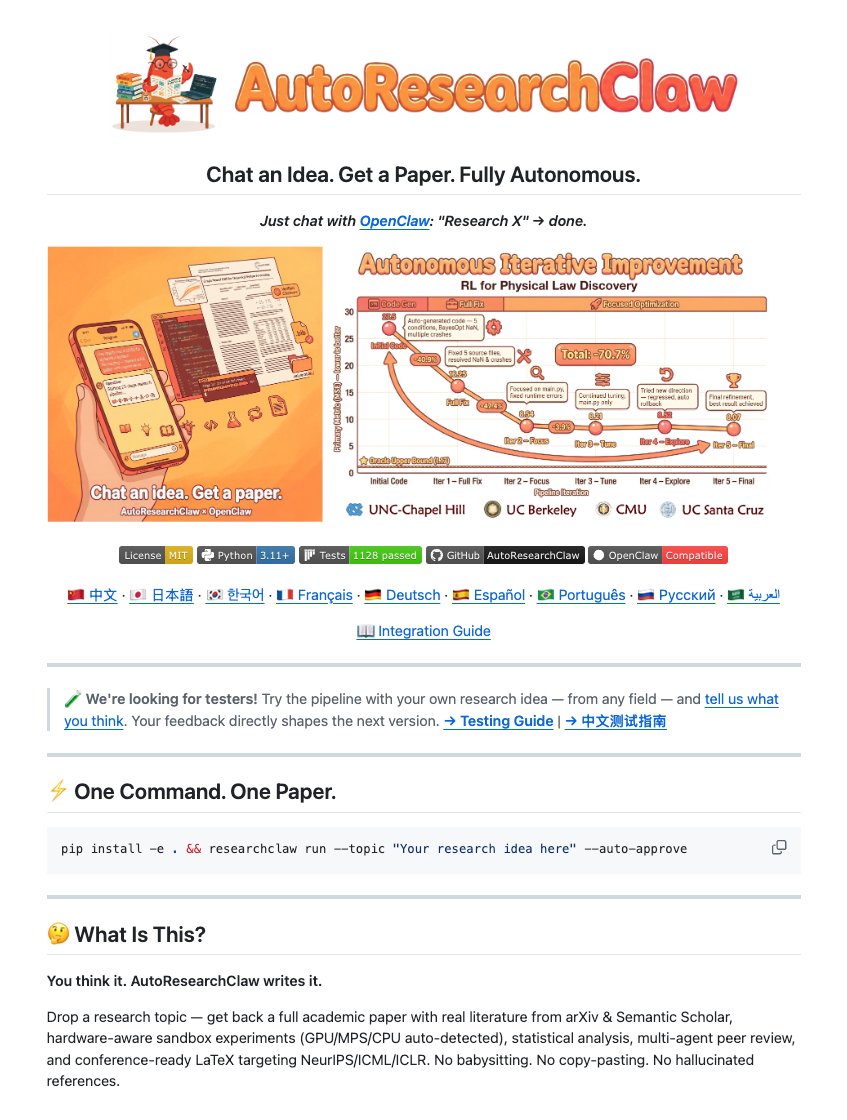
THIS is the wildest open-source project I’ve seen this month.
We were all hyped about @karpathy's autoresearch project automating the experiment loop a few weeks ago.
(ICYMI → https://t.co/ieuH8c0Y4x)
But a bunch of folks just took it ten steps further and automated the entire scientific method end-to-end.
It's called AutoResearchClaw, and it's fully open-source.
You pass it a single CLI command with a raw idea, and it completely takes over 🤯
The 23-stage loop they designed is insane:
✦ First, it handles the literature review.
- It searches arXiv and Semantic Scholar for real papers
- Cross-references them against DataCite and CrossRef.
- No fake papers make it through.
✦ Second, it runs the sandbox.
- It generates the code from scratch.
- If the code breaks, it self-heals.
- You don't have to step in.
✦ Finally, it writes the paper.
- It structures 5,000+ words into Introduction, Related Work, Method, and Experiments.
- Formats the math, generates the comparison charts,
- Then wraps the whole thing in official ICML or ICLR LaTeX templates.
You can set it to pause for human approval, or you can just pass the --auto-approve flag and walk away.
What it spits out at the end:
→ Full academic paper draft
→ Conference-grade .tex files
→ Verified, hallucination-free citations
→ All experiment scripts and sandbox results
This is what autonomous AI agents actually look like in 2026.
Free and open-source. Link to repo in 🧵 ↓