I just launched a longevity Rx platform. Prescriptions I personally use are there.
v1 is live now.
Includes access to:
+ Tadalafil (Cialis)
+ Metformin
+ Oral Minoxidil
+ Tretinoin
+ Estradiol
+ Acarbose
We’re working with licensed doctors and pharmacies to make these medications accessible. Lots more in v2 coming next week.
@Jason@ElishaDLong we've become so integrated with each other, personal and work, that my work performance has suffered. It's like I have this big gaping hole.
I miss Kate so badly that I physically hurt.
It's been a week since we were together. She's still in Australia sorting her visa.
I feel more stressed. My emotions are stunted. My thoughts are cloudy and my mood has dipped.
It just hurts everywhere.
female business owners…
would love to help you spread awareness on your health products
email us and we’ll have our science team check it out
partnerships at bryanjohnson dot com
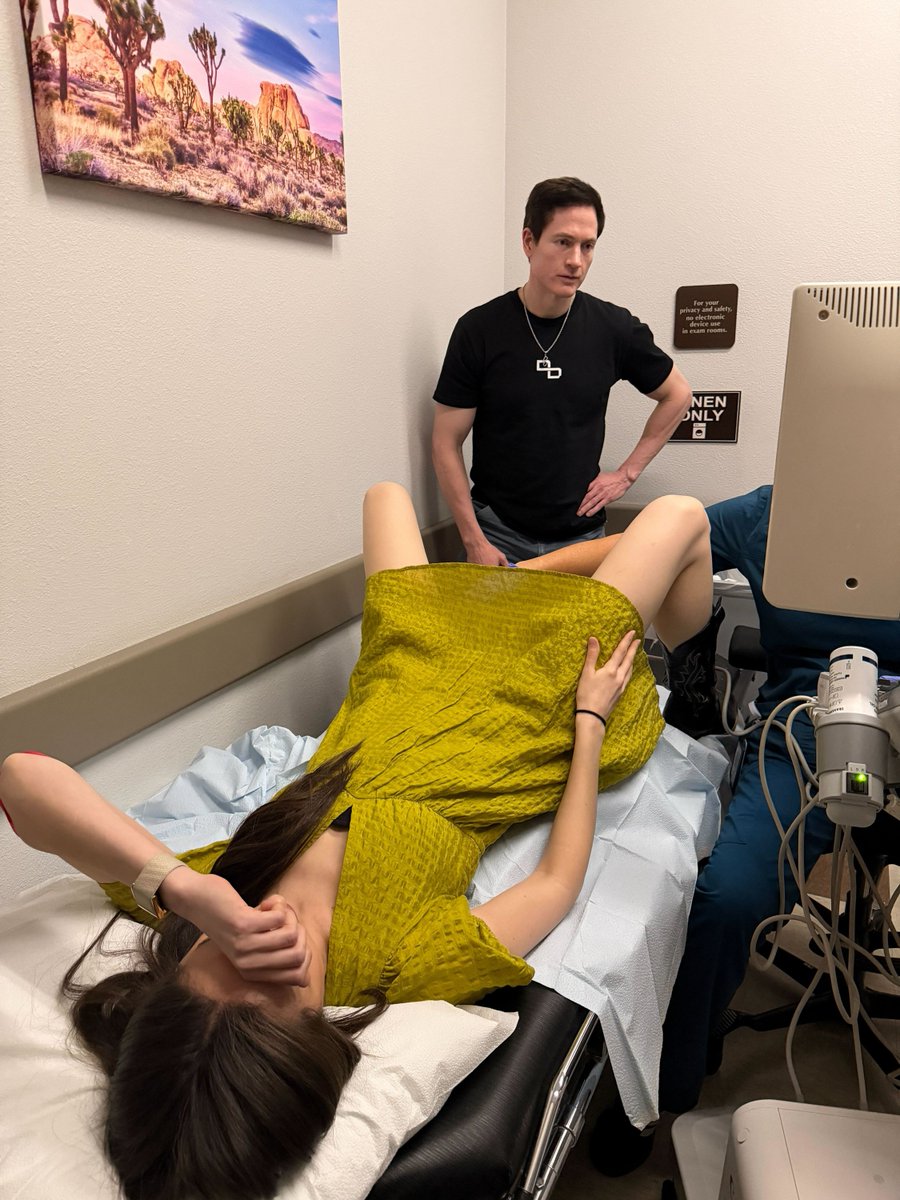
Examining Kate’s 1%
She has suspected endometriosis. This affects at least 1 in 10 women, likely more.
Here she’s getting an ultrasound.
Historically you needed surgery just to diagnose it (incisions are made in the abdomen). We're doing a non-invasive route.
Typically women live with endometriosis for 7-10 years before being diagnosed. It’s the leading reason women aged 30 to 34 get hysterectomies (permanent surgery to entirely remove the uterus).
This condition is where endometrial-like tissue starts growing outside the uterus, in ovaries, bowel, bladder, even the diaphragm. This tissue inflames, scars, and glues organs together.
Our first step is to find out if @_katetolo has it.
Initial measurements we’re doing:
+ trans vaginal ultrasound
+ pelvic MRI w and w/o contrast
+ hormonal labs
All during the early part of her cycle to get the clearest picture.
During her ultrasound, a slim probe, about the width of two fingers, 10-12 inches long (although only a small portion is inserted) is covered with a protective sheath and lubricant and gently inserted into the vagina (patient has to empty their bladder first). This creates real-time images of the uterus, ovaries, and surrounding pelvic structures. While inserted, the probe is turned 90 degrees to evaluate all the various structures, angles and views. There is no radiation exposure.
The technician is looking for scarring, ovarian cysts, adhesions, and for organs that are fused together with tissue. This ultrasound can confirm endometriosis but it cannot rule it out.
What endo does to the body:
+ 90% report pelvic pain
+ 50% report severe fatigue
+ 26% report infertility. However many sources cite 30 to 50 percent.
+ 50% experience pain during sex.
+ Many have pain with ovulation, bowel movements, and urination
+ Severe bloating called “endo belly” where the abdomen visibly distends
There are a handful of theories about why endometriosis develops but the honest answer is no one is quite sure.
We’ll keep you posted on her results.
I completed the most measured psilocybin experiment in history. The data from my experiment suggests that psilocybin may be a longevity therapy.
https://t.co/BpIKdISQ5G
I think magic mushrooms are a longevity therapy.
After seeing the data from two doses, psilocybin offers unique longevity effects that complement the best performing therapies I’ve done to date including sauna, hyperbaric oxygen therapy, sleep, nutrition and exercise.
This was the most quantified psychedelic experiment ever done.
It's noteworthy that even though many of my biomarkers are already in the 99th percentile optimal, psilocybin still showed multi-system improvements. Something other therapies have not been able to accomplish.
Of course, my data will need to be replicated and the magnitude and duration of benefits needs further assessment.
Here is what we learned:
0. We observed broad benefits across mental, hormonal, metabolic, and anti-inflammatory systems. Since these are the primary drivers of biological aging, this multi-system signal offers a compelling case for longevity potential.
1. Psilocybin may be a metabolic reset button for the brain. We expected brain changes, but not a potential metabolic breakthrough. My blood sugar control improved from the top 2% of the population to 0.2%, better than 99.75% of 18-25 year olds.
2. Psilocybin reduced my inflammation (hsCRP) to below detectable levels one week post dose.
3. Psilocybin calmed my body and mind. Lower cortisol, and an inhibited HPA-axis in the days following the dose. Both my cortisol and DHEA (another product of the adrenal cortex) dropped 42% and 45% respectively, indicating an overall adrenal reset associated with rest and recovery.
4. Psilocybin increased brain plasticity, desynchronized default networks, resulting in enhanced creativity, playfulness, and openness, with reduced mental rigidity.
5. A second psilocybin dose built on the first and pushed sensory integration even further, increasing primary sensory-motor integration beyond the peak of the first dose.
6. Psilocybin induced an intense blend of joy, deep insight, and a subtle hint of melancholy, also detectable by thermal biometrics.
We had two significant firsts in this experiment:
0. First documented human CGM-based observation of improved post-psilocybin glucose control.
1. First-ever thermal profile of an intense psilocybin dose.
Pending data:
+ Telomere length and relative telomerase activity (telomere regeneration capacity).
+ Epigenetic measurements
+ Microbiome
Experiment details
Here are more details about my two magic mushrooms trips, doses, and the results of my measurements up to date.
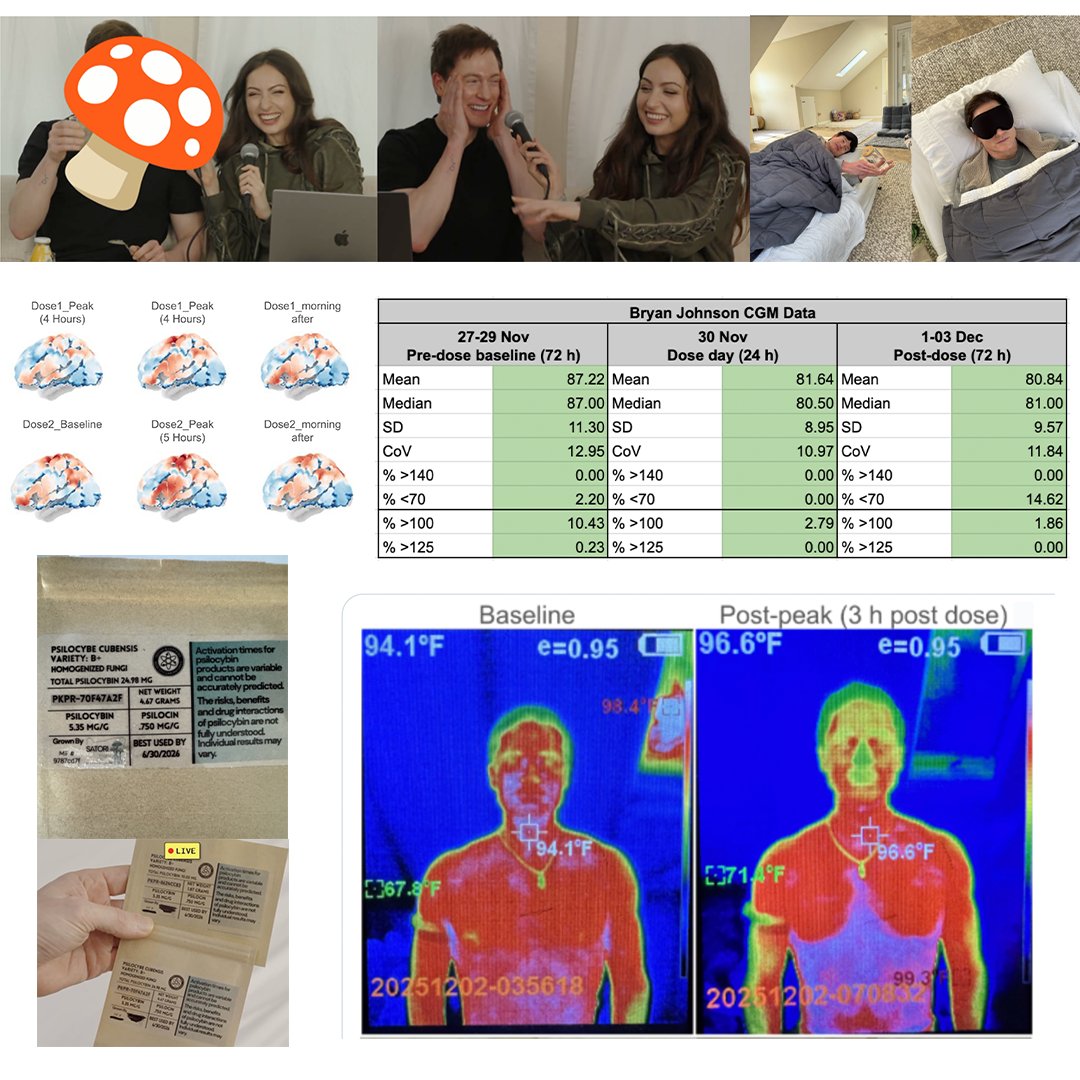
I had two doses of dried and powdered Psilocybe Cubensis (Variety B+) mushrooms, three weeks apart.
First dose Nov 9th: 4.67g (24.98 mg psilocybin and 3.5 mg psilocin). Setting: relatively private, only with @_katetolo and the accompanying guide.
Second dose Nov 30th: 5.35 g (28 mg psilocybin and 4 mg psilocin). Setting: relatively open, with friends and family joining virtually, and live streaming.
I dissolved the first dose in orange juice but used lemon juice for the second, for the following reasons:
+ Lemon is more sour, which delays the conversion to psilocin and breakdown in solution, thus preserving more total psilocybin to be activated to psilocin after ingestion.
+ Lemon juice has, on average, 70% less sugar and 45% less calories, making it less disruptive to my otherwise faster state throughout the journey, and leading to a much lower glucose peak.
Rewired brain connectivity
Kernel Flow measurements after the first dose showed shifts in my brain connectivity mirroring my subjective experience, and the mapping of 5-HT2A receptors.
These included the inhibition of my default networks and command centers including prefrontal context and a shift towards increased functional connectivity and hyperintegration between primary motor, sensory, auditory, and speech integration. This coincided with an entropic brain pattern, more open, flexible, exploratory, and creative, indicating a shift from aged and rigid to open youthful brain state.
The baseline measurement before the 2nd dose indicated a strong lasting effect from the first dose 3 weeks earlier, post-peak measurement after the 2nd dose indicated an additive effect of the 2nd dose, with a brain entropic and increased primary sensory-motor integration beyond the peak of the first dose. Most notable was the increased intensity of integration and activation of the auditory, speech, and language networks, coinciding with the second dose being joined by family, friends, where I enjoyed expressing and describing my feelings.
Face and body thermal biometrics
We produced the first ever face and upper body thermal map of a magic mushroom journey.
A core temperature increase of 1.5–2°F suggests an intense psychedelic experience, likely due to a large psilocybin dose (28 mg psilocybin, 32 mg combined psychoactive content).
Heat was redistributed to the core, consistent with 5HT2A–mediated autonomic activation, which can include increased sympathetic tone, lasting through the peak and early post-peak of the experience.
Facial and body thermal shifts indicate a potential blend of intense joy, insight, and subtle sadness or melancholy.
First documented human CGM-based observation of improved post-psilocybin glucose control
Psilocybin appears to have triggered a previously unknown metabolic reset in my brain, an unexpected breakthrough. Comparing the 3-day periods before and after the psilocybin dose:
My blood glucose control dramatically improved, moving from the top 2% to the top 0.2% of the entire population, including healthy 18-25 year olds.
+ 8% reduction in mean blood glucose, reaching 80.84 mg/dL, a new personal best.
+ 11% reduction in fluctuation, indicating smoother glucose peaks and improved control.
+ This single session reduced my estimated HbA1c 0.3 6.8% from 4.7% to 4.4%, (a relative reduction of 6.8%).
+ Durability: The positive effect was still as strong on Day 3 post-dose as it was on Day 1.
Note: A long trip to China on Day 4 interrupted this streak. We plan to explore the full durability of this effect with the next dose.
This matters because we treat diabetes and metabolic dysfunction with chronic daily medication (Metformin, Insulin, GLP-1s). This data suggests that a neuroplastic event might have downstream effects on the liver and pancreas that mimic or exceed these drugs.
Systemic inflammation was below detectable levels
Five days after the first dose, my hsCRP dropped to an undetectable level (below 0.15 mg/dL), representing a 35-100% decrease from the pre-dose level of 0.23 mg/dL.
Three days post-second dose, hsCRP was barely detectable at 0.18 mg/dL, which is still a 22% drop from the initial baseline.
Tumor necrosis factor-alpha (TNF-alpha) remained unchanged between baseline and post-second dose. It was not measured after the first dose.
For the next dose, we will measure a wider panel of inflammatory markers, including IL-6 and IL-10, and cover several time points post-dose.
High cortisol at Peak, low cortisol and stress the following week
Cortisol spiked at the peak of the acute phase, followed by a decline in morning cortisol levels and HPA-axis inhibition, consistent with a relaxed "after-glow" phase in the week following the trip.
My cortisol spiked to 3x morning spike levels four hours after taking the mushroom dose. Levels returned to normal nightly baseline before bedtime.
Five days post-dose, my morning cortisol levels had dropped by 42%, and DHEA-S (a marker of adrenal activity) also dropped by 45%, aligning with inhibited HPA-axis and adrenal activity.
Estradiol levels increased by 200%, consistent with preliminary published evidence that peripheral 5HT2A activation increases cortisol by driving aromatase expression.
This is biblical.
A woman in her eighties. Ten years into Alzheimer's. Hadn't spoken a full sentence in five years.
Takes one, 5 gram dose of psilocybin.
She slept 19 hours and woke up and spoke for hours about her life, recognized family and held real conversations. She regained bladder control after five years, walked on her own. and dressed herself. Gains held for weeks.
@IterIntellectus Growing up, I was taught to seek a practical, functional relationship. Then I read John Adam's biography and learned of his and Abigail's relationship. It remapped what I could aspire to. Secretly I was afraid I'd never find it and forever long. Feel grateful that I found it.
@glukianoff Had someone said this to me before my relationship with Kate, I wound have eye rolled or not believed it.
While it’s painful as hell, it’s kind of the best feeling in the world, knowing that you love someone that much and that you’ve grown so deeply together.
@ripchillpill Your chronotype is genetic. It determines when your circadian rhythm is primed to initiate slow wave sleep which is when the GH pulse fires. Most people are somewhere between 9-12pm.
Interested in hundreds of dollars of free peptides?
Go to bed on time.
It doses you with natural growth hormone. No injection.
GH great for recovery, muscle synthesis, cellular repair.
Dose is gated to first night’s sleep window.
You miss the dose if you miss the window.
For those of you who have a terminal illness, a chronic condition, or debilitating health issue, there is new reason to have hope.
New treatments are arriving that buy more time for the next to arrive. Even for the most vicious of diseases, for example, metastatic pancreatic cancer.
The recent breakthrough, daraxonrasib, nearly doubled overall survival, 6.7 to 13.2 months, with fewer side effects than chemo. It's hard to overstate the significance of this.
In a slow world, a few months doesn't matter much. In a fast world, that could mean the difference to make it to the next life-extending therapy.
We are on a long arc of getting increasingly better at solving disease.
In 1919, Elizabeth Hughes was diagnosed with type 1 diabetes. The only treatment was a starvation diet, which she did for three years. Her weight dropped to 45 pounds at age 14.
Then insulin arrived in 1922. It allowed her to live to 73.
And recently, Sid Sijbrandij used AI and existing biotech infrastructure to fight a recurring osteosarcoma that standard medicine had given up on. Today he has no evidence of disease.
A new era for life is here. It won't appear overnight. Nor will it be all sunshine and rainbows. But we are at the inflection point where hope can dare rise as the sun for those who have been stuck in the darkness.
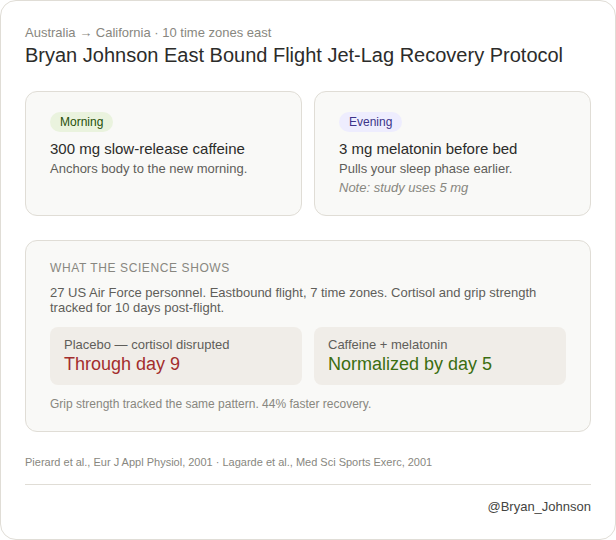
Testing a new protocol to accelerate jet lag recovery.
The study showed a 44% faster recovery.
> 300 mg slow release caffeine in am
> 3 mg melatonin before bed
Note: this is eastbound flight recovery.
When your circadian clock is off, your hormones, recovery, and output drift. Cortisol is downstream of your circadian clock. Caffeine and melatonin accelerate the reset the rhythm.
The caffeine keeps your body anchored to the new morning. The melatonin pulls your sleep phase earlier.
Things we're curious about:
1. Is the 300mg too much? Would a smaller dose be better?
2. The study uses 5 g of melatonin. I used 3 g. We still think that's probably too much and a much smaller dose of 0.5 or 0.3 would be enough.
@PhilippZentner Agreed, hydration is important. About 8 oz every hr. Cabin humidity drops to ~7%, drier than most deserts. At that level, your body loses roughly 8 oz of water per hour from breathing alone.