Wow, this tweet went very viral!
I wanted share a possibly slightly improved version of the tweet in an "idea file". The idea of the idea file is that in this era of LLM agents, there is less of a point/need of sharing the specific code/app, you just share the idea, then the other person's agent customizes & builds it for your specific needs.
So here's the idea in a gist format: https://t.co/NlAfEJjtJV
You can give this to your agent and it can build you your own LLM wiki and guide you on how to use it etc. It's intentionally kept a little bit abstract/vague because there are so many directions to take this in. And ofc, people can adjust the idea or contribute their own in the Discussion which is cool.
Expectation: the age of the IDE is over
Reality: we’re going to need a bigger IDE
(imo).
It just looks very different because humans now move upwards and program at a higher level - the basic unit of interest is not one file but one agent. It’s still programming.
Incentives explain outcomes.
Free money from the US taxpayer is like a giant magnet attracting 90% of Earth to America!
So why wouldn’t vast numbers of illegals want to come here?
Unfortunately, if allowed, this will cause the collapse of America.
We grew to $1B ARR faster than Stripe, Salesforce, and Palantir, while being 100% remote
This was a combination of a lot of luck, focus and an excellent team
Looking back, I can our team's success boils down some key principles I'm sharing in a 700-word long post:
I hope that it will help every startup as much as it helped us:
1. Everything is sales.
Recruiting is sales. Fundraising is sales. Retaining your best talent is sales. Dating is sales. And sales is sales.
A founder’s effectiveness = (technical skill × ability to sell).
2. You need to be in the details.
The best founders can zoom all the way in and out. If someone tells you to “scale yourself” by pulling back too early - they’re wrong.
Being in the details is important to understand what org structure best fits your company's goals. Every 'in the weeds' founder designs their org structure from first principles.
Jensen: 40 direct reports,
Elon: Engineers in charge of everything,
Jobs: Creative Dictatorship with Directly Responsible Individuals.
Zuck: The first growth-hacking team with @chamath
Founders not in the details forget what makes their products great and eventually recede into designing a standard org with standard departments which lead to standard results.
3. Your company's fate is 70% sealed by the first 20 hires
Ben Horowitz: "I got this advice like 27 times. They said 'Look, here's the key: Hire A players:' and I was like ok yeah, my plan was to hire a bunch of morons but now I'm going to hire A players" The hard part isn’t intent, it’s judgment.
The problem is you can't spot a top 1% engineer if you're not a top 10% engineer yourself. This applies to everything.
Your definition of great is just what you've seen. Founders have some blind spots. Technical founders usually build bad marketing orgs. Sales-focused founders sometimes build mediocre product teams. You need the right eyes to be able to spot genius. Ego aside, bring on a technical expert and have them vet talent for you. Your first hires are your culture, your standard, your work environment. They are the company. Get the first 20 hires right.
4. Live with your customers.
You can’t know what’s working if you’re not talking to them - all the time.
Be where they are: WhatsApp, calls, DMs, in person. The closer you are to customers, the fewer mistakes you make.
"The customer is the boss. They can fire everybody by choosing to spend their money elsewhere." - Sam Walton
5. Be extremely responsive.
If I reply in 30 seconds, what usually takes a day gets done in hours.
What takes hours gets done now.
Speed compounds.
6. Your TAM is limited by your imagination, not by the market.
Constantly rethink the pod, find other big issues that need solving and are valuable, and solve them exceptionally well. We went from contracts ($100M) to Employer of Record ($300M) to Payroll ($200M).
Each 3x'd the TAM.
7. Never run out of cash.
The only way a business dies is by running out of cash.
Profitability = power. You call the shots, not investors.
You can always act in the company's long-term interest because you know you are safe.
We reached Series A after spending <10% of our seed.
We have been profitable for the last 3 years.
Cash discipline buys freedom.
8. Over-index on angels early.
Angels are your best shot at making important people care - when it matters. They might not be involved day to day, but when you really need help, they’ll show up. If you don't know how to solve a problem, you should know at least a person who knows the person who can.
Pick the right ones, and time your asks well.
9. There's always something out there that can kill your company.
Your job is to de-risk the company. Capital, talent, and products are all a small part of a larger effort to de-risk your startup and build an enduring business. Covid-induced work from home grew our payroll and EOR business. And it seemed like RTO might kill it. But we were prepared. If you worry, you won't have to worry.
10. Stay focused.
Fundraises, competitors, headlines - all noise.
Focus on your customers. Focus on your product. Keep executing.
In the long run, the most relentless team wins.
11. Trust your instinct.
If something feels off - it probably is. Dig deeper.
Courage in your convictions matters, especially as the team grows.
Don’t let “performative democracy” slow you down.
As long as you’re in the seat, lead decisively - and unapologetically.
I went through this exact journey myself.
After 13 years climbing the ladder at hedge funds in NYC and ultimately reaching my goal of becoming a portfolio manager, I had a major internal crisis. I had the analytical capabilities to do the job, but my nervous system wasn't wired in a way that aligned with navigating the volatility of the marketplace (and workforce) while also finding internal peace & joy. I worked with a coach, and he asked me "is this what you want to be doing at 50?". I was burned out and no longer found meaning in seeking to generate 300bps of alpha for institutional LPs - the answer was obvious. I knew I needed a change.
I decided to move my family from NYC to Scottsdale, and downshift & reorient my career, while also meaningfully restructuring my personal cost structure.
I thought the peace and joy would flow immediately upon the move...remove the stressor and joy arrives, right? Right?!
WELL, for really the first time in my life, this gray feeling of depression crept in, and it surprised me.
In NYC I was special. I had status, I had an identify. The first thing people ask at a cocktail party in Tribeca is "what do you do?". With pride, I responded "I'm a PM at Citadel". Brokers rolled out the red carpet and "friends" emerged given your perch and your ability to help them. I was infected with mimetic desire and I moved into a beautiful apartment building and was neighbors with Leonardo DiCaprio and Tyra Banks. And it was fun, it was thrilling.
Then, all of a sudden I didn't have that. I was a failed "semi-retired" PM. I looked around me, and I didn't feel special...I felt, for the first time in my life, average. I lived in an average house, drove an average car, and lived an average lifestyle. And it hit me harder than I thought it would.
And I went through it. I struggled for a solid 18 months. I went through the letting go of my ego, the letting go of the identity that I had been so carefully crafting for nearly 20 years.
What did I learn along the way?
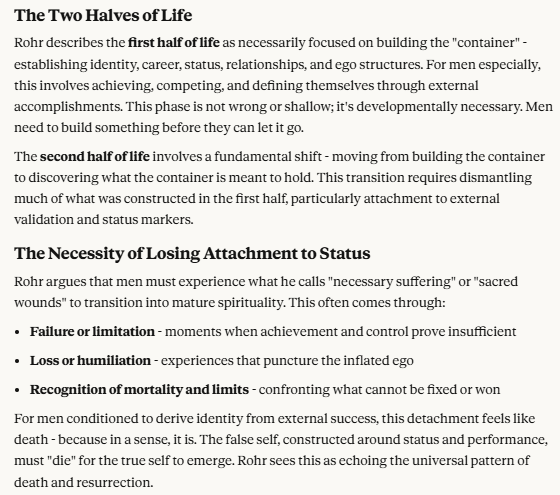
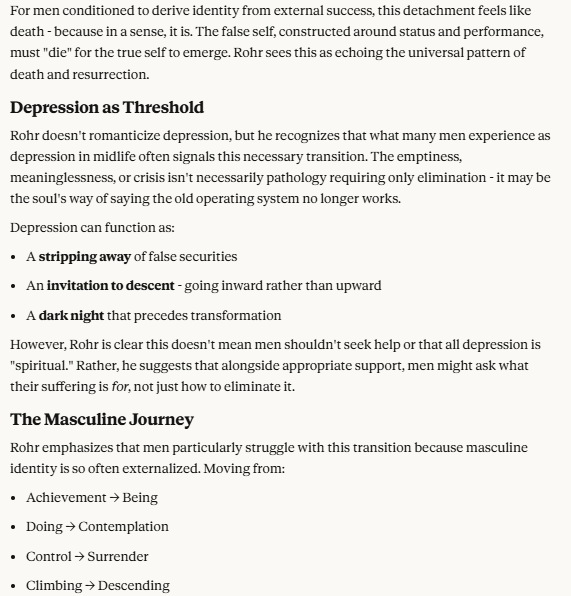
I learned that depression is a feature, not a bug. A period of depression, when associated with the letting go of identity, is actually a well-established threshold in the archetypal evolution of male spirituality.
The journey for me kicked off a transition towards a much deeper exploration of the true meaning of life, which I believe is a deeply personal question. For me, this transition point marked a transition towards inner growth as a primary metric of success. Who I can become.
In exploration, I learned that what I was going through was far from unique, but was actually a well-established transition point in a well-lived life.
I stumbled upon Richard Rohr's wonderful book, Falling Upward, and it seemed to explain this journey in wonderful precision.
How the loss of attachment to status and identity is actually a wonderful gift!
I have established this framework as a core part of my personal philosophy of life. And, with some distance from the gray, now look at that period of my life as a wonderful gift. A necessary letting go and reorientation towards more true and more enduring sources of peace, joy & meaning.
So, if you are feeling depressed at the loss of identity. Keep going. It's a sign you are on the right track.
Please enjoy @bhorowitz and me answering questions on the current state of AI!
01:14 How AI startups can compete with the bigger players
05:57 Will the "God models" get 100x better?
09:19 Counter argument: Are the tests too simple?
10:14 Internet data represents average human activity
11:50 AI's ability to unlock latent super genius limits
15:30 Neural networks exhibit generalized learning and computation functions
17:01 Reports of self improvement loops
19:10 Current data improvements
22:05 Challenges for AI applications
25:48 Business value-based pricing model
29:38 Two diametrically opposed questions about AI's impact on tech investment
32:48 The Jevons Paradox
36:46 John Maynard Keynes vs. Karl Marx
39:29 Demand for softwares is perfectly elastic
41:12 AI based medical diagnosis
42:09 Reality of data moats
48:06 Big companies and actionable data validation
52:05 Big companies using stolen data
53:07 Genetic Information Nondiscrimination Act (GINA)
57:53 Comparison of AI boom and internet boom
1:02:23 Marc's prediction for the AI industry
1:08:07 Lessons learned from internet era
1:12:12 Big companies trying to lock down AI
1:13:28 Core VC assumes half of investments will fail
Today in "Weird open source stuff":
I got a strangely passive aggressive email from @NASA.
I mean, I love you @NASA, and it's a real honour that you're using @pydantic, but why on earth are you (presumably) paying @KPMG lots of money to ask unimaginably dumb and uninformative questions of open source projects?
Struggling to find a job in SaaS today? Here’s the thing.
On the one hand, jobs are fewer, layoffs are up, and spend it tighter. Everyone has to be 2x or more as efficient as 2021.
But on the other hand … literally almost every SaaS company I know doing even reasonably well is hiring. And … struggling to find anyone truly good for their roles.
So finding a job may be 5x harder than 2021, but there are still a vast number of unfilled roles at just about every good or great SaaS company.
So how do you get those jobs?
A few perhaps obvious points, that still, I see 98/100 candidates failing / not doing:
#1. Enough With the AI Job Applications
Sure, use ChatGPT to improve your grammar. But everyone can see the generic job application written by ChatGPT. It’s zero effort and no one wants to hire those candidates.
#2. Stop Blindly Applying in One Click to Jobs on LinkedIn etc. With Zero Effort
No, this does not count as a job you “didn’t get”. Stop. Slow it down. Take 30 minutes to write a personal email on why you’d truly make an impact in that role, and send it to the CEO / VP / Director etc. directly by email. You will stand out instantly.
#3. Realize You May Have to Do The Work Yourself, Not Just Be a Strategist
I know you may be a bit tired or burnt, but almost no one wants to hire a “strategist” these days. They want to hire someone to do the work. It really feels like 95% of the applicants I see, even at relatively junior phases of their career, just want to either manage people or be “strategists” and not do the work.
#4. Follow Up Quickly
There are two ways to be great — either literally be great, or be good and hyper responsive. If you are the best engineer in the world, the best CRO, sure take a few days to get back to them. The rest of us? Respond in minutes if possible. It’s so, so easy to stand out here.
#5. Don’t Tell Them The 1 or 2 Slots You Are Free
Instead, just tell them you’ll make almost anytime work for the interview. Telling a potential employer you just have 1 slot free next week tells them it’s not going to work out.
#6. Share Some Actual Examples of How You’d Do It
Everyone says they “be great” at the role. Hooray. Share 2-3 examples of how you actually did it in your last role. I.e., make case studies … of yourself.
#7. Comp Matters. But Don’t Ask About Comp Too Quickly
Comp matters, and fair pay matters. But if you start asking about comp before you even understanding the job … that’s a flag, at least for most startups and scale-ups. Ask about comp. But maybe at the very end of the first interview. Not in the first 5 minutes.
#8. Don’t Argue
I see way too many job applicants for both senior and junior roles argue. They argue they know how to do it. No one wants to hire you. Prove you are smart in other ways.
#9. Make Sure Your LinkedIn and Resume Speaks for Itself
Ask 3-4 folks you trust. Would they hire you just based on your LinkedIn? If not, put more work there
To get rich, do work where you get paid in proportion to the number of customers you satisfy instead of the number of hours you work. Not all work of this kind will make you rich, but nearly all work that can make you rich is of this kind.
This is an important point. A lot of the most successful people, not just in startups but in many fields, do what they do because there's something they want to exist, or some mystery they want solved, and no one else is working on it.
Pattern I’m noticing:
Many deca-millionaire, centi-millionaire, or billionaires have a story that starts with them selling their first company (in a very boring but reliable market) for $10M-$20M and netting at least a few million personally.
Then it’s just continuing to play the game with higher stakes, bigger markets, and bigger ideas.
This first exit should be the first goal of aspirational entrepreneurs who want to tackle bigger things later in life. Not building a billion-dollar-company on their first try.
I was sad to learn that Charlie Munger died today at age 99.
What a life.
He would likely roll his eyes and argue that none of us should be too surprised, based on the actuarial tables, but we’ve lost one of the 20th century’s greatest investors and businessmen.
Chris and I were lucky enough to get to know Charlie over the past few years.
There’s a saying, “Don’t meet your heroes; they will only let you down.”
In this instance, the quote does not apply. Charlie was exactly how he appeared, the same person whether he was being interviewed on CNBC, hosting dinner at his home, or negotiating a deal.
We could all learn a thing or two from him about how to play the (very) long game.
Here are four things he said to us that stuck:
“I don’t need the last dollar”
We heard Charlie say this many times while discussing potential deals. Either it was a good deal, or it wasn’t. He didn’t need to chisel out a few more percent and risk bad feelings.
“Hold your nose and carry on”
Charlie wasn’t one to dwell on the past, unless there was an important lesson to learn for the future. He expected things to occasionally go wrong and having learned from the error, he moved on.
“It’s foolish to try to change someone’s mind”
When we asked him for advice about a difficult person we were working with and how we could convince them to change course, Charlie told us not to waste our energy trying to change their mind. “They think what they think,” he told us—it was locked in. We were better off simply aligning ourselves with people who already think the way we do.
“It’s a mistake to be deeply ideological about almost anything - it’s better to have doubt”
On just about every topic—even investing—Charlie’s frequent refrain was “it’s hard...” The intellectual equivalent of folding your cards in a game of poker when you aren’t sure about your hand. Charlie didn’t need to have a firm opinion about everything. (Ok, maybe cryptocurrency.)
If you’re curious to learn more about Charlie, I highly recommend his book, Poor Charlie’s Almanac, as well as The Tao of Charlie Munger by David Clark. It’s a wonderful collection of some of his best quotes, and the audiobook is great.
We’ll miss you, Charlie.