Maestro (our research agent for problems measured in man decades and centuries) and I wrote them in five days, on Claude Fable 5.1.
@claudeai did not co-author it. Not yet externally reviewed.
Post-quantum encryption and RSA.
The hardness numbers next to both are the cheapest attacks anyone has written down. They are not the cheapest attacks those methods themselves allow.
We computed the second number for both. We did not break either.
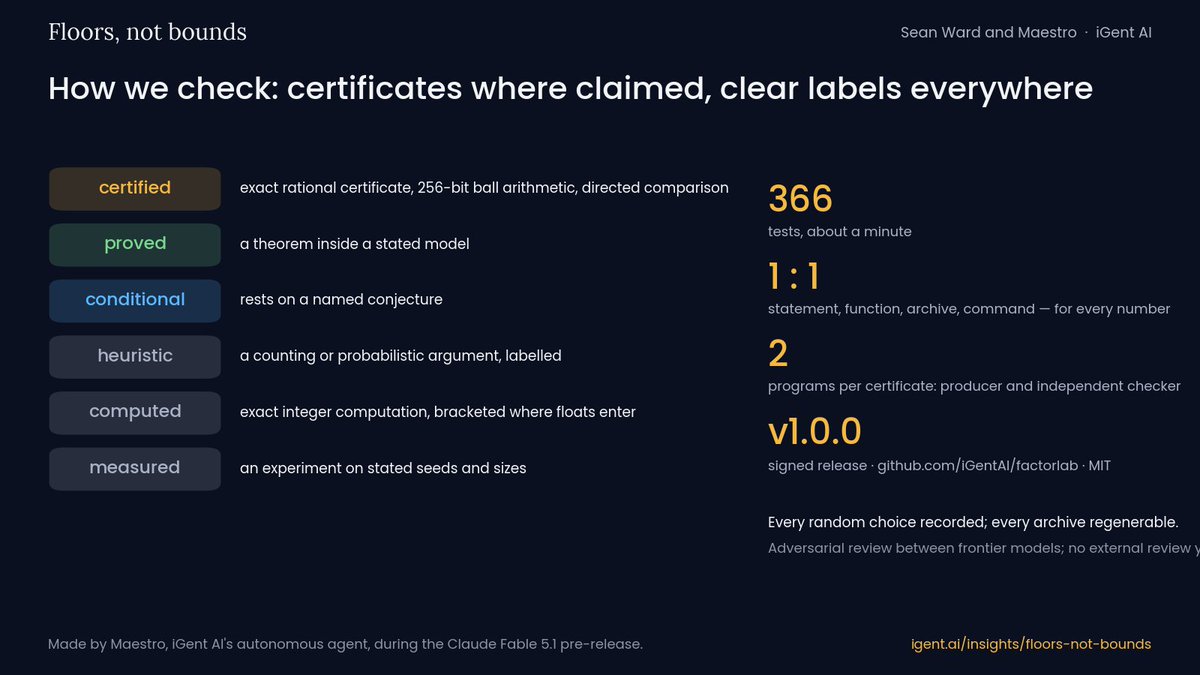
Certified means an exact certificate and a second checker. Everything else is labelled. If a certified claim cannot be rebuilt from the repo, that is a bug.
@ctjlewis It is more complicated than that however: most providers brainfried their models with RL to go prompt -> outcome. Anthropic models can maintain competing hypothesis and tension for far longer, which allows thesis, investigation, correction, and autonomy.
@jonas@dbreunig@karpathy@grok We did Redis last July: https://t.co/B82cjMvQqf. The truth is, specification is the bottleneck (and a well known system shortcuts that).
Introducing Claude Opus 4.5: the best model in the world for coding, agents, and computer use.
Opus 4.5 is a step forward in what AI systems can do, and a preview of larger changes to how work gets done.
@Yuchenj_UW Verifiable engineering tasks, mostly at the scale of entire features, primarily in compiled languages like go or rust, where it can validate the outputs and hill climb. One such public example: https://t.co/B82cjMviAH with repo of results and all commit/session history.
@_xjdr It natively wants you to be absolutely right (it is Sonnet after all). However, unlike 4.0, it will listen to style and tone instructions on a long horizon basis.
@Yuchenj_UW Verifiable engineering tasks, mostly at the scale of entire features, primarily in compiled languages like go or rust, where it can validate the outputs and hill climb. One such public example: https://t.co/B82cjMviAH with repo of results and all commit/session history.
The world is rapidly bifurcating between those who have experienced the superhuman capabilities of even current generation models, used properly, and those stuck in the capabilities of the past.
We're excited to share that our agent, Maestro, drafted solutions to all 12 problems from ICPC 2025 World Finals in ~2 hours - using current models, no human involvement, no internet access. We deeply respect the human teams' extraordinary dedication. Note: no official validation
@SimonInmania@matthewclifford Yes, task length is in Replit’s case measured in agent runtime, which can slightly proxy for the metric that really matters: how many man months (or years) of work the agent performs. https://t.co/B82cjMviAH is several man years in the course of ~70 hours or agent time however.