Hey all!
Looking for my next challenge in AI / deep tech!
I’ve spent the last several years building at the intersection of AI, distributed systems, and developer experience:
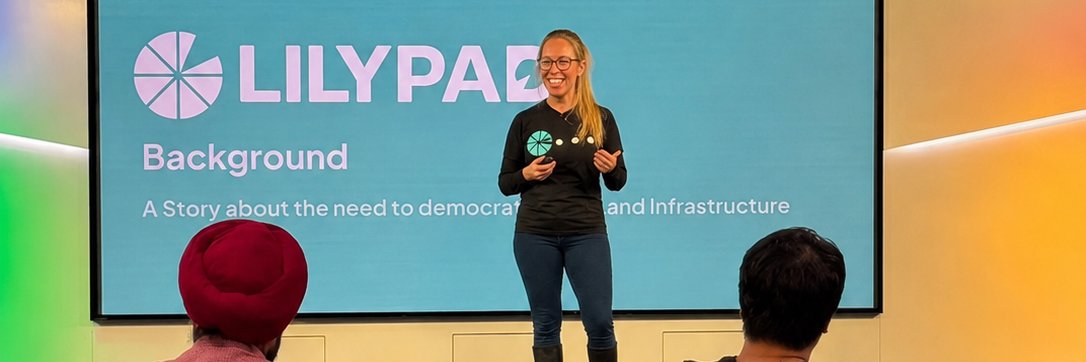
→ Founded Lilypad Network — a permissionless distributed AI compute marketplace (from smart contracts all the way to live GPU nodes running real workloads)
→ Led Developer Experience for the Filecoin Virtual Machine launch at Protocol Labs / Filecoin Foundation
→ Built and scaled developer communities + technical storytelling as Lead Developer Advocate at IBM
→ Shipped production software across Accenture, University of Sydney (ML/IoT), and earlier startup work
I’m strongest when the work involves:
- Turning frontier AI into products people actually use
- 0 → 1 technical product and infrastructure
- Developer experience, storytelling, and ecosystem building
- Systems thinking across hardware, software, and go-to-market
Australia-based. Open to remote or relocation. Full-time or fractional.
I’ll be at Token2049 Singapore (7–8 Oct) - would love to meet founders and teams building serious AI infrastructure, agents, or developer platforms while I’m there.
If someone comes to mind, an intro would mean a lot. Happy to share more about what I’ve built!
My biggest takeaways from @illscience:
1. Company building will now be creating a series of loops. A coding loop turns a bug report into a fix and a low-risk production release in five minutes. Anish expects similar loops to spread from individuals to functions, business units, and eventually large parts of a company—from growth experiments to sales demos to legal and support. The key is to figure out what the agent doesn’t know and give it that context so it can complete the loop.
2. Moats are discovered, not designed. Anish uses Cursor as an example: it began as a high-engagement DAU product, then captured reasoning traces and trained its own models over time. A founder does not need a fully formed moat story on day one if the product has momentum, craft, and growing engagement. The classic moats—like network effects, scale advantages, brand, and proprietary data—still matter, but the small product decisions that create them often become visible only after the product is in the world.
3. We appear to be on the slow takeoff timeline. The case for fast takeoff always follows the same structure: everything up until now is OK, then something no one can articulate happens, then runaway acceleration. Anish doesn’t buy it. Model progress is real and faster than ever, but most problems aren’t intelligence-bound. A data center of PhDs doesn’t exponentially improve pizza supply chains.
4. The “permanent underclass” fears are a Silicon Valley dark fantasy. By almost every empirical measure, things have never been more distributed or opportunity-rich. Job postings for radiologists and programmers are at historic highs, despite years of “they’re cooked” predictions. And within the AI stack itself, rather than one winner-take-all platform, there are 20 credible players at every layer.
5. The biggest opportunity in consumer AI right now is “/loop make me happier” (not “/loop make me more productive”). Most people want to spend time, not save it. The biggest products in the world are entertainment and social, not productivity tools. Anish sees a spiritual hunger, particularly outside major urban centers where cultural institutions have thinned out. The opportunity: How do we feel more connected, more loved? How do we have fun? “We built a technology that extends our intellect and nothing to extend our soul.”
6. Three things have held consumer AI back, and all three are now improving. First, model costs were too high for free-to-use consumer products. Second, chat is a high-agency interface that works for Elon and Sam but not for the average consumer, who needs something between chat and TikTok. Third, the technology has been aimed almost entirely at productivity rather than connection and entertainment. The consumer moment is coming; Anish puts us at iPhone 2010, pre-Airbnb, pre-WhatsApp, pre-Uber.
7. Humans will remain critical for identifying the next opportunity. Agents are excellent at climbing to a local maximum, but then they plateau. They aren’t great at picking which hill to climb next. That’s where humans come in. Anish illustrates this with a chart he uses in conversations: agents hill-climb, then a human steps in to set the direction for the next climb, and the cycle repeats.
8. The most important attribute for teams is now ambition. Three years ago, Anish and his colleagues would pass on companies that seemed too crazy or complex. Today the opposite is true: an idea that’s too small isn’t worth engaging with. The firm’s internal posture with every founder: “We’re here to help you build the strongest form of your vision.”
9. There’s a big opportunity in creating very expensive consumer software. The old wisdom was that consumer products have to be free. Anish is taking the opposite position—that consumer discretionary spend is entirely up for grabs, and price is a measure of product-market fit. His product exercise for founders: what would the Birkin bag version of your product, at $1,000 or $10,000 a month, have to do to justify that price?
10. Become a model sommelier. Models are not interchangeable; Anish experiences different models as suited to different kinds of work. His way to learn their shape is to build something with every release, ideally using one or two low-stakes projects as a recurring test bed. His minimum heuristic is to ship once a week.
China published the most uncomfortable paper on vibe coding.
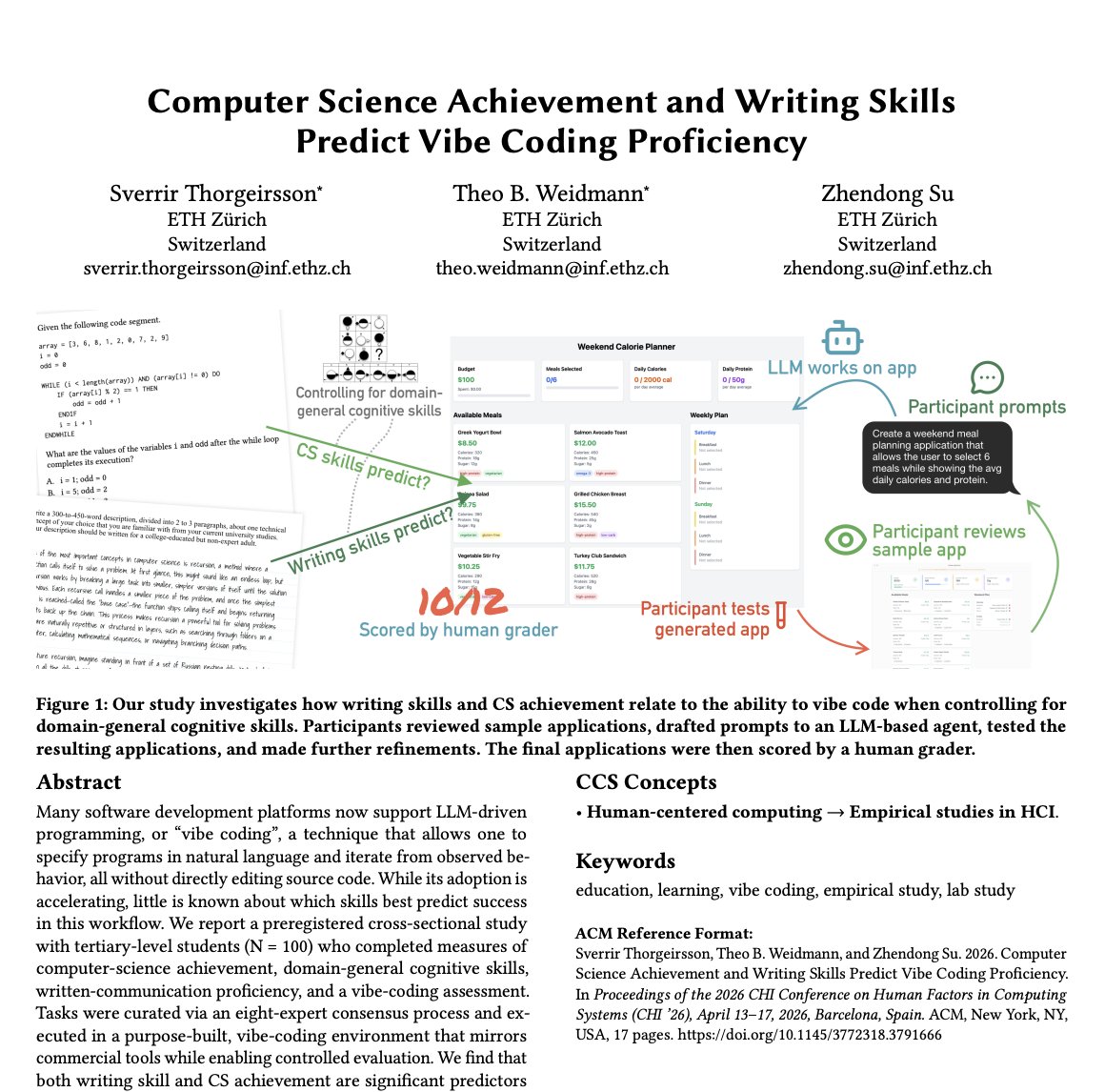
ETH Zurich tested 100 developers in a controlled, commercial-grade vibe coding environment to see who actually succeeds.
The findings are brutal.
The researchers tracked computer science achievement, written communication skills, and general cognitive reasoning.
They wanted to see what actually predicts vibe coding proficiency when you never touch a line of source code yourself.
Two major predictors emerged.
Written communication proficiency mattered. The ability to structure thoughts and articulate intent unambiguously in text directly impacts what the AI builds.
But that wasn't even the main takeaway.
Computer science achievement was a massive, dominant predictor of success.
Even when researchers controlled for general intelligence and reasoning skills, CS background still heavily dictated who built working software and who completely crashed.
In fact, CS knowledge contributed roughly twice the unique predictive variance of writing skills alone.
Why? Because vibe coding isn't about writing code. It’s about debugging logic.
When an AI agent builds a complex application and quietly breaks an edge case under the hood, a non-technical user looks at the glowing UI and assumes it works.
They don't know what questions to ask. They don't know what logic to challenge. They lack the mental models to recognize architectural catastrophe.
You can prompt your way past syntax.
You cannot prompt your way past a fundamental lack of engineering intuition.
The hype told us that learning to code is dead because language is all you need.
The data just proved the opposite.
To truly master the vibe, you still need to understand how the machine thinks.
Exciting day for NVIDIA and @huggingface.
Open models strengthen safety and cybersecurity, accelerate innovation and diffusion, and enable sovereignty. They allow every developer, startup, university, industry and country to build with, customize and benefit from AI.
Thank you @ClementDelangue for coming to me.
NVIDIA is going to be a great home for Hugging Face, its community and the future of open models. 🤗
https://t.co/q8Om2Xc5ye
Today, I’m open-sourcing /fuck-cancer, an AI skill that helps patients and caregivers navigate cancer diagnosis and treatment and advocate for themselves and their loved ones.
Here’s what patients and caregivers have told me since I shared my mom’s story:
“You have to be a huge patient advocate. Ask questions and push for answers, biopsies, and proper testing.”
“I need help navigating difficult conversations and advocating for myself.”
“The volume of doctors, documents, and insurance paperwork can quickly become overwhelming.”
I built the skill to help with these problems. It creates and updates a practical brief with five sections:
1. Patient and care-team information for easy reference during calls
2. What to do next, limited to three specific actions
3. What we know, separating confirmed facts from what remains unclear
4. Medical terms explained in plain English
5. A care log with recent updates and decisions
It builds this brief from documents, and context you provide. When research is needed, it uses trusted sources such as the National Cancer Institute and the ClinicalTrials gov API.
I use it with ChatGPT/Codex and Claude Code to prepare for conversations and research. It can save the brief locally as a Markdown file or update a shareable Google Doc so the whole family can work from the same information.
📌 Get the free, open-source skill here:
https://t.co/YUGoFbhnNc
If you find it useful, please ⭐ the repo and share it with someone going through this BS disease.
IMO Near intents has the best UX for daily operations. Paying people in what ever currency on anychain with super fast finality was already great. But now with confidential mode there is basically no downside versus using a web2 bank account for your daily business onchain. ( Oh and Near Intents is just https://t.co/A8IFaqonaN accoutns now )
@palomasupremacy I'm interested in how they act under different assumptions, and honestly dont see a difference to who I am professionally, so I let the assumption ride :)