@0xperp is a special builder. We had the pleasure of having him as part of the @DCGco family in various capacities since 2019, and now are lucky to back him and the @adjacent___ team in their journey building innovative products within the prediction markets category.
LATEST: ⚡ Zcash plans to roll out quantum-recoverable wallets within a month and reach full post-quantum status within 12 to 18 months, says Zcash Open Development Lab CEO Josh Swihart.
Fantastic to spend time with many of the leaders in the Bittensor $TAO community at Yuma's first ever summit. The vibes, enthusiasm and camaraderie reminded me of DCG's first Summit in 2015
https://t.co/ritf6lTYGK
Truly an inspirational group. Big things are happening
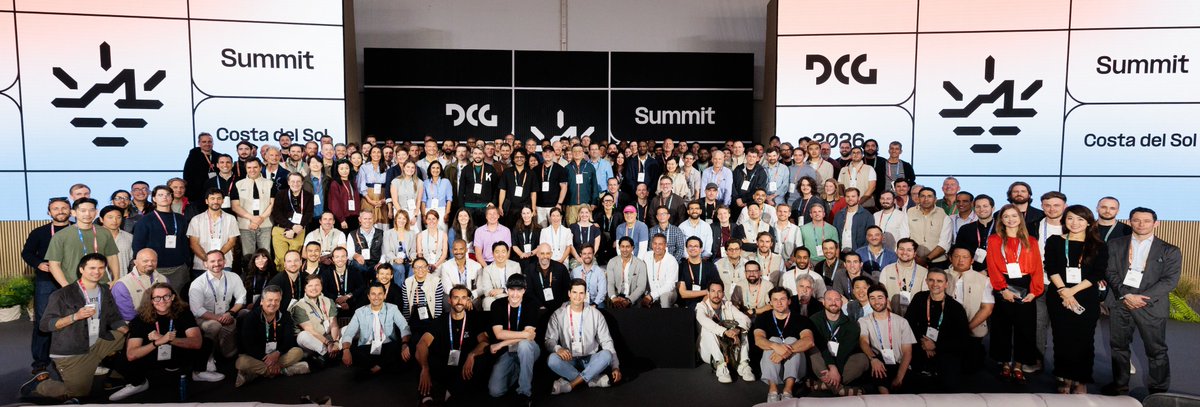
Our ninth DCG Summit is a wrap, the largest to date. Three days in Spain with 250+ of the greatest founders and leaders from across 5 continents, building the future of digital assets. The strength of our community is unbeatable.
Something this WSJ piece omits is that what @brian_armstrong is arguing for is not obviously in Coinbase's interest: in a world where yield sharing is prohibited, USDC will at least in a first-order way be more directly profitable for Coinbase. As far as I can tell, Brian's position stems from his belief in the importance of a vibrant and competitive market that protects consumer liberty, and I think he deserves a lot of credit for that.
https://t.co/7WKM7mhqjd.
LPs sometimes ask me who I think the best VC investors in crypto are.
I think about this a lot.
Ever since I started as a crypto VC, I have wanted to be the best. I’m deeply driven by competition, and investing is as pure of a competition as it gets. Only one person can win the deal, only one person can pick the winner of the cycle.
But when you honestly look at it and do the accounting, there are three people who have proven themselves the GOATs of crypto VC investing.
This is going to seem like glazing (it is) and probably not interesting to anyone who's not a crypto VC. But I am. So this is for all of us who make this our life’s work.
Here are my all-time top 3.
#3. @danrobinson (@paradigm)
There’s a legendary story about how Mike Speiser, Managing Partner at Sutter Hill Ventures, incubated Snowflake, which went on to become a $75B company. A VC adding that much value to a portfolio company is basically unheard of.
Dan Robinson is the Mike Speiser of crypto.
Again and again, Dan has been at the ground floor of generational companies in crypto. He was there from the very beginning of Uniswap, literally a co-author and foundational contributor to Uniswap V3, which became the backbone of on-chain spot trading. He was a critical contributor at the beginning of Flashbots, which birthed modern MEV auctions. And he was an early research contributor to Plasma, the predecessor of modern rollups, which led to him leading the seed round of Optimism.
Dan is a genuine polymath. He breaks the mold of a traditional VC. He started as a securities lawyer, then became a self-taught protocol architect and mathematician, and is now a self-taught investor. Perhaps the greatest investment that @matthuang ever made was hiring Dan. When we lose deals to Paradigm, so often it’s because people say: yeah you guys are great, but sorry, I have to work with Dan.
The scariest investors are people who can do more than just invest. Dan saw where it was all going, and he rolled up his sleeves and helped make it happen, multiple times. That’s what makes him one of the greatest to ever do it, and earns him his spot on the crypto Mt. Rushmore.
#2. @cdixon (@a16zcrypto)
Chris Dixon is the OG’s OG. He saw it before anyone. Before Chris, crypto VC was minor leagues.
He was the first mainstream VC to throw his hat in the ring and publicly bet his career on crypto. He was the first to adapt the language of VC to crypto and network investing. He was the first to socialize these concepts with Silicon Valley and its universe of institutional LPs. So many concepts we bandy about every day in our IC, we stole directly from Chris. It’s not an exaggeration to say I am walking along the train tracks that Chris set down originally for himself.
There are two most important deals that I attribute to Chris Dixon. The first, of course, is Coinbase. Chris led the Series B of Coinbase in 2013, at a time when the industry was still fledgling and none of this was obvious. That deal is the apotheosis of the Dixon-ism—"what the smartest people are doing on the weekends is what everyone else will be doing in 10 years." He had the foresight to do that deal, and then doubled down to go all-in on the industry. It was so much harder to do what we are now doing at the time when Chris first did it.
Second deal was Uniswap. Almost everyone who saw the Uniswap Series A passed on the deal ($100M FDV—Uniswap was still tiny back then). At the time we were having heated debates about whether AMMs were capital-efficient enough, whether they’d face too much adverse selection, whether they were too easily forkable. Paradigm passed (despite leading the seed round), we passed as well, and from what I’ve heard, everyone else at the a16z IC didn’t want to do the deal.
But Chris? Chris supposedly said: “A smart contract that can buy and sell anything? That sounds so cool. Who knows what will happen—let’s just do it.” And he was right. It was cool. All sorts of non-obvious things would happen because of what permissionless AMMs enabled. I learned a big lesson after passing on that Series A.
I disagree with the a16z worldview in many ways. But everyone in this industry owes Chris enormous credit. He has single-handedly done more than any other VC to put the industry onto the cultural footing it now has, has fought tooth and nail with his career to legitimize crypto in DC, and has earned us cultural recognition as a positive frontier technology. So much of the language we use about crypto was imbibed directly from Chris.
Crypto VC would not be where it is today were it not for Chris Dixon championing it as early as he did. For that, we owe him deep gratitude.
And that leads to the #1 VC of all time...
#1. @KyleSamani (@multicoin)
Kyle, Kyle, Kyle.
I give Kyle a lot of shit. He rubs a lot of people—including me—the wrong way. All the time.
But investing is like a sport. At the end of the day, you either put up points on the board, or you don’t.
And Kyle has put up the most points of anyone. The sheer scale of PnL he made from his Solana seed round investment, the amount of work he did for that deal, someone will write a book about it someday, and I’ll be grimacing the whole time while I read it.
You see, the best investors are contrarians. And Kyle is a true contrarian. To be a contrarian doesn’t mean that you write a hot take that gets a bunch of people to say "wow that was smart." If everyone wants to retweet you, by definition you’re not a contrarian. You’ll know you’re a true contrarian when you piss people off. When people think you’re an idiot. When they think you’re lighting your money on fire.
Kyle is one of the only true contrarians in crypto. I disagree with him about almost everything. But his original investment and subsequent conviction on holding Solana through the depths of the valley of darkness after the collapse of FTX, make him, bar none, the best VC investor in crypto history.
We always say that venture is a power law business. Kyle and his legendary Solana investment is precisely what we all mean by that. Sometimes it genuinely only takes one deal.
And that’s what makes Kyle the best crypto VC of all time.
So that’s my top 3.
---
LPs sometimes ask where I think I should go on this list.
As much as I think highly of myself—and boy do I think highly of myself—I don’t think I’m top 3. I’m top 10 for sure, and there’s an argument for top 5, but I’m not better than any of these three. I hope to be, someday, before I’m done. And if you break it out by seasons, there are seasons I’ve done better than each of them.
But in aggregate? These three are the best to ever do it.
It’s not helpful to Dragonfly for me to praise our competitors. But there’s a game bigger than the game. You see, this is a hard industry to be an investor in—most of the peers I’ve had along the way have not survived. Crypto is brutal.
As much as I compete with these guys every day, I have enormous respect for them. I've seen them evolve through almost a decade of ups and downs. We've all endured through the vicissitudes of crypto together to support our founders, to support this industry, and to help it stand shoulder-to-shoulder next to any other technology. As I was doing some end-of-year reflection, I thought it was worth acknowledging them in an industry that often doesn't give out much praise to VCs.
Each of these people have done a lot for me, whether they know it or not. I've learned so much from each of them. And I genuinely hope they are proud of what they’ve accomplished.
Dan Robinson saw it clearly.
Chris Dixon saw it first.
And Kyle Samani saw it through.
Hats off, gentlemen. Here’s to another vintage of competition. 🫡
I’m not “hating” on ETH (or other L1s). I just don’t like the valuation. Simple
What I am calling out is the maximalism. Wild to be this closed-minded when we’re still so early
No chain is perfect. The only thing that matters long-term is adaptability
And honestly? I don’t sense urgency. Maximalism breeds complacency and I see a lot of complacency right now.
L1 is infrastructure and it’s going to be a dog fight to capture more economic activity on chain among the existing L1s and new ones like Tempo.
We have excess supply of blockspace and not enough demand for it. That’s the key issue.
What’s telling is how fast people tried to shut down the discussion.
“No fundamentals, no comparisons.”
But when it’s time to stretch analogies to justify valuations?
“Yes yes yes, give us more. ETH is oil. It’s Singapore. It’s the U.S. It’s the world computer. It has a monetary premium. No, that didn’t work? Okay—back to oil. Yes yes yes, that’s better. Supply and demand.”
Pivots are part of startups. But Ethereum community is acting as if it won the game. Not even close. Not this early in the game…
We don’t need another hype loop. We need to solve the hard problems that actually could justify these valuations. We have a lot of work to do
Less speculation → more real GDP on-chain
Better pricing of security + blockspace
Clearer value capture
Most of us came into crypto out of intellectual curiosity. Somewhere along the way, many stopped being curious and started defending bags. Worst mindset to have this early.
It comes from a place of defensiveness and fear to protect your capital. The market is a weighing machine and it will come to collect.
If you believe in exponential growth: stay curious. Don’t get married to narratives. Or your bags.
Job’s not finished
My Telegram account got compromised and I’m locked out for now. If you get any messages from my old handle (@diegodecolombres), please ignore them. Already reported it and working on getting it back.
We’re excited to announce that Optimum has raised an $11 million seed round led by @1kxnetwork to build the world's first high-performance memory infrastructure for any blockchain.
The missing piece in the world computer architecture has arrived ♾️
Sat down at DAS to debate the Dudas @mdudas on all things VC.
- Are VCs cooked?
- Is there too much infra?
- Memecoins, good or bad?
Things got spicy, MMs walked out half-way in disgust, and the audience voted at the end who between us won...
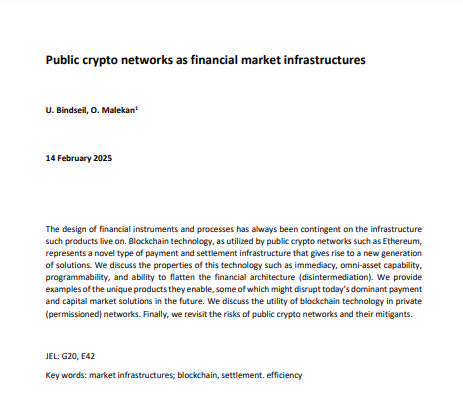
And now for some positive news: I'm excited to announce the publication of a new paper, co-authored with ECB director general (and noted Bitcoin skeptic) Ulrich Bindseil, on the utility of public crypto networks as financial infrastructure.
This is our best attempt to explain the unique attributes of DeFi for any asset, including RWAs, as compared to traditional market infrastructure.
We break those attributes down to unique time structures, streaming payments, omni-asset settlement, programmability, and disintermediation.
We also consider (and mostly dismiss) the utility of permissioned networks which seem to be popular with international orgs like the IMF and BIS.
The paper provides examples of unique DeFi primitives that could only exist on a public blockchain, and also considers their limitations.
So give it a read (link below) and let us know what you think. Some of you here gave Ulrich a lot of flack for his papers questioning the utility of Bitcoin and might be interested to see how he's a lot more bullish on DeFi.
Part of my motivation for doing this was to have a single point of reference to share with all the TradFi and government people who still ask "what is crypto good for?"