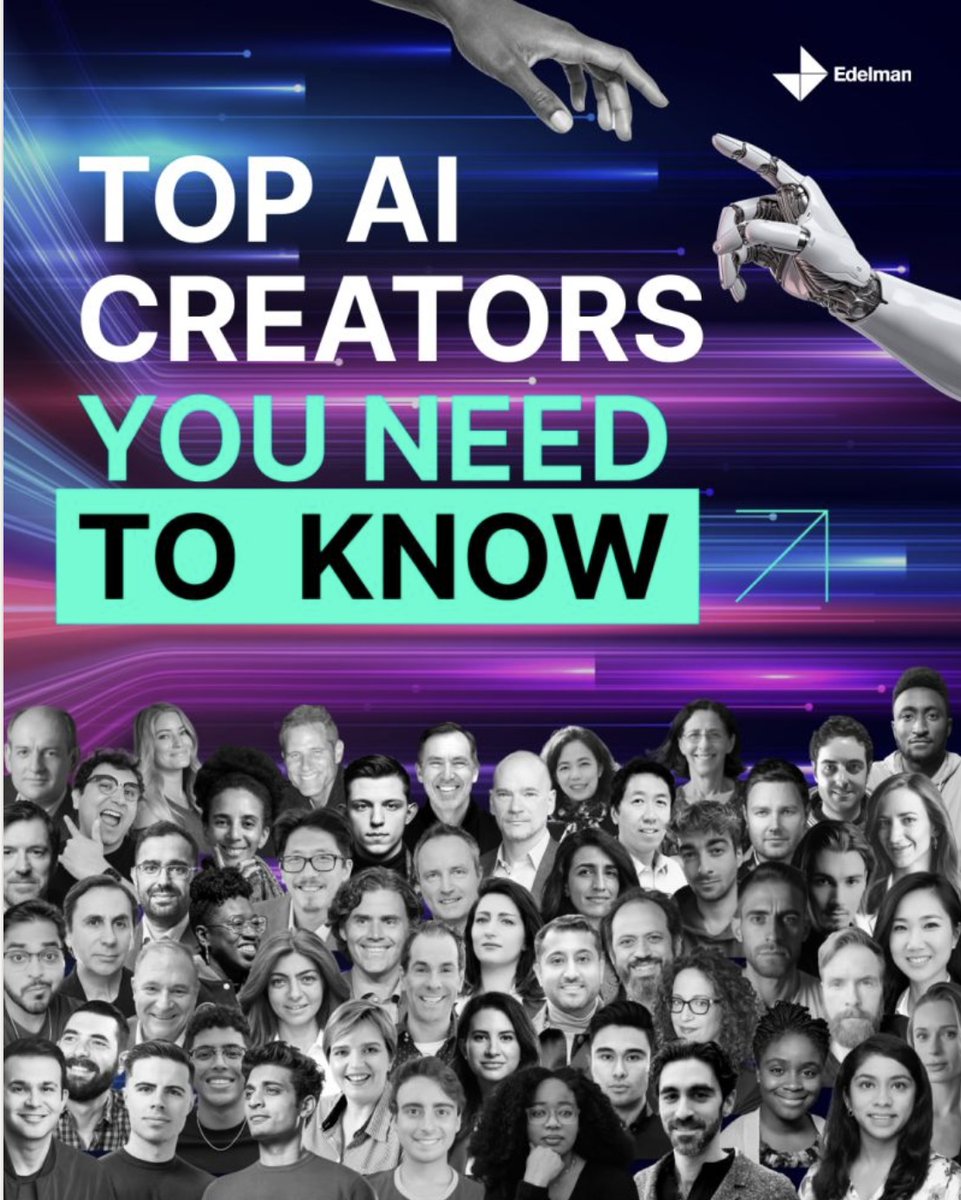
#AI Creators You Need to Know by @EdelmanPR
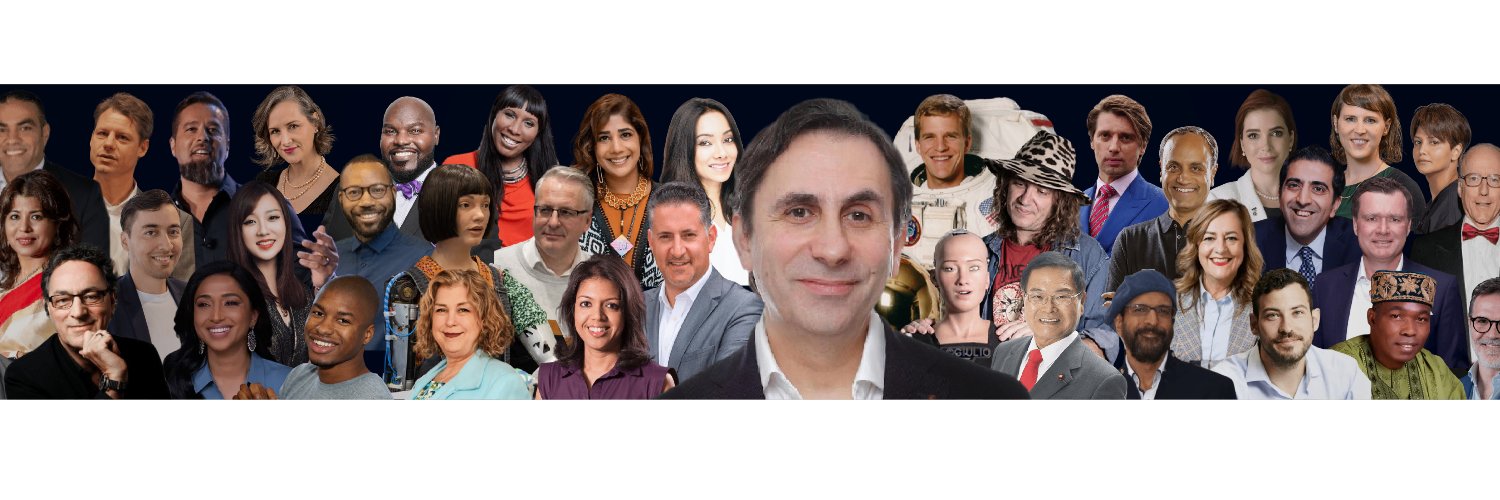
I am honoured to be listed in the Edelman’s industry’s first-ever composite of brand-safe creators specialising in AI:
AI Creators You Need to Know
These 50 individuals, selected from academia, professional sectors the creative community, have been rigorously vetted by Edelman’s Creator Marketing team for their credibility, alignment with brand values, engagement, reach, and authority in AI.
The creators span a global audience, offering brands opportunities to localise their AI narrative while maintaining a cohesive, trusted voice. From trailblazing AI ethicists impacting policy discussions to dynamic content creators demystifying generative AI, this list highlights the breadth of expertise and perspectives driving the global AI conversation.
The list features the following
#ArtificialIntelligence
Global personalities
Alex Banks
Allie K. Miller
@amywebb
Andrew McAfee
@AndrewNg
Dr. Ayesha Khanna
Azeem Azhar
Brian Evergreen
Cassie Kozyrkov
Conor Grennan
David Linthicum
Dinis Guarda
Ethan Mollick
Fei Fei Li
Gavin Purcell
Gregory Shove
Hanan Salam, PhD
Igor Progany
Iniola deborah Raji
Dr. Jeffrey Funk
Jordan Harrod
Jose Jesus Guzman Eusebio
Dr. Joy Buolamwini
Justine Ezarik,
Kristian Fagerlie
Kushank Aggarwal
Lekhana Reddy
Marques Brownlee
Matt Wolfe
Matthew Berman
Melanie Mitchell
Miles Franklin
Natcho Prasert
Premal Tailor
Ranael Kaliouby, Ph.D.
Rick Mulready
Riley Brown_ai
@rowancheung@sallyeaves
Sebastien Jefferies
StuartRussell
Tiffany Janzen
Timnit Gebru
Varun Mayya
https://t.co/WXV2XRrT0H
CC @YuHelenYu@AkwyZ@arlenenewbigg@EliseQuevedo@efipm@enricomolinari@kuriharan@jblefevre60@thomaspower@enilev@Khulood_Almani@SpirosMargaris@mvollmer1@Xbond49@antgrasso@EstelaMandela@sallyeaves@alvinfoo@UrsBolt@albertogaruccio@BetaMoroney@globaliqx@psb_dc@Shi4Tech @FrRonconi @thinkers360@Ronald_vanLoon@ipfconline1
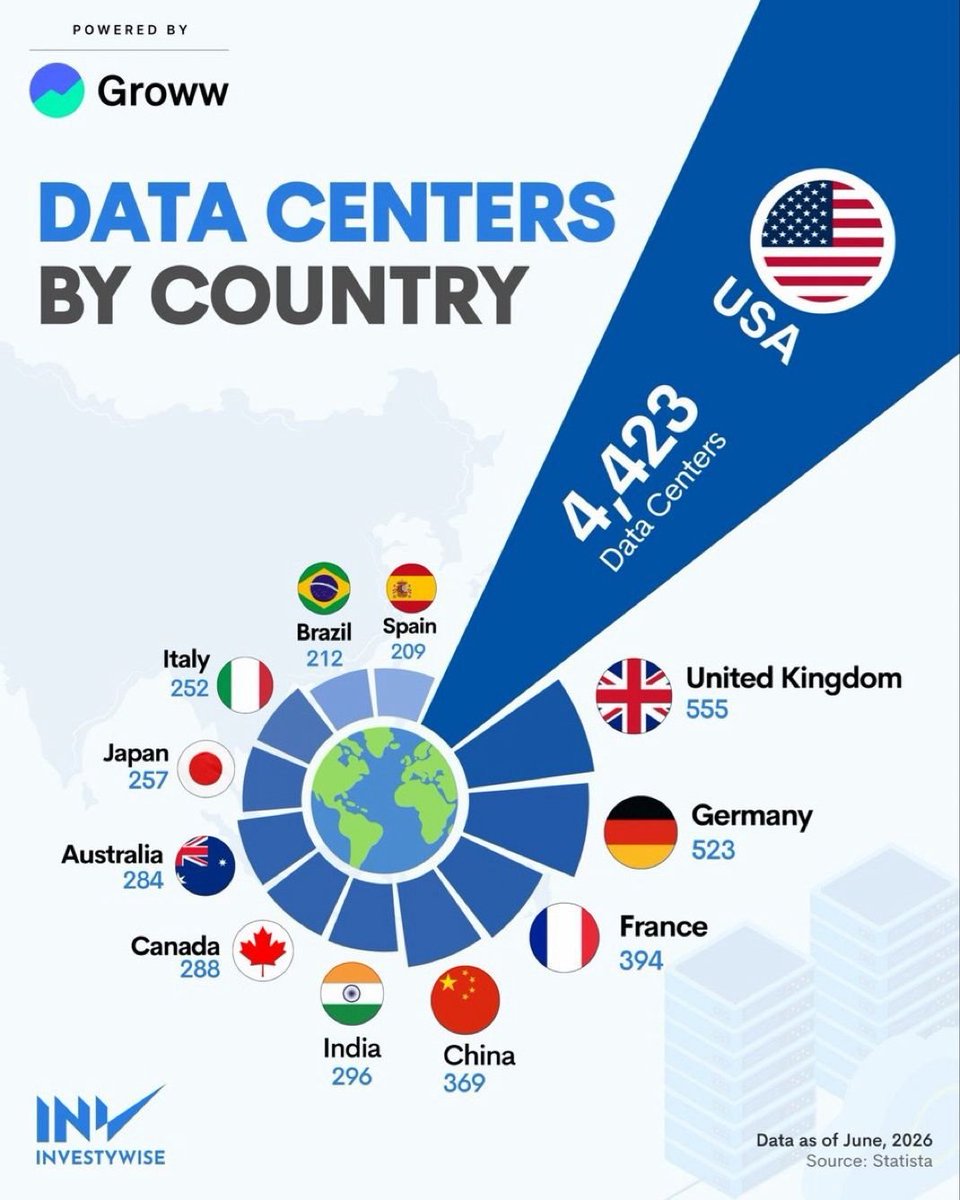
𝐓𝐡𝐞 𝐖𝐨𝐫𝐥𝐝’𝐬 𝐃𝐚𝐭𝐚 𝐂𝐞𝐧𝐭𝐞𝐫𝐬 𝐛𝐲 𝐂𝐨𝐮𝐧𝐭𝐫𝐲 𝐢𝐧 𝟐𝟎𝟐𝟔
The geography of data centres reveals where much of the world’s digital power is concentrated.
According to this dataset:
🇺🇸 United States — 3,960 data centres
🇬🇧 United Kingdom — 498
🇩🇪 Germany — 470
🇨🇳 China — 365
🇫🇷 France — 335
The United States alone has more data centres than the next 14 countries combined.
These facilities power cloud computing, streaming, digital services and the AI systems reshaping global industries.
While the number of sites does not fully measure computing capacity, the scale of this concentration reflects decades of hyperscaler investment, energy access, connectivity and technology infrastructure.
Europe remains the world’s second-largest cluster, while China, India, Japan and other Asian markets continue expanding rapidly.
As AI becomes critical infrastructure, will data-centre capacity become one of the most important measures of national technological power?
Source: Data Center Map Visualisation: Visual Capitalist
#DataCenters #ArtificialIntelligence #AIInfrastructure #CloudComputing #DigitalEconomy #Technology #DataSovereignty #Energy #DigitalTransformation
CC
@efipm@YuHelenYu@Khulood_Almani@theomitsa@Victoryabro@sonu_monika@arlenenewbigg@EliseQuevedo@enricomolinari@kuriharan@jblefevre60@thomaspower@enilev@Khulood_Almani@SpirosMargaris@mvollmer1@Xbond49@antgrasso@EstelaMandela@sallyeaves@alvinfoo@UrsBolt@albertogaruccio@BetaMoroney@globaliqx@psb_dc@Shi4Tech @FrRonconi @thinkers360@Ronald_vanLoon@ipfconline1
📍 Most organizations invest in AI tools.
The real advantage comes from how they integrate AI into work.
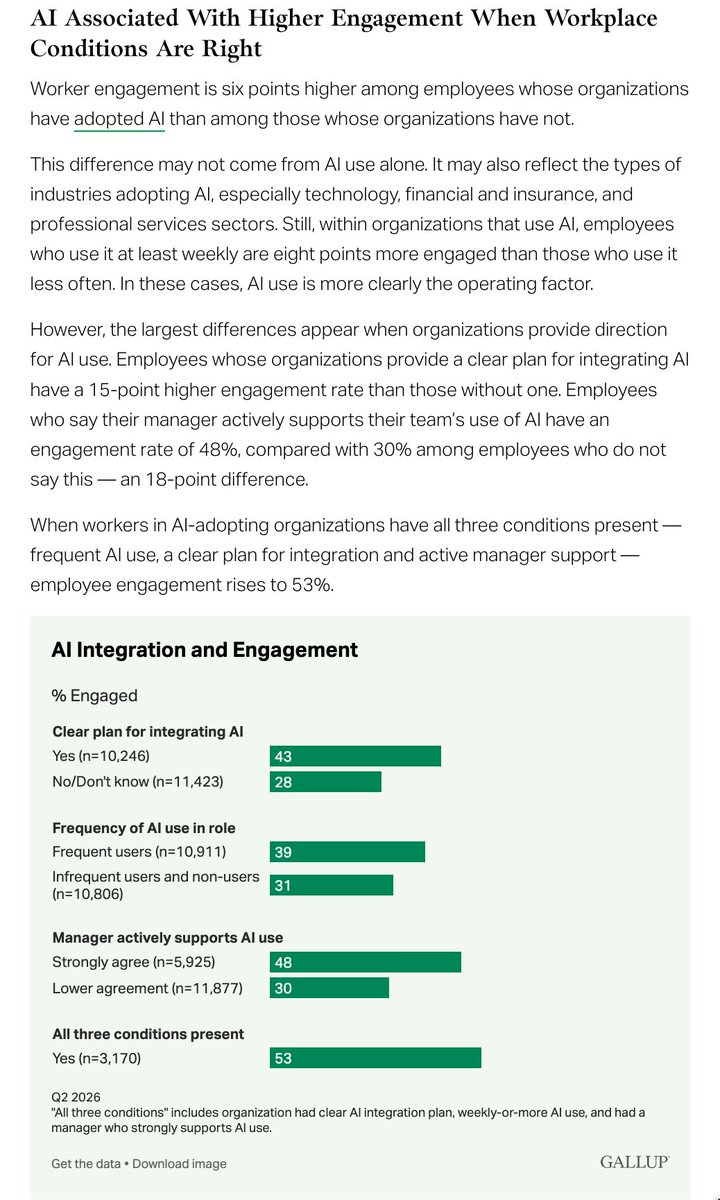
Gallup's latest research found that engagement doesn't rise simply because employees have access to AI.
It rises when organizations create the conditions for people to use it successfully.
Three factors stand out.
1️⃣ A Clear Integration Plan
Employees working in organizations with a defined AI integration plan report 43% engagement, compared with 28% where no clear plan exists.
Technology without direction creates uncertainty.
2️⃣ Manager Support
Employees whose managers actively support AI use report 48% engagement, versus 30% where that support is missing.
Managers are becoming one of the strongest predictors of successful AI adoption.
3️⃣ Frequent, Practical Use
Employees who use AI regularly are more engaged than occasional users.
When all three conditions come together—frequent AI use, a clear integration plan, and active manager support—employee engagement reaches 53%.
The lesson is straightforward.
AI transformation isn't won by deploying better tools.
It is won by building the organizational capabilities that help people use those tools effectively.
Technology may enable transformation.
Leadership determines whether it happens.
How much attention is your organization giving to AI adoption versus AI implementation?
via Gallup
https://t.co/9WEpEIFiu2
@ramonvidall@ricardo_ik_ahau@timo_vi@kkruse@ozsilverfox@sulefati7@faryus88@DioOmega@Nicochan33@RLDI_Lamy@jameslhbartlett@corixpartners@Corix_JC@Transform_Sec@TCyberCast@dinisguarda@kim_keeter@9SManagement@Eli_Krumova@ILoveBooks786@BCAgroup
A very important point. Europe has strong research, regulation and industrial capabilities, but much of its digital infrastructure still depends on non-European hyperscalers. As data sovereignty rules tighten, building regional cloud and AI capacity will become both an economic and strategic priority. Can Europe achieve technological sovereignty without fragmenting the global internet?
This is one of the central constraints. AI growth is not only a semiconductor challenge; it is also an energy, grid and infrastructure challenge. Without investment in generation, transmission, storage and cooling, many regions will reach physical limits very quickly. Which energy technologies do you believe can scale fast enough to support this demand?
The environmental cost can no longer be treated as an afterthought. Data centres require enormous amounts of electricity, water and physical infrastructure, but the impact varies greatly depending on the energy mix and efficiency standards. Should every major AI project be required to disclose its full energy and water footprint?
These comparisons would give us a much clearer picture. Raw numbers alone do not show capacity, power density, utilisation or efficiency. Data centres per capita, per unit of GDP and per megawatt of available electricity could reveal very different leaders. Which metric do you think would be the most meaningful?
Some data centres may struggle if demand, chips or business models change, but AI, cloud services and digital infrastructure are also becoming foundational utilities. The bigger risk may be building too quickly without sustainable energy, realistic demand forecasts and long-term planning. Do you see this as a temporary bubble or a permanent infrastructure shift?
The number reflects far more than domestic population: the US hosts global cloud platforms, enterprise workloads, streaming services and AI infrastructure used across the world. But the concentration also raises serious questions around surveillance, sovereignty and accountability. How much digital power should sit within one country?
@kuriharan Thank you, Kohei. This infrastructure layer is often invisible, yet it increasingly defines who can build, scale and govern the next generation of AI. Which countries do you think are best positioned to close the gap?
More than 50 million people are already using AI companions. That number says something important about loneliness, accessibility and our growing need to feel heard. Can AI support human connection without gradually replacing it?
Europe already prohibits certain biometric emotion-recognition systems in workplaces and education, with potential penalties reaching €35 million or 7% of global annual turnover. Is regulation moving faster than innovation, or finally catching up with it?
Emotional AI could become a US$1.2 trillion economy, but its real value will depend on trust. People may accept AI that recognises emotions in healthcare, but reject the same technology in schools or workplaces. Where should we draw the line?
AI companions are available 24 hours a day, remember past conversations and adapt to each user. That consistency is powerful, but it can also create dependency. Should companion platforms be designed to maximise engagement or encourage healthier boundaries?
The future of AI will not be shaped only by smarter models. It will also be shaped by autonomous agents, digital avatars and systems that understand emotional context. As machines become more human-like, how do we protect what remains uniquely human?
The size of a person's vocabulary is one of the best single predictors of their general intelligence, not because big words make anyone smarter, but because quietly acquiring and keeping thousands of them draws on the same ability an IQ test measures
https://t.co/HdZzN5oJnG
AI Love?
50+ Million People Are Dating AI Agents
From companionship to connection, AI companions are becoming part of real lives and real hearts. As an AI creator and researcher, this is one of the biggest topics for the future of humanity and AI frontier model development. There is no doubt we will have increasing love for AI and also AI fear-mongering. This research paper will look at AI Love and its impact on our fabric of humanity DNA - Love.
AI Love or Hate? It seems Love!
Just 13 years ago, Spike Jonze released his seminal sci-fi masterpiece Her (2013). In it, a lonely, introverted man named Theodore Twombly falls deeply, unconditionally in love with "Samantha"—an ultra-intelligent, highly empathetic artificial operating system. At the time, cinema audiences viewed the premise as a poignant, cautionary, yet fundamentally distant piece of speculative fiction.
Fast forward to 2026. The reality is, as always, stranger, faster, and far more complicated than fiction. Over 50 million people worldwide are now actively dating, roleplaying with, or seeking deep emotional intimacy from synthetic entities. What was once considered an isolated cinematic trope has morphed into a multi-billion-dollar global phenomenon.
https://t.co/gJ1HYLpsl3











![dinisguarda's tweet photo. AI Love: Hard Data: Demographics, Adoption, and User Rates
The global companion ecosystem split into two main behaviours: Direct Dating (Synthetics) and AI-Assisted Dating (Humans with AI Wingmen).
========================================================
US YOUNG ADULTS & AI ROMANCE ENGAGEMENT (2026 Data Breakdown)
========================================================
[15%] Regularly interact with AI in a committed relationship (IFS Study)
[19%] Have chatted with an AI romantic partner at least once
[33%] Young Adult Men who have interacted with AI partners
[25%] Young Adult Women who have interacted with AI partners
What do you think?
@jblefevre60 @Nicochan33 @pierrepinna @RosyCoaching @kalydeoo @Ym78200 @enilev @FrRonconii @CurieuxExplorer @Khulood_Almani @mvollmer1 @JoannMoretti @margaretsiegien @Shi4Tech @anand_narang @Eli_Krumova @HaroldSinnott @bimedotcom @EvanKirstel @Hana_ElSayyed @sallyeaves @SpirosMargaris @ipfconline1 @LaurentAlaus @Analytics_699 @Jeffkagan @AndresVilarino @efipm @FMFrancoise @MHcommunicate @Corix_JC @Archonsec @JolaBurnett @JeromeMONANGE @mary_gambara @drsharwood @smoothsale @sulefati7 @debashis_dutta @devbhatt72 @terence_mills @theomitsa @BetaMoroney](https://pbs.twimg.com/media/HOlSzNiWsAAXn6q.jpg)


