There is an aggressor: Russia.
There is a victim: Ukraine.
We were right to help Ukraine and sanction Russia three years ago—and to keep doing so.
By “we,” I mean the Americans, the Europeans, the Canadians, the Japanese, and many others.
Thank you to all who have helped and continue to do so. And respect to those who have been fighting since the beginning—because they are fighting for their dignity, their independence, their children, and the security of Europe.
Il y a un agresseur : la Russie.
Il y a un peuple agressé : l'Ukraine.
Nous avons tous eu raison d'aider l'Ukraine et de sanctionner la Russie il y a trois ans et de continuer à le faire.
Nous, c’est les Américains, les Européens, Canadiens, Japonais et plusieurs autres.
Merci à tous ceux qui ont aidé et continuent. Et respect à ceux qui, depuis le début, se battent. Parce qu'ils se battent pour leur dignité, leur indépendance, pour leurs enfants et pour la sécurité de l'Europe.
1. It’s stunning that we’ve been unable to escape Visa’s stranglehold on debit payments — despite legislation mandating competition, despite disrupters like PayPal & Apple, despite loads of businesses eager to shed the crushing fees.
The DOJ’s monopolization case explains why.
Mario Draghi's new report on EU competitiveness doesn't mince words.
"Across different metrics, a wide gap in GDP has opened up between the EU and the US, driven mainly by a more pronounced slowdown in productivity growth in Europe. Europe’s households have paid the price in foregone living standards. On a per capita basis, real disposable income has grown almost twice as much in the US as in the EU since 2000."
"First – and most importantly – Europe must profoundly refocus its collective efforts on closing the innovation gap with the US and China, especially in advanced technologies. Europe is stuck in a static industrial structure with few new companies rising up to disrupt existing industries or develop new growth engines. In fact, there is no EU company with a market capitalisation over EUR 100 billion that has been set up from scratch in the last fifty years, while all six US companies with a valuation above EUR 1 trillion have been created in this period. This lack of dynamism is self-fulfilling."
"There are not enough academic institutions achieving top levels of excellence and the pipeline from innovation into commercialisation is weak. [...] However, while the EU boasts a strong university system on average, not enough universities and research institutions are at the top. Using volume of publications in top academic science journals as an indicative metric, the EU has only three research institutions ranked among the top 50 globally, whereas the US has 21 and China 15."
"Regulatory barriers to scaling up are particularly onerous in the tech sector, especially for young companies. Regulatory barriers constrain growth in several ways. First, complex and costly procedures across fragmented national systems discourage inventors from filing Intellectual Property Rights (IPRs), hindering young companies from leveraging the Single Market. Second, the EU’s regulatory stance towards tech companies hampers innovation: the EU now has around 100 tech-focused laws and over 270 regulators active in digital networks across all Member States. Many EU laws take a precautionary approach, dictating specific business practices ex ante to avert potential risks ex post. For example, the AI Act imposes additional regulatory requirements on general purpose AI models that exceed a pre-defined threshold of computational power – a threshold which some state-of-the-art models already exceed. Third, digital companies are deterred from doing business across the EU via subsidiaries, as they face heterogeneous requirements, a proliferation of regulatory agencies and “gold plating” of EU legislation by national authorities. Fourth, limitations on data storing and processing create high compliance costs and hinder the creation of large, integrated data sets for training AI models. This fragmentation puts EU companies at a disadvantage relative to the US, which relies on the private sector to build vast data sets, and China, which can leverage its central institutions for data aggregation. This problem is compounded by EU competition enforcement possibly inhibiting intra-industry cooperation. Finally, multiple different national rules in public procurement generate high ongoing costs for cloud providers. The net effect of this burden of regulation is that only larger companies – which are often non-EU based – have the financial capacity and incentive to bear the costs of complying. Young innovative tech companies may choose not to operate in the EU at all."
More: https://t.co/x1d1ApvG2Z.
Ces dernières semaines, les restrictions aux formes d’expression en soutien aux Palestinien·nes se sont multipliées en France.
Interdiction ou annulation d’évènements publics, accusations d’"apologie du terrorisme", critiquer la politique de l’État d’Israël devient difficile.
🔴 Attaque de l’Iran contre Israël ➡️ "Le cauchemar de la diplomatie des États-Unis continue, Israël risque de ne pas écouter les conseils américains et de riposter contre l’Iran. Aujourd’hui les États-Unis n’ont plus la main”, estime Bertrand Badie
🔴 Attaque de l’Iran contre Israël ➡️ “L’Iran ne pouvait pas ne pas réagir. Mais Il y a une retenue et pas de volonté d’escalade du côté de l’Iran qui n’y a aucun intérêt, pour Israël c'est différent", analyse Bertrand Badie, spécialiste des relations internationales
«Netanyahu joue la montre aujourd'hui parce qu'il attend le retour de Trump.» Jean-Pierre Filiu, Professeur en histoire du Moyen-Orient
#CCeSoir
➡️ https://t.co/ysA3V8PYXX
🎧en podcast https://t.co/iA4QuHBys9
« Les Israéliens ne trouveront une alternative politique à la situation actuelle que s'il y a des conditions très fermes posées à l'international.» Jean-Pierre Filiu, Professeur en histoire du Moyen-Orient
#CCeSoir
➡️ https://t.co/ysA3V8QwNv
🎧en podcast https://t.co/iA4QuHC6hH
Ce qui se passe à Gaza est insupportable. C’est la crédibilité de chaque membre de la communauté internationale qui est en jeu. Comment élever la voix ailleurs au nom de nos principes et du droit si nous ne le faisons pas dans ce cas?
“I have never… seen a place… so bombarded for such a long time with such a trapped population without any escape. People are traumatized beyond belief.” Jan @NRC_Egeland of @NRC_Norway is in Gaza for the first time since Oct 7. “I’m pretty shaken, actually, from what I saw.”
Les victimes civiles des guerres ne sont pas des «dommages collatéraux». Ce sont des hommes et des femmes avec un nom et un prénom qui perdent la vie. Ce sont des enfants qui deviennent orphelins, privés d'avenir; des personnes qui souffrent de la faim, de soif, mutilées. #Paix
Read.
Voter: "What was the cause of the United States Civil War?"
Nikki Haley: "Don't come with an easy question, right? I mean, I think the cause of the Civil War was basically how government was gonna run — the freedoms and what people could and couldn't do. What do you think the cause of the Civil War was?"
Voter: "I'm not running for president."
Haley: "I mean, I think it always comes down to the role of government. We need to have capitalism, we need to have economic freedom. We need to make sure that we do all things so that individuals have the liberties so that they can have freedom of speech, freedom of religion, freedom to do or be anything they want to be without government getting in the way."
Voter: "In the year 2023, it's astonishing to me that you can answer that question without mentioning the word 'slavery.'"
Haley: "What do you want me to say about slavery? Next question."
The situation in Gaza is a total failure of our shared humanity
Countries supporting Israel with arms must understand that these civilian deaths will be a permanent stain on their reputation.
They must demand an immediate ceasefire in Israel & Gaza
Read: https://t.co/ZyiC4pDZgY
1.3 million people are currently living in shelters in #Gaza.
Overcrowding and lack of food, water, sanitation and basic hygiene, waste management and access to medication are resulting in a high number of cases of:
- acute respiratory infections: 111,000
- scabies: 12,000
- lice: 11,000
- diarrhoea <5: 36,000
- diarrhoea >5: 39,000
- skin rash: 24,000
- impetigo: 2,500
- chickenpox: 2,500
- jaundice: 1,100
On top of all this: heightened risk of disease outbreaks.
Given the living conditions and lack of health care, more people could die from disease than bombings.
We need a sustained ceasefire. NOW. It's a matter of life or death for civilians.
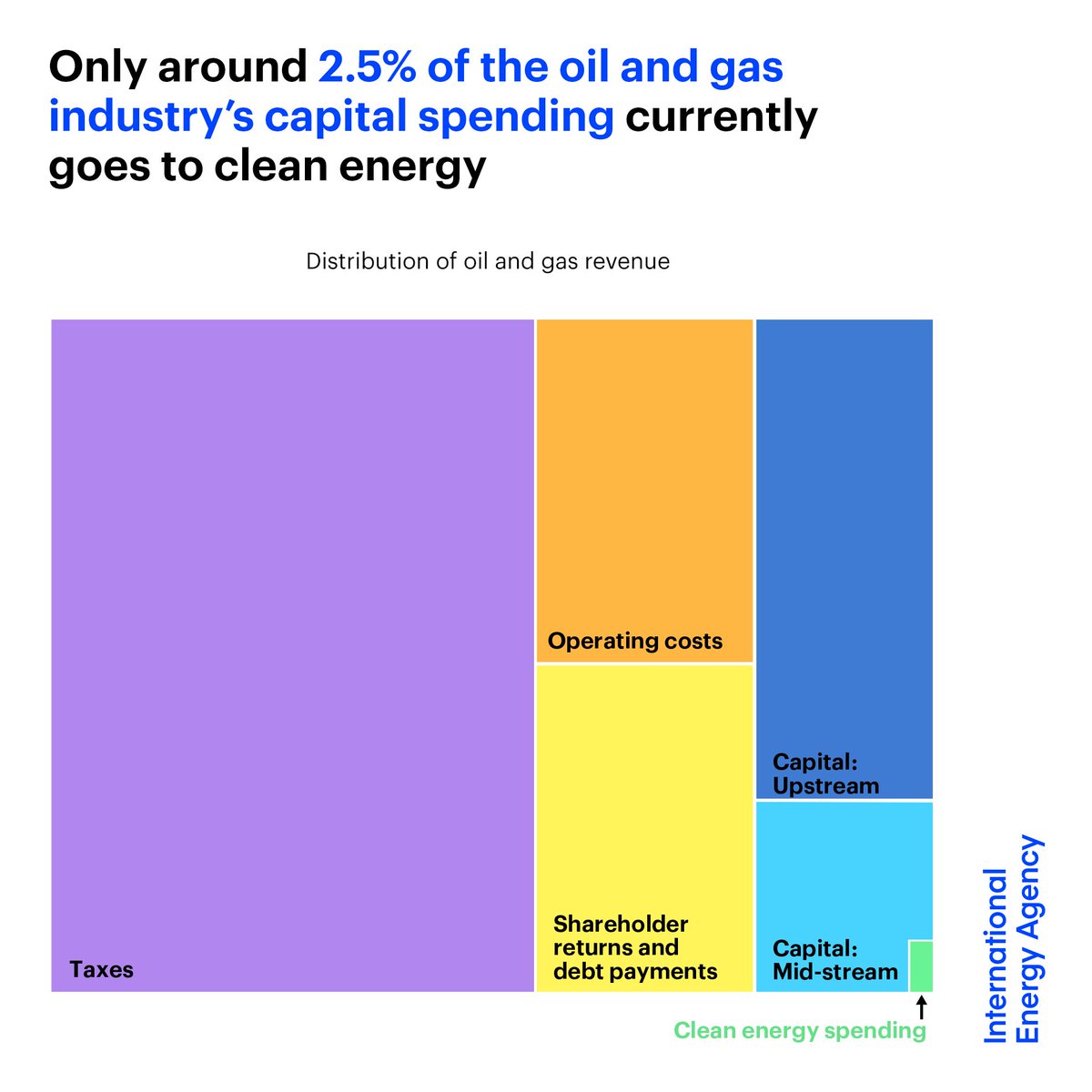
Today, the oil & gas industry invests about 2.5% of its total capital spending in clean energy
If oil & gas producers want to play their full part in meeting the goals of the Paris Agreement, our report shows that 50% of their investments should be going to clean energy by 2030
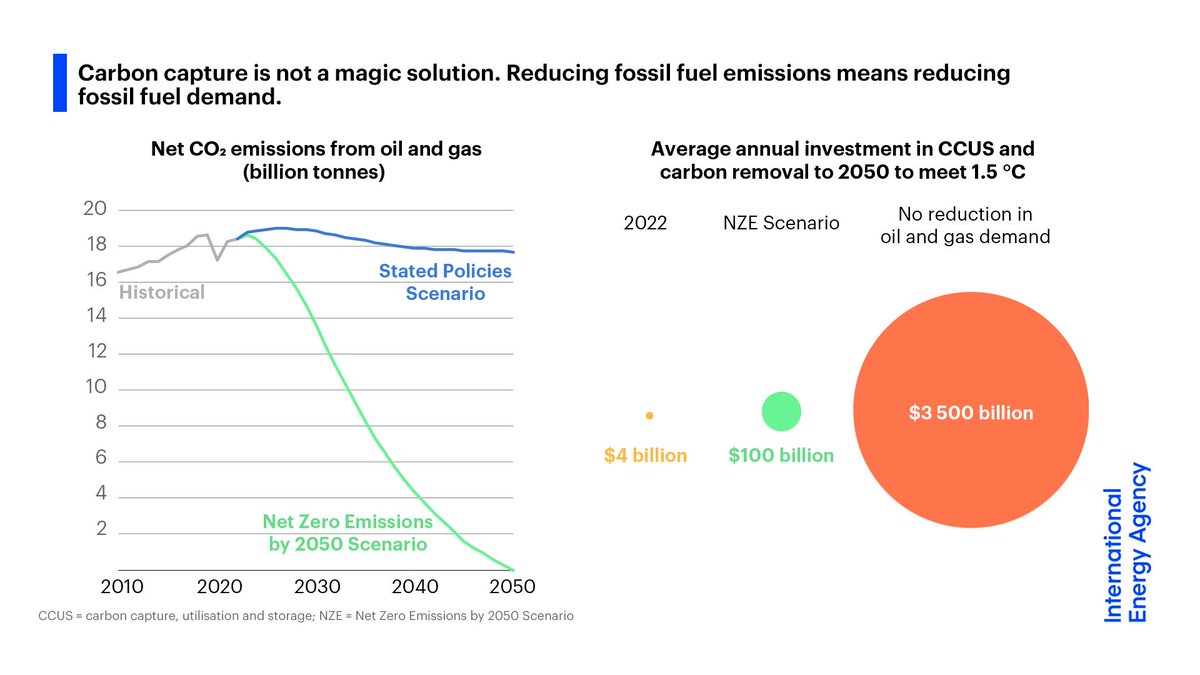
Continuing with business-as-usual for oil & gas while hoping a vast deployment of carbon capture will cut the emissions is fantasy
It would mean an implausibly large amount of carbon capture, requiring a huge leap in annual investment from $4 billion last year to $3.5 trillion!
WHO leads very high-risk joint humanitarian mission to Al-Shifa Hospital in #Gaza
Earlier today, a joint UN humanitarian assessment team, led by WHO, accessed Al-Shifa Hospital in northern Gaza to assess the situation on the ground, conduct a rapid situational analysis, assess medical priorities, and establish logistics options for further missions. The team included public health experts, logistics officers, and security staff from @UNOCHA, @UNDSS, @UNMAS /@UNOPS, @UNRWA and WHO.
The mission was deconflicted with the Israel Defense Forces (IDF) to ensure safe passage along the agreed route. However, this was a high-risk operation in an active conflict zone, with heavy fighting ongoing in close proximity to the hospital.
Earlier in the day, the IDF had issued evacuation orders to the remaining 2,500 internally displaced people who had been seeking refuge on the hospital grounds. They, along with a number of mobile patients and hospital staff, had already vacated the facility by the time of the team's arrival.
Due to time limits associated with the security situation, the team was able to spend only one hour inside the hospital, which they described as a “death zone" and the situation as “desperate.” Signs of shelling and gunfire were evident. The team saw a mass grave at the entrance of the hospital and was told more than 80 people were buried there.
Lack of clean water, fuel, medicines, food and other essential aid over the last six weeks have caused Al-Shifa Hospital—once the largest, most advanced, and best equipped referral hospital in Gaza—to essentially stop functioning as a medical facility. The team observed that, due to the security situation, it has been impossible for the staff to carry out effective waste management in the hospital.
Corridors and the hospital grounds were filled with medical and solid waste, increasing the risk of infection. Patients and health staff with whom they spoke were terrified for their safety and health and pleaded for evacuation. Al-Shifa Hospital can no longer admit patients, with the injured and sick now being directed to the seriously overwhelmed and barely functioning Indonesian Hospital.
There are 25 health workers and 291 patients remaining in Al-Shifa, with several patient deaths having occurred over the previous 2 to 3 days due to the shutting down of medical services. Patients include 32 babies in extremely critical condition, two people in intensive care without ventilation, and 22 dialysis patients whose access to life-saving treatment has been severely compromised.
The vast majority of patients are victims of war trauma, including many with complex fractures and amputations, head injuries, burns, chest and abdominal trauma, and 29 patients with serious spinal injuries who are unable to move without medical assistance. Many trauma patients have severely infected wounds due to lack of infection control measures in the hospital and unavailability of antibiotics.
Given the current state of the hospital, which is no longer operational or admitting new patients, the team was requested to evacuate health workers and patients to other facilities. WHO and partners are urgently developing plans for the immediate evacuation of the remaining patients, staff and their families.
Over the next 24–72 hours, pending guarantees of safe passage by parties to the conflict, additional missions are being arranged to urgently transport patients from Al-Shifa to Nasser Medical Complex and European Gaza Hospital in the south of Gaza. However, these hospitals are already working beyond capacity, and new referrals from Al-Shifa Hospital will further strain overburdened health staff and resources.
WHO is deeply concerned about the safety and health needs of patients, health workers and internally displaced people sheltering at the few remaining partially functional hospitals in the north, which are facing the risk of closure due to a lack of fuel, water, medical supplies, food, and the intense hostilities. Immediate efforts must be made to restore the functionality of Al-Shifa and all other hospitals to provide urgently needed health care services in Gaza.
WHO reiterates its plea for collective efforts to bring an end to the hostilities and humanitarian catastrophe in Gaza. We call for an immediate ceasefire, the sustained flow of humanitarian assistance at scale, unhindered humanitarian access to all of those in need, the unconditional release of all hostages, and the cessation of attacks on health care and other vital infrastructure.
The extreme suffering of the people of Gaza demands that we respond immediately and concretely with humanity and compassion.