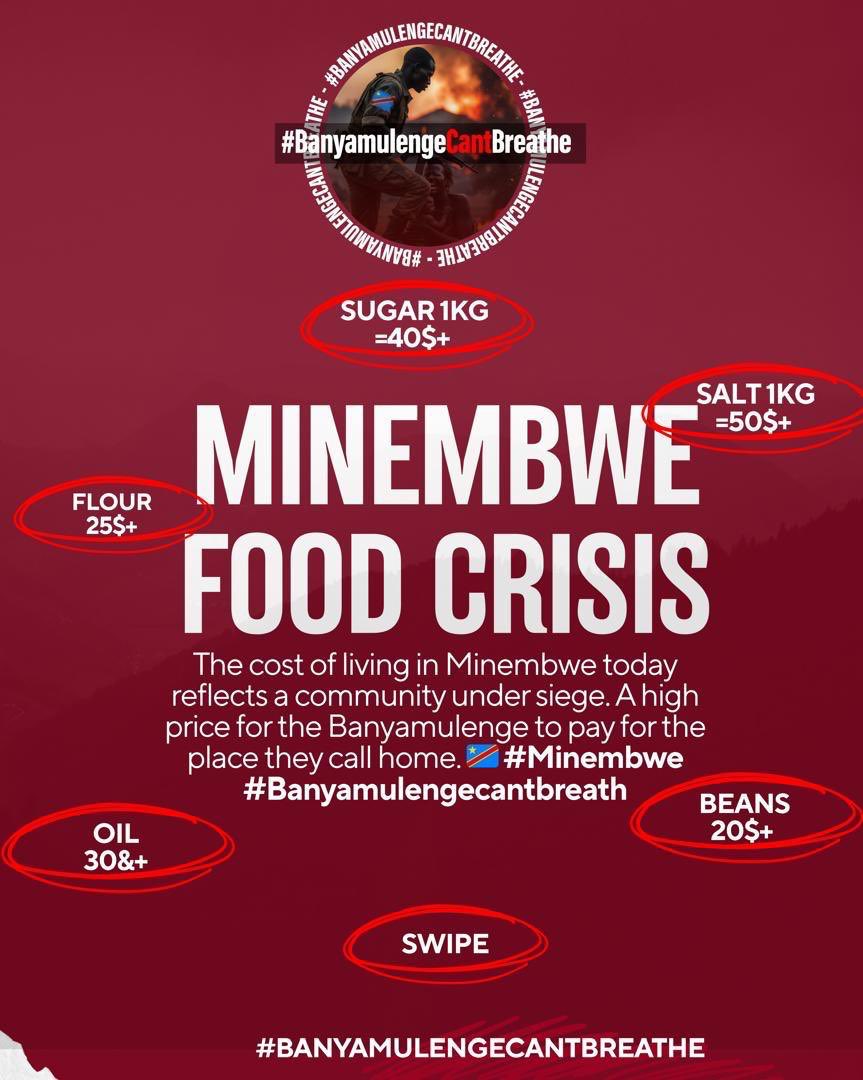
In Minembwe, 12kg of maize flour now costs $35. That is a 205% price increase.
This isn't a market shift. It's the result of a blockade. Roads into the High Plateaux have been closed, so goods can't get in, people can't get out, and farmers can't safely reach their fields or markets.
For a family in Minembwe, one bag of flour can now cost more than a month's income. Parents are skipping meals so their children can eat. Children are going to bed hungry. The sick can't get medicine.
Hunger should never be used as a weapon of war. Starving civilians to pressure a community breaks the most basic principles of international humanitarian law.
We condemn the blockade on Minembwe and call on the UN, MONUSCO, the US Government and humanitarian agencies to:
• Open safe humanitarian corridors now
• Allow food and medicine to reach civilians without obstruction
• Hold accountable those who use hunger against civilians
@WFP@UNOCHA@UNOCHA_DRC@UNICEF@MSF@ICRC
#EndBlockadeOnCivilians #SOSMinembwe #Banyamulenge
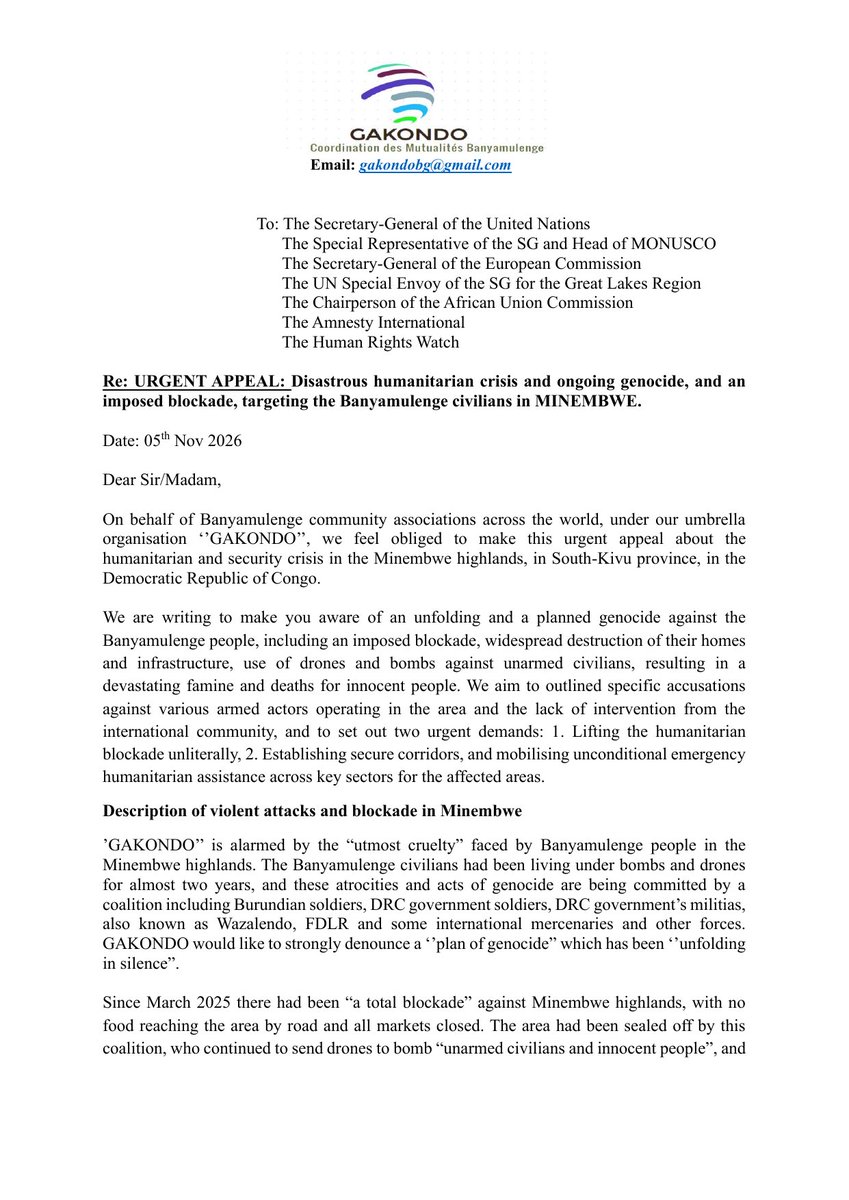
📢 APPEL URGENT : Gakondo interpelle officiellement la communauté internationale sur Minembwe
Au nom des associations banyamulenge du monde entier, Gakondo a adressé un appel urgent au Secrétaire général de l'ONU, à la MONUSCO, à la Commission européenne, à l'Envoyé spécial de l'ONU pour les Grands Lacs, à la Commission de l'Union africaine, à Amnesty International et à Human Rights Watch.
Ce que vit notre peuple à Minembwe :
• Un blocus total depuis mars 2025. Depuis 19 mois, aucune nourriture n'arrive par la route et tous les marchés sont fermés.
• Des frappes de drones et des bombardements qui touchent enfants, mères et personnes âgées
• Maisons, hôpitaux, écoles et centres de santé détruits
• Des pistes d'atterrissage bombardées, rendant toute évacuation impossible
• Radios communautaires réduites au silence et réseaux téléphoniques coupés : nos morts ne peuvent même pas être comptés
• Des nourrissons sans lait et des malades qui meurent de maladies soignables
Affamer des civils est interdit par le droit international. Cibler délibérément une communauté de cette manière porte un nom, et nous ne nous tairons pas.
Nous demandons aussi pourquoi l'aide atteint les zones voisines du Sud-Kivu alors que Minembwe est laissé de côté.
Nos deux exigences ne souffrent aucun délai :
1️⃣ La levée immédiate du blocus et l'ouverture de corridors terrestres et aériens sécurisés vers Minembwe, Itombwe et les hauts plateaux d'Uvira
2️⃣ La mobilisation d'une aide humanitaire d'urgence inconditionnelle : alimentation, nutrition, santé, eau, assainissement, protection, éducation et abris
Pas de commission d'étude. Pas de nouvelles consultations. Chaque jour de blocus se paie en vies humaines.
Signé par les responsables des communautés banyamulenge de plus de 20 pays.
@antonioguterres@MONUSCO@EU_Commission@_AfricanUnion@amnesty@hrw@Presidence_RDC@PatrickMuyaya@MahoroMpa@MoiseNyarugabo@SecRubio@UNHumanRights@FRANCE24
#SOSMinembwe #Banyamulenge #EndBlockadeOnCivilians
If I were given the choice to be born Munyamulenge a thousand times, I would choose it 10,000 times over without hesitation. ❤️ My people, my pride, my identity! How I love our resilience, courage, and unbreakable spirit. Ten years of hardship, yet our spirit remains alive. The Twirwaneho spirit lives within us, and the Makanika legacy runs through our veins. Being Munyamulenge is not just where I come from; it is a legacy I will carry with pride forever. Our spirit will never fade! Aluta Continua! ❤️✊ #twirwanehonubuzima✊
@US_SrAdvisorAF You Target continue as you're shading blood of innocent, today @POTUS45 his blockade for Banyamulenge is causing loss of lives through famine, why can you continue this #genocide against Congolese citizens Banyamulenge? Shame on you, @SecRubio, @POTUS45, @UN.
🇨🇩🚨 SOS MINEMBWE: CIVILIANS ARE PLEADING FOR URGENT HELP!
For nearly 10 years, the Banyamulenge population in Minembwe has endured insecurity, repeated attacks, displacement, and humanitarian deprivation.
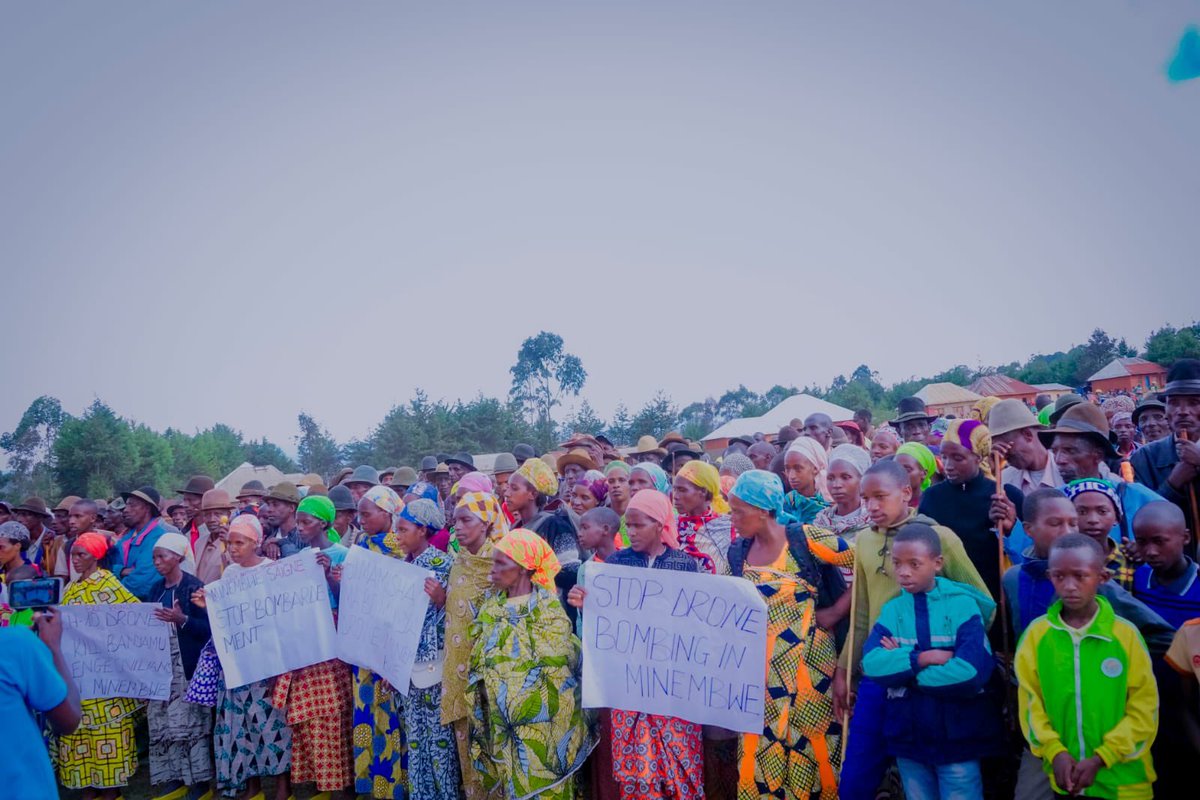
Today, November 6, 2026, residents took to the streets once again to protest drone attacks on civilian communities, the humanitarian blockade, and the worsening humanitarian crisis.
Protesters are also raising concerns about the reported involvement of Erik Prince-linked private military operations and drone capabilities in military support to DRC and Burundian military activities affecting the region.
They demand transparency, independent investigations, and accountability for any involvement in attacks that endanger civilians.
Women and children face the threat of aerial attacks, while families struggle with hunger, lack of medicine, and shortages of essential supplies. Despite similar protests last year, their pleas remain unanswered.
Mahoro Peace Association (MPA) stands in unwavering solidarity with the people of Minembwe. We share in their suffering, stand with their families, and remain committed to advocating for their protection, dignity, and access to life-saving humanitarian assistance.
We appeal to the UN, US Government, MONUSCO, humanitarian organizations, and the international community for urgent intervention.
We urgently call for:
1. An end to attacks threatening civilians.
2. An end to restrictions on humanitarian assistance and safe humanitarian corridors.
3. Emergency delivery of food, medicine, and essential supplies.
4. Independent investigations and accountability for all those responsible.
After nearly a decade of suffering, Minembwe’s people are still asking for the most basic rights: protection, food, medicine, and the right to survive.
How much longer must the world remain silent?
🚨 SOS MINEMBWE. PLEASE HEAR THEIR CRY AND SHARE THIS POST.
@UN@UNPeacekeeping@Presidence_RDC@PatrickMuyaya@MfaBelgium@US_SrAdvisorAF@SecRubio@IsokoUSA@cnn@GakondoOfficial@wembi_steve, @julianpecket @jeune_Afrique@foreign_lobby@StanysBujakera@ORuhumuriza@MaishaRdc@MaitreRuberwa
"Nous sommes les banyamulenge, nous sommes congolais, nous sommes des humains, nous avons une histoire, une identité, une dignité et le droit d'exister
Nous ne voulons pas que le monde vienne demain déposer des fleurs sur les tombes de nos enfant. Pop MINEMBWE lors de la manfest
#RDC- Minembwe face à la famine comme arme de guerre : une analyse à la lumière du précédent historique de l’Holodomor
L’Holodomor est un terme ukrainien composé de deux mots : holod, qui signifie « faim », et mor, qui signifie « extermination » ou « mort massive ». Ce terme a été consacré pour désigner la famine provoquée par les politiques du régime soviétique, qui a entraîné la mort de millions d’Ukrainiens entre 1932 et 1933. A Minembwe ça peut se traduire à "kwicha rubozo".
La situation à Minembwe est similaire de celle de lUkraine entre 1932-1933. Elle détériore de manière préoccupante. Aux attaques récurrentes de drones visant les populations civiles s’ajoute un blocus humanitaire qui semble s'inscrire dans une stratégie délibérée de privation des moyens de subsistance et de persécution des habitants en raison de leur appartenance ethnique. Cette combinaison de violences militaires et de privation intentionnelle de ressources essentielles est préoccupante.
Imposer délibérément la famine dans le but d’exterminer des individus ou d’affaiblir une population est strictement interdit par le droit international. Il s'agit juridiquement de forme de « génocide silencieux », l’utilisation intentionnelle de la faim comme arme prive les populations civiles de ressources essentielles à leur survie, entraînant une mortalité massive et des traumatismes susceptibles de se transmettre de génération en génération.
La situation à Minembwe exige une attention urgente, en premier lieu de la part des pays de la région et de l’Union africaine. Les tueries d’Africains par d’autres Africains devraient susciter une véritable prise de conscience du continent dans son processus de décolonisation. La persistance de ces violences, alimentées par des logiques d’exclusion, de domination et de persécution identitaire, traduit une forme d’autocolonisation. Comment l’Afrique peut-elle prétendre achever sa décolonisation si elle continue de reproduire, au sein de ses propres sociétés, les mécanismes de domination, de déshumanisation et de destruction qu’elle a historiquement combattus ?
Food is a human right. The people of Minembwe cannot continue to be denied access to essential supplies and humanitarian aid.
To the international community and humanitarian organizations: silence is not an option.
BREAK THE BLOCKADE. LET AID REACH MINEMBWE.
Minembwe is under relentless drone bombardment. Civilians, including children and the elderly, are being forced to flee their homes. These attacks are intolerable. The DRC government must be held accountable. The international community must act.
#banyamulengecantbreathe
The cost of basic food in Minembwe has reached an alarming level. 12kg of maize flour now costs $35. The blockade and restrictions on essential supplies are placing civilians under unbearable pressure. This is unacceptable. Humanitarian access must be restored.
Sometimes, I find myself returning to the same question: What is truly in Minembwe? What makes this small, remote and largely forgotten area such a strategic obsession for the Kinshasa regime? Since early 2021, we have witnessed the deployment of thousands of soldiers, the involvement of Burundian troops, the integration of Mai-Mai militias into military operations, the use of foreign mercenaries, combat drones and even Sukhoi fighter jets. What are we supposed to expect next? What is it about Minembwe that justifies such an extraordinary concentration of military force against a small civilian community? Why should an entire community continue to suffer simply for who they are and where they come from? Every time the United Nations or MONUSCO engages in discussions with the FRN, Minembwe seems to face another wave of military pressure, leaving innocent civilians to pay the price. Is Minembwe the only territory under FRN administration? How long must the Banyamulenge endure this suffering, and how many more lives must be lost before the international community decides that enough is enough? An imposed blockade, severe food shortages, virtually no access to medical care and civilians trapped in an increasingly desperate humanitarian situation what more must happen before the world pays attention? The people of Minembwe are not asking for privilege; they are asking for the most basic human rights: life, dignity, security, food and access to healthcare. The international community cannot continue watching from a distance while an entire civilian population faces such suffering. What does the world need to see before it finally acts?
#DRC - Consequences of State Partnerships with Armed Groups in the DRC - 50 years of security instability.
Shortly after gaining independence, in 1960, the DRC) was engulfed in a nationwide crisis involving military mutinies, attacks on European-owned properties, extreme violence against white missionaries, and the rape of Catholic nuns. For Belgium, Congolese independence had come prematurely. The Belgian authorities had anticipated that independence would take place in 1985, approximately 25 years later than it actually did.
The DRC: Africa’s Strategic Hub of Cold War Politics
Given its geographical size and strategic importance, the Congo quickly became a focal point of Cold War politics. Colonel Mobutu was used as a facilitator in the assassination of the country's first Prime Minister, Patrice Lumumba, who was regarded by Belgium and the United States as a communist and pro-Soviet leader.
From Anti-Imperialist Revolution to Identity Politics
Pierre Mulele, who had served as Minister of Education after independence, subsequently launched a rebellion against the government in Kinshasa. In South Kivu, this rebellion brought together numerous small armed groups. Their alliances became a major security challenge, contributing to localised violence in Fizi, Uvira and Mwenga. The militarisation of the conflict fuelled intercommunal tensions and political violence at the national level and militarisation of ethnic and political identities, deepened an identity crisis whose consequences continue to be felt today.
Following the defeat of the Mulele rebellion, it took former President Mobutu approximately 25 years to complete the demobilisation of former militias and the withdrawal of weapons from civilian populations. It is worth noting that the number of armed groups involved in this movement in South Kivu and Katanga was fewer than ten.
Mobutu's political will to demobilise and pacify the country
Mobutu demonstrated a clear political will to disarm the non-state actors and ultimately ensuring that the state retained its monopoly on the use of force. He implemented strategies and mechanisms aimed at restoring state authority and controlling armed mobilisation. His government did not necessarily have a problem with foreign armed groups. It eventually pursued the demobilisation of militias and the disarmament of civilians.
The case of President Felix Tshisekedi and today's situation
Today, the situation in the DRC is considerably more complex. The country has more than 150 armed groups.
According to the United Nations, 85% of the ammunition used by these armed groups is supplied by the DRC government. Kinshasa not only lacks the political will to disarm them, but also lack the financial resources, operational capacity, intelligence capabilities and coherent strategy required to achieve this objective. On the contrary, Kinshasa rely on them and many of these groups have been legitimised by the government and incorporated into its security arrangements as partners of the state.
Hypothetically, even if Kinshasa demonstrated strong political will, mobilised the necessary financial resources, developed adequate intelligence capabilities and decisively disengaged from both foreign and domestic armed groups, restoring security and state authority across the DRC could take more than 50 years. Unless there is a joint African technological effort to demobilise non-state armed actors.
Even under such favourable conditions, the outcome would depend largely on the willingness of the United Nations and major global powers to reconcile competing geopolitical and economic interests with the objective of building a stable DRC. The country's long-term stability cannot be considered separately from the international interests that continue to shape its conflict.
Final remark
The DRC’s prolonged instability represents a major obstacle to Africa’s development. As long as the country remains insecure, neighbouring states will continue to face spillover effects, regional instability will deepen, and the continent’s broader development ambitions will be undermined.
Condamnation des attaques aériennes contre Minembwe et Kakenge*
Le Front pour la Refondation de la Nation (FRN) condamne avec la plus grande fermeté les attaques aériennes menées ce jour, 4 novembre 2026, par les régimes de Kinshasa et de Gitega.
Ces frappes ciblées ont touché le centre-ville de Minembwe ainsi que le village de Kakenge.
Bilan provisoire :
- Le bureau de l'Église CEPAC a été touché ;
- De nombreuses maisons ont été détruites ;
- Plusieurs civils sont traumatisés.
Le FRN dénonce ces attaques qui visent directement les populations civiles et les infrastructures communautaires, en violation flagrante du droit international humanitaire.
Le FRN appelle la communauté internationale, les organisations de défense des droits humains et les missions diplomatiques à prendre acte de ces crimes et à exiger l'arrêt immédiat de ces bombardements contre les civils.
You have absolutely no idea what you’re talking about, and the confidence with which you lecture people about a reality you clearly don’t understand is astonishing.
The people of Minembwe did not invite this war, nor did they voluntarily turn their communities into battlefields. This conflict was imposed on the Banyamulenge. For years, the government in Kinshasa has contributed to a situation in which civilians have been isolated, abandoned and subjected to violence, while efforts to draw international attention to their suffering have repeatedly been met with silence. To this day, parts of the area remain without reliable communication networks, meaningful humanitarian access or even adequate UN presence.
The Banyamulenge have spent nearly nine years struggling to survive under these conditions. They did not wake up one morning and decide to host a rebellion. They have been fighting to protect their communities and their right to exist. And now you, sitting comfortably in New York, think you can lecture them about what they should do, as though you understand their daily reality better than the people living through it?
We don’t care what political or financial arrangements you may have with Tshisekedi’s government. Whatever promises or deals were made, they do not give you the authority to dictate how an abandoned population should defend itself.
And this obsession with blaming Rwanda for everything has become intellectually embarrassing. It is the same political reflex we hear from Kinshasa: when they cannot provide basic governance, address insecurity, fix their infrastructure or even manage their own sewage systems, somehow Rwanda becomes the explanation for everything.
If you genuinely care about saving lives, go to Minembwe. Speak directly to the Banyamulenge. Listen to their experiences, investigate what has happened over the past nine years, and then come back and tell us what you have learned. You might hear things that will completely challenge the narrative you are so confidently promoting from New York.
Enough of lecturing victims while ignoring the circumstances that made them victims in the first place.
Today, #Minembwe is under attack again. I honestly struggle to understand how the international community has become so comfortable watching an entire population live under such conditions.
It is difficult to identify another situation in which a particular community’s belonging to its own country has been contested for generations, and its very existence has become a political and security question. Since the 1960s, the citizenship of the Banyamulenge and Congolese Tutsi communities has repeatedly been challenged, largely because some have refused to recognize them as genuinely Congolese, reducing their identity to their physical appearance and perceived ethnic origins.
The United Nations, the Congolese government and many of its international partners have remained largely silent about the suffering of this population. When the Banyamulenge eventually organized themselves to defend their communities, a powerful political narrative emerged: everything became about Rwanda. To this day, we are still labelled Rwandans in our own country, and our struggle for survival is conveniently presented as evidence that Rwanda is protecting us. How convenient! It is a way of avoiding the uncomfortable questions about what is actually happening on the ground.
Meanwhile, civilians are dying. We are living under a blockade, losing people to hunger, deprivation and the consequences of continued military operations, including drone strikes. How long is this supposed to continue? How many more lives must be lost before Minembwe becomes more than a footnote in international diplomatic discussions?
And what has happened to American foreign policy and the values Washington claims to defend? Today, it increasingly appears that strategic interests and mineral agreements are taking precedence over the protection of civilians and accountability. The United States has demonstrated its willingness to impose sanctions on Rwanda, but why is the Congolese leadership in Kinshasa seemingly exempt from comparable scrutiny? Why is there so little discussion of sanctions or other meaningful consequences for President Félix Tshisekedi’s government over the conduct of its security forces and its relationship with armed groups?
The Congolese army operates alongside, or has been accused of cooperating with, various armed groups, including the #FDLR, #Wazalendo and #MaiMai factions. These groups have been implicated in violence against Tutsi communities. What is particularly disturbing is that some of these armed actors have openly expressed hostility towards Tutsis, with rhetoric and actions suggesting that their place is not in Congo but in Rwanda. Yet Washington continues to engage with Kinshasa. Where is the consistency? Where is the accountability?
And to our American partners, I have a straightforward question: How many more sanctions against #Rwanda will it take to bring peace to Minembwe? Is repeatedly punishing one country going to resolve the citizenship question, end the blockade, protect civilians or address the armed groups operating alongside Congolese forces?
At some point, the international community must stop confusing diplomatic agreements with actual peace. The #Washington and #Doha processes may produce signatures, photographs and political declarations, but what do those agreements mean to a mother in Minembwe who cannot access food, a child living under the threat of drone strikes, or a family burying its loved ones?
I also wonder whether #Minembwe would receive the same attention if it were not inhabited by a community whose Congolese identity is constantly questioned.
And perhaps it is time to ask a bigger question: why must African lives always depend on the political calculations of foreign powers?
African problems should be addressed with genuine African ownership, accountability and solutions that reflect realities on the ground. But African-led solutions must never become another excuse for abandoning civilians.
Homes, Churches have been destroyed, crops ravaged, and livestock decimated. With health centers destroyed and medical supplies exhausted, thousands of civilians are left without shelter, food, or access to lifesaving care. If urgent assistance is not provided, there is a serious risk of famine, starvation, and outbreaks of disease among the affected population. It is time for humanitarian organizations to uphold the principles of humanity and impartiality and demonstrate that aid does not discriminate and that Banyamulenge lives matter equally.
@AsstSecStateAF@US_SrAdvisorAF@StateDept@secgen@antonioguterres@UNOCHA@DougGasore@kivuutile@TopKivu@Fkaniki@bbisimwa@CNangaa@TiborPNagyJr@USAmbUN@USAmbDRC@jbserugo@KayinamuraJose8
@DougGasore@AugustCohen4@AugustCohen4 your text shows that your hands agrees with the government of Kinshasa for this #genocide against Banyamulenge, why are you troubling like this? Which rebel group alow government to kill the citizens? What you're doing is killing innocent, Titus's are human being.