Congrats @SanazVajedian on publishing a paper in Journal of Hydrology. She led the work on a novel new approach for measuring and modeling subsidence in agricultural regions. @JeremyLMaurer https://t.co/0IqCHpIWWm
***AGU session alert***
'NS006 - Advancing the Use of Geophysical and Geodetic Methods for Groundwater Science and Management'. Invited speakers are Rosemary Knight and @grace_carlson1 Please consider submitting! https://t.co/dNE9XFflad
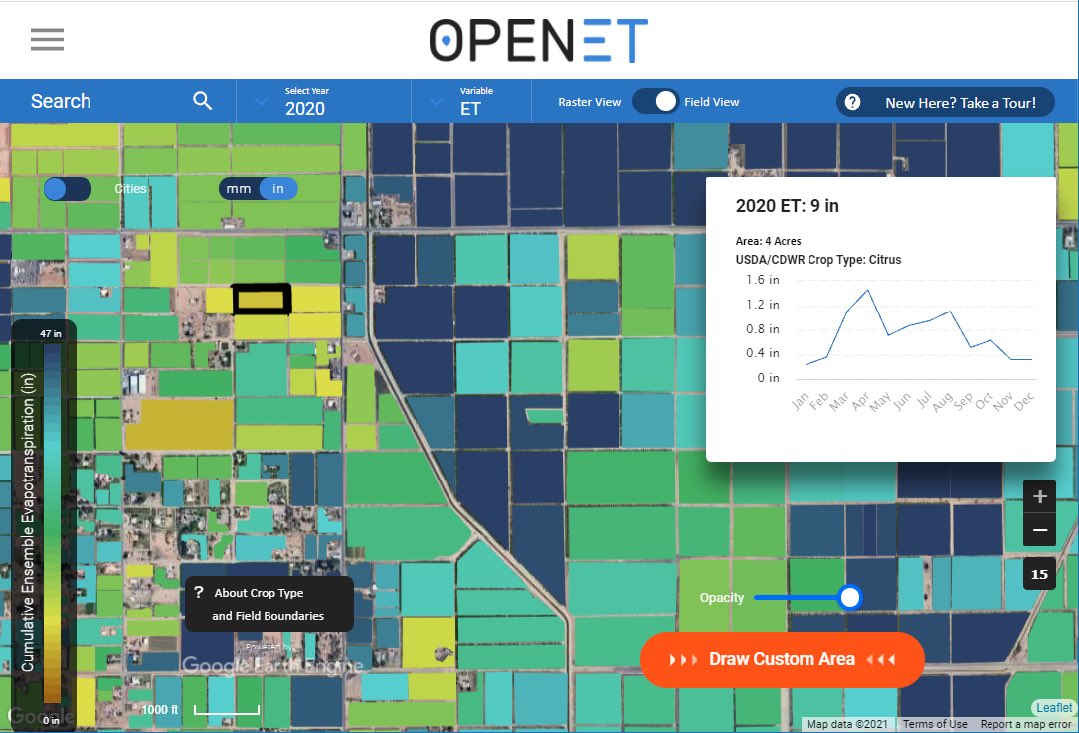
Today is #WorldWaterDay! Let’s shine a light on the unseen hero of our ecosystems- evapotranspiration (ET), crucial for sustainable agriculture and food security. #OpenET
Working closely with professionals in Bangladesh, Geospatial Analytics Ph.D. student Varun Tiwari (@varunkt1) developed research to address an important data gap he’d learned about while an analyst at an international nonprofit. Learn more: https://t.co/lf9LNnHlnD
New machine learning-based groundwater withdrawal estimates for the Mississippi Alluvial Plain. Check out our new work, led by @hydromaj and @SubsidenceGuy, at - https://t.co/wFJDR5qffQ
Super stoked to share that our work with the @USGS got published in @ElsevierConnect Journal of Hydrology: Regional Studies. We conceptualized this work in January 2021, and I am really excited to see this getting published after multiple rounds of @USGS reviews of the data, software, and journal article, and reviews from the Journal of Hydrology: Regional Studies.
Authors: @hydromaj [1], @SubsidenceGuy [2], @FahimHydroSense [2] Jordan Wilson [3], Vincent E. White [3], @eldbristow [3], @HydrOxford [3], @WadeKress [3], and Jaime Painter [3].
[1] @DRIScience [2] @CSU_CivE , [3] @USGS
Summary: In this study, we incorporate remote sensing datasets and machine learning to improve the Aquaculture and Irrigation Water Use Model (AIWUM) 1.1, previously developed by USGS. Unlike AIWUM 1.1, which assigns annual irrigation water use per acre based on average water use for each crop type, our approach integrates remote sensing data in a machine learning framework to produce improved estimates of annual and monthly groundwater use (2014-2020) at 1-km spatial resolution. More details are available from the journal article, data release, and software release as follows:
Journal article: https://t.co/nBumG2YNCn
Data release: https://t.co/OX4t23ZpbX
Software release: https://t.co/eAyTKdhP4V
Acknowledgments: We would like to acknowledge funding from the @USGS (Grant Number G21AC10245) for supporting this project. We also extend our thanks to @DRIScience for covering the open-access journal publication costs.
#remotesensing #machinelearning #aquaculture #irrigation #groundwater #groundwatermanagement
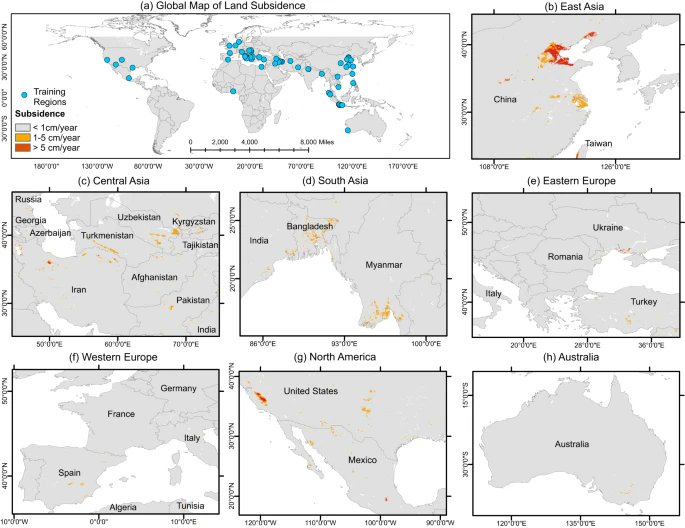
Thanks for featuring our recent paper on global groundwater-induced subsidence @JorgeTWeather@abc15.
@SubsidenceGuy explained some key features and implications in the news.
main article link: https://t.co/GFgHGu3oWr
Great AGU 2023 so far. Presented my work “A Data-driven Approach for Estimating Irrigation Groundwater Use for the Western United States”. Really appreciate the postive feedbacks from everyone. Enjoyed meeting old and new friends and well-wishers. Looking forward to AGU 24!
Paper alert! One of the most famous photos showing subsidence is from the San Joaquin Valley. Although that region sank ~9 m in a 52 year time span, it is now subsiding far less than other parts of the San Joaquin Valley. Photo below https://t.co/tIfl4C8L8U
Our global land subsidence, triggered by groundwater pumping, dataset was hosted in https://t.co/jjsnkMyc1Y. Thanks to @samapriyaroy!!
GEE community catalog: https://t.co/ziTefrG4Rj
@NatureComms paper: https://t.co/M6lSm638Sd
@SubsidenceGuy@SanazVajedian @HydroRahel @hydromaj
How much is your country subsiding due to over-pumping?
Find more information about it in our latest paper in Nature Communications "Global land subsidence mapping reveals widespread loss of aquifer storage capacity"- https://t.co/CfRNSUxfrm
Thank you @CSU_CivE for sharing news of our recent paper of global groundwater-subsidence in @NatureComms . To read the paper : https://t.co/skJXwAexZD
From drinking water to irrigation, groundwater is a vital resource. Yet, the amount of groundwater available is not without limits.
CEE's @SubsidenceGuy and @FahimHydroSense developed a new model to map subsidence globally for the first time.
Read more: https://t.co/Z5Kp92PHfa




![hydromaj's tweet photo. Super stoked to share that our work with the @USGS got published in @ElsevierConnect Journal of Hydrology: Regional Studies. We conceptualized this work in January 2021, and I am really excited to see this getting published after multiple rounds of @USGS reviews of the data, software, and journal article, and reviews from the Journal of Hydrology: Regional Studies.
Authors: @hydromaj [1], @SubsidenceGuy [2], @FahimHydroSense [2] Jordan Wilson [3], Vincent E. White [3], @eldbristow [3], @HydrOxford [3], @WadeKress [3], and Jaime Painter [3].
[1] @DRIScience [2] @CSU_CivE , [3] @USGS
Summary: In this study, we incorporate remote sensing datasets and machine learning to improve the Aquaculture and Irrigation Water Use Model (AIWUM) 1.1, previously developed by USGS. Unlike AIWUM 1.1, which assigns annual irrigation water use per acre based on average water use for each crop type, our approach integrates remote sensing data in a machine learning framework to produce improved estimates of annual and monthly groundwater use (2014-2020) at 1-km spatial resolution. More details are available from the journal article, data release, and software release as follows:
Journal article: https://t.co/nBumG2YNCn
Data release: https://t.co/OX4t23ZpbX
Software release: https://t.co/eAyTKdhP4V
Acknowledgments: We would like to acknowledge funding from the @USGS (Grant Number G21AC10245) for supporting this project. We also extend our thanks to @DRIScience for covering the open-access journal publication costs.
#remotesensing #machinelearning #aquaculture #irrigation #groundwater #groundwatermanagement](https://pbs.twimg.com/media/GFrZhHNaEAAmnz_.jpg)





