Students shouldn't have to choose between buying groceries and buying their course materials. 🛑 Give them a high-quality, digital-first textbook that doesn't break the bank. High engagement, fair price. https://t.co/AP6ovLtBOp
#biology#science#3D#animation#Edtech#HigherEd
🔬 ¡Una sola célula convertida en un depredador letal!
La Lacrymaria extiende su “cuello” como un arpón hidráulico hasta 30 veces su tamaño en segundos, paraliza a su presa y se la traga entera. Todo sin cerebro ni sistema nervioso.
El ojo es el único lugar del cuerpo humano donde podemos observar directamente la microcirculación: pequeños glóbulos rojos moviéndose en tiempo real a través de diminutos vasos sanguíneos. 👁️🩸
Así reparan tus células el ADN dañado: mediante recombinación homóloga. Usan una copia intacta del ADN como plantilla para reconstruir con precisión la secuencia dañada, evitando mutaciones y manteniendo estable la información genética.
Everything inside this cell is about to spill out. Your body does a version of this ~60 billion times a day, except it's coordinated.
This is a Frontonia, a ciliate about the size of a grain of sand. You can see its food vacuoles full of digested algae, cilia still beating, and the moment the membrane fails and everything spills out.
Damaged or old cells are dismantled from the inside and cleared without inflammation. When that system breaks down, you get either uncontrolled growth (cancer) or excessive loss (neurodegeneration).
The difference between a single cell dying and a multicellular organism managing death is basically the difference between a building collapsing and a building being demolished on schedule.
Si pudieras ver a tu cerebro aprender, se vería así: diminutos destellos entre neuronas uniéndose, creando nuevas rutas y transformándote en tiempo real. No es magia… es pura biología. 🧠✨
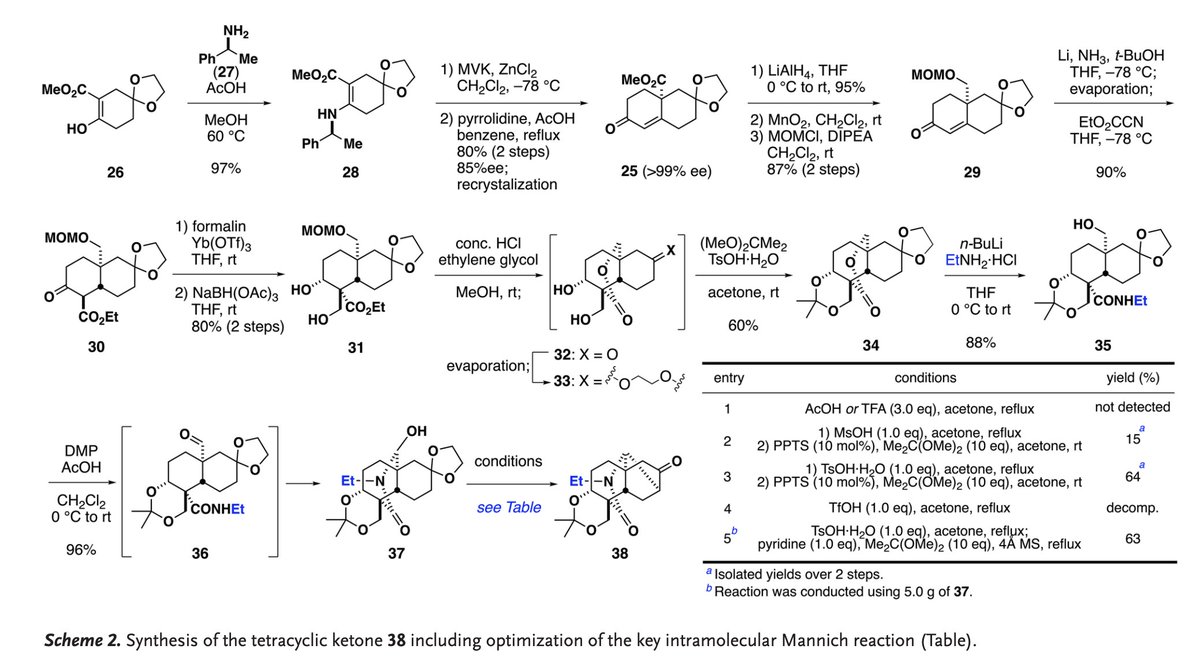
Well, my favorite part is the team’s mindset: How do you convince yourself you can control a thing that loses its stereochemistry instantly and trap it fast enough with ANOTHER transient radical. Thinking this could work (and actually making it work) is kind of crazy.
a shortcut to remembering metabolism in just 9️⃣ arrows:
1️⃣ Glu → Fru → Pyr
(Glucose → Fructose → Pyruvate)
This is glycolysis — the breakdown of glucose into pyruvate for quick energy.
💡 Example: Eat bread, glucose enters your cells, and is converted to pyruvate to start producing ATP.
2️⃣ Pyr → ACoA → TCA
(Pyruvate → Acetyl-CoA → TCA Cycle)
When oxygen’s available, pyruvate becomes Acetyl-CoA and runs through the TCA (Krebs) cycle for sustained energy.
💡 Example: A post-lunch walk taps into this aerobic pathway.
3️⃣ TCA → NADH → ETC → ATP
(TCA products → NADH → Electron Transport Chain → ATP)
The TCA cycle generates NADH, which powers the electron transport chain to make ATP — your cellular energy currency.
💡 Example: Your brain uses that ATP to keep you sharp while studying.
4️⃣ G6P ↔ PPP → NADPH + Ribose
(Glucose-6-Phosphate → Pentose Phosphate Pathway → NADPH + Ribose)
This detour from glucose creates NADPH (for antioxidant defense) and ribose (for DNA/RNA synthesis).
💡 Example: Immune cells use NADPH to neutralize pathogens.
5️⃣ Pyr → Lac
(Pyruvate → Lactate)
In low-oxygen conditions, pyruvate shifts to lactate.
6️⃣ Pyr → OAA → Gluconeogenesis
(Pyruvate → Oxaloacetate → Glucose)
During fasting, pyruvate is turned into oxaloacetate, then glucose, to maintain blood sugar.
💡 Example: After 10+ hours without food, your liver makes glucose for your brain.
7️⃣ ACoA → FAs → TAGs
(Acetyl-CoA → Fatty Acids → Triglycerides)
Excess energy is stored as fat.
💡 Example: Too many sweets? Your body parks the surplus as belly fat.
8️⃣ FAs → β-ox → ACoA → TCA
(Fatty Acids → Beta-Oxidation → Acetyl-CoA → TCA)
When carbs run low, fat becomes your fuel.
💡 Example: After 14 hours of intermittent fasting, fat breakdown kicks in.
9️⃣ AAs → Pyr / ACoA / TCA
(Amino Acids → Pyruvate or Acetyl-CoA or TCA)
Amino acids can feed into different energy pathways, depending on type.
💡 Example: In prolonged starvation, muscle protein is converted into energy intermediates.
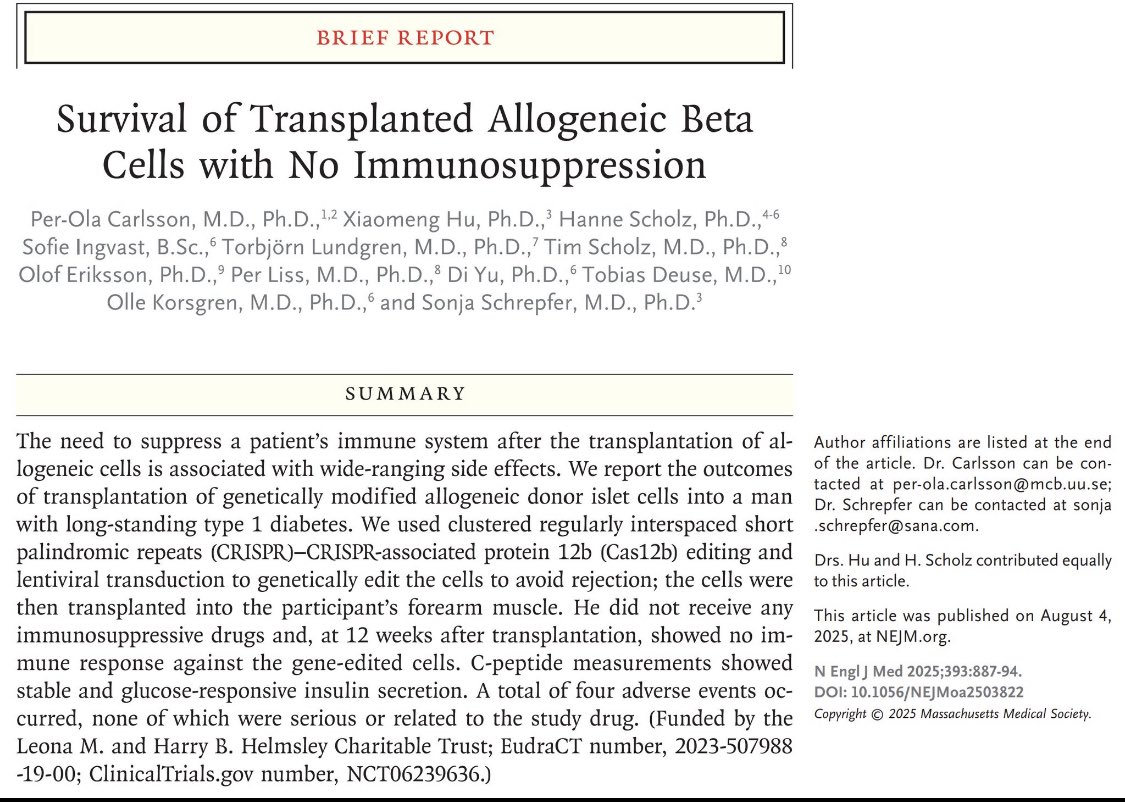
This might be the most badass brief report I’ve read in a long time.
In @NEJM
A team just published what feels like a glimpse straight into the future of cellular therapeutics: successful survival and function of transplanted allogeneic, CRISPR-edited beta cells with zero immunosuppression — in a real human with long-standing type 1 diabetes.
No anti-rejection meds.
No immune flare.
Glucose-responsive insulin secretion documented weeks after implantation.
A clean safety profile.
This is the kind of translational science that makes you think about how close we might be to rewriting what’s possible in autoimmune and metabolic disease.
Medicine is moving fast. This is one of those papers that makes you feel it.
Las células de cáncer pueden ser muy resistentes. Aquí se ve una célula de cáncer de mama cruzando una estrecha abertura en la que tiene que ir rompiendo su núcleo, pero lo reconstruye. (De @LammerdingLab )
Flavonoids might defend your cells by building near-invisible scaffolds inside them
Flavonoid diversity has long been linked with lower all-cause mortality, but antioxidant chemistry alone couldn’t explain why. New research from Harvard’s Wyss Institute suggests that these plant compounds may act through an entirely different mechanism; by self-assembling into supramolecular fibers that stabilize cellular proteins under stress.
In this Frontiers in Nutrition study (PMID: 40964684), molecular dynamics simulations and cell assays showed that flavonoids such as quercetin, isoquercitrin, and quercitrin stack into nanofibers that physically interact with enzymes and structural proteins, preserving their shape and activity. When human fibroblasts were exposed to ultraviolet radiation, cells pretreated with sugar-containing flavonoids maintained far greater viability and collagen-related protein expression than those treated with vitamin C, suggesting a non-antioxidant route to cellular protection.
Does this translate to humans?
✅ Possibly, but evidence is preliminary. The study used cultured cells and computational models, not dietary interventions. However, the findings align with large epidemiologic data showing that greater flavonoid diversity (6–20 % lower all-cause mortality) predicts better long-term resilience.
Practical Application:
🍇 A variety of flavonoid-rich foods like berries, tea, citrus, and cocoa may support cellular stability by providing structurally distinct molecules that assemble differently within cells.
🧪 The research points toward the idea that molecular diversity, not just antioxidant capacity, is what underpins the health benefits of polyphenols.
Limitations:
🔹 In vitro and in silico data; human tissue distribution and concentrations remain uncertain.
🔹 Flavonoid glycosides are often metabolized by gut microbes before absorption, so identical assemblies may not form in vivo.
🔹 The mechanism remains hypothesis-generating; future work must confirm structural interactions in living systems.
Flavonoids may protect cells not just by neutralizing radicals, but by building molecular scaffolds that reinforce protein networks - a hidden architecture of resilience inside the cell.
How your body moves electrons from food to energy
This figure explains how the human body acts like an electrical circuit—moving electrons extracted from food all the way to oxygen to generate energy. Every meal you eat feeds an invisible current that powers your cells through a continuous flow of electrons inside the mitochondria.
1️⃣ Food as an electron source
Carbohydrates, fats, and proteins are broken down into molecules like glucose and fatty acids that release electrons during oxidation. These electrons are captured by carrier molecules such as NAD⁺ and FAD.
🟢 Example: One molecule of glucose donates enough electrons through NADH and FADH₂ to drive the production of about 30 ATP molecules.
2️⃣ Electron delivery to mitochondria
Nutrients are converted into acetyl-CoA, which enters the TCA cycle in mitochondria. Each turn of the cycle generates high-energy electron carriers that feed into the electron transport chain.
🟢 Example: When oxygen is limited, cells divert pyruvate to lactate to keep glycolysis running and prevent a bottleneck in electron flow.
3️⃣ The electron transport chain
Electrons move through a series of protein complexes embedded in the inner mitochondrial membrane. As they flow, energy is released to pump protons across the membrane, creating an electrochemical gradient.
🟢 Example: This “proton motive force” is the voltage that powers ATP synthase, the enzyme that produces ATP from ADP and phosphate.
4️⃣ Oxygen as the final electron acceptor
At the end of the chain, oxygen captures electrons and forms water, completing the circuit. Continuous oxygen flow keeps the system balanced and prevents electron buildup.
🟢 Example: When oxygen supply drops, excess electrons can leak, generating reactive oxygen species that damage cells.
5️⃣ ATP as usable energy
The proton gradient drives ATP synthase to generate ATP, the chemical energy currency used for everything from muscle contraction to DNA repair.
🟢 Example: Tissues with high energy demand, such as the brain and heart, contain dense mitochondrial networks to maximize electron throughput.
In essence, metabolism is electricity at the molecular level. Food provides the electrons, mitochondria manage their flow, and oxygen completes the circuit—turning chemical energy into the electrical current that sustains life.
Predicting protein-protein interactions in the human proteome
Predicting which human proteins shake hands—and how—is a longstanding bottleneck. Proteins rarely act alone; they assemble into complexes that drive immunity, metabolism, signaling, and disease. But testing hundreds of millions of possible pairs experimentally is slow, expensive, and blind to many weak or transient interactions.
Jing Zhang, Qian Cong, David Baker and coauthors tackle this with a smart AI + data pipeline. First, they amplify evolutionary “clues” by assembling omicMSAs—deep multiple sequence alignments mined from petabytes of raw eukaryotic genomic data—so coevolution across species pops out. Second, they train a fast interaction model, RoseTTAFold2-PPI, not just on scarce complex structures, but on domain–domain contacts distilled from ~200M AlphaFold monomers—a huge synthetic training set that teaches the network what real interfaces look like.
The payoff is big: a proteome-scale screen over ~200M human pairs yields ~18,000 PPIs at ~90% precision (and ~29k at 80%), including ~3,600 not previously reported. The method excels on transmembrane interactions, a class that’s notoriously hard in the lab, and produces 3D complex models—so you don’t just get a yes/no, you see the interface. Mapping human variants onto these models flags ~4,950 PPIs with disease mutations at the contact surface, offering concrete hypotheses for mechanism.
Beyond pairs, the team reconstructs higher-order assemblies and nominates new components for well-studied complexes (e.g., telomere maintenance, GPI-GnT, cilia/flagella machinery), and highlights GPCR partners and mitochondrial modules that have been hiding in plain sight.
Stepping back: this is a credible path toward a computed 3D human interactome—faster, cheaper, and increasingly comprehensive as more genomes and structures arrive. It doesn’t replace experiments; it prioritizes them, focusing bench time where the biology is richest.
Paper: https://t.co/IphUI7KEQT