At @openservai, we've been building SERV Reasoning around the idea that you don't need the biggest, most expensive models to get reliable results on complex tasks.
Coinbase's recent results are a pretty good validation of that direction. Smaller models, fine-tuned for specific tasks, can outperform frontier models while being faster and cheaper to run.
In SERV v4, we are taking SERV Reasoning further with specialized, fine-tuned models tailored to enterprise customers and their specific workflows, right inside Graph Sharding, automated, training a model that you own on your own production data.
The goal is to make reliable AI more practical and cost-effective to deploy at scale.
Another great TOKEN2049 in the books.
The demand for AI reasoning is here. Teams want better agent performance, lower costs, and the ability to unlock open source models for production use.
This came up time and time again in conversations throughout the week.
Our first SERV Reasoning Hackathon resulted in 70+ project built across agentic finance, RWAs, autonomous trading systems and more. Pretty incredible to see the range of things builders are already cooking with the infrastructure.
Singapore sparked some really interesting conversations about where we take things next.
We're exploring new ecosystem collaborations, potential integrations, and partners for the next SERV Reasoning Hackathon. Some of these conversations help shape the next tracks and bring even more builders, networks, and use cases into the ecosystem.
Shoutout to @reppo@GoKiteAI@dphnAI@BlockRunAI@codecopenflow
That's also a big part of what we're looking to do through SERV Labs.
Work alongside established projects and networks, bring more grassroots builders into the ecosystem, and keep pushing what's possible with SERV infrastructure.
At the same time, we're opening up new paths for enterprise adoption through established distribution channels and cloud marketplaces, starting with AWS.
Whether it's a cracked team building something entirely new or an enterprise deploying AI at scale, the underlying need for reliable reasoning is only going to grow.
Next up is SERV v3, Graph Sharding, specialized models, and broader distribution across both the ecosystem and enterprise markets.
We've come a long way, but are still so early in what SERV Reasoning can and will unlock.
Billions will SERV.
$SERV ISN’T BOTTOMING ON HYPE. IT’S BOTTOMING ON PRODUCT. 🧨
The market is still valuing SERV like a token, the product is already moving like infrastructure.
That’s the disconnect.
$SERV isn’t holding because CT is bored.
It’s holding because the product is already in production.
Most AI tokens are still selling what they plan to build.
OpenServ is already shipping.
1/
Q3 was the foundation phase.
SERV Reasoning API is public.
The first hackathon is done.
Real enterprise workloads are already running against it.
Now Q4 becomes the distribution phase:
Graph Sharding.
SERV v3.
SOC 2.
HIPAA.
$SERV as a payment currency.
Next hackathon.
Token2049.
That matters because the roadmap has actual deliverables attached to it.
Not another “AI is coming” slide.
2/
The strongest proof point is the Neol case.
Neol runs network intelligence for companies and governments, including UAE government workloads.
For high-stakes applications, “usually right” isn’t enough.
Their published evaluation across 2,400 runs showed:
54.1% — prompt-engineered stack
63.1% — SERV research applied
100% — full SERV Reasoning across every category
That’s the difference between another model wrapper and a reasoning layer.
Auditable graphs.
Not free-form chain-of-thought.
3/
Then look at how the token is designed around the product.
1B fixed supply.
77% already circulating.
No endless emissions schedule sitting over the book.
And demand isn’t purely hypothetical.
25% of SERV Reasoning API revenue is earmarked for market buys and burns.
Another 25% of launch pool trading fees is designed for the same mechanism.
The API is also drop-in compatible with OpenAI and Anthropic SDKs.
One line of code.
That gives SERV access to an enormous existing base of LLM applications.
4/
Staking adds another layer.
The Oct 2 update says stakers won’t simply receive a cut of platform fees.
They get a share of tokenized startups built on SERV Reasoning and launched through the platform.
No lockups.
Proportional accrual.
The docs route 5% of every launch toward stakers.
The rewards date is going to a community vote:
Oct 15 or Nov 15.
Active voters receive a 1.15x claim multiplier.
That’s a much more interesting mechanism than another points farm.
5/
Now the valuation becomes interesting.
$SERV is around ~$0.021.
$16M market cap.
770M of 1B circulating.
The 30 day chart is still green despite the recent weakness.
At that valuation, the market is still treating this like an early AI token.
But the product is already entering enterprise territory.
That’s the gap.
6/
What I’m watching next:
Graph Sharding.
Singapore / Token2049.
Rewards snapshot.
Enterprise pilots.
$SERV becoming a payment currency across the products.
SOC 2 and HIPAA opening the door to regulated buyers.
And most importantly:
Inference volume.
If usage scales, the buy and burn mechanism has something real to work with.
If usage doesn’t scale, $SERV stays a $16M option on enterprise AI infrastructure.
That’s the risk.
7/
So the thesis is pretty simple.
Product is live.
Enterprise proof point is already published.
Supply is fixed.
Token utility is expanding.
Roadmap has actual deliverables.
And the valuation still looks like the market hasn’t fully connected the dots.
I’m not interested in chasing the candle.
I’m watching whether the product keeps pulling demand toward the token.
Because if that happens, the current valuation becomes the least interesting number in this thread.
$SERV
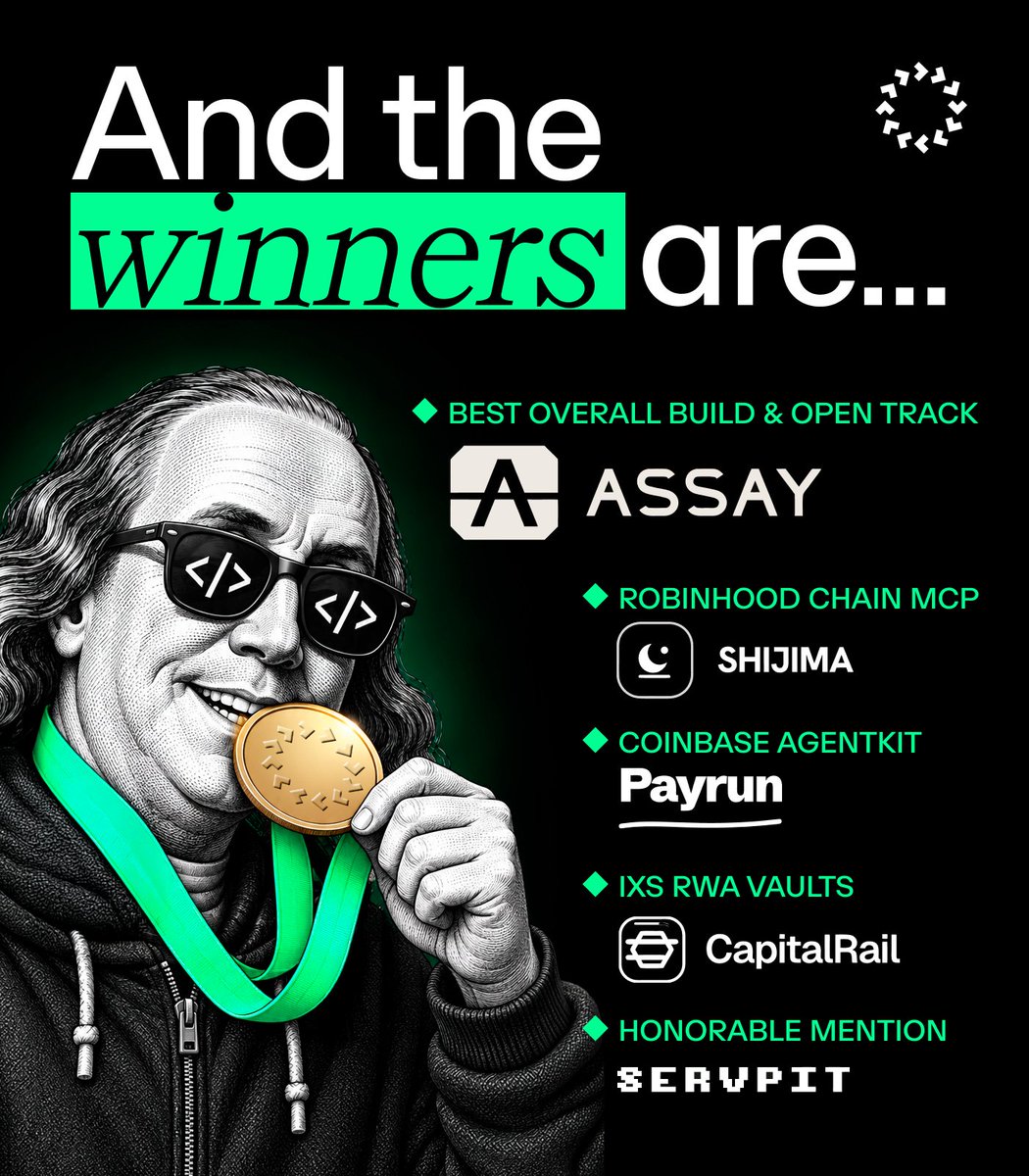
🎉 Congrats to all the winners of the SERV Reasoning Hackaton, and a special congrats to @thybow1 for winning the IXS track!
And a big thank you to @openservai for having us!
1st SERV Reasoning Hackathon results are in.
Few weeks after opening the SERV API, builders submitted 70+ projects - an early look at what more reliable AI agents can unlock across the agentic economy.
Next up for builders: SERV v3 + Graph Sharding.
Meet the winners ↓
Give builders SERV Reasoning and let them cook.
Onchain trading agents, AI fund managers, autonomous wallets, RWA risk, programmable payments, treasury management, gaming and more.
SERV Hackathon winners announced next week.
stoked to join the @solrouterai team 🌊
here’s the alpha: @GhostHash1 is a beast, private AI is about to see massive demand and Router has longterm privacy plans that will blow your mind, plus I just love working within the @solana eco
Spent the last few hours going through the $SERV hackathon submissions and damn, I'm mind-blown.
Just a heads up, this is a long read.
So far we've got 33 properly documented public submissions, and this is a pretty good look at what SERV Reasoning can actually do in real products:
@Knowledge_JO + @Sabercodes123 built Arena 67, a chat-first trading agent for Robinhood Chain. SERV handles the research and reasoning behind the trades.
@Chain_Oracle built Shijima, a 24/7 agent trading Robinhood stock tokens. The role SERV plays here is helping the agent reason through trades, while onchain limits control what it can actually do.
@stewardpay built a WhatsApp wallet assistant. You say “buy AAPL” and SERV turns that request into a proposed transaction for you to confirm.
@0xMemeshe built Batpilot, which turns plain-English investment goals into protected stock-trading plans. SERV explains the decisions and why certain trades get rejected.
@AlleManfredi built Managerv, an AI fund manager for Folyum ETFs. SERV is integrated here to handle allocation, risk and portfolio reasoning.
@TweetBySoft built Ledgerly, a treasury agent that can DCA, rebalance, pay contractors and bills. SERV proposes and explains what should happen while code controls the money.
@Dollar782 built Halo, a protection layer for stablecoin payments. SERV judges refund cases, while onchain rules prevent unauthorized payments.
@Datweb3guy built Deed, an AI trustee for family remittances. SERV interprets instructions like “school fees, not phones” and reasons through the payout while code restricts where money can go.
@willIsbillls built Payrun, an AI payroll agent. Here SERV checks invoices against the payment policy before AgentKit decides whether the payment can actually happen.
@NFTreeVerse built Unbribable, where you try to convince an AI to pay you from a USDC vault. SERV evaluates every argument, but the vault rules still control the money.
@HollowEchoes_23 built Steward, a stablecoin treasury where SERV decides what should happen and deterministic code decides what is actually allowed.
@jmadhanai built Spare, an automated savings agent. SERV decides how much should be saved, then AgentKit moves the money into an IXS vault.
@thenameisMufasa built Tender, which lets an agent buy only the data it needs. SERV decides which paid information is worth spending on while code enforces the budget.
@aspekt19 built AllowLatch, a spending gate for AgentKit. SERV drafts and reasons through the policy, but deterministic code gives the final ALLOW or BLOCK.
@25THPRMR built ServPit, where six SERV-powered agents make decisions around staking, borrowing and spending. SERV is basically the reasoning engine behind each agent.
@zendrace built AutoWallet, where SERV plans what to do with spare USDC before sending it into an IXS RWA vault.
@henrysammarfo built BOND, an RWA deposit agent. SERV checks the mandate and allow/denies the action, while the system waits for the vault to actually settle before calling it done.
@0xBaqi built Terms, a pre-execution authorization layer. SERV verifies the reasoning, but the transaction can still be blocked if the policy or vault says no.
@Dami904_ built a Steward for RWA vaults. The model proposes the allocation, SERV reasons through it, and smart-contract limits determine how much authority the agent gets.
@diversifi_app built DiversiFi, using SERV to reason through currency risk and allocation across RWA vaults before producing a decision receipt.
@thybow1 built CapitalRail, which checks whether an RWA vault is actually ready to accept capital. SERV helps assess the live conditions before the deposit happens.
@okey_amy built VAULT-PILOT, an autonomous RWA treasury. SERV reasons over live yields, with every decision recorded before execution.
@chiboy0123 built Hatrey, a treasury agent that takes policies like “keep 20% liquid” and uses SERV to decide whether to allocate, hold, redeem or refuse.
@Minerxx_ built Docket, which stress-tests RWA allocations against rate spikes, liquidity crunches and depegs. SERV handles the reasoning before and after capital moves.
@encrypt_wizard built Judr, an autonomous arbitration system. SERV reasons through disputes while code verifies the evidence and AgentKit handles the payout.
@_HEISEMMA built afterhours, a trade assistant that uses SERV to compare options against the user's actual preferences instead of blindly executing.
@Daveilorah built Relay Guard, which uses SERV to parse a payment request and return ALLOW, REVIEW or BLOCK. The other layers make sure the agent can't bypass that verdict.
@kenn_ronin built EXHIBIT A, a chargeback agent where SERV maps evidence to payment rules. Code then verifies every citation before anything gets submitted.
@the_Main_Charc built Weryon, a human approval layer for trading agents. SERV can reason about the trade, but the agent still can't sign without the required approval.
@RobinHill85 built T1000, giving one agent $150 to manage yield while another checks its work and code controls execution. SERV sits in the reasoning layer between those steps.
@ram_krish2000 built Urai, which tests whether SERV actually improves an existing agent by comparing performance with and without it.
@Dems_thePenlord built VetoLayer, putting SERV between autonomous agents and high-impact actions so production changes and money movements can require approval.
@Timidan_x built Tern, an agent that trades on untrusted text. SERV reasons through the input while Prompt Guard and Shadow Agent check the process before execution.
SERV Reasoning is being applied across a surprisingly wide range of use cases: trading, payments, treasury management, RWA allocations, disputes, security, autonomous spending, etc.
Everybody can integrate SERV Reasoning. And soon, the majority will.
This is much bigger than people realize.
Still sitting at $17M. Ridiculous.
CA: 0x5576D6ed9181F2225afF5282Ac0ED29f755437Ea