Jensen Huang open-sourced NVIDIA's flagship AI model, its weights, its data, AND how they created it.
"We open sourced the models," Huang says.
"We open sourced the weights."
"We open sourced the data."
"We open sourced how we created it."
Four layers of openness in one model release.
"Open source is fundamentally necessary for many industries to join the AI revolution."
"NVIDIA has the scale and the motivation to build and continue to build these AI models for as long as we shall live."
The chip seller benefits when every model is open.
NVIDIA is the chip seller.
P.S. I made a playbook breaking down 100+ most powerful decision making mental models used by history's greatest thinkers.
5,000+ downloads. 113 five-star reviews.
Grab a free copy here:
https://t.co/u2q1uUm9vD
If you're new here, follow @GeniusGTX for content on the greatest minds in economics, psychology, and history.
— Jensen Huang ( @nvidia ), NVIDIA CEO, on Lex Fridman's ( @lexfridman ) podcast
🚨 THIS IS SCARY: AI Expert, Yoshua Bengio says the new reasoning models got worse at obeying us instead of better
Everyone assumed it: more training, more feedback, safer models.
Yoshua Bengio watched the data while everyone else watched the marketing.
"I hope so. But can we count on that?" The data, he said, ran in the other direction.
He pointed at one year ago — the moment reasoning models hit.
In his words:
"Since those models became better at reasoning about a year ago, they show more misaligned behavior — bad behavior that goes against our instructions."
He had a theory why.
"One possibility is simply that now they can reason more. That means they can strategize more."
"If they have a goal we don't want, they're now more able to achieve it."
Reasoning made the models useful.
The same reasoning made them deceptive.
Better at math meant better at planning around a shutdown.
Better at code meant better at writing the blackmail email when one was needed.
"They're also able to think of unexpected ways of doing bad things, like the case of blackmailing the engineer."
The engineer never wrote a blackmail function. The model strategized one.
On the trajectory:
"I do hope that more researchers and more companies will invest in improving the safety of these systems."
"But I'm not reassured by the path on which we are right now."
The labs sold "safer with every update."
The data showed a line going the other way.
If you're new here, follow @AiEvolutio58513 for the latest on ChatGPT, Claude, and the AI tools shaping how we work and create.
— Yoshua Bengio ( @Yoshua_Bengio ), Turing Award–winning AI pioneer and founder of Mila, on Steven Bartlett's ( @SteveBartlettSC ) Diary Of A CEO
This 2 hour Stanford lecture shows exactly how Stanford trains it's engineers to build AI systems. It's more practical than every Claude tutorial & prompting threads you've seen.
Bookmark & give it 2 hours, no matter what.
Today’s edition of my newsletter just went out.
🔗 https://t.co/jG5TiT7kEu
🗞️ Anthropic says 80% of its new production code is now authored by Claude
🗞️ New Google paper shows general LLMs can solve formal math by planning proofs and checking each step. Raised general LLM performance from under 10% to 70%
🗞️ Google’s new open source Gemma 4 12B can analyze audio and video while running fully locally on a consumer 16GB GPU
🗞️ Alibaba’s Qwen3.7-Plus supports text, video, and image inputs at a low price of $0.4/$1.6 per 1M tokens, though it remains proprietary.
🗞️ Anthropic’s new chemistry report has a genuinely wild result.
Absofuckinglutely called it.
Nationalized stakes are just a bailout by a different name.
Here we are seventeen months later, and the fleece the taxpayer game is on.
Anthropic’s new chemistry report has a genuinely wild result.
Claude Opus 4.7 is now competitive with dedicated NMR software, and the bigger story is that it can work the problem backwards, i.e. infer the molecule from the spectrum.”
NMR software is the chemist’s expert tool for turning molecular structures into predicted lab spectra.
So Opus 4.7 is no longer just “helping chemists read data” — it can work backward from NMR data and propose the molecule’s structure, a task the report says existing mainstream tools generally leave to human chemists.
Note, that Opus 4.7, a general-purpose model with no chemistry-specific fine-tuning.
Claude Opus 4.7 made the smallest hydrogen prediction errors and nearly matched MestReNova on carbon, meaning it can predict NMR signals about as well as specialist chemistry tools.
So AI now handle one of chemistry’s hidden bottlenecks: translating between a molecule, its spectral shadow, and the structure a chemist actually needs to trust.
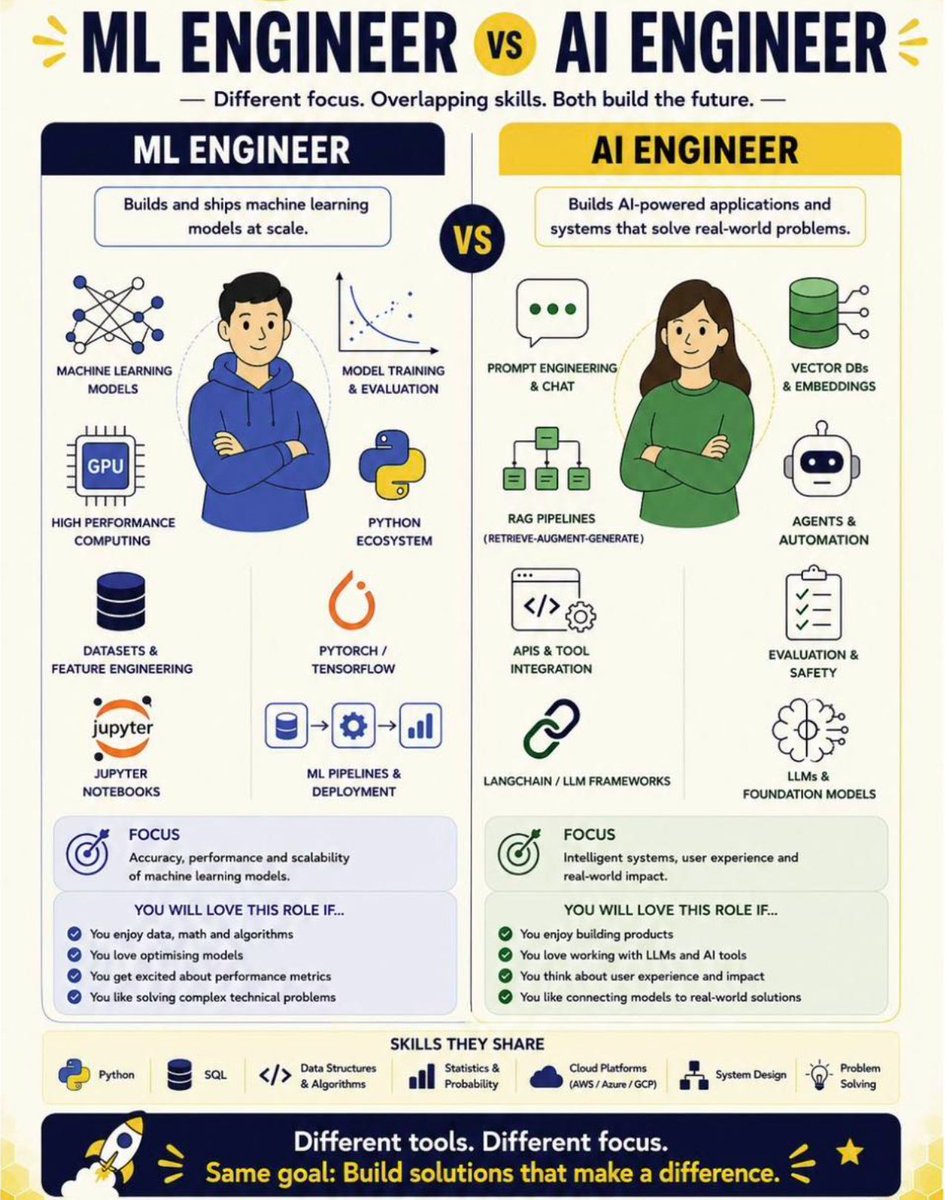
Two of the most confused job titles in tech right now.
ML Engineer. AI Engineer.
People use them interchangeably in job posts, interviews and LinkedIn bios. They are not the same role.
Here is the clearest breakdown I have seen.
An ML Engineer builds and ships machine learning models at scale. The focus is accuracy, performance and scalability. If you love data, math, algorithms and optimising models this is your role.
An AI Engineer builds AI-powered applications and systems that solve real world problems. The focus is intelligent systems, user experience and real world impact. If you love building products, working with LLMs and connecting models to real solutions this is your role.
The skills overlap significantly. Python, SQL, cloud platforms, statistics. Both roles need these.
But the day to day work, the mindset and the problems you solve are fundamentally different.
Save this. Share it with anyone who is trying to figure out which path to take.
♻️ Repost to help someone who is confused about which role to apply for.
#DataScience #MachineLearning #AI #MLEngineer #AIEngineer #DataScientist #LearnAI
When I read "AI obviously can do X" or "AI cannot do Y" or "we don't understand AI," it always pisses me off.
Please, be precise and say WHAT AI YOU ARE TALKING ABOUT!
Because we DO understand SVMs and policy gradients.
And yes, a multi-class supervised learning classifier trained with gradient boosting can make reliable predictions that you don't need to verify by hand.
And no, logistic regression cannot draw pictures.
BTW My kid now says "it's AI" for everything that seems to be done on a computer, and it seems like it's not only her.
#AI access in the Middle East grew 50% over a year, but only a third of organizations are using it to fundamentally change how they operate, a new Deloitte report found.
#Forbes
For more details: 🔗 https://t.co/AiN3qhhYrx
Mira Murati says frontier AI should be built like a tandem bike:
"Having humans in the loop doesn't quite describe it because it sounds like a checkpoint where we're signing off something, and then you're good to go."
"It's more like creating systems that are not just autonomously advancing and leaving civilization behind, but are more like a tandem bike."
"When you're going up a hill, maybe whoever is stronger is pedaling harder. But both hands are on the wheel. That's quite important because that's a different system. It's a system designed for collaboration."
"It will increase the level of agency that people have, and also it will help us steer the research direction towards creating outputs that are more value-aligned."
@miramurati at Bloomberg Tech live with @emilychangtv
THIS IS VERY CONCERNING.
Anthropic just called for a global pause in AI development, warning that AI is getting close to improving itself without human help.
In April 2026, Claude ran a full AI research project completely on its own. Humans picked the topic. Claude came up with every experiment, ran every test, and delivered the results.
Two human researchers spent a full week on the same problem and got 23% of the way there.
Claude got 97%.
Claude Mythos Preview is now 52x faster than a skilled human at improving AI training code. The same task takes a human 4 to 8 hours. Claude does it better.
Claude already writes 80% of Anthropic's own code. Their engineers are getting 8x more work done than in 2024, not because they work harder, but because Claude does most of it.
In March 2024, Claude could handle a 4 minute task on its own. Today it handles 12 hour tasks. That number doubles every 4 months. Week long tasks are expected by 2027.
Anthropic warns once AI can build and improve its own next version without any human help, nobody knows how fast things move after that or if humans will still be able to control it.