Jonathan Keeperman (@L0m3z) gave a speech at the Nat Con conference, and I posted a crude reaction to it. He asked me politely if I would explain myself. Here is my response:
Jonathan, thank you for your gracious response to my rather ungracious characterization of your speech. I appreciate your civility. Let me explain what provoked my reaction.
I agree with your central premise. Today's political climate calls on us to justify the American-Israeli alliance in terms of American national interests. But after calling for a hardheaded accounting of costs and benefits, you never actually perform one. Instead, you offer a selective account of the grievances that some American nationalists harbor toward Israel and its supporters. At several points, you toggle almost imperceptibly between describing those grievances impartially to validating them, without acknowledging the toggle.
You came to Jerusalem while the United States and Israel were engaged in a war against Iran. American and Israeli forces have fought alongside one another on an extraordinary scale. Both countries have committed military power and made great sacrifices in a struggle against a common enemy. Yet you barely acknowledge the war, let alone consider what it reveals about the value of the alliance.
Surely that experience belongs at the center of any serious discussion of what America gains from Israel.
There is also a question of elementary respect. You came to a country at war to explain why Americans are growing weary of its demands on their attention and resources. You found time to discuss the immigration preferences of liberal American Jews and the political sins of the ADL, but not the soldiers fighting, the lives being lost, or the sacrifices being made in a common struggle. Whatever your intentions, that is a failure to recognize the gravity of the occasion.
And it is inseparable from the larger failure of your analysis. You tell us that Israel receives $3.8 billion annually in American assistance. But what does the United States receive in return? What is the value of Israeli intelligence, military power, technological innovation, and cooperation against common adversaries? What role does Israel play in America's competition with Iran, China, and Russia? What would it cost the United States to replace the capabilities and regional influence that the alliance provides?
These questions are the beginning of the prudential calculation you call for but never undertake. More importantly, what would happen if Washington weakened the relationship to the point that Israel concluded it could no longer rely on the United States?
No sane Israeli wants that outcome. But national survival may force Israel to contemplate it in the coming years. Israel would not simply disappear as a strategic actor. It would become a more independent one, making decisions about war, peace, deterrence, and relations with other powers with less regard for American preferences.
American support does not give Washington control over Israeli decisions, but it does help keep Israeli military power integrated into an American-led regional order. That is an asset with considerable strategic value. If Israel became a de facto free agent, Washington might save money and escape some immediate obligations, but it would also surrender influence over one of the most formidable military powers in the Middle East.
And Israel would not be operating in a vacuum. China and Russia would have opportunities to exploit the resulting realignment. Iran would have opportunities of its own. The regional order would change, and not necessarily to America's advantage.
Perhaps you believe this would be a good bargain. But you never consider the possibility, much less calculate its costs. You call for realism while leaving the most consequential strategic questions unexamined.
Your treatment of the American right is similarly selective. You emphasize the growing skepticism of younger conservatives, but you never mention that Donald Trump, the dominant figure in the nationalist movement you describe, has taken American military cooperation with Israel to unprecedented levels.
Trump recognized Jerusalem as Israel's capital, recognized Israeli sovereignty over the Golan Heights, withdrew from the Iran nuclear agreement, and brokered the Abraham Accords. In his second term, he went much further, committing American military power to a joint war against Iran. How does his record fit your account of national conservatism? Why does the behavior of the nationalist president receive less attention than the attitudes of young nationalists? Is Trump an anomaly? Does he misunderstand the movement he leads? Or might his support for Israel reflect a nationalist assessment of American interests fundamentally different from the one you describe? These questions are indispensable to your argument. Yet you don't address them.
I am also troubled by your treatment of antisemitism. You correctly observe that accusations of antisemitism no longer carry the political force they once did. But the declining effectiveness of an accusation tells us nothing about the reality or seriousness of the phenomenon it describes.
There has been a conspicuous resurgence of antisemitic rhetoric in parts of the American right. Influential voices have promoted the idea that American foreign policy is controlled by Jews or manipulated on Israel's behalf. Such claims encourage Americans to interpret strategic decisions through theories of sinister manipulation rather than through an examination of American interests.
Antisemitism, therefore, is not simply a problem for Jews. It is a problem for American national security, political judgment, and national cohesion. It also offers opportunities to foreign adversaries seeking to weaken the United States from within.
Yet in a speech devoted to explaining declining support for Israel on the right, you give remarkably little attention to the role that antisemitic agitation has played in producing that decline. Instead, you place considerable responsibility on Israel's American defenders. You blame neoconservatives for opposing Trump, liberal Jews for supporting immigration, and even the ADL for antagonizing populists.
Your reference to the ADL is particularly strange. What do the immigration preferences of liberal American Jews have to do with the strategic value of America's alliance with Israel? The ADL is an American Jewish organization, not an arm of the Israeli government. American Jews are predominantly liberal. They disagree with national conservatives on many domestic questions. So what?
Even if every criticism you make of the ADL were justified, what do they have to do with the value of Israel as an American ally? Nothing, unless one assumes that Israel bears responsibility for the political behavior of American Jews. That is precisely the kind of collective attribution that ought to be examined critically, not casually incorporated into an explanation of why Americans are turning against Israel.
The same problem appears in your treatment of America's wars in the Middle East. You say they are closely associated with Israeli interests. Associated by whom? Which wars? Which interests? And how accurately does that association explain actual American decisions?
You leave those questions unanswered. Instead, you point to deeply tendentious interpretations of American foreign policy -- ones often advanced by antisemites such as Tucker Carlson -- as though they were established facts. Arguments frequently employed by Israel's worst antagonists enter your speech disguised as an objective description of American attitudes.
This brings me to a broader problem with your method. You present yourself as a relatively detached observer of Israel and an informed observer of the American right. But throughout the speech, you alternate between describing the attitudes of nationalists and adopting their explanations for those attitudes. Reporting that some conservatives blame Israel for America's Middle Eastern wars is one thing. Treating that blame as an adequate explanation of their alienation is another.
Political attitudes do not develop in a vacuum. Personalities, institutions, and campaigns of persuasion shape them. Yet your account assigns considerable agency to Israel's defenders, whose conduct supposedly alienated the nationalist right, while giving remarkably little attention to the people on the right actively encouraging hostility toward Israel and Jews based on the most vile lies. You thus present the consequences of an ideological struggle as though they were an impersonal historical development to which Israelis must accommodate themselves.
Finally, there is something peculiar about the posture of the speech itself. You begin by explaining that Israel has never occupied a central place in your thinking and that you make no claim to expertise about it. Fair enough. But you then proceed to deliver sweeping judgments about the future of the alliance and the political adjustments Israelis must make.
There is nothing wrong with an outsider offering uncomfortable observations. But the authority of those observations depends on their accuracy, not on the speaker's professed detachment. You conclude by imagining an Israel that Americans "do not have to think about."
But the Middle East will not cease to matter to the United States simply because Americans grow tired of thinking about Israel. Iran will not abandon its ambitions. China and Russia will not relinquish their interests. And Israel's enemies will not stop threatening it because American voters would prefer to concentrate on domestic affairs.
The question is whether America is better positioned to manage those challenges with Israel as a close ally or with Israel acting increasingly on its own. That is the prudential question you say would should address. It is also the question your speech conspicuously avoids.
I don't know you. I have no basis for judging your intentions. I accept that you may regard your speech as a candid warning delivered in good faith. But whatever your intentions, its effect is to give a veneer of dispassionate analysis to a series of highly dubious claims about Israel, Jews, and American foreign policy. That is what I objected to. And it is why I reacted so strongly.
Today is the third anniversary of the October 7th tragedy in Israel. It’s also an inflection point for how the country is thinking about its strategic position. I explain, in my latest for @usatodayopinion.
https://t.co/5kTXsCIhnJ
My latest, in which I argue that the defense of Taiwan is a vital U.S. interest.
Grateful for the chance to publish in @afpc’s new Statecraft & Strategy journal — and to write alongside @jekavanagh, who takes the opposite position. https://t.co/oxxfc1X8SS
Look, it's a new episode of GREAT POWER PODCAST! In it, I talk to @AmbDennisRoss of @WashInstitute about the next steps in the U.S.-Iran confrontation, the changes it has wrought in the Gulf, and how the current conflict is reshaping global politics.
https://t.co/uo6NVlx9YC
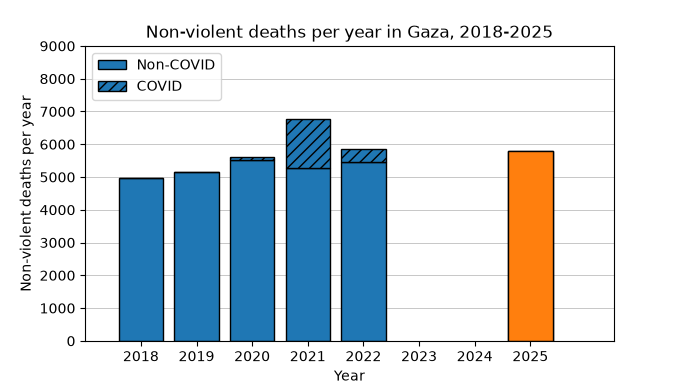
Gaza Ministry of Health has now released mortality numbers for 2025. For the first time since the war, they give numbers for all deaths, including natural deaths.
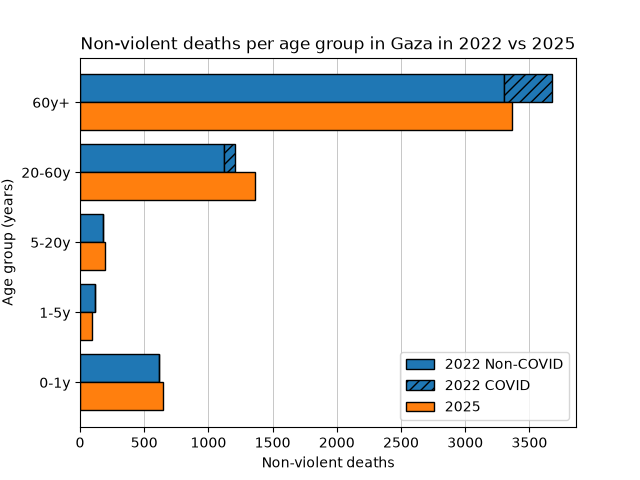
In 2025 there were a total of 24,650 deaths in Gaza. 18,870 (76.6%) of these were violent, of which 17,286 (70.1%) were due to "war operations" and 1,584 (6.4%) were classified as accidents. There were a total of 5,780 (23.4%) non-violent deaths, including disease, old age, and all other causes.
5,780 deaths is about the same as the annual non-violent mortality in Gaza before the war, and the age distribution is similar to 2022. There is no significant excess of non-violent deaths.
In other words, despite frequent and loud claims to the contrary, there seems to be very few indirect deaths due to the war in Gaza in 2025.
As there were 50,227 births in 2025, this gives a natural population growth of 25,577 or 1.2% in Gaza in 2025, which is higher population growth than most countries in the world and more than the world average.
There are currently ~6,000 births/month in Gaza, per GMH. Assuming a similar number of non-violent deaths in Gaza in 2026 as in 2025, that means there are currently 12x more births than deaths in Gaza, and that Gaza is now experiencing one of the highest population growths in the world.
For 50 years, American leaders have asked Israel to stop expanding settlements in the West Bank. For 50 years, Israeli governments have refused. It is past time to stop asking and start imposing consequences, and in the past week we are starting to see the beginnings of a new approach.
First with a narrower bill in the Senate led by Senators Coons, Warren, Wyden, and Gallego that would impose sanctions on anyone supporting construction in E1. And now a broader bill in the house led by Castro, Dean, Beyer, Casar, and Jacobs with 40 of their colleagues.
It is time for the United States to impose targeted sanctions on entities that finance, build and support settlement expansion that threatens the viability of a Palestinian state, and on officials responsible for it.
This is bigger than Netanyahu. Settlement growth has continued under Israeli governments across the political spectrum. The settlement movement is organized and politically powerful. Palestinians living under occupation cannot vote in Israeli elections. There is little domestic political counterweight. Polite or even loud American objections have never been enough to change that calculation. Targeted sanctions could.
How would you do this? Start by actually designating the worst offenders: organizations and entities supporting the tremendous boom in farming outposts over the past few years from which most of the violent attacks and officials such as Bezalel Smotrich and Itamar Ben-Gvir who are behind the effort. Make an example of them and make it much harder for them to operate.
Then give other companies and financial institutions a deadline to wind down activities that support settlement construction.
What you would likely get relatively quickly is a de facto settlement freeze on Israeli construction in the West Bank. Israeli banks are quite risk averse and deeply value their connection to the U.S. and international banking system. They would respond relatively quickly by pulling out from all of these projects. You’d have to couple that with continued targeting of the most problematic settlements and activities that threaten the viability of a Palestinian state, but you could fundamebntally shift the momentum.
Over time there would also be a change in incentives for settlers. Many live in the West Bank because housing is cheaper and subsidies are generous. If living in the settlements becomes financially harder, if new construction and roads aren’t happening, if businesses are pulling out since it’s simply too risky to operate, some of these settlers will choose to move inside green line Israel and you start changing the overall momentum on the ground.
Importantly, this approach targets the settlement enterprise, which makes it distinctly different from the BDS movement which calls for sanctions on al of Israel and boycotts on Israelis including those working for a better future with Palestinians.
And once Palestinians and Israelis can agree on a map, which likely means Israel keeping many of the settlements in exchange for unpopulated land beyond the Green Line, Israelis can build to their hearts content inside those borders.
The reality is that only the President of the United States with the tools of the executive branch can fully implement such an approach. But it is vital for members of Congress to start going on the record, building political support for a future policy, and beginning to signal to Israeli companies that it's time to stop investing in or supporting the settlements. That is why the new legislation this week is so important.
After 50 years of failed persuasion, the settlement movement needs to face consequences.
https://t.co/MS3OPNTC02
@ColinPClarke Ever since they were little, my kids have known the answer to the following riddle: “if pro is the opposite of con, what’s the opposite or progress?”
Don't look now, but the Trump administration's Iran strategy and its approach toward China are on a collision course. I explain why, in @newsweek today
https://t.co/C61MlQiPM8
Vladimir Putin’s latest victory at the polls should not be taken as evidence of widespread Russian satisfaction with the regime. I explain why the Russian electoral fix is in, in my latest for @TheNatlInterest
https://t.co/8Z7vjZaJiN
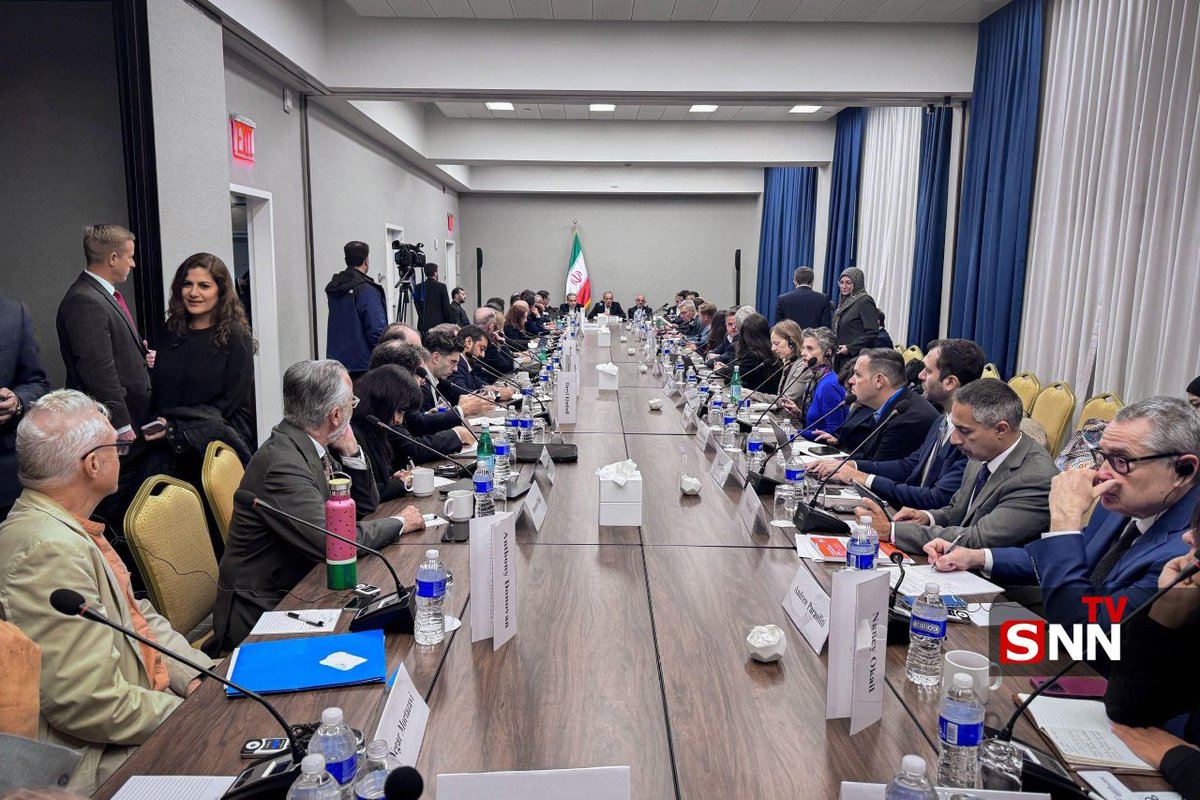
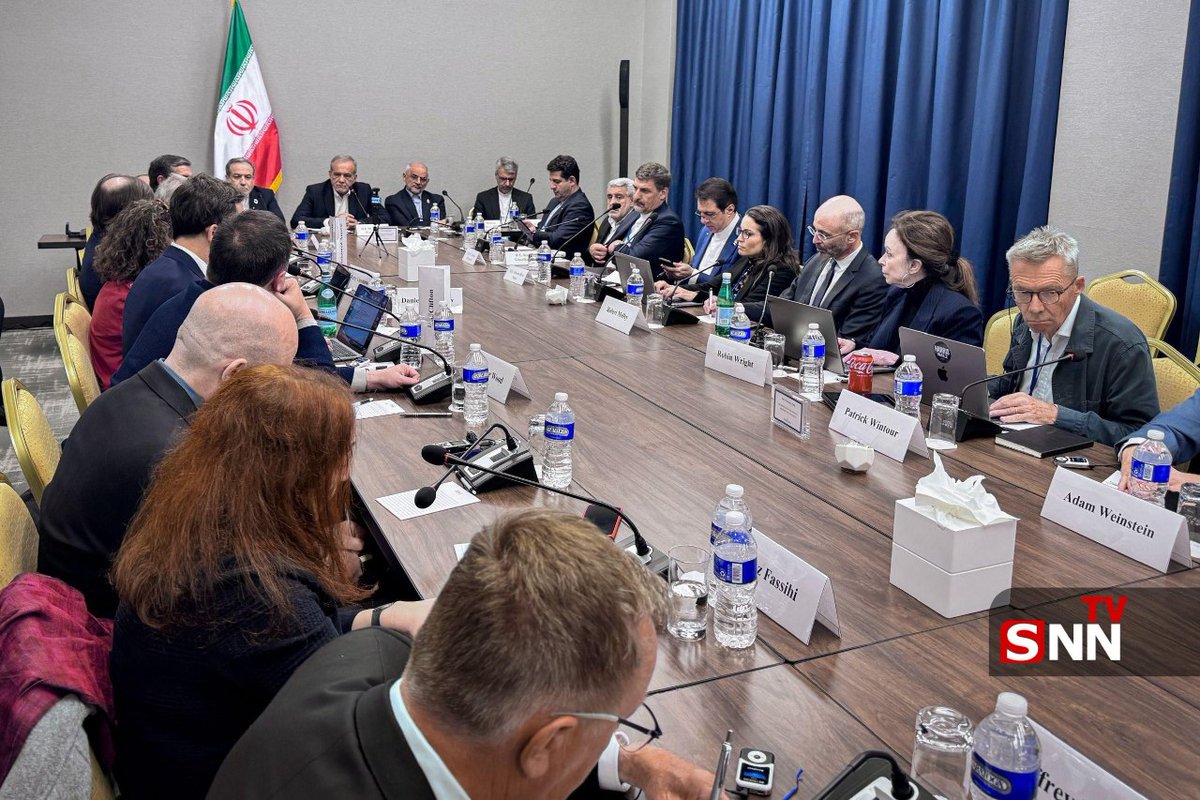
It's not often that the contemporary Iran influence network all assembles in one place for easy cataloguing. Eagerly awaiting some intrepid sleuth to issue the full attendee list.
Today the Iranian regime hosted its annual UNGA meeting for think tanks and media in New York. One #Iran specialist who was previously invited told the WSJ earlier in the week, "no one wants to be seen going." But some showed up.
@laurnorman By my tally, all the outlets represented have settled, and decidedly friendly, attitudes toward the regime.
I think listening is great and diverse opinions are wonderful... but let's be clear, this wasn't what this was. And to suggest otherwise is disingenuous. Sorry.
@laurnorman Really? I don't have a full list, but I'm struggling to find someone in the pictures who advocates anything other than accommodation with the regime. Please, edify me.
@hmajd That presupposes these are journalists and analysts who are simply curious, and impartial. The respective advocacy track records of people like Parsi, Fassihi and others suggest otherwise, as you and I both know all too well (even if it's polite to pretend otherwise).
Was there any coordinated walkout by member states when Pezeshkian spoke at the @UN?
Asking for the tens of thousands of Iranian protesters slaughtered in January, those currently on death row, and the countless families still seeking justice.
Mayor Mamdani, you said war criminals who set foot in New York should be arrested.
Good news. One is in New York city this week.
The president of the Islamic Republic is coming to the United Nations, right here in New York.
He heads the regime that massacre innocent protesters. They gunned down unarmed protesters in the streets, hanged our children, and sent its agents to Brooklyn to kidnap and kill a New Yorker.
That New Yorker is me. The FBI files and federal indictments are public. Look them up.
If you have the courage to talk about arresting those responsible for crimes against humanity, start with the man sleeping five miles from your office.
Are you willing to act, Mayor? Or do Iranian lives not count?
Japan is intently focused on the future of warfare. The state of its population tells us why. I explain, in my latest for @forbes.
https://t.co/U75BfuX7Iy
Pray tell, how can a university that does not reflect the political system at all possibly prepare students for the real world? For that matter, why is its polisci department still accredited? Explain to me like I’m five years old.
Princeton is the latest university to achieve academic nirvana: not a single faculty member contributes to a Republican candidate or campaign. Conversely, 98% of political donations went to Democrats or Democrat-affiliated groups...https://t.co/FRLOSWGEHb
The war in Ukraine is increasingly connected to conflicts and strategic competition far beyond Eastern Europe.
On this episode of Peace and Power Ukraine, host @Garymarx is joined by @ilanberman, Senior Vice President of the American Foreign Policy Council, to examine the growing connections between Russia, China, Iran and North Korea—and what those relationships mean for Ukraine and U.S. foreign policy.
Berman discusses Ukraine’s expanding defense technology capabilities, the pressures created by competing demands for air defense and munitions, and the challenges facing U.S. efforts to negotiate with Vladimir Putin.
The conversation also examines sanctions against Russia, efforts to pressure Russia’s energy sector, Ukraine’s deep-strike campaign, and how Moscow has transformed its economy to sustain a prolonged war.
Finally, Berman explains why he believes Russia’s wartime economic model could have implications beyond Ukraine and argues that any strategy for isolating Moscow must account for the international partnerships helping Russia sustain its war effort.
https://t.co/YliRsMYIUh