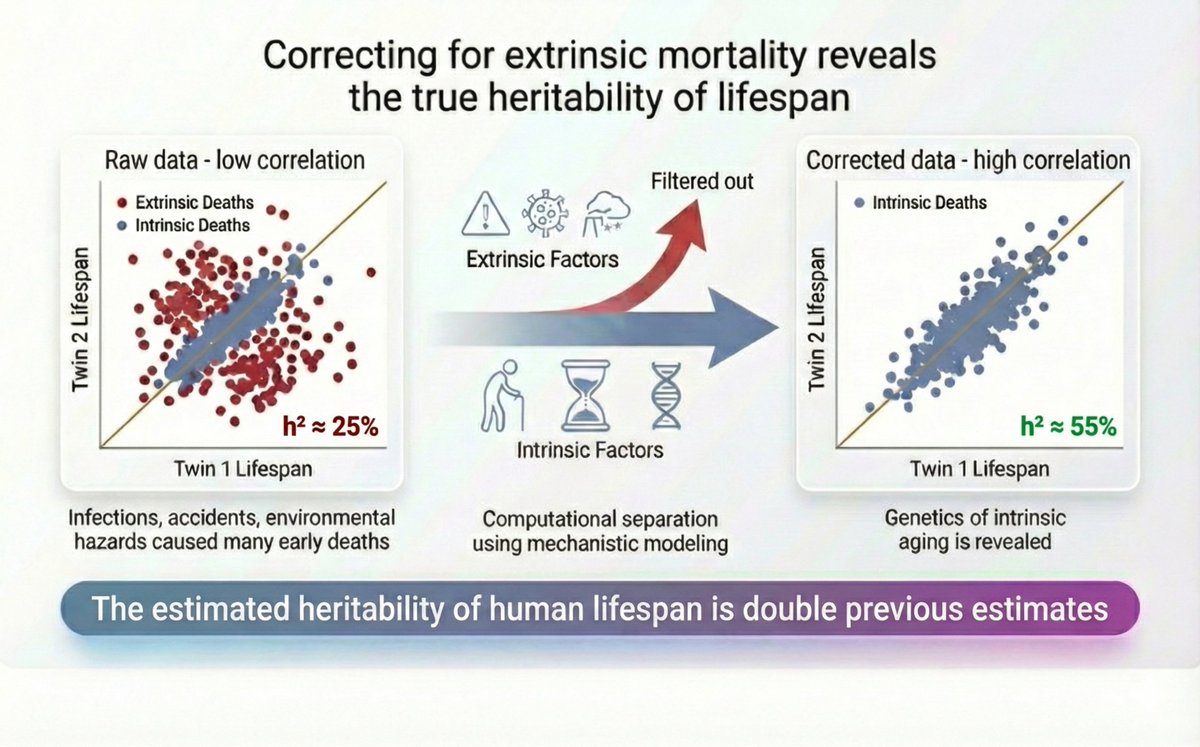
Our new paper on reassessing the heritability of human lifespan is out in @ScienceMagazine! 🧬
For decades, the consensus has been that genetics explains just 20–25% of lifespan differences. We found that after accounting for extrinsic mortality, that number jumps to ~50%.
A 🧵
Randomized, placebo-controlled, double-blind clinical trial on the contributions of vitamin D in the control of cardiovascular risk factors, depressive symptoms and suicide risk
Authors: "Weekly administration of 50,000 IU of vitamin D for six months proved effective in reducing depressive symptoms and suicide risk while improving cardiovascular health markers, highlighting its promise as an accessible, low-cost adjunctive therapy in psychiatric and primary care settings."
https://t.co/tgSYmdEDVp
@agingdoc1 E) Evidence-based. IMO, the only supplements worth taking are those that have shown benefit in human clinical trials, and I’ve found these overlap with @BradStanfieldMD ‘s supplement stack (i promise he did not pay me to say this 😅).
@EricTopol@Stifel Infographics are poor ways to track aging biotechs.
https://t.co/iN88rddRNv has a more comprehensive list w/ category + details like pipeline status, $ raised, # employees. Fully sortable/filterable.
289 biotechs currently & 180+ more on the to-be-considered tab (vs 75 above).
One of the saddest realizations being in tech is that a lot of capital allocation happens on vibes, networks, fomo, and marketing.
I have said this to a lot of our researchers; the best and most rigorous science does not necessarily win.
The downstream effects of that is that we probably have a very big graveyard of real scientific innovation (actual cures, therapeutics and more), while questionable projects have millions.
An interesting perspective. What regulatory pathway will 3D printed organs take to along the way to the market? Will there be restrictions on IP in the context of 3D printed organs? This article explores these questions.
https://t.co/reaa3uvTdG
Anti Aging Breakthrough: Stem Cells Reverse Signs of Aging in Monkeys.
Buzzing lay article (Titled above & image): https://t.co/u379TRvt8a
Original Study: https://t.co/13qpNSGjCJ
🤔Author interpretation: "This study provides initial evidence that genetically modified human mesenchymal progenitors can slow primate aging, highlighting the therapeutic potential of regenerative approaches in combating age-related health decline."
Share your data-driven📊 comments below 👇
Introducing the 1st annual pharma aging report card!! The race is on to see who will positively transform humanity and in the process unlock a bigger market than obesity.
Gero, backed by the VitaDAO community, just landed a $1B+ deal with Chugai (Roche)!
Their AI finds the root causes of age-related diseases → Chugai develops antibody drugs from these discoveries.
Big leap forward for longevity research 🧬
https://t.co/HSdz0GIqpe
NEW: No technology currently exists to repair damaged brain tissue and fully restore lost function. FRONT aims to enable millions with what is considered permanent brain damage to regain lost functions, including motor control, vision, and speech. https://t.co/uaAhiQV7bf
I'm thrilled to share our new study out in @NatureMedicine! We show that a blood test can estimate how aged or youthful one’s organs are and that these organ ages predict future disease and lifespan. Final paper from my PhD in the @wysscoray lab. 🧵1/12
🔗 https://t.co/2bxtfEJ0TS