Our study with @g_hellenthal on detecting adaptive signals before and after European contact in #admixed Latin Americans is finally out in @MolBioEvol
https://t.co/MaMBgZutOa
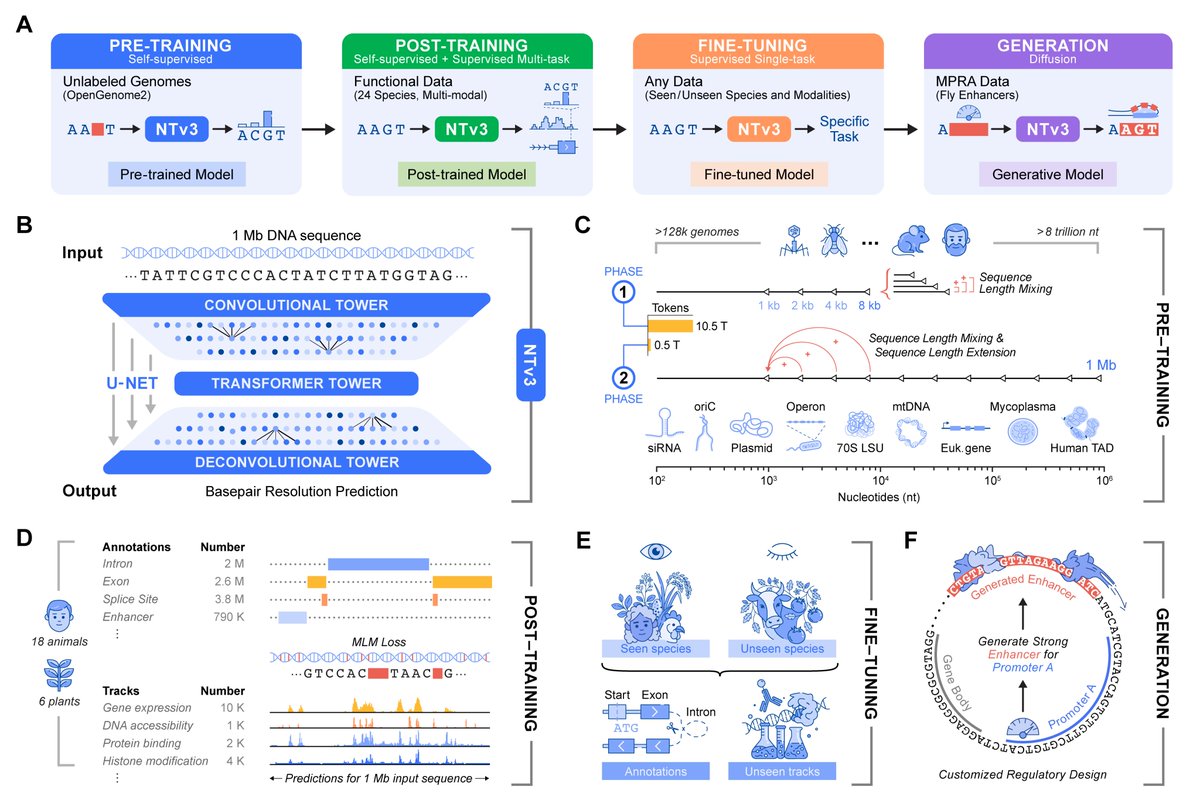
🚀 Introducing Nucleotide Transformer v3 (NTv3)
Today, we are very excited to share our latest foundation model for biology - Nucleotide Transformer v3 (NTv3).
NTv3 is @instadeepai new multi-species genomics foundation model, designed for 1 Mb, single-nucleotide-resolution prediction, and for bridging representation learning, sequence-to-function modeling, and generative regulatory design within a single framework 🧬
This work was developed in close collaboration with @AlexanderStark8 , @volokuleshov , and @pkoo562 , and reflects several years of joint effort at the intersection of machine learning and regulatory genomics.
Nucleotide Transformer is a series of genomics foundation models of different parameter sizes and training datasets which can be applied to various downstream tasks by fine-tuning. @instadeepai
https://t.co/R31y1UNU6w
We were invited to write a review article on DNA/genomic language models (gLMs). We took this occasion to gather our thoughts on promising applications, and major considerations for developing and evaluating gLMs. Pls share with your colleagues: Preprint: https://t.co/iUjl874VoG
🌱 As scientists wrestled with the mysteries of plant genomics, our #AI problem solvers had a daring question, "Can AI make a difference?" @Nature covered how our #research and AI #genomics teams teamed up to search for an answer, with AgroNT – our new #LLM. 📚Read more→ https://t.co/2G0hOZY6fP
🤗 Access our LLM #open-source on : https://t.co/dz7YOz0MTf
A DNA-based large language model, AgroNT, trained on multiple plant genomes, can accurately predict various molecular phenotypes within plant species, including important crops.
@instadeepai@JavierMenRev@thomas_pierrot@LopezMarie05
https://t.co/K1zehDejL7
Our work on the development of a #DNA Large Language Model trained on genomes from various plants, #AgroNT, is now published in @CommsBio
https://t.co/GKWTUT9Btw
Very proud to announce ChatNT, the first multimodal conversational agent for biological sequences🧬. ChatNT can be simply prompted with a question and a nucleotide sequence to solve DNA, RNA and Protein tasks 🧑🔬!
📚Paper: https://t.co/mU6HsNJweA
🌐Blog: https://t.co/DRzLIHr0Zt
Glad that our sequence model of promoters in human genome is now published in @ScienceMagazine. Check out the paper for a deep dive into the sequence basis of transcription initiation at the basepair level: https://t.co/gA08yaJLVp
✨ Meet SegmentNT: the first-ever LLM capable of annotating DNA sequences at single nucleotide resolution.
Built on top of our Nucleotide Transformer, SegmentNT offers precise genome annotation surpassing traditional methods and can offer deeper insights into our genome 🧬
InstaDeep's @JavierMenRev will share how AI systems - and LLMs specifically - deepen our understanding of the Maize genome tomorrow at 7:20 pm at the Maize Genetics Meeting in Raleigh, NC. #MGM2024
Read the paper: https://t.co/1832A5M5eB
We released the weights and downstream task datasets of the agroNT, our 1B parameters DNA foundation model for plant genomics 🧬🪴. Check out our github (https://t.co/oyMSkhXf8Q) for Jax lovers⚡❤️and our @huggingface space (https://t.co/z4uYMEec0y) for the pytorch version🤗.
I am looking for PhD research interns at the
@instadeepai Paris office for the coming summer. Join us if you are interested in DNA LLMs and regulatory genomics!
We have different projects available and are flexible to find one that fits your PhD.
Link: https://t.co/5CWgeONDyM
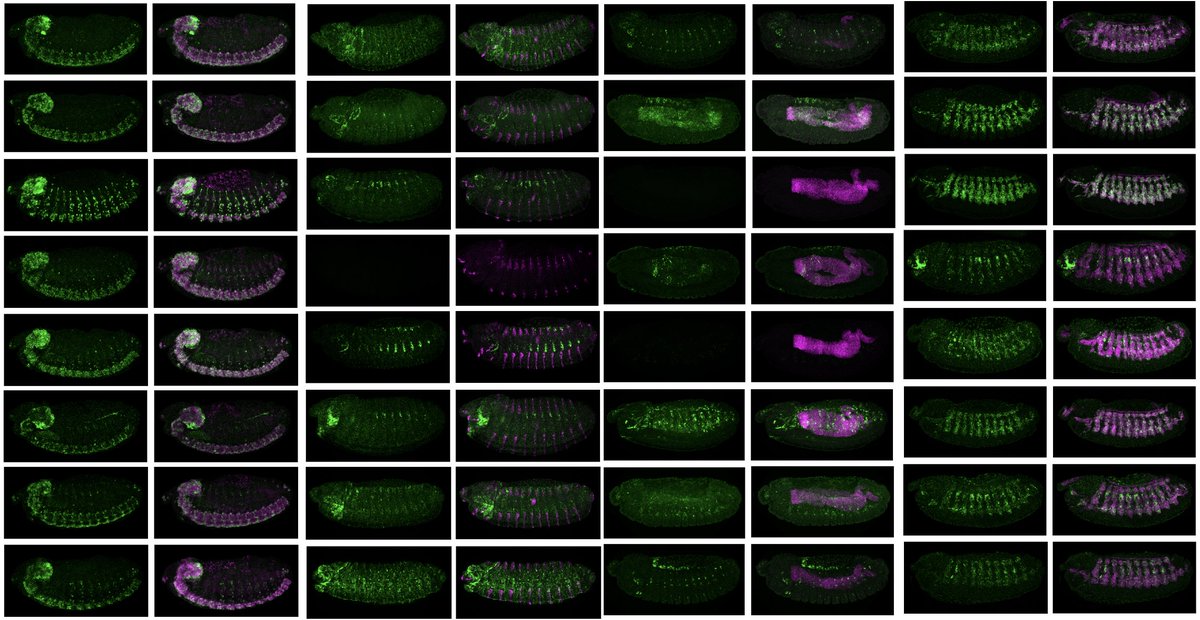
We are very excited to present a major breakthrough achievement – the de novo design of synthetic enhancers for selected tissues in fruit fly embryos in vivo using deep- and transfer learning, @deAlmeida_BPet al published today in @Nature https://t.co/TIlPrBKYaK. Thread 👇(1/N)
If you are interested in gene-environment interactions, molecular phenotypes and single-cell genomics, join us at @institutpasteur in the sunny Paris!
Post-doctoral position in single-cell genomics at Institut Pasteur in Paris https://t.co/aJ0hx7jxvl
@AxelOlin2 Yes, the adoption of this type of screening would need to be extremely widespread for it to have a significant effect on the population level. But, yes, that was essentially my point on pleiotropy—we wouldn't know how we are affecting other phenotypes.
We’re excited to announce the first whole genome screening for embryos is available!
Parents can get 100x more data about their embryos’ genomes, empowering them to make an informed decision and give their baby the best chance at a healthy start.
(2) GWAS Transferability: PRS show much greater accuracy in individuals of European ancestry than in others. Thus, the PRS they report may be highly inaccurate for many individuals (admixed/from underrepresented populations) and potentially even irrelevant for some.
(1) Pleiotropy: Meaning, a variant at a locus can affect multiple traits simultaneously. Also, pleiotropy can be antagonistic, implying that a variant may be simultaneously harmful AND beneficial. What, then, will these types of screenings be selecting for?