I am happy to share that the work I did for my Ph.D. with @Hyunwoo_Lee5223 that has just been published on
@CellReports. We collaborated to investigate how the hippocampal subregions CA1 and CA3 represent the various visual environments. 👇(1/15)
https://t.co/9L9rrSTNa4
When we enter a new environment, we use visual input to rapidly build an internal model of the local spatial environment. How does our brain do this? We review past literature and suggest some new ways forward in our new review in @CurrentBiology: https://t.co/tS5ZB8TXGa
I am thrilled to announce that the first paper from my lab has been published! 🎉 Check it out here: https://t.co/4qk05HCCtF
Huge congratulations to the incredibly talented team, led by co-first authors @ErinBigus and @Hyunwoo_Lee5223! 1/N
Excited to share our review on natural visual behavior and active sensing by @SkybergRolf at Current Opinion in Neurobiology.
There are a lot of important visual computations that get engaged once an animal is actively interacting with the environment!
https://t.co/ViYXnP0EWi
We love natural behavior! Our new review highlights recent work from @cris_niell, @bbo_lab & others. Is natural behavioral all we need to understand brains? We say no & hypothesize why training critters can be hard. Pls post your training thoughts below. https://t.co/XDxaGmuyQE
Amazing day for my first tweet. Super excited to share my PhD research, published today @Nature.
We find that contrary to popular belief, cortical reactivations predict the future rather than reflect the past.
https://t.co/OrUqE5n0KM
1/10
Recordings in visual cortex (V1) of mice and marmosets revealed neurons respond to gaze shifts in a sequence, such that new visual input is processed in a “coarse” to “fine” manner
@cosmousevision@dmmartins@emmalynleonard@cris_niell@judefmitchell
https://t.co/xCuE7YrQKS
Octopuses (yes that’s the plural) are amazing. This one is tiny. Unlike humans, their brains GROW continually across the lifespan. Thank you @uoregon & @cris_niell for the tour of the amazing Neuroscience happening here. I’ve always loved UofO & Eugene.
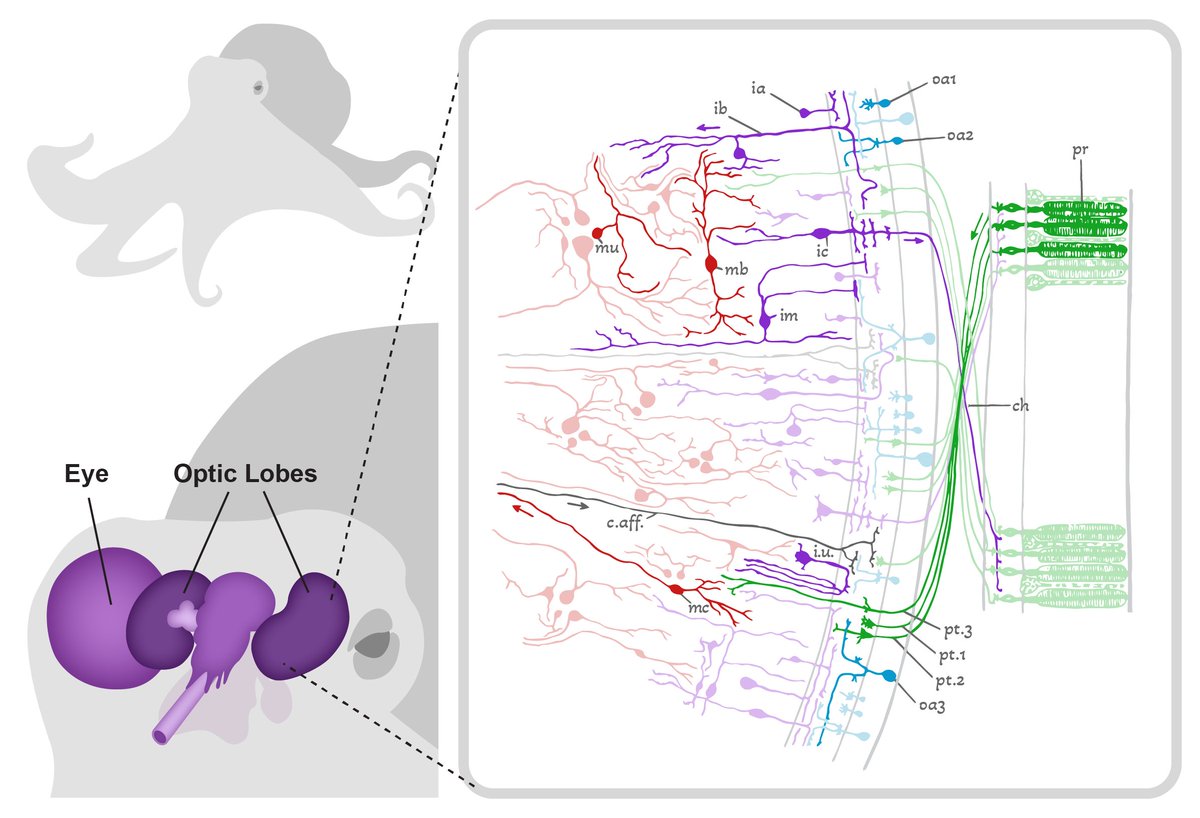
Curious about cephalopod vision? Check out our review led by Judit Pungor @traceofpink on visual processing and behavior in cephalopods @CurrentBiology. We know relatively little at the level of neural function, so there's still a lot of mysteries!
https://t.co/XNsQqnjp0r
1/11 How are cognitive maps formed during learning?
Very excited to share new work by outstanding co-first authors @sunw37 and @JohanWinn and other wonderful collaborators @HHMIJanelia https://t.co/W9IgIPZYHH
Research in visual and spatial systems has been dominant in systems neuroscience. We are in exciting times of studying these systems together and undersanding how they interact.
Thrilled to share this review on interactions between the systems
https://t.co/dqTUdLKsJU…
Happy to share one of the last pieces of my postdoc work on hippocampal inhibitory circuits, published today in @NatureNeuro. Big team effort with Bert Vancura to record activity of molecularly-identified CA3 (and CA2) interneurons during behavior. 1/n
https://t.co/ChMV9h0btG
Very happy to announce a new paper (led by @neurognome) out today in @NatureComms on how mice use visual inputs to orient themselves in their spatial environment: https://t.co/EJ6G04M6mO
🧵:
I’m proud to share our new paper dissecting norepinephrine (NE), astrocytes, and arousal in cortical circuits, a project led by PhD student Michael Reitman: https://t.co/Mnxgq7NvGP.
As often happens in science, an unexpected result gave us a big clue in this project. 🧵 1/12