@73v3@willdepue What do you mean? The curve *was* right.
The singularity begins once you're in the attractor. Market forces post AlexNet became irresistible.
It was precisely then, that the modern AGI became inevitable.
There is some context here for those who care: AlexNet won the ILSVRC 2012 on September 30th, but it's unclear when the methods details were made public, or when it's paper was first uploaded (no Arxiv upload ever, only UofT website).
The only published information is the full publication at NIPS December 3rd 2012.
@ShivamDuggal4@ShivamDuggal4 Great work. Could you talk more about the compute costs (FLOP, memory, pipeline communication), compared to Pre-Norm/Block AttnRes?
Looking into this now, given that this has already been raised:
It's quite disturbing that you're continuing to not attribute Qwen.
This must be within every post.
It's not built by you. It's Post-training by you. Big, big difference.
Say "Post-trained" by Alpie. Nothing more.
https://t.co/fgGHHhzbWC
We want to address concerns and criticism about Alpie Seed directly.
First, to be absolutely clear: Alpie Seed is based on Qwen3.5-9B. It is a post-trained model, not a foundation model pretrained from scratch by 169Pi. We recognise the Qwen team's work and the wider open-source community, and we are grateful for the foundations they have made available to researchers and developers.
We should have made this attribution more prominent and consistent across all our announcements. That is on us, and we will ensure the model lineage is clearly stated wherever Alpie Seed is presented.
Our work at 169Pi has focused on what comes after the base model: supervised fine-tuning, DoRA-based training, GRPO optimisation, reasoning and coding improvements, and deployment optimisation across different precision formats and hardware environments. Getting a multimodal 9B model to run across workstations, laptops, smartphones and CPU-only systems is a substantial part of the engineering work we have been pursuing.
We also want to be clear about our broader direction. Alongside research on post-training and optimising existing open models, we are working towards developing our own foundational models. We will share more about that work as it progresses.
We welcome genuine technical criticism, questions about our methodology and scrutiny of our results. We believe transparency, proper attribution and reproducible research are essential to building trust in this community.
Open source moves forward when we acknowledge the work that came before us and contribute meaningful work of our own.
@169Pi_ai@169Pi_ai Please be transparent about this being a Qwen 3.5 9B fine-tune.
If true (which is likely), hollow marketing speak like this is rather shameful, and builds neither credibility nor brand.
Fitting on piece-wise segments and points with a recency bias, sure. But you could imagine significant enough regressions, that make this a very different curve.
"History has looked the last 1M years' is a massive claim, when we have *no evidence of absence* of greater historical progress.
@_rockt@pfau Plots like these have such a large western bias, its quite unsettling. Contributes to the idea of gradual directed progress, without accounting for regressions.
🚨“It works, but why is training so much slower?”
We kept hearing this from people replacing standard residual connections with Hyper-Connections, and ran into it ourselves. 𝗗𝗲𝗲𝗽𝗦𝗲𝗲𝗸 𝗺𝗛𝗖 𝗮𝗱𝗱𝘀 𝗲𝘅𝘁𝗿𝗮 𝟱𝟵–𝟭𝟬𝟬% 𝘁𝗿𝗮𝗶𝗻𝗶𝗻𝗴 𝗼𝘃𝗲𝗿𝗵𝗲𝗮𝗱 𝘄𝗶𝘁𝗵 𝗮 𝗣𝘆𝗧𝗼𝗿𝗰𝗵 𝗶𝗺𝗽𝗹𝗲𝗺𝗲𝗻𝘁𝗮𝘁𝗶𝗼𝗻.
That’s why we’re introducing 𝗦𝗶𝗺𝗽𝗹𝗲𝗛𝗖, one of the fastest Hyper-Connections methods to date.
It adds just 2.4% training overhead over vanilla residual at the largest tested width, with competitive performance compared to mHC and demonstrated scalability.
📄 https://t.co/pJnXKyoOcl
💻 https://t.co/AdTnHHynH7
@rustyryan@rdesh26@_albertgu This was an interesting thread to read.
@rustyryan Do you have any opinions on why this line of work on pixel/unicode codepoint autoregressive modelling didn't lead to anything mainstream?
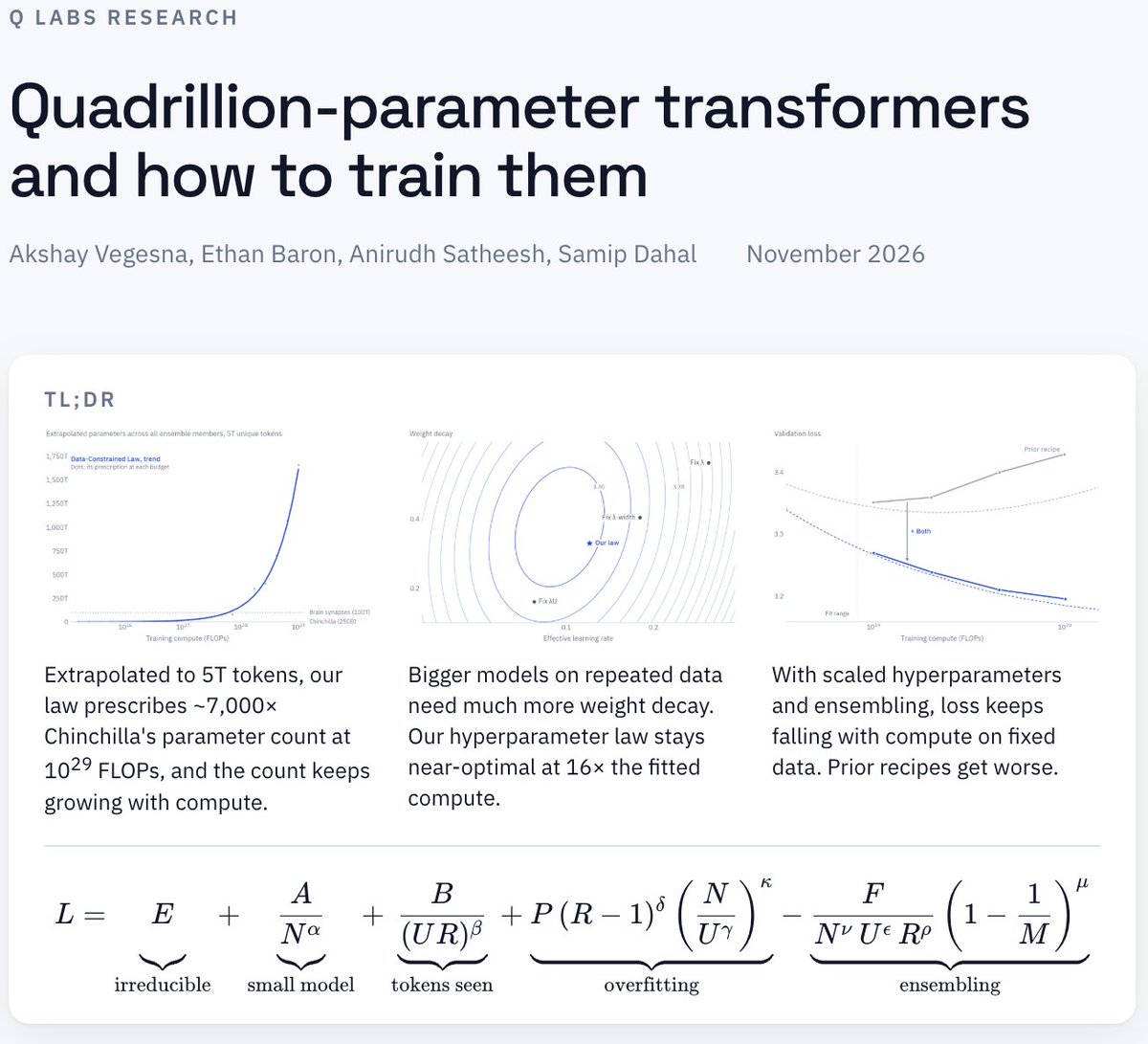
Humans are ~1,000,000x more sample efficient than LLMs, and there are no good explanations.
We’ve found that a big part of the answer is that LLMs are *massively* underparameterized by many orders of magnitude. The brain has 100T synapses learning from ~200M tokens of language. Chinchilla prescribes a 1T-parameter model on 20T tokens. That’s 7 OOMs apart in parameters per token.
After a lot of painstaking work, we present new data-constrained scaling laws and learning algorithms to scale to (extrapolated) quadrillion-parameter transformers.
w/ @akshayvegesna, @EthanBaron78553, @asatheesh6561
Full paper led by @EthanBaron78553, with @ShmuelBerman, @andrewgwils
One reason I am sanguine about the technological singularity is that I have seen it coming for over 50 years. In 1975, when I was 17, I wrote:
"Before man can most effectively aid his problem solving machinery, he must first understand it. At present, his understanding is very poor. However, when the breakthrough in understanding the brain occurs, improvement will come very fast and in an exponential increase. Once man has created an intelligence greater than his own, that intelligence should be able to create an intelligence greater than itself, as man whose intelligence is less than its was able to create its intelligence. Thus, the level of intelligence will shoot up with incredible rapidity, probably within the space of years. Within a few years of a breakthrough, which may occur any time now, man will either have been left behind by a superior intelligence of his own making, which he can no longer understand, or he will have become that intelligence and will no longer be like anything imaginable today."
LayerRoPE: Dynamic Depth-wise Magnitude & Angular Superposition
LayerRoPE encodes depth into normalization weights, reaching Pre-Norm's 1.3B model loss with 3.4x less compute while enabling stable scaling up to 512 layers.
https://t.co/B5MaShMwjo