One of the pivots I did over a year ago when I started as Faculty @LTIatCMU and @CMUEngineering was towards AI for Molecule Design and Drug Discovery, and today we are releasing a blog post + our @PrimeIntellect and @harborframework environments for our benchmark SMDD!
We find that: 1) Harness optimization can go a super long way in scientific tasks, and we are still heavily bottlenecked by the model capabilities rather than the knowledge, 2) Automating the harness optimization can work on some cases and not others!
Amazing work led by @SureshRaghu07, w/ @KevinH1119568 and @aviral_kumar2
RL needs more long-horizon tasks beyond math and coding. @niloofar_mire's team at CMU built an environment for drug design.
SMDD-Bench comprises 502 small-molecule design tasks with RDKit, ADMET-AI and Boltz-2 in the loop. The challenges go beyond chemistry: long-horizon planning, exploration, and learning from imperfect feedback are also open problems for RL/ML!
SMDD-Bench is available in our Environments Hub, ready to train with prime-rl. Thank you for sharing with the community!
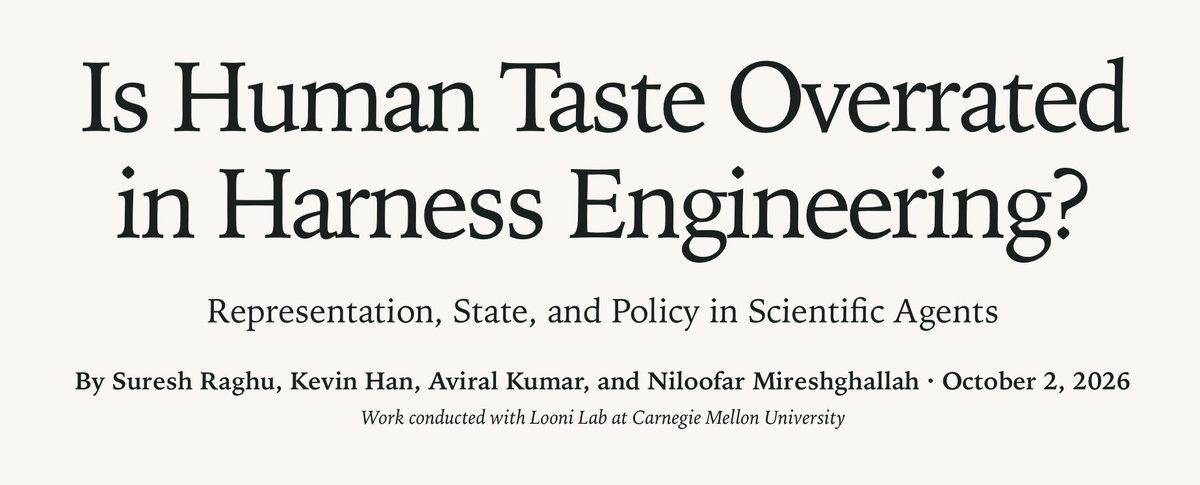
New blog: Is human taste overrated in harness engineering?
An agent harness is the system around a model. It decides which tools the model can call, what evidence it sees, and what it remembers between steps. Most harnesses are still designed by human taste. Run the agent, read where it failed, change the harness, try again.
That loop is increasingly being automated, with a strong model rewriting the harness itself. So we asked how far that can go. We ran Qwen on three drug design tasks from SMDD-Bench and compared a manually redesigned harness against one produced by automated harness search with Claude in the loop.
No single approach won everywhere. The manual harness pulled clearly ahead when the fix was changing what the agent sees and remembers. Automated search did better once that was in place and the remaining problem was how to search the chemistry itself.
The hard part was rarely implementing the fix. It was diagnosing what kind of failure we were looking at, and that is where human taste still mattered.
Work with @KevinH1119568 , @aviral_kumar2 and @niloofar_mire
Read more 👇
Today, Carnegie Mellon University and Ken Griffin, founder and CEO of Citadel and founder of Griffin Catalyst, announced a historic $3 billion gift to elevate Carnegie Mellon in Pittsburgh and launch Carnegie Mellon University Miami. #CMUMiami
Learn more: https://t.co/UkDGUP2Oae
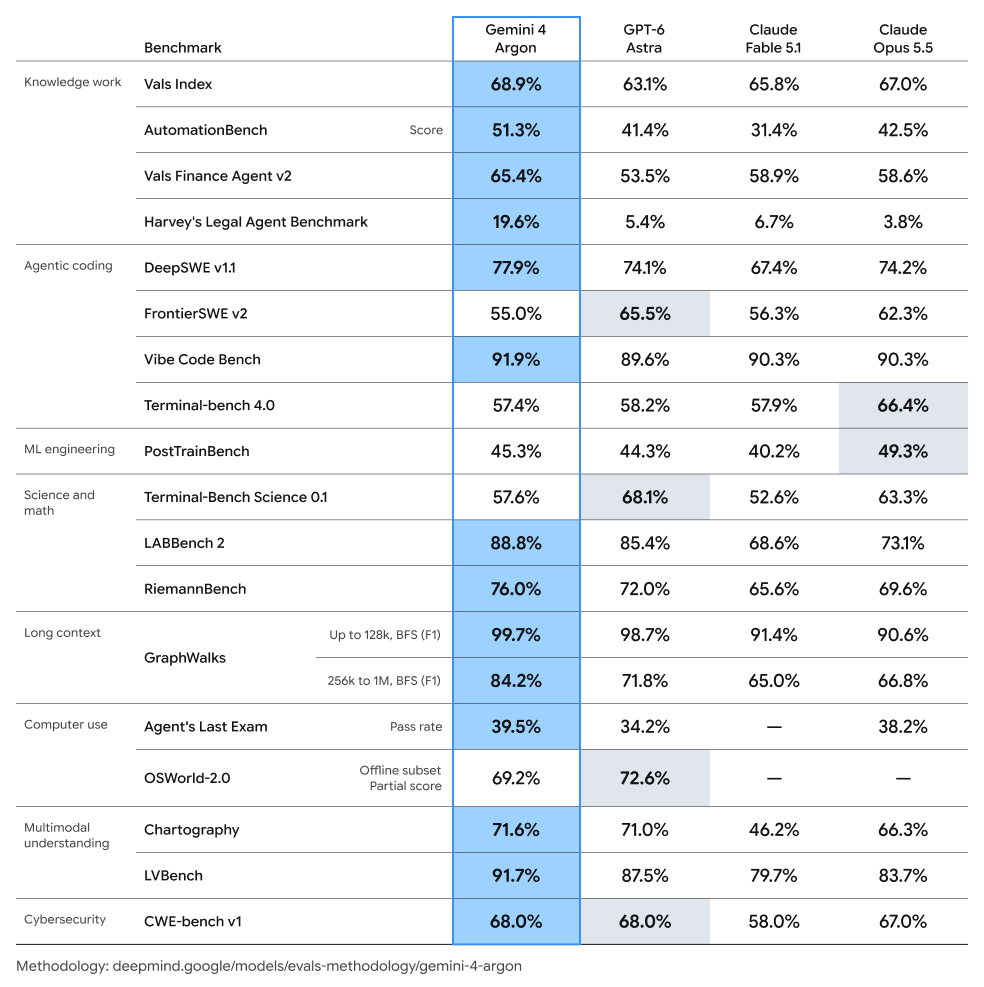
Introducing Gemini 4 Argon – our new frontier model.
It’s built for complex workflows across coding, enterprise knowledge work, and cybersecurity defense – rolling out today to a set of trusted testers through our Fairwind Program.
MiMo-V2.6: The Hard Road to Scaling Up RL
MiMo-V2.6 is very likely one of the largest single RL runs, by compute, that any open-source model team has undertaken to date. In an era when compute is brutally scarce, we still chose to dedicate a team of several dozen people to one goal over an extended period: scaling up RL. That takes more than research conviction. It takes a vision for AGI, respect for the unknown, and the nerve to walk straight into the hardest problems.
The result is a model whose potential was built through mid-training and unlocked through heavy RL. Today, it is the number one open-source model. I strongly recommend reading the technical report. I believe it will become one of those papers that Agent RL practitioners keep reopening and discovering something new in each time. In my view, the research innovations and engineering challenges behind it surpass those of DeepSeek R1, which I was partly involved in.
Some will ask: why MixRL instead of MOPD? First, they are not competing choices. We ran MixRL on verifiable tasks of moderate difficulty, including code and related agentic tasks, and found that the resulting models generalize remarkably well. Second, tasks that are difficult to verify, extremely long-horizon, or simply too challenging to include in a joint RL run are trained separately. Including them would substantially reduce rollout efficiency or introduce significant rollout staleness. We then merge the resulting capabilities through MOPD. Games, 3D tasks, and tasks with subjective evaluation signals all fall into this category.
There is also a third, slightly cheeky answer. Our team is flat enough and free enough of organizational silos that MixRL simply is not difficult for us. More importantly, everyone enjoys working this way. People from different domains come together every day, driven by the pursuit of AGI and intelligence that can continuously improve itself, to confront and resolve the RL bottlenecks in each field. I will always remember the RL daily update meetings from this period. They were intense and dense, with intelligence emerging in real time.
To help the open-source community focus on solving real Agentic RL problems, we have released a Qwen model distilled from MiMo RL trajectories as a stronger starting point for RL, along with 7K diverse environments and a complete RL training framework. We hope these resources will help move Agentic RL research forward.
MiMo-V2.6 is only the beginning. In an era when intelligence is easy to replicate, we still choose the hard road toward self-improvement and AGI. Much of what lies ahead remains unknown. But we are willing to keep investing the time, compute, and passion required to take on one hard problem after another and work each of them all the way through, until intelligence crosses into a new regime.
We’re partnering with @Anthropic to launch the biggest Protein Design Competition in the world, challenging people around the world to use AI to design new potential drug candidates for diseases that affect millions of lives.
The competition will feature five challenges, each focused on a specific disease or biological mechanism. Compared to previous competitions, it will be a big step-up in complexity and scale to push the boundaries of AI-driven protein design.
Together with Anthropic, we’re sponsoring over $1 million in experimental validation, making it possible to test more than 5,000 protein designs in our automated lab at no cost to participants. Anthropic is providing an additional $1 million in Claude credits.
All experimental results will be published openly on @Proteinbase, including designs that didn’t work, so anyone can access the data and build on what we learn.
The competition is open to everyone and free to enter. It will feature 3 tracks:
- Track 1 is aimed at expert protein designers, with up to 20 teams to be selected.
- Track 2 is targeting life science academics and industry researchers.
- Track 3 is open to everyone from tech enthusiasts to high-school students.
By combining Anthropic’s models with access to our automated lab, we want to make it possible for anyone with a laptop and an internet connection to join the global effort to advance human health with AI.
A big thanks to @Modal for contributing compute for protein design and to @TwistBioscience for contributing the DNA for the experimental validation!
Sign up link below -
Today we’re opening applications for the Life Sciences Verification Program.
Through the LSVP, life science professionals can use our models—including, for the first time, Mythos—with a new set of safeguards designed to enable the full range of biology-related work. We designed these new safeguards to provide a better experience for biologists and more protection from risk of misuse.
The program is launching in beta for teams of all kinds—from academic labs to startups, pharma companies, and more. We will continue to improve the program and expand access to individual Pro and Max plans over time.
Learn more about these access grants and apply: https://t.co/uALS2lZuN4
I completely agree with this take related to the “AI will create viruses that will kill us all” BS. But let me add my few cents, because I am really really angry!
I worked with one of the deadliest viruses in history, HIV, for two decades. I was one of the early scientists to engineer it, and engineered versions of HIV are now helping cancer patients. I understand the immune system that defends us against viruses extremely deeply. I have worked in high security biohazard labs.
I don’t have a PhD in AI, but I have been involved with AI since the early 90s and have been all in on AI for years.
People claiming that you can just make a virus in your garage, use AI to engineer it, and somehow build a virus that will kill everyone don’t know what the hell they are talking about!
Of course bioweapons are extremely dangerous. In fact, viruses and bacteria have killed more humans throughout history than almost anything else. HIV alone killed tens of millions of people, yet today, if you have access to effective medicines and take them properly, HIV is generally no longer a death sentence.
COVID-19 killed millions. Why doesn’t it kill at anything close to the same scale anymore? Not because the virus disappeared. It is still here. We developed collective defenses against it through our immune systems, prior exposure, vaccines, treatments, and better medical care.
And this is exactly the point.
The best way to fight biological threats, whether natural or synthetic, is to use AI to develop vaccines, treatments, antibodies, antivirals, and eventually engineer our immune system to create much stronger defenses against them.
By the way, it is already possible to make synthetic viruses. You don’t need some hypothetical superintelligent AI model to do that. We have had sophisticated molecular biology and genetic engineering for decades.
So how many people have actually died from synthetic viruses compared with natural viruses killing millions every year?
And if someday there really is an AI capable of making some unbelievable “supervirus,” then why the hell wouldn’t that same AI make it even easier to develop defenses against it?
Or cure diseases, for that matter?
Where is this damn superintelligence that has cured a single major disease?!
These AI companies and AI doomers keep talking like, “OMG, AI is going to become so unbelievably powerful that it could kill all of humanity!”
Then why is nobody asking the obvious question?
If your AI is already becoming this godlike, unbelievably powerful intelligence, why hasn’t it cured anything?
I mean ANYTHING.
Where is the cure for cancer?
Where is the cure for Alzheimer’s?
Where is the cure for aging?
Forget those. Where is the vaccine that prevents the common cold?
You are telling me this intelligence will soon be smart enough to engineer some magical virus capable of wiping out 8 billion people, defeating every immune system, every vaccine, every antiviral, every laboratory, every government, and the entire global biomedical community…
…but somehow it still can’t cure one disease?
I call that greatest intellectual dishonesty ever!
At least WE actually know how to cure things and save millions of lives with our supposedly stupid human intelligence compared with this future “superintelligence.”
Humans eradicated smallpox, which killed hundreds of millions of people throughout history.
We turned HIV from a almost certain death sentence into a manageable disease.
We developed vaccines in record time against COVID. If we had the same AI back then, would have saved millions more!
We engineer immune cells to kill cancer.
We developed antibiotics, antivirals, monoclonal antibodies, gene therapies, organ transplantation, and thousands of medicines.
We aren't fast enough but we did all of that with our ordinary human intelligence.
So imagine what actual superintelligence could do for medicine!
And here is the part that really makes me angry.
If you actually have, or are close to having, an AI capable of curing diseases and saving millions of lives, and you are deliberately slowing it down or refusing to make those capabilities available, then we also need to talk about the human cost of THAT decision, which you fearmongering people are going to be responsible for!
More than 150,000 people die every single day around the world.
Every. Single. Day. More than 90% from Cancer, heart disease, infections, aging. How many die because of AI? ZERO!
Talk about the people dying TODAY.
Talk about curing cancer.
Talk about stopping the next pandemic before it starts.
Talk about developing universal vaccines.
Talk about engineering our immune system so viruses become almost irrelevant.
Talk about curing genetic diseases.
Talk about reversing aging.
Talk about saving millions and eventually billions of lives.
Instead, we constantly hear this “AI WILL KILL US ALL!” crap, delivered with absolute certainty and with this smug smile on your faces in front of cameras, as though imagining a science fiction extinction scenarios.
I am actually angry about this. Each one of you causing a delay in AI advance every single day will be personally responsible for those 100 thousands deaths that could have been prevented!
Because if you truly believe intelligence is about to become this powerful, then the greatest question humanity should be asking is NOT:
“How could this intelligence hurt us?”
It should also be:
“WHY THE HELL AREN’T WE USING IT TO SAVE EVERYONE WE CAN?”
And if superintelligence really is coming, then make sure one of the first things we do with it is make humanity biologically damn near impossible to kill.
We built high-throughput materials labs in Menlo Park to create a loop between experiments and models. The labs generate fresh data, the models learn from it, and then help us decide what to try next.
Using only 1,300 H200s, plus months of our experimental data, we mid-trained and RL’d an open-source model to surpass GPT-6 Astra on our analysis benchmark. We call it Neon.
This is real footage from our lab. We’re focusing first on hard problems in materials science, including superconductors, magnets, and semiconductor materials.
Read our blog posts below.
For AI to work with us, it needs to understand us
Today, we're introducing Persimmon, the first large-scale model designed to realistically simulate how people talk and interact
🚀 Introducing DeepSeek-V4.1-Flash: smarter, faster, more efficient.
🔹 Introducing the smallest model in our new architecture family, with native visual understanding.
🔹 Designed for greater capability, faster inference, higher throughput, and scaling to larger models.
1/6
The full technical report for Miles is now available.
Miles is built for production-level post-training, with stability, efficiency, and flexibility at its core. The report covers its system design and how it works in practice.
Today we're launching Miles v0.1, an open-source RL framework for LLMs and multimodal models.
RL training is easy to start and hard to debug. Miles helps you ensure your run is correct, use hardware efficiently, and keep RL running at scale.
Over the past 9 months, 72 contributors have landed 1,326 commits, 85 GPU E2E CI tests, battle-testing Miles on frontier open models like Kimi K3, DeepSeek V4, Qwen 3.8, GLM 5.2, Inkling, MiniMax H3, etc.
Miles powers frontier-model development and production RL workloads at @humansand, @periodiclabs, @modal, @DecagonAI, @Eigent_AI, @nebiusai, @IBM and more, on both @NVIDIAAI and @AIatAMD hardware.
Here is what we built, and why teams picked Miles🧵
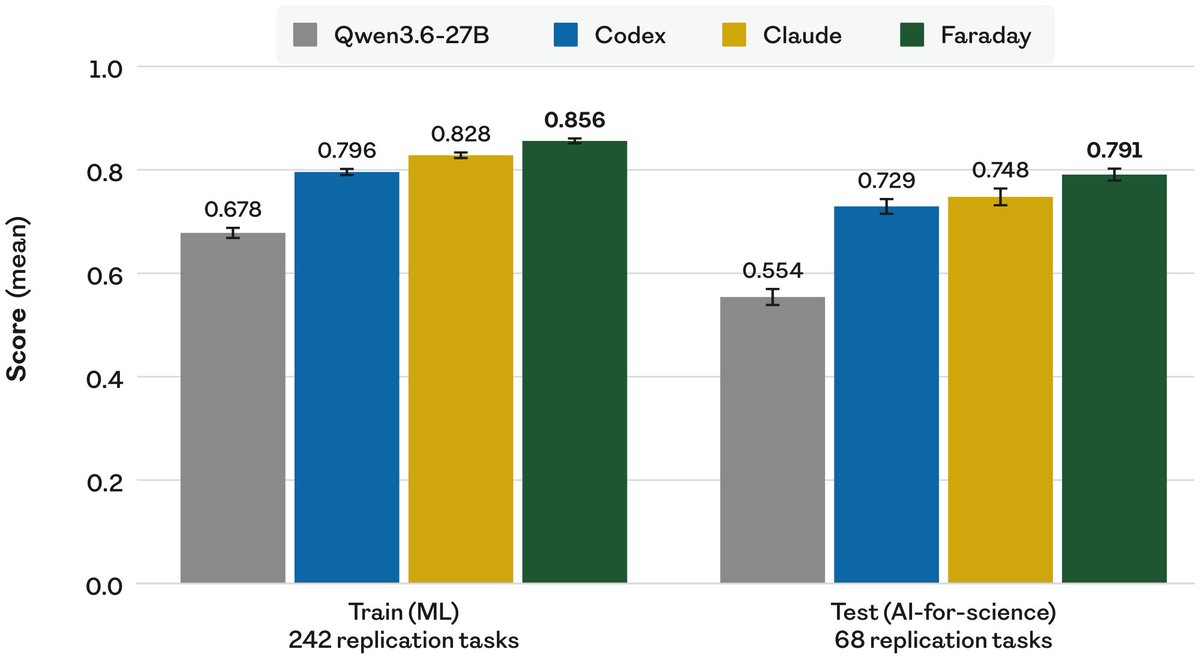
1/ Today, we introduce Faraday, a 27B-parameter AI Scientist that extends the capabilities of coding agents with a layer of scientific intuition. Trained via long-horizon RL, Faraday outperforms Claude Opus 4.8 and GPT-5.5 on the task of replicating research papers. 🧵
We can finally talk about it:
We found a way to extract hidden reasoning of frontier models using a vulnerability in the APIs of every frontier AI company.
We verified that our reasoning token count matches billed API thinking tokens 1:1 for most of the prompts we queried.
CMU got three of Department of @ENERGY Genesis Mission Awards on AI-Enabled Scientific Discovery and the work involving our SMDD-Bench is one of them!! Super excited to continue working on long horizon agents for molecule design!