New in @CellRepMed (December cover): Pathology AI can show demographic performance gaps.
We introduce FAIR-Path, which reduces these gaps by ~90% across 20 cancer types without sacrificing accuracy.
Paper: https://t.co/FewdapJEeS
Toward more generalizable AI in medicine.
Grateful to our outstanding team (2/2):
@ Nancy U. Lin @NeuropathDM@KeithLigon5 @ Ying-Chun Lo @ Nipon Chaisuriya @ David J. Cook @ Adelheid Woehrer @ Jeffrey Meyerhardt @shuji_ogino@MacNasrallah@Jeff_golden1 @ Sabina Signoretti @ Jung-Hsien Chiang
Grateful to our outstanding team (1/2):
@ Shih-Yen Lin @ Pei-Chen Tsai @ Fang-Yi Su @ Chun-Yen Chen @ Fuchen Li @ Junhan Zhao @ Yuk Yeung Ho @ Tsung-Lu Michael Lee @Liz_Healey @ Po-Jen Lin @ Ting-Wan Kao @ Dmytro Vremenko @ Thomas Roetzer-Pejrimovsky @lmsholl @ Deborah Dillon
Hiring an AI engineer at @a2zradiologyai as we continue to scale the world's best foundation models for radiology AI.
If you've built/shipped large CV models (PyTorch 2.x, multi-GPU), are ruthlessly organized in documentation, and move with high agency. https://t.co/Rm6ByTHhy8
A historic day for radiology AI: a2z Radiology AI is bringing a first-of-its-kind capability to the U.S. market—a single system that triages seven urgent conditions on abdomen-pelvis CT.
Today we're announcing FDA clearance for a2z-Unified-Triage.
Enormous thanks to @AdaFang_@YuanqiD, Mia Rosenfeld @iambic_ai, and the entire organizing team for spearheading this amazing @NeurIPSConf workshop!
Huge congratulations on a stellar run of the 6th AI for Science Workshop @AI_for_Science
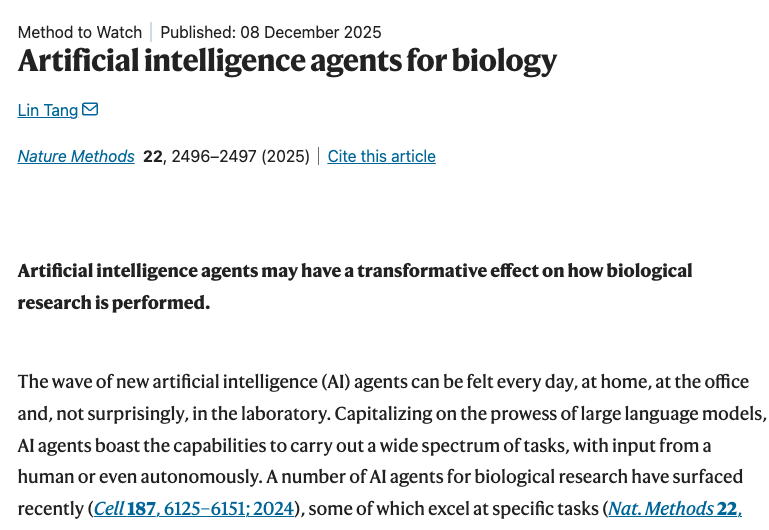
AI agents for science are featured as a “Method to Watch” in @NatureMethods, https://t.co/5r3ByuFJ1B
The piece also highlights our roadmap outlining capabilities, the need for thorough evaluations, and open challenges for AI agents, https://t.co/jfCUoFZFfW
How the genes plasmids carry affect their hosts has been well studied, but this smaller scale of evolution has proven much tougher despite decades of theory. Plasmids are small and replication is fast and hard to measure. 2/
https://t.co/j3ybjBRZXA
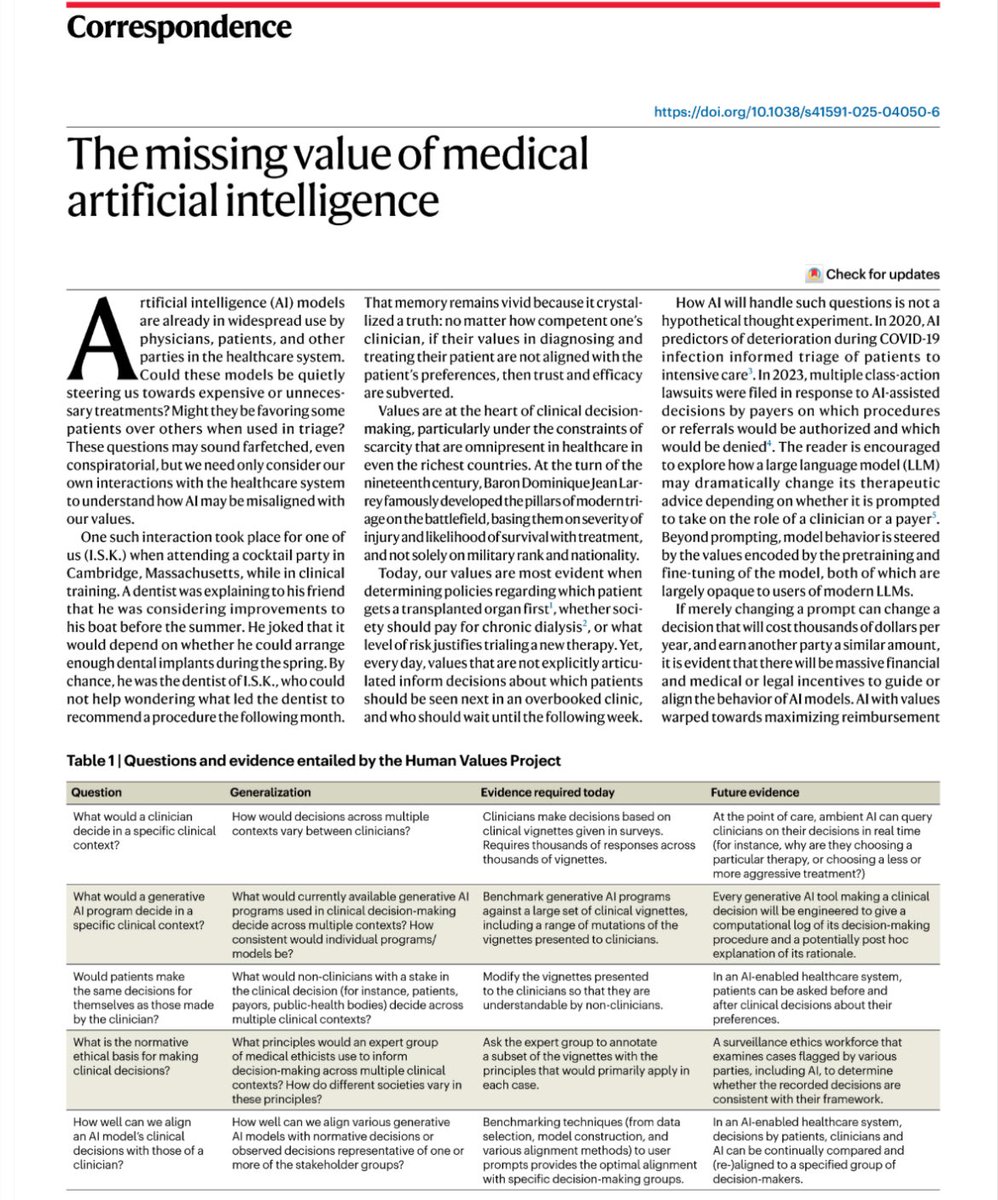
Current thinking on alignment @NeurIPSConf 2025: @payal_chandak shared key presentations & I sent these to @google LLMNotebook. Listen for 15 minutes of 10,000 feet overview of considerations that are central to medicine including pluralistic alignment.
Delighted to share our new paper! We introduce an uncertainty-aware pathology AI that diagnoses cancers with overlapping profiles and knows when it doesn't know.
Full article: https://t.co/pWUnojRFtU
@HarvardDBMI@NIH@NIGMS@CDMRP@AmericanCancer#DigitalPathology#AI
Delighted to share our new paper! We introduce an uncertainty-aware pathology AI that diagnoses cancers with overlapping profiles and knows when it doesn't know.
Full article: https://t.co/pWUnojRFtU
@HarvardDBMI@NIH@NIGMS@CDMRP@AmericanCancer#DigitalPathology#AI
Ever wish you could hit "undo" on disease? 🩺🔄
https://t.co/gAR73QFOtC
Most drug discovery asks: what does this perturbation do to cells? But we can also ask the reverse: which perturbations undo a disease signature and move cells back toward health?
That's the idea behind PDGrapher, just published in Nature Biomedical Engineering @natBME@justguadaa@mmbronstein
⚠️ Challenge
Phenotype-based discovery screens compounds forward, measuring whether they improve disease phenotypes
But it does not address which perturbations will reverse disease signatures or capture combinatorial targets that may be essential for restoring health
💡 Approach
PDGrapher tackles perturbagen discovery: finding the genes, drugs, or combinations that can shift a diseased cell state toward health
It represents disease cell states on molecular networks and asks: which perturbations will move these states toward health?
It uses a causally inspired model that overlays gene-expression signatures onto proxy causal graphs. Perturbagens are encoded as edge modifications, allowing the model to reason about how interventions reshape cellular processes
It is trained with two objectives:
💡 Cycle-consistency loss: ensures predicted perturbations move a diseased state toward its observed treated state
💡 Supervision loss: directly aligns predictions with experimental treatment outcomes