Activation of IRF3 in cardiomyocytes impairs mitochondrial oxidative function through PGC-1α inhibition and drives heart failure
https://t.co/lVUy9Ba24g
This is insane.
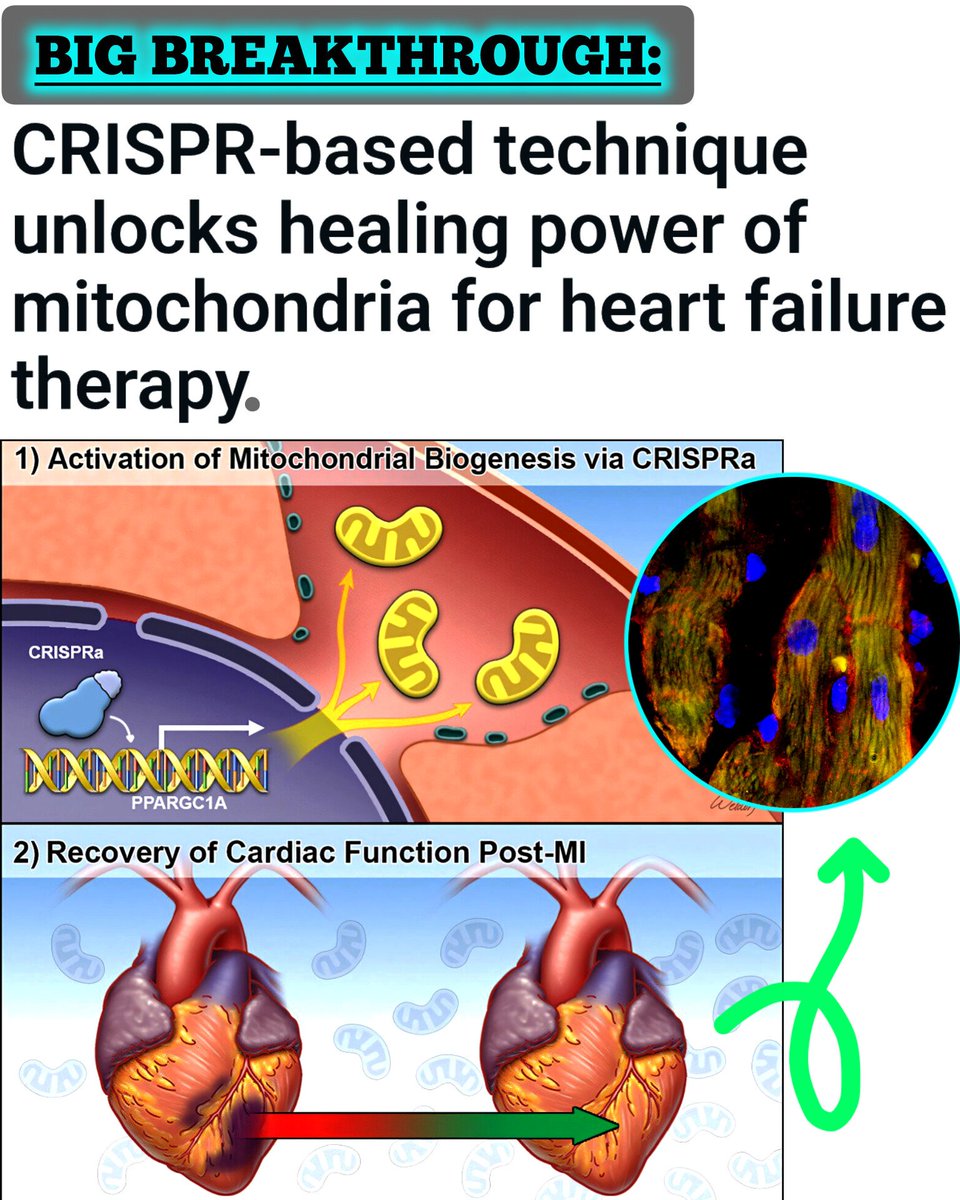
BIG BREAKTHROUGH: Scientists just developed a CRISPR gene switch that helps heart cells rebuild their own power plants.
Researchers have created a CRISPR based system that activates the gene PPARGC1A, which produces the metabolic regulator PGC-1α, the master controller of mitochondrial biogenesis.
Instead of editing DNA, the system uses CRISPR activation (CRISPRa) to turn the gene on, triggering cells to naturally produce more mitochondria, the structures that generate ATP and power cellular metabolism.
When tested in human cardiomyocytes and donor heart tissue, the technique significantly increased mitochondrial respiration and oxygen consumption, clear indicators of stronger cellular energy production.
This matters because heart failure is fundamentally an energy crisis. After a myocardial infarction, mitochondria become dysfunctional and heart cells cannot generate enough ATP. About 1/3 of heart attack patients eventually develop heart failure, and around 6.8 million people in the U.S. live with the disease.
Previous attempts to boost mitochondria forced cells into metabolic overdrive 👀!
This CRISPR approach works differently. It fine-tunes the cell’s internal regulatory network, allowing mitochondria to increase in a controlled way without damaging metabolism.
This new study shows that gene activation CRISPR systems can reprogram cellular metabolism, not just edit DNA.
If future trials succeed, this approach could help treat:
> Heart failure after heart attacks
> Mitochondrial disorders
> Metabolic diseases
> Possibly neurodegenerative conditions
#Throwback
COMMENT | C Hsu & @DrLoomba
From NAFLD to MASLD: implications of the new nomenclature for preclinical and clinical research
https://t.co/ofcR1MXM60
“Ten years ago I was kicked out and forced to retire.”
Our new medicine laureate Katalin Karikó (@kkariko) told us how much it means to be awarded the Nobel Prize after a scientific career that has been full of challenges.
Ten years ago, Karikó was still doing all her experiments by hand but today she has been awarded the medicine prize for her research on mRNA, which led to the development of COVID-19 vaccines.
Listen now:
The May issue is live https://t.co/CnNGWM0Uch
On our cover, disease signatures in high-dimensional biomedical data are detected with a visualization algorithm https://t.co/0ppHvNZyVy
Doesn't look to good to me. Why would you vaccinate the under five year old set if they immune response is under par and the rate of complications in the absence of underlying illness is very, very low? Are we into homeopathy? Inquiring minds want to know.
We are seeking motivated and talented PhD candidate for studying immunometabolism in cardiac and skeletal muscle disorders. Interested? Then apply https://t.co/3XsnkSUKB8