Its more important than ever to see $tao succeed. Expect criticism, expect praise but most important lets make sure it progresses
Aside from being critical we hired multiple people from frontier labs + investing 6 figures in our own little compute cluster
Actions matters and doubling down to have a meaningful impact
Announcement from @const_reborn and @opentensor today:
Starting next week we will be introducing an interim measure to block emissions on Bittensor subnets which are engaging in active foul play and or with no clear path to adding value into the Bittensor ecosystem.
This will need to be done on a case-by-case basis, however the criteria for blocked emissions will revolve around the following:
1) Long-term burning of 100% miner emissions with no plan from the team to bring them online.
2) Active self-mining i.e. subnets that do not have code and instead use stake weight to pass emissions to their own keys.
3) Dead or fully abandoned subnets, or those that have not announced themselves i.e. "unclaimed" subnets.
4) Subnets engaged in TaoFlow exploitation, such as 104, which have very little to no chain activity from the network at large.
A chain operation to block emission will be available on Tuesday to carry this out. Note this is not a long term solution as further protocol upgrades such as conviction, shorting, and the eventual full decentralized governance system of Bittensor, coming into play this year, will allow much more organic and swarm based intelligence to organize Bittensor's emission vector.
Onwards
@bittensor
BitGo has partnered with @YumaGroup to deliver an institutional-grade solution for Bittensor Subnet Tokens.
Clients can stake and trade subnet tokens within a single platform, managing exposure to the Bittensor ecosystem within the security of a qualified custodian alongside a leader in non-custodial $TAO staking since 2024.
🔒Locked Stake & Conviction are Being Proposed for Bittensor
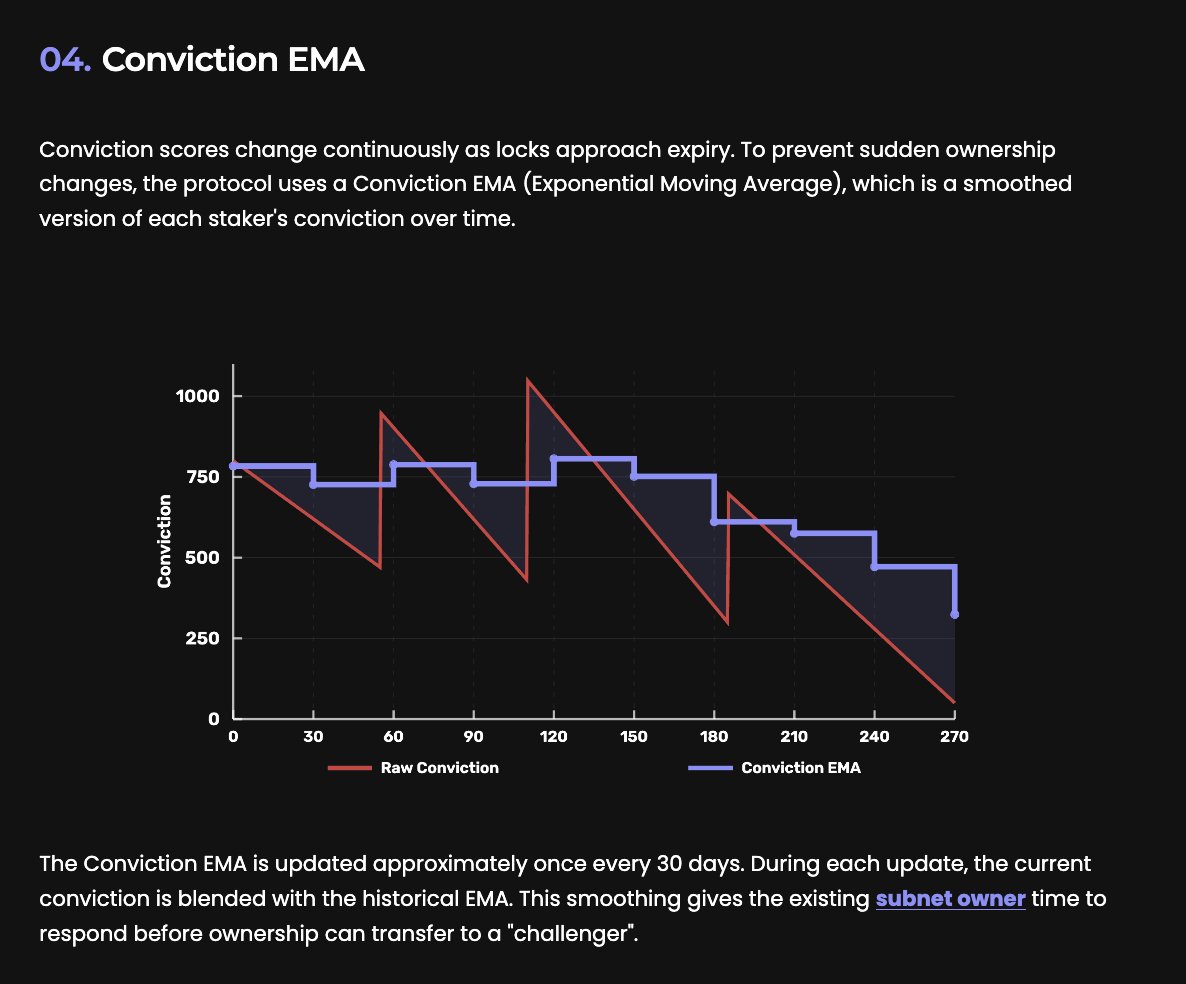
Subnet ownership may be about to change. BIT-0011 proposes that anyone can challenge for ownership of a subnet by locking their ALPHA stake and building "conviction."
Right now, inactive subnet owners can hold onto subnets indefinitely. 'Locked Stake' would make ownership a contest of commitment, giving motivated participants a path to take over neglected subnets.
How it works:
- Lock ALPHA on a subnet for a chosen duration to build conviction
- Conviction starts at the full locked amount and decays linearly to 0 at expiry
- Every 30 days, the staker with the highest conviction EMA becomes the subnet owner
- The EMA smoothing prevents anyone from briefly locking a large amount to "snipe" ownership
Learn More: https://t.co/YpHcT5Nth3
NOTE: This is a draft proposal (BIT-0011) currently being discussed. The implementation and design may change or be replaced completely.
We needed to run trusted workloads on untrusted host machines.
So over a year ago, we started building the Targon Virtual Machine to enable Confidential TEEs in production.
Today we're sharing our white paper written alongside @intel: Decentralized Compute on Untrusted Hardware Using Intel® TDX and Encrypted CVMs
@realvijayk@FinanceFreeman Bittensor right now has 128 Subnets - i give you only 1 Subnet out of all 128 which you can use right now, its Bitmind, Subnet 34 , has an Android/ioS App and is the worlds most accurate deepfake detector. Try it out - https://t.co/EqP8Noqg1l
Introducing the Yuma Composite Index (YCX), a new way to track the full universe of subnets on Bittensor.
YCX is a one-stop destination for aggregate subnet market price performance.
Learn more here ⬇️ https://t.co/uFjlerJGuj
Fair warning, about to get into the weeds here. But you flatter me, so I'll give you an organized brain dump (plus I've been enjoying writing my ideas out lately).
In my mind TAO has two key innovations that set it apart, and once they click you'll understand why the "subnets over TAO" framing is a false choice. Some subnets will absolutely outperform. But TAO is going to do fantastically well regardless of which ones win.
First: Yuma Consensus. The fundamental problem with "mining useful work" is that useful work is subjective. How do you get a decentralized consensus on which AI model gave the better answer? Which code actually works better? Yuma cracks it by recognizing that while any single quality judgment is subjective, patterns of agreement among independent judges are objective and measurable. It also recognized that not all the work has to be on-chain for verification (in this context, all that matters is the answer/output). Validators score outputs on a gradient, outliers get mathematically clipped, and the whole system is subject to economic selection pressure (bad judges lose money). Early skeptics of Bittensor considered this sacrilege given Proof of Work is an objective consensus mechanism where everyone shows their work, and a lot of their criticisms back then (i.e. it was rife for manipulation) were correct. But post-dTAO I personally think it's safe to say the skepticism is settled. The outputs speak for themselves. The DePIN subnets are humming, Ridges is competing with SOTA models on benchmark tests, Templar coordinated the world's largest decentralized training run (my three favorite examples but there are probably a dozen other things worth talking about here).
Second: the tokenomic design. Crypto's promise has always been minimally extractive coordination (i.e. think coordinating drivers and ride-seekers without Uber extracting 30% for designing the marketplace on your phone app). But every decentralized network faces a chicken-and-egg problem: users won't pay for an underdeveloped network, and operators won't build without revenue. VC capital "solves" this but reintroduces the extraction crypto was supposed to eliminate (don't we all know this too well). Fair-launched native tokens solve the bootstrap without reintroducing extraction. But that only works if sufficient value eventually flows back to the token.
This is where dTAO and TAO Flow come in. Every subnet has a protocol-native AMM pairing its alpha token against TAO. No other way in. Subnets that attract buying flow get more emissions. Subnets that don't, lose emissions and eventually get deregistered. This creates a direct incentive for subnets to (1) be good faith actors (i.e. don't try to farm/manipulate the system) and (2) generate real revenue and commit it to buybacks (rather than farm tokens and dump). If you don't, your subnet simply flounders and dies.
Those buybacks mechanically create TAO demand because all alpha pairs against TAO. This is accretive yield. That doesn't even account for the fact that the best subnets earn an outsized portion of protocol emissions (which is a different form of yield entirely). Once you hit a certain scale that subnet alpha token is going to become an attractive investment on its own. Importantly, anyone who wants to join in and invest in that subnet to earn a piece of it will be required to first buy TAO off the market and then stake it (thereby locking up the supply) to hold the subnet token with its yield. So at bottom what you have is TAO functioning as the index for the entire subnet ecosystem. If any subnet is doing fantastically (real revenue and/or speculative investment) TAO is necessarily and mechanically pumping. All subnet tokens are essentially rehypothecated TAO (due to the way you stake to "buy" alpha) so every subnet benefits when one succeeds. Revenue buys back token → token appreciates → larger dollar value of emissions → bigger subsidies → attracts better miners and validators → better outputs → more revenue → cycle repeats. That's the flywheel underpinning the entire ecosystem.
And here's the part I think most people haven't fully internalized yet. I genuinely believe Bittensor is a 0-to-1 moment in cryptoeconomic incentive design. The subnet architecture can be purpose-built for just about any idea you can conceive of (not just AI, although that's obviously the dominant focus given where the world is heading). If you have a good idea and a sound incentive mechanism, why would you go anywhere else? You get the lowest-friction path to insanely deep mining and liquidity pools that took years and over a billion dollars in emissions and four years to coalesce. If your idea works, you get massive subsidies immediately to bootstrap. Study the ascent of Ridges. Went from zero to 80%+ on SWE-Bench and a consumer product launch in less than a year. I'm pretty sure total emissions to that particular subnet are less than $10 million. How much have Cursor/Windsurf/Replit spent?
And it fair launched. No premines, no VC insiders sitting on discounted tokens waiting for liquidity events. Everyone who holds TAO earned it through work. It's already more distributed than Bitcoin. The code is open source, anyone can fork it. But you cannot fork the mining pools, the validator set, the subnet composability, or the deep liquidity in the enshrined DEX. That's the moat, and I think it's impenetrable at this point.
@realvijayk@anbrandenburger Bittensor right now has 128 Subnets - i give you only 1 Subnet out of all 128 which you can use right now, its Bitmind, Subnet 34 , has an Android/ioS App and is the worlds most accurate deepfake detector. Try it out - https://t.co/YKVooLC116
If you’ve heard us talk about Bittensor but still aren’t totally sure what it is, this quick explainer is for you.
In under 90 seconds you’ll get the basics and why it matters. $TAO⬇️
Zoom out.
Seen this a number of times. Bull markets attract the most unsavory of people. They build casinos, ponzis and financial schemes. The market punishes us.
Next, those people, those scammers leave. Bitcoin goes back to being real. Crypto takes a breath of fresh air, the builders keep building and cycle begins again.
That cycle literally *is* the technology. A monetary system that reacts and sheds itself.
If it were any different it would be a stultified cabal that stays ugly for ever. It can’t. That’s what is good about it.
When you understand technically what was built with Bitcoin. You’ll understand it doesn’t matter if Epstein funded the core developers. It doesn’t matter if Satan himself runs the nodes, made a DAT, or wrote the code.
The structure or Bitcoin is itself Good and decentralized, and fair.
The need for this monetary revolution didn’t end with a price drop and indeed we need it now more than ever.
LFG
Stillcore Capital @stillcorecap is proud to release our STATE OF TAO: January 2026 Report.
It is aimed primarily at people who know nothing about Bittensor.
It explains, in simple-speak, what Bittensor $TAO is and how it works, and then characterizes where the ecosystem is at today.
Hope you enjoy it!
Download PDF:
https://t.co/DSoFzVQyUL
Grayscale filed an S-1 for $GTAO, which would be the first Bittensor $TAO ETP in the U.S.
Decentralized AI is developing quickly and @Grayscale is pioneering access
NOVA Compound's new scoring function builds upon @MIT and @RecursionPharma Boltz-2's predictions to improve BOTH Hit and Hit-to-Lead identification!
Better predictions means less $$$ wasted in experiments downstream.
Read more about how we evaluated this new approach in the article below.