Can we reconstruct our subjective experiences from brain signals? Check our latest paper in @ScienceAdvances w/ my PhD advisor @ykamit and colleagues. We explore how reconstruction methods can advance understanding of neural representations behind illusion.https://t.co/lDPcVXB1pi
Visual illusions suggest that what we see is not always a direct reflection of the world, but rather a constructed representation. Is it possible to generate images mirroring illusory experiences directly from brain activity?
Check our preprint! https://t.co/KgV2H1dt4r
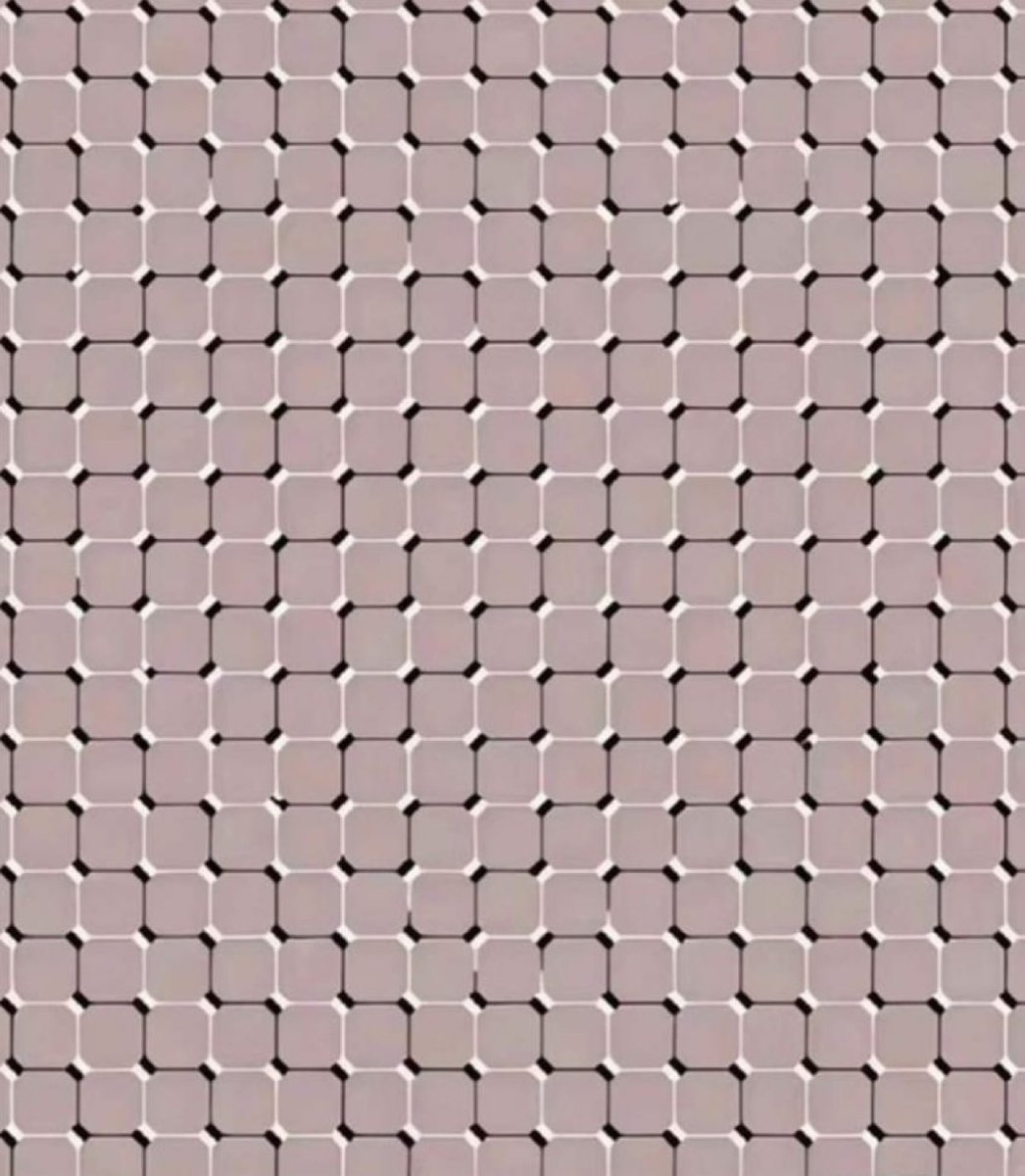
You see rotation when you move your eyes, even though the image is 100% static.
Our #CVPR Findings paper uses motion illusions to (1) reveal gaps between human and AI motion processing and (2) identify architectures key for aligning vision models with human perception.
https://t.co/gls6P3Lx2T
Can AI "see" motion from static images like humans?
We tested 10 state-of-the-art vision models (multi-scale, recurrent, and bio-inspired) on the Rotating Snakes illusion, one of the most extensively characterized motion illusions in human and primate vision. Almost all failed — only one bio-inspired model, Dual, predicted motion most closely aligned with human perception, particularly under simulated eye movements.
Accepted to @CVPR Findings!
Paper: https://t.co/zSu4fKvpSq
w/
@LibraCheng@zitangsun@KriegeskorteLab
A 🧵:
#ComputerVision #Vision
1/
When diffusion generates images from text, before an image has objects, how does each noisy token know what it should become?
In our new work, we found that Diffusion Transformers solve spatial-relation prompts using a circuit motif reminiscent of developmental biology: morphogen-like spatial gradients.
At the start of sampling, image tokens are mostly uninformed noise — like an undifferentiated sheet in an embryo. Relation heads then write smooth spatial gradients onto the image canvas, guiding where objects should emerge.
Accepted as a @CVPR 2026 Highlight🌟: https://t.co/oIC6QKwQ3R
Beautiful collaboration with my friends and colleagues @fjxdaisy & Xu Pan!
A 🧵
Look. The snakes rotate.
Hold still. They stop.
Glance away. They spin again.
We asked 10 visual-motion models to play this game with us. Only one could. 🐍
I'll present "Neural networks reveal candidate computational mechanisms underlying anomalous motion illusion" at #VSS2026
🗓️ May 19th, Tuesday 8:30–12:30
📍 Pavilion, Board 53.435
Welcome to drop by! 👋
w/ @IsabellaRosario@ZitangSun@KriegeskorteLab
1/ New preprint + VSS poster! Attention has long been thought to enable efficient vision. But does it? First demonstration that attention—consuming just 4-5% of the energy budget—can cut the energetic costs of vision in half. #VSS2026
🧵Excited to announce—
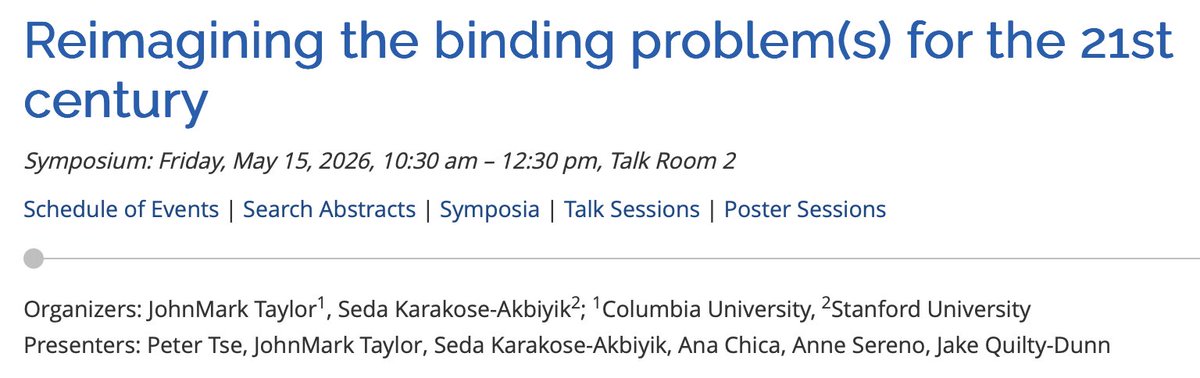
"Reimagining the binding problem(s) for the 21st century": A VSS Symposium
St. Pete Beach @VSSMtg
May 15th, 10:30am
Presenters: Peter Tse, JohnMark Taylor, Seda Karakose-Akbiyik, Ana Chica, Anne Sereno, & Jake Quilty-Dunn
https://t.co/sFPA1zuj3L
🧠What do neurons “want”?✨
Kempner researchers @WangBinxu and @HombreCerebro have developed a way for neurons to train AI image models to match their “preferences.”
Read more about the research, out now in @NatureNeuro, here: https://t.co/p6FJ4FITRY
#neuroscience#NeuroAI
I am searching for postdocs interested in developing a deeper scientific understanding of any aspect of AI and using this understanding to improve AI systems. If interested please email me materials by Jan 10th 2026: a CV, 3 letters of reference, and a statement of research interests (can be short, just indicating what you would like to work on).
The positions are generously funded by grants from @schmidtsciences and @SimonsFdn. You will have the opportunity to collaborate with many labs across @StanfordHAI and also the Simons Collaboration on the Physics of Learning and Neural Computation (https://t.co/TfOKlQxCrE).
Bringing our Tactile UMI and additional two tactile fingers to NeurIPS! All three authors @YunzhuLiYZ @XinyueYolandaZ and I will be at our poster for demo on Thu 12:00–15:00 in Exhibit Hall C/D/E, #2400.
Otherwise feel free to catch me around the venue Wed–Fri 🙂
Our "mind captioning" paper is now published in @ScienceAdvances.
The method generates descriptive text of what we perceive and recall from brain activity — a linguistic interpretation of nonverbal mental content rather than language decoding.
https://t.co/Lt48p2pUYS
This is gona be the best Ai detector..
It's an image not a video, try it on whatever Ai you want, they won't see the floating heart.
It's the human brain.
The MIT Consciousness Club will have a Zoom option for those who would like to join online. First session Friday, Sept 19, 12pm-1:30pm. For more, see: https://t.co/hThTIkJIFE. You can also register to the email list here: https://t.co/cSGzcknLHH.
Genie 3 feels like a watershed moment for world models 🌐: we can now generate multi-minute, real-time interactive simulations of any imaginable world. This could be the key missing piece for embodied AGI… and it can also create beautiful beaches with my dog, playable real time
Our paper is now accepted at Neural Networks!
This work builds on our previous threads, updated with deeper analyses.
We revisit brain-to-image reconstruction using NSD + diffusion models—and ask: do they really reconstruct what we perceive?
Paper: https://t.co/sb7APaLBQN
🧵1/12
Absolute honor to be awarded the David Marr Medal by the Applied Vision Association
Looking forward to my talk “Five Illusions Challenge Our Understanding of Visual Experience”
Thanks so much to NOMIS Foundation, @ItalianAcademy, @columbiacss, @KriegeskorteLab, @ZuckermanBrain