@ashley_wright17 A2: For ex. in math, I can incorporate a UDL style of assessment by allowing students to demonstrate their understanding in multiple ways say, show their understanding in patterns and relations concept, options can be algebraically, graphically, pictorially or using manipulatives
@MOnespot A3: For me, different forms of graphic
organizers are helpful and effective for students to build their ideas and
express their thought process then more valuable to transform into narratives.
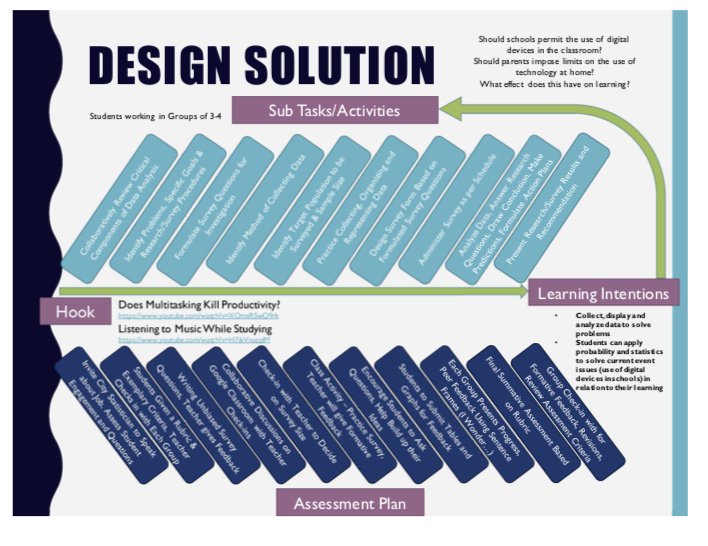
Our EDUC 546 design solution - engaging students in mathematics through a discipline based inquiry project on the use of digital devices in school. #dtk12 @Liza74508839 @MBates2019
@6243_1#dtk12 for example, in the issue of effects of technology in students' learning, there are many ways students can go about investigating that issue but the end line is to determine the pros and cons of tech to their learning.
@MrsTenHove For example in math, students are so hang up with just getting the right answer. I would design assessment that will assess the process they did to arrive with the answer.
@MrsTenHove A4: As Galileo Education Network mentions, "when teachers treat answers as the primary evidence of learning, lessons end once students have given these answers”. We should design learning where understanding the process in important-emphasis on how students perform the task.
@Jon_Beckett A1: I think administrative support and school-wide initiative would
prompt teachers’ to embrace co-designing approach to students learning.
@Jilby09 A4: providing students with engaging and rich learning experience through design thinking projects and mindsets, although students still have to complete the required assessments.
@MBates2019 I think it would be possible... but #1 constraint is time. Students would still have to write the standard test as summative but design thinking elements can be included as part of the students learning experience.
@jnordh9 A4: We can start redesigning by changing our mindset, including some elements of design thinking projects in students learning to keep them engaged and curious about learning.
@KorolErin A1: For this incoming practicum, for math 8 - shapes and space unit, I was thinking of giving students opportunity to create to build something where they can apply measurement, problem solving and critical thinking skills.