Every week, I read through dozens of articles so you don’t have to.
This week, my favorite reads explored the ideas shaping the next phase of crypto, AI, and business.
From the future of exchanges and onchain finance to AI workflows, robotics, growth strategies, and productivity systems, here are 10 articles worth your time.
—
@TheDeFiPlug explains why the shutdowns of @BitMEX and @BitMartExchange reflect the evolution of crypto exchanges rather than the failure of their products.
While BitMEX pioneered perpetual swaps, success in today’s market depends more on liquidity, distribution, execution quality, compliance, and UX than on being first.
BitMart’s exit also reinforces that crowded markets punish anyone without lasting operational edges.
Innovation builds the category. Distribution, liquidity, and execution decide who survives.
https://t.co/iqgGfcp0VC
—
@R2D2zen compares Robinhood Chain, Stable, and Arc, highlighting how they target different aspects of onchain finance rather than competing for the same market.
@RobinhoodCrypto Chain focuses on tokenized retail investing, @Stable on USDT-powered payments, and @arc on institutional USDC settlement
Each offers distinct opportunities, so it’s not just about picking the winning chain, but positioning around the infrastructure, tools, and services each one needs.
https://t.co/GjIMMPtoau
—
@therosieum explores why robotics has become VC’s fastest-growing sector, arguing that AI is turning robots into systems that can handle real-world environments.
Instead of being limited to repetitive factory tasks, modern robots are expanding into logistics, defense, autonomous transport, and hazardous work where flexibility and decision-making matter.
As AI moves into the physical world, robotics is becoming one of the top investment themes of the next tech cycle.
https://t.co/jzPizRB2Do
—
@Nick_Researcher argues that crypto’s next growth phase will be driven by expanding onchain access to RWAs like stocks, bonds, commodities, and private credit.
As tokenized RWAs continue to grow, perpetual markets are emerging as the preferred way to gain leveraged, 24/7 exposure, with equities leading trading activity.
The vision is an onchain financial system where users can hold, trade, borrow, and earn yield from tokenized assets in one place.
https://t.co/xxgRDquu93
—
@TendersAlt explains why understanding KOL behavior is a critical part of trading, especially as today’s market relies heavily on attention-driven narratives.
Unlike community coins that can remain resilient after influential holders exit, hype-driven tokens often lose momentum quickly once key KOLs stop promoting them.
Successful traders focus not just on charts, but also on tracking narratives, wallet activity, and the behavior of influential market participants.
https://t.co/qlfWUnEwEs
—
@akshay_pachaar explains graph engineering as a way to coordinate multiple AI agent workflows, showing how it builds on loop engineering rather than replacing it.
It connects specialized agents through shared state and structured routing, making complex workflows easier to manage and audit.
Rather than being a new technology, it is best viewed as a design approach for orchestrating AI systems only when the added complexity is truly necessary.
https://t.co/D0djkAMbwh
—
@thelearningpill examines @moonpay’s PayBox launch, arguing that its viral airdrop attracted attention but did not necessarily convert participants into long-term users.
Although over 220,000 people signed up, onchain data showed that around 70% of claimers transferred out their rewards almost immediately, highlighting the gap between user acquisition and retention.
Instead of rewarding simple signups, future campaigns should incentivize sustained product usage and user commitment to attract higher-quality customers.
https://t.co/bjuGJsAHaA
—
@hooeem explains how GPT Voice can become a productivity tool by combining voice interactions with a well-organized AI-powered workflow.
By pairing it with a digital “second brain” and connected work tools, users can offload routine tasks like emails and note-taking while focusing on higher-value work.
The article presents GPT Voice as a way to turn ideas into action faster and build a more efficient daily workflow.
https://t.co/MNDUzQuu3Z
—
@EXM7777 outlines a framework for running a solo business by assigning specialized AI agents to content, projects, outreach, finance, and marketing.
It uses structured workflows, a shared knowledge base, and clear approval rules to automate repetitive work while keeping key decisions human.
The goal is to use AI as an operational layer that scales output without adding headcount.
https://t.co/VHRGyoRos3
—
@Bober_smart outlines the habits of successful millionaires, stressing that long-term wealth comes from consistency, not one-off breakthroughs.
From disciplined routines and continuous learning to financial tracking, investing, and long-term thinking, he highlights practical habits that compound over time.
The key to succeeding is to start with a few sustainable changes and build consistency rather than trying to adopt everything at once.
https://t.co/XzXIjaombI
—
That’s all for this week. See you next week with another roundup of the best reads.
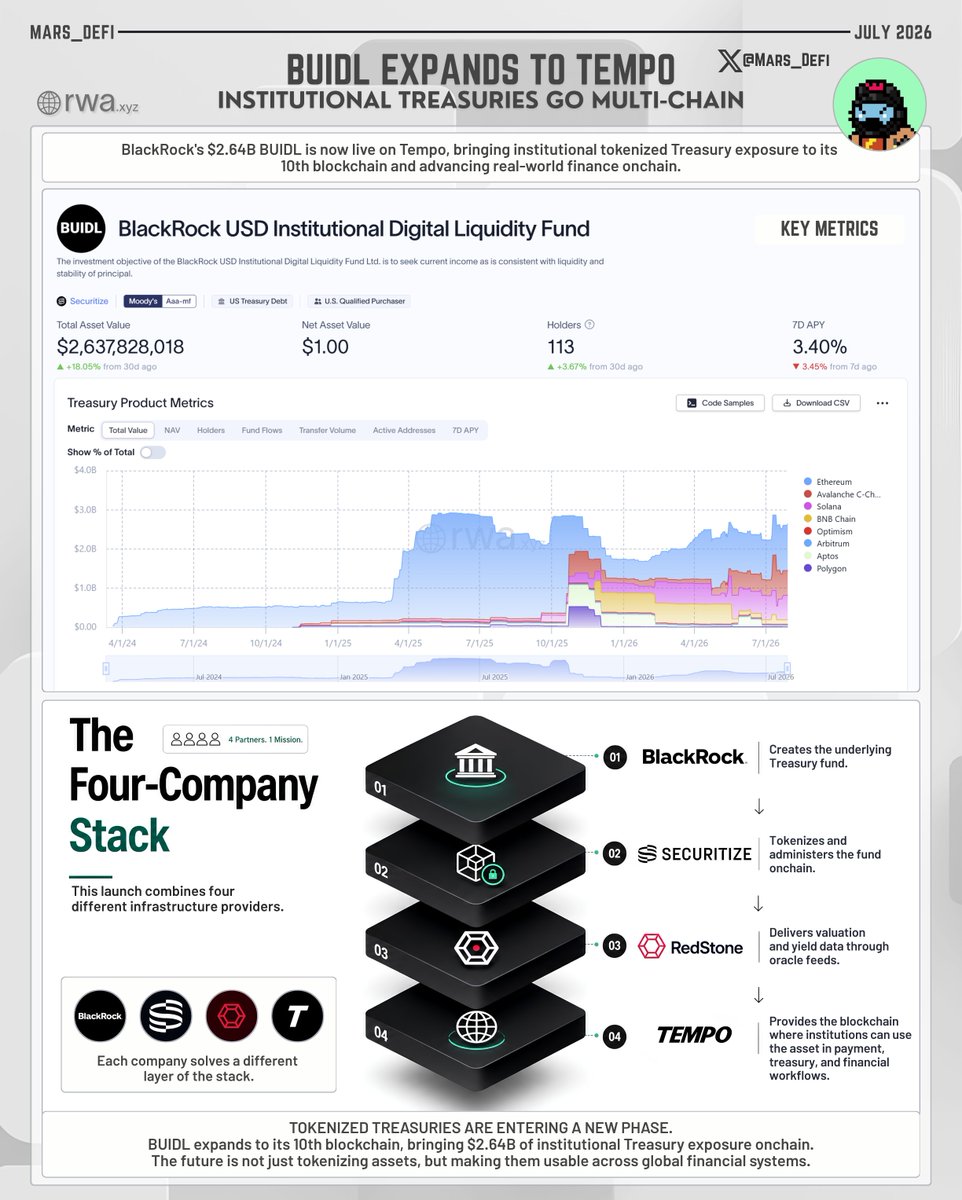
BlackRock's $2.64B BUIDL is now live on @tempo, expanding institutional tokenized Treasury access to its 10th blockchain.
But this launch signals a much bigger shift in onchain finance.
Here's what's actually changing:
—
● Why BUIDL Matters
$BUIDL isn't another token. It represents shares in @BlackRock's tokenized U.S. Treasury fund, bringing institutional yield onchain.
• Backed by cash, U.S. Treasury bills, and repos
• $2.64B AUM, up 18% in the last 30 days
• 3.40% 7-day APY
• Moody's AAA-mf rating
Instead of leaving stablecoins idle, investors can earn Treasury-backed yield without leaving onchain.
—
● Why Tempo?
The bigger question isn't why BUIDL expanded to another chain, but why it chose @tempo.
Tempo is purpose-built for payments, treasury management, stablecoins, and tokenized deposits rather than speculative DeFi activity.
That makes it a natural fit for institutional products like BUIDL, where yield-bearing dollars can integrate directly into real-world financial workflows.
—
● Why Securitize Matters
@Securitize provides the regulated infrastructure that brings BUIDL onchain through tokenization and compliance.
It handles tokenization, investor onboarding, transfer services, and ownership records, connecting regulated financial products with blockchain infrastructure.
This also marks Securitize's first integration with Tempo.
—
● Why RedStone Matters
@redstone_defi provides the pricing and valuation data that keeps BUIDL usable onchain.
Its oracle feeds enable daily valuation, interest accrual, and DeFi composability across the Tempo ecosystem.
—
● The Infrastructure Stack
BUIDL brings together four providers, each powering a different layer of the tokenized asset stack.
• @BlackRock -> Provides the underlying Treasury fund
• @Securitize -> Tokenizes and administers the fund
• @redstone_defi -> Delivers valuation and oracle feeds
• @tempo -> Enables payments and treasury workflows onchain
—
Tokenized U.S. Treasuries have grown into a $13.5B-16B market, highlighting the rapid growth of institutional RWAs.
Despite just ~$28M TVL and ~$43M in stablecoins, Tempo secured one of crypto's largest tokenized Treasury funds.
The next phase isn't putting assets onchain, it's making them usable across onchain financial systems.
The 18% APY on @ADIChain_ $ADI staking initially caught my attention, but the mechanism behind it is far more interesting than the headline number.
This isn’t a conventional staking programme where new tokens are continuously printed to subsidize yield.
There is a fixed pool of 250,000 $ADI, funded once at deployment, and a maximum of 3 million $ADI that can participate.
Your share of that pool is determined by two things:
• How much $ADI you stake
• How long you agree to lock it
The structure uses three lock tiers:
30 days : 1x reward weight
90 days : 2x reward weight
180 days : 3x reward weight
Think of every staked token as earning points. The longer the lock, the faster those points accumulate, and the more points you own relative to everyone else, the larger your share of the fixed reward pool.
—
That distinction matters because the displayed 6–18% APY is emergent, not arbitrarily set by the team and it changes with participation.
If fewer tokens are competing for the pool, each participant earns a larger effective share. As more $ADI enters, the same 250,000-token pool gets distributed across more weighted points, reducing the effective yield for later participants.
But the flip side is that raw accrual can run above the displayed band while the pool is still filling.
So the 18% is better understood as the capped indicative APY for the highest-weight tier and not a permanently guaranteed rate.
What I like here is the absence of the usual “stake, print and dilute” loop.
—
The main trade-off is equally important which is there is no early exit.
Once you choose a tier, those tokens remain locked for the entire period.
That makes this less about blindly chasing the highest displayed APY and more about choosing a lock duration that matches your liquidity needs.
—
$ADI has a fixed 999 million supply, while staking temporarily removes tokens from circulation without creating new inflation to pay participants.
Meanwhile, $ADI remains the gas asset for activity across @ADIChain_ including stablecoin settlement and tokenized assets.
That creates a fairly clean mechanism:
Network usage creates demand for $ADI -> staking locks part of the available supply -> longer commitments receive greater weight -> a fixed pool rewards participants without diluting every holder.
The setup is also non-custodial, rewards have no vesting once harvested, and additional stakes are allowed although each deposit begins its own lock.
—
Personally, the fixed reward pool and participation-based yield make the design more interesting than the percentage alone.
So always check the live pool size, current APY and official staking contract before committing capital.
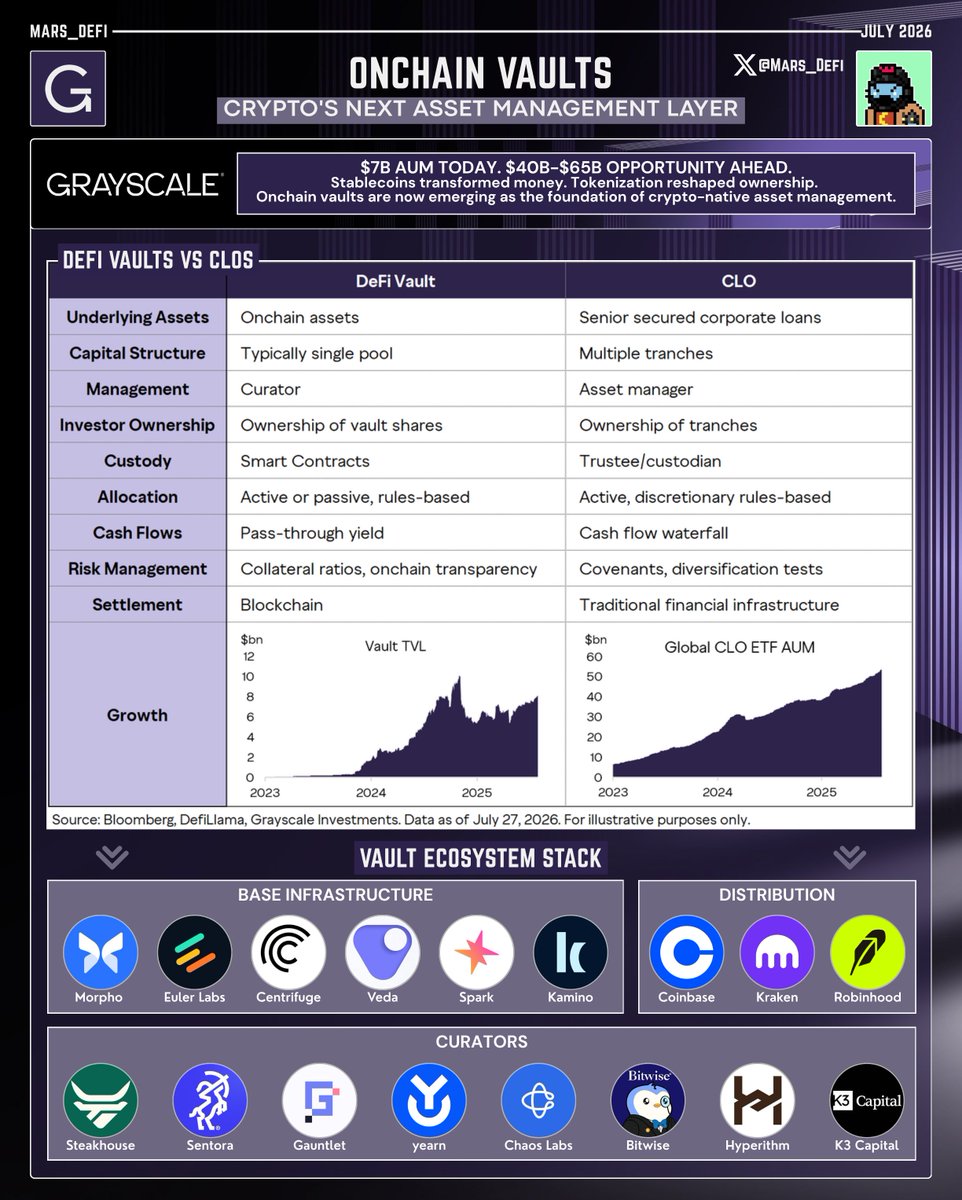
Stablecoins transformed money, tokenization reshaped ownership, and onchain vaults could be crypto's next major evolution.
Already managing nearly $7B in assets, they are quietly becoming the foundation for onchain asset management.
Let's unpack why this matters.
—
Evolution of DeFi Vaults
Vaults are onchain asset managers that automatically allocate capital across yield-generating strategies.
● Generation 1 (2020-2022): Yield Aggregation
Vaults automated yield farming by routing capital across DeFi protocols for the highest APY, but rigid strategies and poor composability limited growth.
Projects:
• @yearnfi
• @beefyfinance
• @harvest
The Turning Point: ERC-4626
ERC-4626 standardized vaults, making deposits, withdrawals, accounting, and vault shares interoperable across DeFi. ERC-7540 later extended support to RWAs and private credit.
● Generation 2 (2023-2025): Curated Vaults
Infrastructure separated from risk management, letting curators manage allocations while protocols remained permissionless and non-custodial.
Projects:
• @Morpho Blue + MetaMorpho
• @eulerfinance V2 Vault Kit
Curators:
• @gauntlet_xyz
• @SteakhouseFi
● Generation 3 (Today): Onchain Asset Management
Vaults evolved beyond yield optimization into onchain asset management infrastructure spanning lending, RWAs, treasuries, private credit, and multi-chain portfolios.
Examples:
• Institutional wrappers
• Portfolio managers
• Fund-of-funds
• Consumer finance apps
Distribution:
• @coinbase
• @krakenfx
• @RobinhoodApp
—
● DeFi Vault V/S CLOs
Vaults mirror CLOs but replace financial intermediaries with transparent, onchain execution.
DeFi Vault
• Onchain assets managed by curators
• Smart contracts replace trustees and custodians
• Transparent, blockchain-native settlement
CLO
• Senior secured corporate loans managed by asset managers
• Trustees and custodians oversee assets
• Traditional financial infrastructure and settlement
—
● Vault Ecosystem Stack
Vaults rely on a layered ecosystem where infrastructure, curators, and distribution each play a distinct role.
Base Infrastructure: Provides the rails for vault creation and execution.
• @Morpho
• @eulerfinance
• @centrifuge
• @veda_labs
• @sparkfinance
• @kamino
Curators: Allocate capital and manage risk across vaults.
• @SteakhouseFi
• @SentoraHQ
• @gauntlet_xyz
• @yearnfi
• @chaoslabs
• @Bitwise
• @hyperithm
• K3 Capital
Distribution: Brings vaults to mainstream users through consumer platforms.
• @coinbase
• @krakenfx
• @RobinhoodApp
—
At ~$7B AUM today versus a $1.5T CLO market, onchain vaults are still in the earliest stage of adoption.
Institutional adoption, RWAs, tokenized credit, and multi-chain expansion could push managed vaults toward a projected $40B-$65B market.
Vaults aren't just another DeFi primitive. They're building the foundation for crypto's next asset management layer.
Read @Grayscale's report on onchain vaults:
https://t.co/TWuSg5SHEj
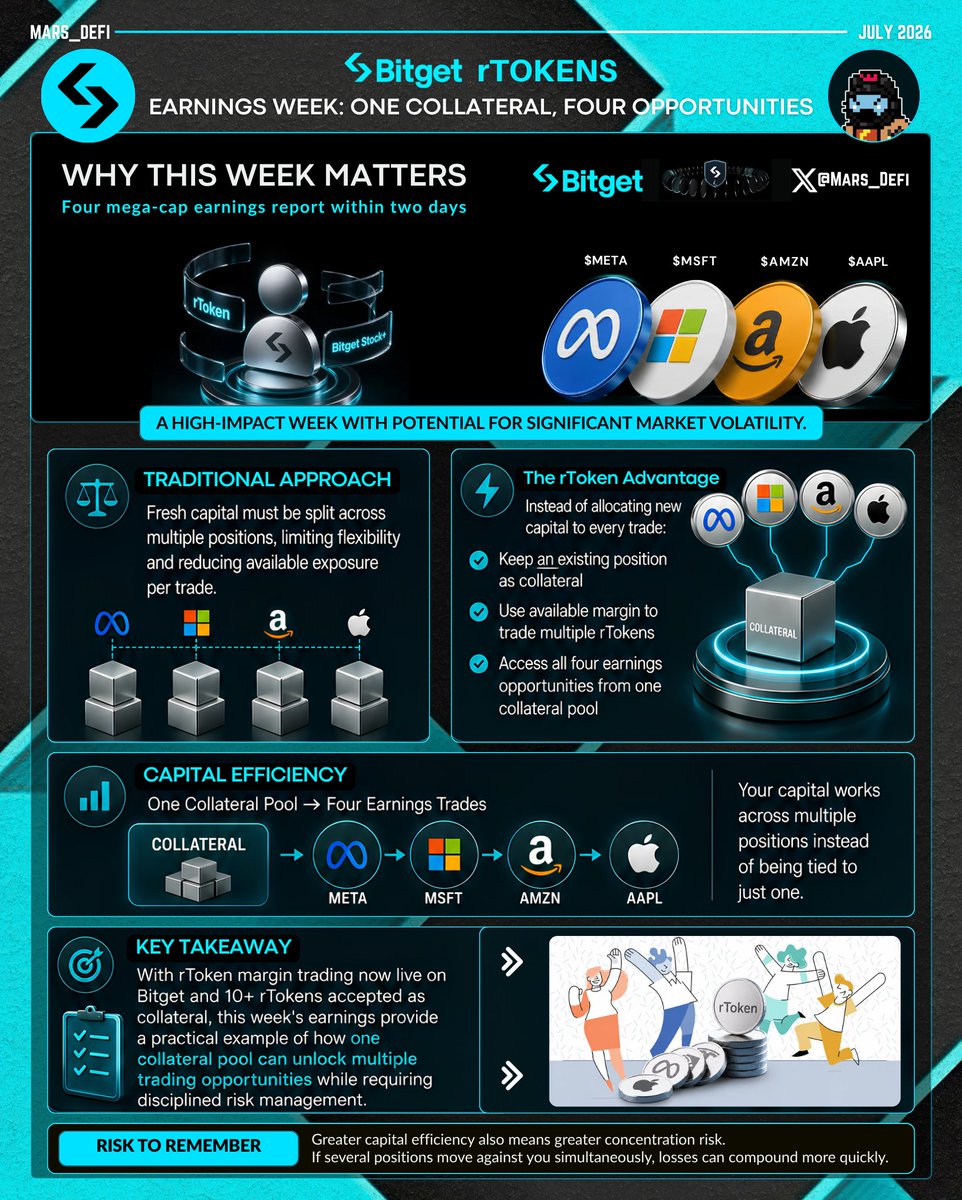
I’ve been looking at this week’s earnings calendar, and the setup around $META, $MSFT, $AMZN and $AAPL is quite interesting.
Four mega-caps reporting within two days means there will be winners, misses and plenty of volatility.
Normally, positioning across all four would require dividing fresh capital between four separate trades. But after reviewing @bitget's rToken’s margin setup, I think that is the real edge here.
—
Instead of treating my capital like a fixed pie where allocating more to $META leaves less available for $MSFT, $AMZN or $AAPL, I can keep my existing position as collateral and use the available margin to spread exposure across the four earnings plays as rTokens.
This is clearly one collateral pool with four different setups.
However, this does not remove the risk that if several positions move against me simultaneously, the same capital efficiency can quickly become concentrated risk.
But used properly, it means my capital is no longer locked into doing one job at a time.
—
With rToken margin trading now live on the @bitget and 10+ additional rTokens usable as collateral, this feels like one of those weeks where the product’s capital-efficiency thesis becomes much easier to understand.
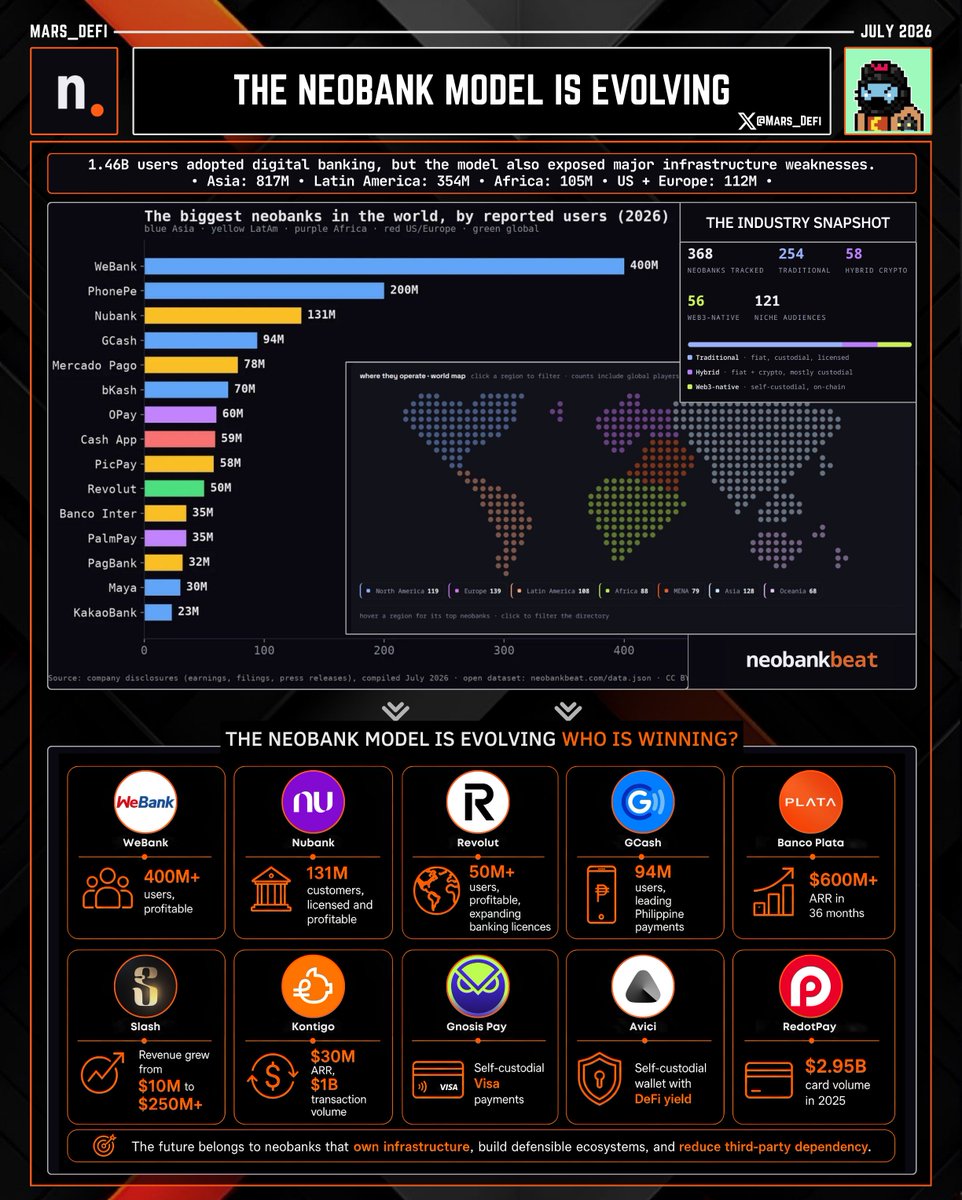
Neobanks onboarded 1.46B users worldwide, yet the same model quietly produced some of fintech's biggest structural failures.
Let's examine what broke beneath the surface.
—
● The Rise of Neobanks
Neobanks have become one of fintech's biggest success stories, serving 1.46B users while reshaping banking far beyond Western markets.
• Asia: 817M users
• Latin America: 354M users
• Africa: 105M users
• US + Europe: 112M users combined
The biggest success stories weren't built where banking already worked. They emerged in regions where millions lacked access to credit, bank accounts, and modern financial services.
—
● Where Neobanks Actually Failed
Most users believe they're depositing money into a bank, but in reality they're trusting an app that often relies on someone else's banking infrastructure.
Out of 368 active neobanks, only 127 hold a banking license, while nearly 65% depend on sponsor banks, BaaS providers, payment processors, or card issuers to operate.
• 368 active neobanks globally
• Only 127 hold a banking license
• Around 65% rely on third-party infrastructure
• Customers rarely notice this dependency until the underlying rails fail
—
● Who's Actually Winning?
The winners either own critical infrastructure or eliminate third-party dependencies.
• @WeBankCN : 400M+ users and profitable, serving more customers than every US and European neobank combined.
• @nubank: 131M customers, full banking licenses, and profitable credit operations across Latin America.
• @Revolut: 50M+ users, profitable payments business, and progressing toward a full UK banking license.
• @gcashofficial: 94M users, dominating digital payments across the Philippines.
• @bancoplatamx: $600M+ ARR in 36 months, reaching a $5B valuation in 2026.
• @slashapp: Annualized revenue grew from $10M to $250M+ in just two years.
• @kontigo_app: $30M annualized revenue, $1B transaction volume, and 1M users on a web3-native model.
• @gnosispay: Self-custodial Visa payments powered by smart accounts instead of custodial balances.
• @Avici: Self-custodial wallet, Visa card, and native DeFi yield in one platform.
• @RedotPay: Processed $2.95B in card volume during 2025, proving stablecoin payments can scale globally.
—
● Wrap-Up
The first generation of fintech/neobanks proved people want digital banking.
The second generation is discovering that the infrastructure underneath those apps is fundamentally broken.
The third generation is trying to fix that using self-custody, stablecoins, AI, and eventually AI agents.
Chart: @neobankbeat
@SachinHMx Now they want to be conversion based and I am wondering what new utility these slop projects can spring up.
Also if everyone is trying to onboard everyone, who's then the fresh user ?
@riley_gmi@launchonvaro@Uniswap Until you have a mechanism against Vamps and using the same ticker to relaunch, you're not going to win the launchpad war.
July confirms the capital concentration trend that has been building all year.
Investors are making fewer but bigger bets on sectors with clear revenue models. This is proof that the market isn’t shrinking, it’s just getting pickier.
If March through July taught us anything, it’s that monthly totals will keep swinging based on whether a Kalshi-sized round happens within a month.
That’s why the number to watch isn’t the headline figure but where it’s landing, and right now, that’s away from DeFi and toward the sectors investors see as closest to real, durable revenue.
● 16th
• @cryptocom
About - Crypto exchange
Raise - $400M
Led by - @citsecurities
• @AlpacaHQ
About - API for stocks, options, and crypto trading
Raise - $300M
Led by - @Payward
• @AlpacaHQ
About - API for stocks, options, and crypto trading
Raise - $135M
Led by - @peakxvpartners
• @pascaldottrade
About - Prediction market
Raise - $9M
Led by - @usv
• @trasiaxyz
About - Asian-first trading platform on @HyperliquidX
Raise - $1.75M
Led by - @multicoin
• @ILITY_xyz
About - Privacy-first L1 for cross-chain data verification
Raise - $1M
Led by - @tbvxyz, @Archer_Capital
—
● 17th
• @SwarmBase
About - Decentralized swarm intelligence for AI agents
Raise - $4M
Led by - @castrumistanbul
—
● 20th
• @Strategy
About - Bitcoin treasury company
Raise - $263.5M
Led by - Undisclosed
—
● 21st
• @augustus_bank
About - Clearing bank
Raise - $180M
Led by - Tiger Global
• @CordantHQ
About - Command center for payments companies, fintechs and banks
Raise - $8M
Led by - @oakhcft, @motive_partners
—
● 22nd
• @TenorFinance
About - Fixed-rate lending and borrowing platform
Raise - Undisclosed
Led by - @variantfund
—
● 23rd
• @notabene_id
About - Trust layer for global money movement
Raise - Undisclosed
Led by - @Ripple
• @K25dotai
About - Prediction market
Raise - Undisclosed
Led by - @ambergroup_io
—
● 24th
• @worldnetwork
About - Digital identity and financial platform
Raise - $52.5M
Led by - @PanteraCapital
• @memecoin_fun_
About - Token launchpad and trading platform
Raise - $3.5M
Led by - @BeckerVentures
—
● 27th
• @Strategy
About - Bitcoin treasury company
Raise - $544.5M
Led by - Undisclosed
• @axisrobotics
About - Crowdsourced data infrastructure platform for Physical AI
Raise - $12M
Led by - @hack_vc
● M&As
• @SunscreenTech
About - Privacy-focused applied cryptography last
Acquired by - @fhenix
• @01Exchange
About - trading terminal and DEX aggregator
Acquired by - @N1Chain
• @Cypher_HQ_
About - Crypto neobank
Acquired by - @NiumGlobal
• Imperator
About - Validator and data infrastructure company
Acquired by - @hypurrdash
• @sovereignxyz
About - Infrastructure provider for interoperable ZK rollups
Acquired by - @celestia labs
• @MasterDEX_xyz
About - DeFi aggregator and analytics platform
Acquired by - @lcx
• @bloxroute
About - Blockchain trading and networking technology
Acquired by - @FalconXGlobal
• Glide
About - Crypto deposits startup
Acquired by - @moonpay
• @coinhako
About - Singapore-based crypto exchange
Acquired by - @sbigroup
• @Bybit_ID
About - Trading platform
Acquired by - @Bybit_Official
• @StakingRewards
About - Risk-adjusted rewards platform
Acquired by - @TheTieIO
• @RavenMarkets
About - Digital options protocol
Acquired by - Premia
• @Liquidity_Land
About - Liquidity layer and yield aggregator
Acquired by - @TheTieIO
• @LunarStrategy
About - Marketing and advisory firm
Acquired by - @turtledotxyz
• @creepz
About - Entertainment and gaming ecosystem
Acquired by - @Unserious_Inc
• @OdinBotio
About - Copy-trading bot on Solana
Acquired by - @CieloFinance
• @newton_xyz
About - Onchain finance infrastructure provider
Acquired by - @Payward