Dopamine shifts from reward to cue during learning. But how is this reflected across the brain?
Combining NAc dopamine photometry with whole-brain fMRI in behaving mice, we link this classic dopamine dynamic to brain-wide changes as learning unfolds.
https://t.co/VFcRNleeuR
@zenbrainest@K_Miyamichi I'll add: TTX is used to block sodium channels and thus action potentials and 4-AP to block K+ channels and enhance the ability of ChR2 to depolarize. Any current must be monosynaptic, an intervening neuron would be unable to fire APs.
This work is now online!
https://t.co/AtncO1z35Y
Many thanks to @mbruchas for the mentorship, our co-authors, reviewers and @NIDAnews for the funding.
If you're interested in following up on how endogenous opioids promote motivated behavior, my lab @neuro_MUSC is hiring!
Two of the most important biomedical breakthroughs came from science of the Gila lizard venom (GLP-1s) and yogurt (CRISPR genome editing).
"The system that turned that lizard into a medicine is now being dismantled."
"Less support for scientists means strange questions no one will get to chase."
gift link https://t.co/JKEzQCGm75
📣📣We are recruiting 1-2 postdocs at Northwestern University Feinberg School of Medicine.
We studies how neuropeptides shape circuit function and behavior, and psychiatric disease using Neuropixels, calcium imaging, and optogenetics. Pls RT!
More info: https://t.co/2ggCC3sQXA
What is the difference between excitatory and inhibitory neurons?
Beyond the obvious difference of neurotransmitter effect on postsynaptic cell, another remarkable difference is the fact that excitatory neurons have lots of spines, while inhibitory neurons have less spines. 1/13
New lab paper @NeuroCellPress!
@_Aaron_McKnight asked a simple question:
Do calories look the same to hunger neurons in the brain? The answer is no.
Fructose and glucose contain the same calories, but they engage fundamentally different gut-brain pathways.
https://t.co/iiIaVfpE5x
Online now: POINTseq: Cell-type-specific barcoding reveals single-cell projection architecture of the mouse dopaminergic system https://t.co/atS6DUIAyk
First Castro Lab paper, brought to you by the hard work of Dr. Kathryn Braden @katybraden In this manuscript we investigate the role of endogenous enkephalin or dorsal raphe nucleus. We find that it is incredibly important for buffering negative affect 😱 https://t.co/b26BBDUcqi
Our special issue on control theory and behavior is finally complete. I was reluctant to edit this at first because I didn't expect much interest in this topic. But it turned out that I was wrong--there was a lot more interest than I anticipated (18 articles from people with diverse backgrounds). In fact I received inquiries recently from multiple researchers who wanted to contribute but unfortunately it was too late to accommodate them.
Control Theory and Closed-Loop Behavior in Humans, Other Animals, and AI/Robots. https://t.co/0Q8nv7oW23
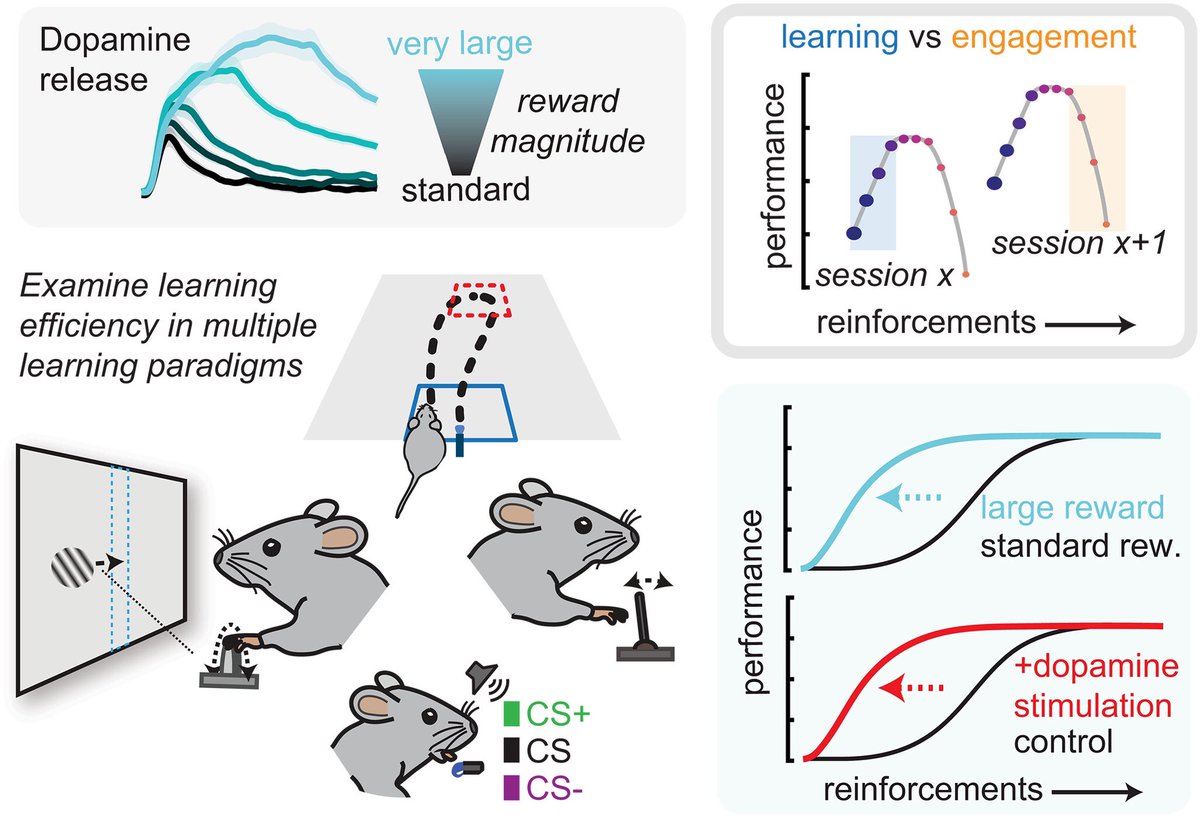
Learning from small numbers of very large rewards can be very fast. @ScienceMagazine
Very large rewards markedly accelerated learning across tasks and led to increased dopamine release in the striatum
New work from Claire Gao in @NatMetabolism uncovering the intracellular signaling mechanisms by which semaglutide drives weight loss in the brain. This study goes DEEP into how GLP1R signaling works inside hindbrain neurons. 🧠⚡ https://t.co/mjn2nOcdUy
Thrilled to share our work out in @Nature! Linking flexibility modeling, single-cell imaging, and targeted optogenetics allowed us to characterize how some prefrontal neurons, and mPFC-VTA neurons in particular, drive contingency degradation behavior. https://t.co/Dkk32XwGtX