Books that have had a big influence
- Principles, Ray Dalio
- Hackers and painters, Paul Graham
- Steve jobs, Walter Isaacson
Also:
- Creative destruction, Ken Kocienda
@kocienda
- How to start a startup, Sam Altman
@sama
Most content from y-combinator and many more books.
Met a German founder this week and asked him if all the stories one reads about the challenges of startups in Germany are exaggerated. "No, they're understated." Proceeded to describe spending a full day having a 90-page investment contract read to him (mandatory under German law; § 13 BeurkG) by a notary that then charged €30,000. That was for his first company. His second company, needless to say, was not incorporated in Germany.
>Be Elon
>Get bullied so badly as a kid that you end up in the hospital
>Escape into books
>Read more than 8hrs a day
>Teach yourself programming
>Sell a video game at 12
>Leave South Africa
>Sleep on couches
>Work odd jobs
>Get into America
>Build a startup
>Get fired from your own company
>Start over
>Build another company
>Merge it into PayPal
>Get removed as CEO
>Your company gets acquired
>Walk away with nearly $180 million
>Instead of retiring at 31, put almost all of it into three impossible ideas: Electric cars, Solar energy, Rockets
>People tell you you're insane
>Start a rocket company with no aerospace degree
>Learn rocket science from textbooks
>First rocket fails
>Second rocket fails
>Third rocket fails
>Divorce
>Public humiliation
>Cash running out
>One launch away from bankruptcy
>Launch anyway
>The fourth rocket reaches orbit
>NASA signs a contract
>Survive
>Tesla is weeks from collapse
>Save it at the last minute
>Get mocked for wanting reusable rockets.
>Land one.
>Then another.
>Then dozens.
>Turn science fiction into engineering
>Get mocked for betting on EVs
>Turn electric cars into status symbols
>Force the entire auto industry to follow
>Build the most valuable car company in history
>Launch astronauts into orbit
>Create a global satellite internet network.
>Buy Twitter
>Fire most of the staff
>Rename it X
>Walk into politics
>Risk your reputation
>Risk your companies
>Risk your fortune
>Become one of the most polarising people on Earth.
>Get attacked by the media, politicians, competitors, and activists
>Keep building anyway
>Become a TRILLIONAIRE
Karpathy said something we all read without really understanding it.
Elon Musk doesn't run the biggest companies in the world. He runs the biggest startups in the world. And he's the only person on Earth who knows how to do that at this scale.
That nuance isn't a detail. It's becoming the standard, and I think in ten years it will be the only acceptable way to run a company.
What Karpathy describes is a man who refuses growth by default. Small teams, deeply technical. No middle management to filter the information. Engineers and code as the only source of truth, never a VP's slide deck. A CEO who spends half his time talking directly to the people who build, not five layers up in an ivory tower. And a personal obsession with removing bottlenecks one by one, by hand.
Most people read this as the eccentricity of a genius. I read it as a job description.
Because this model implies a few non negotiables.
Being a polymath. You cannot understand the real state of your company if you only speak one language. You need to drop into the code, climb back up into go to market, open the cap table, read a contract, challenge an architecture. Every layer, every node.
Being curious about everything, not as a hobby, as a necessity. Curiosity is the tool that gives you a complete map of your organization. Without that map, you fly blind and you outsource your judgment to people who have every incentive to hide the truth from you.
Not wanting to be liked. This is the part nobody owns. You cannot make the right calls and give real feedback if your deep need is to be appreciated. The need to please is the number one enemy of quality. It turns every decision into a social negotiation and every piece of feedback into a lukewarm compliment.
And the last point, the most important one. Building for humanity, not for profit itself. When abundance arrives, profit for the sake of profit loses all meaning. The only thing left is whether what you build actually moves people forward. That's what justifies the intensity.
It took me years to understand this.
In every company I worked at, I couldn't understand why the CEOs, and even the CTOs, lived in their ivory tower. Disconnected from the product, disconnected from the ground, managing slides instead of managing reality. It felt absurd to me. Almost professional malpractice.
And then I understood the real reason.
People, and organizations, on average never question the status quo. They endure it. The ivory tower isn't a strategic choice, it's the default state of any structure you let grow without friction. Nobody decides to become disconnected. You become it because it's the path of least resistance.
Musk didn't invent a magic method. He just refused the default. His entire singularity fits in one sentence: being a permanent force against the entropy of his own company.
That's the real standard coming. Not the size of the teams. The refusal of the status quo as a daily discipline.
And most companies will die not because they were wrong, but because they never thought to ask themselves why they did things the way they did.
@paulg Maybe some do understand but instead they say what the voters want to hear.
Some might not understand because it's just so foreign to them and not realistic for them so their mind block it.
Stoicism is the philosophy of slaves (Epictetus), unjustly condemned men awaiting death (Seneca), and emperors of a dying empire (Marcus Aurelius).
It became the philosophy of people who couldn’t control events, but still needed to feel sovereign over a dwindling sphere.
Create LIVE Meta Ads Dashboards in Claude [2026]
https://t.co/qbgENiiRIW streams live #MetaAds campaign performance directly into your #Claude chat, powering the new Live Artifacts dashboard feature.
🚀 Try It Now: https://t.co/x7NRR8P9xv
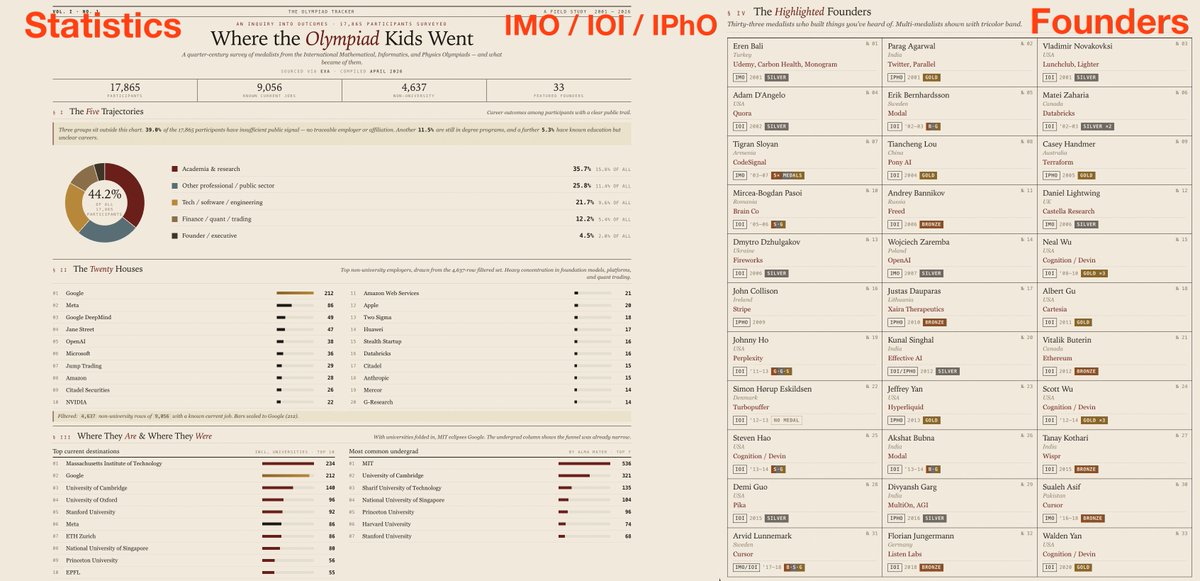
What do the smartest kids in the world do when they grow up?
I did the largest study of ~18,000 International Olympiad medalists (IMO, IOI and IPhO) over the last 25yrs, arguably the sharpest analytical minds of the world in high school, to see where they ended up and traced ~50% of them.
Founders of ~20 unicorns and ~7 decacorns and ~10 billionaires: OpenAI, Cursor, Stripe, Databricks, Perplexity, Ethereum, Cognition, Hyperliquid, Fireworks, Modal, Quora, Parallel, Cartesia, Wispr
Most kids went to MIT, a whopping 12% of them, followed by Cambridge (7%) and Sharif (3%)!
The career paths they chose (of those who graduated) were:
— 36% Academia (professors)
— 26% Other
— 22% in Software / Tech
— 12% in Quant / Finance
— 5% Founders!
The biggest employer was Google, by far, at 6%.
Others interesting tidbits were:
— 47 of them work at Jane Street (#3)
— 38 at OpenAI (#5)
— 15 at Anthropic
— 8 at Cognition
— 6 at Isomorphic Labs
Olympiaders were 1500x more likely to be billionaires and 4000x more likely to be unicorn founders than the average person!
I bought a Tesla. Never thought I’d get an electric vehicle, but took a ride in a buddy’s Tesla and changed my mind.
I’ve been using the supervised self-driving mode for my daily commute into DC. It’s pretty amazing.
Today the car suddenly moved into the left lane, very abruptly. In that split second a very large piece of debris blew into the lane I had been in. The Tesla self driving system saw what I couldn’t see.
When I drive I can only see from the perspective of the driver side front seat. The Tesla has multiple censors with different angles of view. It saw what I couldn’t.
Importantly, even I I had seen it at the same time, the split second that it would have taken me to check blind spots and then consciously make the decision to move over would have taken too long. The Tesla knew all these variables simultaneously and almost instantly and was able to avoid impact safely.
Well done @elonmusk and @Tesla team.
@patrickc “Unleashing coding agents on my genome” is the most Bay Area sentence ever written. Most people can’t get their insurance to cover a basic physical and you’re running LLMs on your DNA.