Moderna/Merck just ran a 1,137-patient Phase 3 trial where every single dose was unique to that patient's tumor. It worked.
The pipeline: surgical resection → whole exome + RNA sequencing → ML neoantigen ranking → mRNA encoding up to 34 patient-specific targets → manufactured and shipped in 8 weeks. One drug, different sequence for every patient.
The ML step is worth to note: the algorithm ingests WES + RNA-seq to identify somatic mutations, then predicts which of those will actually be immunogenic, ie, displayed on tumor cell surface and trigger a T-cell response. It's designed to keep learning from accumulated clinical and immunogenicity data across patients, not just per-patient.
INTerpath-001 (Stage IIB-IV resected melanoma, 2:1 randomized): combination with pembrolizumab beat Keytruda alone on both primary (RFS) and key secondary (DMFS) at interim. Phase 2b at ASCO 2026 showed 49% reduction in recurrence/death, 59% in distant metastasis/death at 5 years. Phase 3 confirmed both.
What this validates:
— tumor-specific neoantigen prediction by ML works in a blinded trial at scale
— 8-week personalized mRNA manufacturing is operationally real
— effect is additive on PD-1 blockade, not redundant
This is first positive Ph3 for individualized neoantigen therapy. First positive Ph3 for any mRNA cancer therapeutic.
What a great time to live in!! This is the best time for AI & biotech!
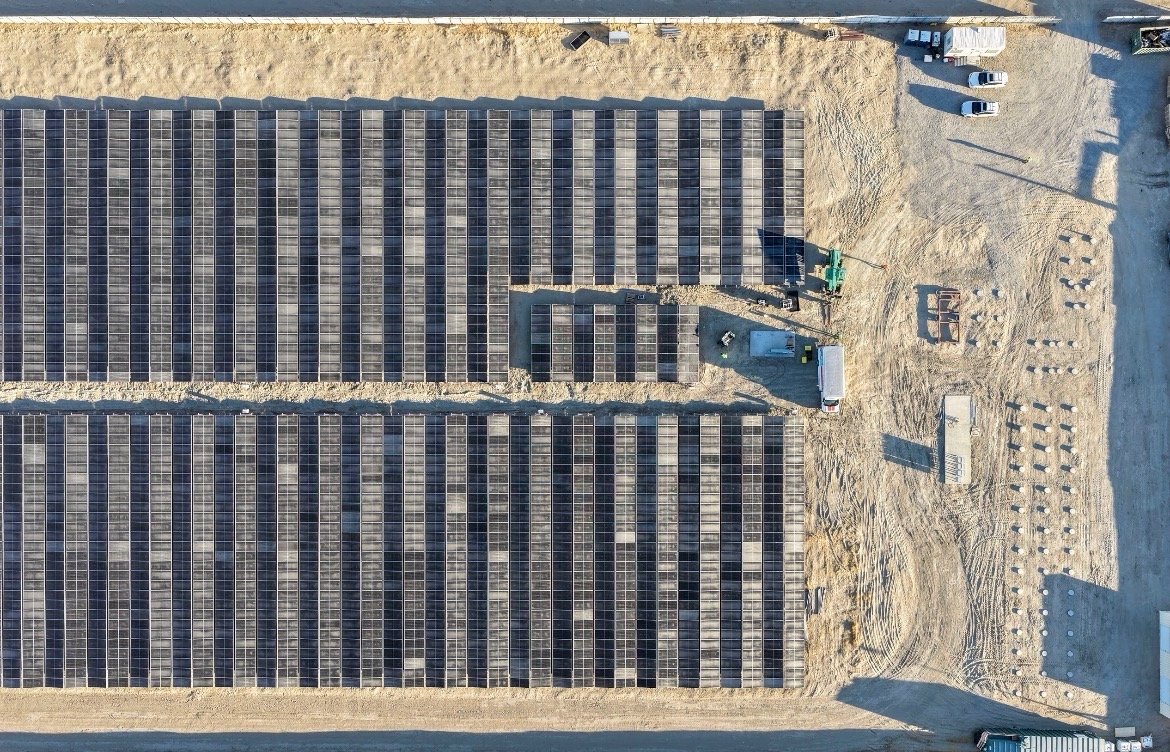
Last week the hydrogen electrolyzer team @terraformindies pulled off yet another first, the sustained production of >99.9% pure H2 from our vertically integrated, California-manufactured electrolyzer stack while it was coupled directly to a solar array at our Muroc desert test site.
WTAF?
Most commercial electrolyzers need carefully conditioned power from expensive battery-meditated backup systems. Ours runs directly off the sun. Clouds pass, the day turns to night, and we maintain purity from a stack whose Bill of Materials cost is well below $100/kW.
Terraform's single-minded focus on capex reduction has allowed us to convert sunlight to hydrogen in an unprecedented demo at a cost below $2/kg. If that wasn't enough, we have a crystal clear plan of steady execution to push that cost below $1/kg in the coming years.
Rather than linger on this point in response to experts-with-spreadsheets who said this was not only beyond my team, it was forbidden by known laws of physics, let me tell you a bit about how we actually pulled this off.
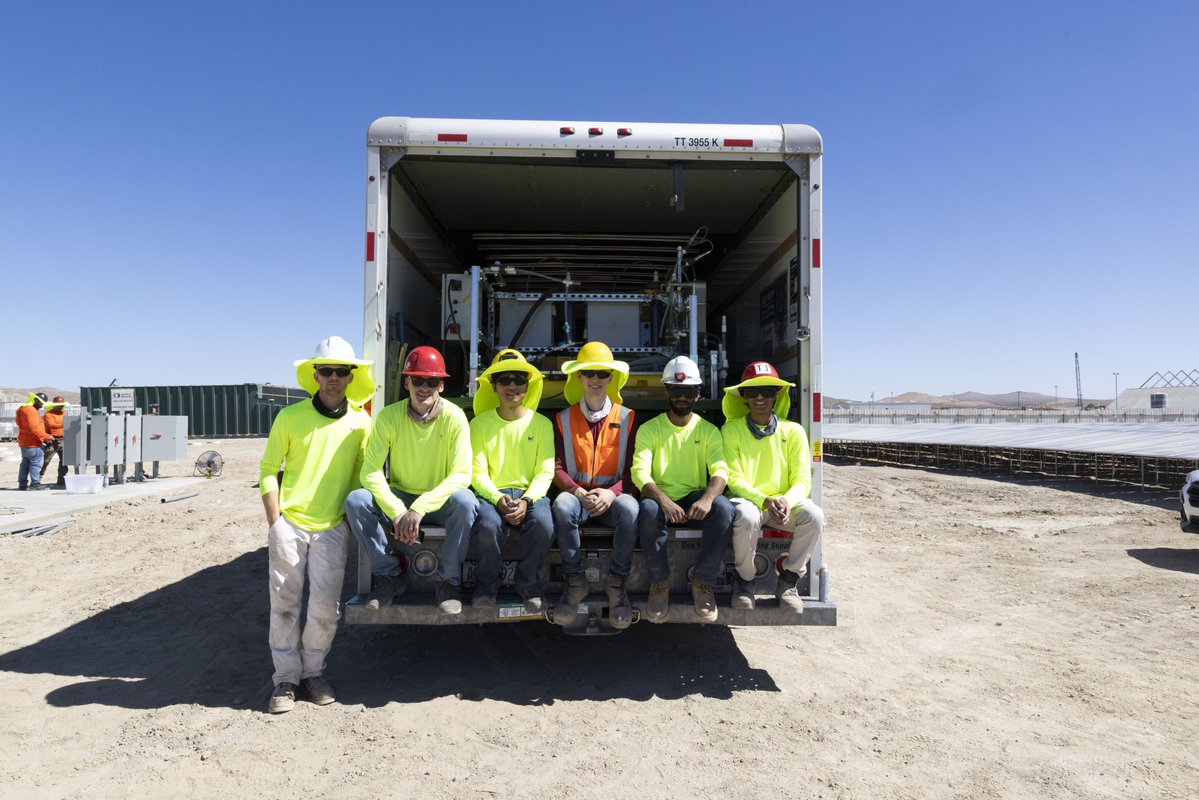
We started building this test site in March. Once the panels and electrics were in place the CO2 team were the first to demonstrate production on site. Close behind them the electrolyzer team planned the logistics necessary to project substantial operational ability into a hostile test site in the middle of nowhere. It's no good to find you're missing a wrench half way through the day!
Much of the test prep was completed before dawn, when the panels go live. The sun came up and the stack immediately started splitting water into hydrogen and oxygen. The team carefully monitored purity and flammability as the sun climbed through the sky. As designed, the stack warmed up and conducted even more power, maintaining solid production until late afternoon when the setting sun shaded the panels.
Terraform's synthetic fuel system is uniquely designed to follow the sun and extract the maximum possible value from cheap solar panels.
Hydrogen is a pernicious molecule. It leaks through and embrittles metals, burns almost invisibly at a wide range of mixtures in air, burns hot and fast and can easily undergo detonation transition, and has about half a dozen other spookily dangerous properties. My advice is to never work with it unless you absolutely have to. The Terraformer produces and consumes H2 in one compact discrete area with a minimum of complexity and fuss, and as expected this demo was completed in accordance with our rigorous safety standards and no unscheduled excitement!
This successful demonstration was also a profound milestone for the team after a testing anomaly last December compelled us to finally rip off the bandaid and move decisively towards the "future design" with half the parts but considerable complexity in assembly. No-one else makes electrolyzers this way and we, more than anyone, know exactly why. And also how to do it anyway, translating directly into a unique cost advantage.
A huge congratulation to Ken, Sherman, @ckalitin, Nikhil, Abdullah, and Aaron for their successful test campaign.
Terraform's hydrogen and CO2 are the chemical precursors for synthetic methane and methanol, which we make in our own synthetic fuel reactor.
Combined, we make oil and gas out of sunlight and air. We are breaking the geological and geographical monopolies on oil production.
In the limit, Terraform will deploy these electrolyzers by the millions and they will all be plug-and-play with solar PV arrays.
The Muroc smoke test campaign is far from over.
We will win!
My advice to founders in 2026: spend tokens, not headcount.
Record everything. Make your company queryable. Build self-improving loops.
Before long, AI won’t just help you operate your company. It will make it self improving.
Don't think AI adoption, think AI transformation.
This is the biggest shift in how startups get built since cloud computing.
Two interesting points. 1. AI will be better than almost all doctors at diagnosis. 2. Doctors are not nearly as good as they think they are now, because the system punishes admission of errors, has little feedback, little learning, lots of moral certainty of correctness.
Kuli (@kuli_ai) is the AI coworker that gives marketers their time back and makes them 10x more efficient. It watches all videos on socials to find the next trend and gets work done.
Already live at Fortune 100 brands, it plans and runs their campaigns with creators.
Congrats on the launch, @maradoh22 & Jonathan!
https://t.co/P1SJsvB8h7
Three days ago I left autoresearch tuning nanochat for ~2 days on depth=12 model. It found ~20 changes that improved the validation loss. I tested these changes yesterday and all of them were additive and transferred to larger (depth=24) models. Stacking up all of these changes, today I measured that the leaderboard's "Time to GPT-2" drops from 2.02 hours to 1.80 hours (~11% improvement), this will be the new leaderboard entry. So yes, these are real improvements and they make an actual difference. I am mildly surprised that my very first naive attempt already worked this well on top of what I thought was already a fairly manually well-tuned project.
This is a first for me because I am very used to doing the iterative optimization of neural network training manually. You come up with ideas, you implement them, you check if they work (better validation loss), you come up with new ideas based on that, you read some papers for inspiration, etc etc. This is the bread and butter of what I do daily for 2 decades. Seeing the agent do this entire workflow end-to-end and all by itself as it worked through approx. 700 changes autonomously is wild. It really looked at the sequence of results of experiments and used that to plan the next ones. It's not novel, ground-breaking "research" (yet), but all the adjustments are "real", I didn't find them manually previously, and they stack up and actually improved nanochat. Among the bigger things e.g.:
- It noticed an oversight that my parameterless QKnorm didn't have a scaler multiplier attached, so my attention was too diffuse. The agent found multipliers to sharpen it, pointing to future work.
- It found that the Value Embeddings really like regularization and I wasn't applying any (oops).
- It found that my banded attention was too conservative (i forgot to tune it).
- It found that AdamW betas were all messed up.
- It tuned the weight decay schedule.
- It tuned the network initialization.
This is on top of all the tuning I've already done over a good amount of time. The exact commit is here, from this "round 1" of autoresearch. I am going to kick off "round 2", and in parallel I am looking at how multiple agents can collaborate to unlock parallelism.
https://t.co/WAz8aIztKT
All LLM frontier labs will do this. It's the final boss battle. It's a lot more complex at scale of course - you don't just have a single train. py file to tune. But doing it is "just engineering" and it's going to work. You spin up a swarm of agents, you have them collaborate to tune smaller models, you promote the most promising ideas to increasingly larger scales, and humans (optionally) contribute on the edges.
And more generally, *any* metric you care about that is reasonably efficient to evaluate (or that has more efficient proxy metrics such as training a smaller network) can be autoresearched by an agent swarm. It's worth thinking about whether your problem falls into this bucket too.