I search for high-conviction, multiBAGger investment opportunities. Explore every angles,deep research , then invest big. 29% CAGR since 2009. IT'S IN THE BAG
This quarter, Lemonade Giveback funded 16,000 medical kits and five hurricane shelters through Direct Relief, emergency support for thousands of families in the days after a crisis through GiveDirectly and CARE, and 15 local causes through Giveback Grants. Lemonade community <3
@kylaschwaberow $LMND is so blatantly obvious at this point and might be a great pick for you. You should dig into @PaperBagInvest analyses as he covers this stock with great detail.
$LMND with some great news this morning. They have a new financing arrangement similar to their deal with General Catalyst, but at a much lower rate.
Under the new deal, financing for growth spend will be at the 3-year T-Bill rate + 5.8%, which as of today would be ~10% vs. 16% via the deal with General Catalyst.
I don't see any language around downside risk sharing as is the case with the GC deal, so it does seem that @Lemonade_Inc is taking a bit more risk here, but I think this is a very prudent move.
It looks like $LMND is getting a better financing deal than their agreement with General Catalyst.
GC is 16% ROI.
Hannover is 5.8% + U.S. Treasury rate (likely around 3-5%).
And, if they are financing a lower ROI than GC, to me that signals confidence in $LMND's underwriting.
Read this article carefully and then examine $LMND’s LTV/CAC unit economics and then invest accordingly … it could make you a fortune.
**not financial advice**
If $LMND LAE goes to 3% while incumbents is at ca 9%, and loss ratio matches the best incumbent the margins will be best in class...if loss ratio also becomes industry leading the margins will explode in insurance context as the TAM is very large.
🍋
In this second very red day (Lemonade is now at -9%, at 56.10), with the still awful feeling of disappointment in the market not seeing what we see, it is time for a balanced, self-critical, cold, assessment of my investment in Lemonade.
If you want a full-on positive, cheerleading-type of post, skip this. This will include some positives and some negatives. Investing is, in the end, a numeric business and all of us (or at least most of us) are here to earn money.
Feelings, insulting the market for its stupidity, etc, should have no place here except for blowing off a bit of steam. Certainly not in analysis.
As I said yesterday in the post I am reposting here, I think Q4 2025 and guidance for 2026 were amazing.
But...
First, the positives.
1. The business is extremely well managed (I would say impeccably so), it has passed the risky part where reserves are sufficient bur scarce (now it has ample reserves for operation and growth) and is growing rapidly and profitably. Furthermore, because of the growth and reserve restrictions for the business, it is extremely predictable (not CAT events but growth). What investor wouldn't want a steady, well choreographed rise in his business? It is boring, even.
2. Lemonade's AI models have been proven. As investors, we couldn't ask for more evidence that gross loss ratios and customer service are not only under control, but top-tier and forever improving.
3. The company's leaders are fully committed as large shareholders. Employees are also aligned with the success of the company as they benefit from SBC.
4. If, as I expect, the share price reaches 500 by 2030, that would mean, for our very discounted prices today, a >50% CAGR. What investor could possibly complain about that?! (if it only reaches 300, that would mean >37% CAGR, not bad at all)
5. It has already delivered very nice returns. On such red events and coming from almost 100 it may not feel like that, but LMND has returned 4x (from 15 to 60) in the 2 years since I begin investing in it. 4x in two years.
But there are also negatives and risks (there are many, as with all investments, but I want to comment on only two in particular).
1. The risk of the uncertainty caused by AI. Could future market developments kill Lemonade? Maybe, but in that case, they could kill any business. If we freeze by those fears, we would never invest at all. Or get out of our house. To me, that is easily brushed aside.
2. The second negative is more valid and something that each investor needs to deal with on his/her own. The opportunity cost. Many of us suffer FOMO when we look at other investments taking off. But one thing is FOMO and another is opportunity cost.
Opportunity cost is real, numeric and cold. As investors, we should always be looking for opportunities and questioning our investments. That's one of the great advantages of the public American stock markets: the menu is very large.
If I find better opportunities (I never invest in more than 4 or 5 companies at a time), I will not hesitate and abandon Lemonade. The AI revolution has already delivered many great successes, and will deliver many more, with its fair share of failures. Many will be rockets. True rockets.
In comparison, Lemonade feels like a laggard. Slowly creeping towards profitability. Slowly gaining market share.
---------------------------------------------
In conclusion, Lemonade is a very well-managed, growing, AI company, in a difficult industry, with almost infinite TAM.
Lemonade is not a market favorite, and most investors are looking the other way, either at the rockets or away from AI all together. That will continue to punish the stock price generally.
Lemonade is NOT a rocket. When I made that analogy in this community 2 years ago, I was wrong. Yes, 4x in two years should be a rocket, but we are surrounded by true rockets now. Rockets that achieve huge sums of revenue instantly and with 70% profit margins.
Lemonade is a train. An AI train. Slowly gaining speed, on a very predictable path. Predictable, trustworthy, with an attractive future and an even more attractive current share price.
For any investor that finds a rocket before takeoff with certainty of success, investing in Lemonade would be foolish.
For other investors and for patient investors, Lemonade should deliver very refreshing results in the next few years.
Time to build another $LMND account.
I added 4.1k shares today. If the opportunity presents itself at $53-54, I will buy another large chunk.
Un regalo my friends.
"Isn't $LMND just another insurtech?"
This chart can lay that argument to rest.
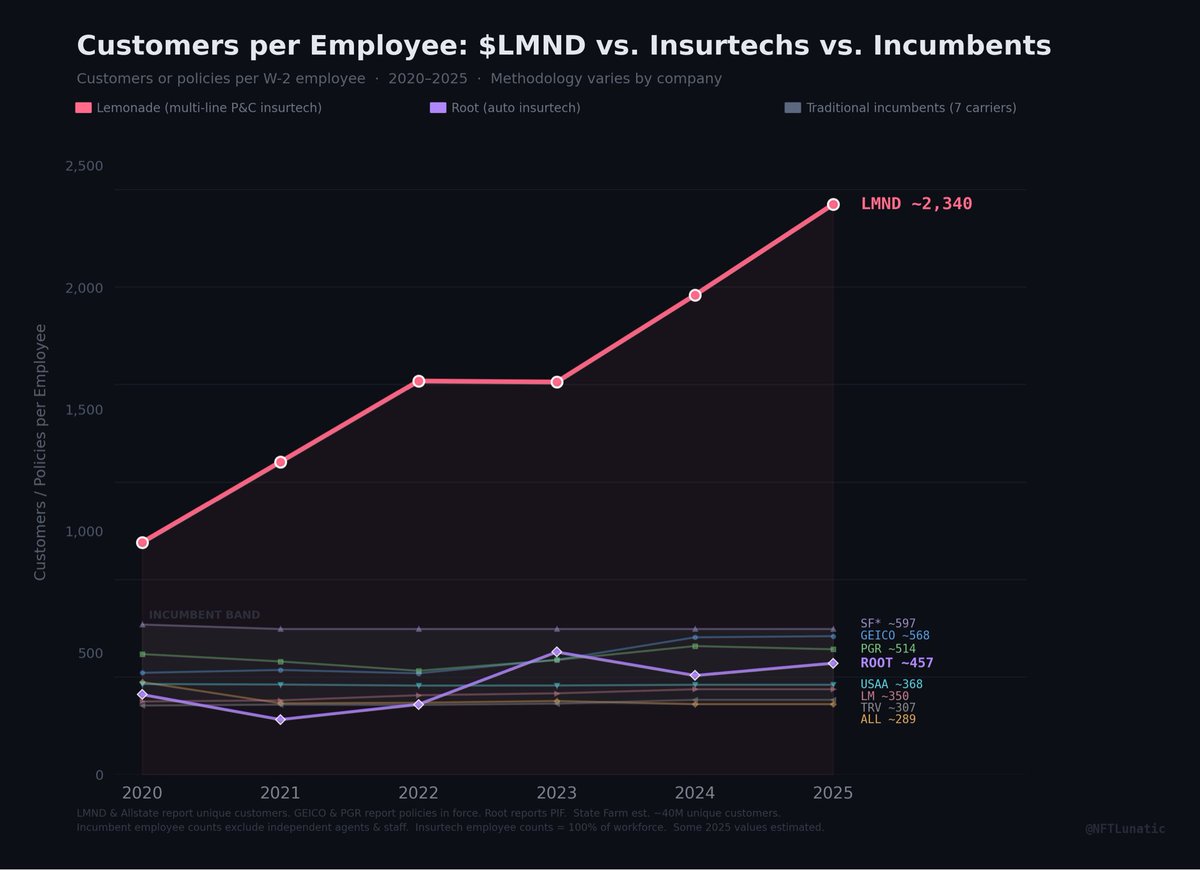
Customers per employee, 2020–2025:
$LMND vs. $ROOT vs. 7 major incumbents.
$ROOT is the perfect test case. Same era. Same "insurtech" label. Same direct-to-consumer P&C model. Public company with clean data.
$ROOT at 457 customers per employee.
GEICO at 568.
Progressive at 514.
Root IS the incumbent band.
Why? $ROOT innovation was telematics — better pricing through driving data. That helped them reach profitability. But it didn't change how many humans they need to operate.
Root hired 341 people last year to add 73K policies. $LMND hired 47 to add 570K.
That's not a difference of degree. It's a difference of kind.
$LMND didn't just digitize the front end. AI Maya underwrites. AI Jim handles claims. The marginal customer costs almost nothing to serve.
$ROOT used tech to price better. $LMND used AI to run the company.
That's why one curve compounds and the other flatlines.
This also kills the bear argument that competitors will "just copy $LMND playbook."
$ROOT has been trying for 9 years. Backed by $1.2B+ in funding. Public since 2020. Building technology from scratch with no legacy constraints.
And they still ended up in the incumbent band.
If a well-funded, tech-native insurtech with zero legacy baggage can't replicate this efficiency curve, what makes anyone think State Farm or Allstate will?
$LMND AI-first architecture isn't a feature. It's a compound advantage that gets harder to replicate every quarter — because every new customer, claim, and interaction feeds the models that make the next one cheaper to serve.
The moat isn’t JUST the AI operating system running the company. It’s 3 million customers (and growing) training the AI.
Watch out for $LMND. Collapsing gross loss ratios, soaring in-force premiums, flat operating expenses, plenty of cash. Doesn’t get simpler than that.
Multi-bagger in the making. Average price ~$40/share
Shoutout @PaperBagInvest
Another $LMND buy in the wife's HSA. Record Lemonade shares for us. I've been drinking so much Lemonade that at this point I am just hoping it doesn't crash! 😂
Go big or go home!
Good afternoon everybody.
I have no idea how the market is going to react to Lemonade's great Q4 2025 results tomorrow morning, but the odds are decisively in our favor.
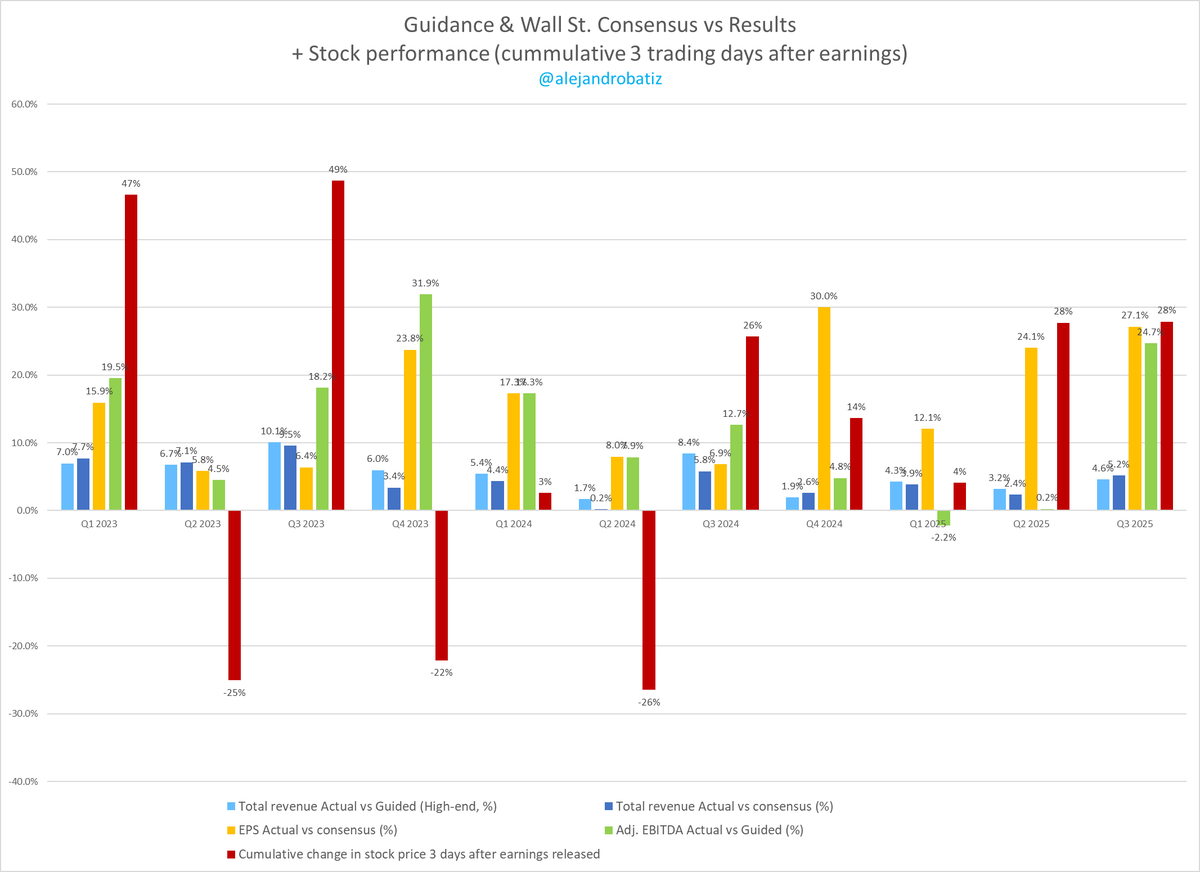
Here is what has happened since Q1 2023 (see chart).
I removed the noise from IPO until Q4 2022. IPO, the exuberance of the bull run in 2020-21, the market crash in 2022 and the subsequent aftermath, plus the Metromile acquisition. This is all noise.
Since Q1 2023, there have been several, significantly positive, market reactions to good results presented by LMND and the down or muted reactions can be easily explained.
In Q2 2023, GLR jumped too much (all the way up to 94%) and the market got spooked.
In Q4 2023, Lemonade guided to a higher growth spend, a slowdown to their home insurance efforts and in general underwhelming results for 2024.
In Q1 2024, management reaffirmed their 2024 guidance. The stock did not dropped but neither did it rise significantly.
In Q2 2024, deliberate pruning of their home book of business was a very negative surprise.
In Q4 2024 the stock rose 14%, but it could've risen much more had it not been for the LA fires, which were also the reason why the stock only rose 4% after Q1 2025.
The LA fires are normal and expected, from time to time, for insurance companies. But the rest of the issues were simply part of Lemonade's evolution and will probably not happen again, or not with that severity.
We now have clear skies ahead of us, except for the once in a while extraordinary CAT event.
Opex is under firm control. Growth spend is de-risked through the Synthetic Agent program and is producing great results, which translate to an acceleration in very profitable IFP and loss ratios are firmly under control and in a now profitable range. Lemonade has ample cash reserves to operate a grow.
Barring any strange surprises, Q4 2025 should be the best ever for Lemonade, Q1 guidance should be pretty good for a Q1 (Fern will simply confirm this.), the first Adj. EBITDA positive quarter is around the corner (my bet is on Q3, barely) and an improvement of around 70-80% in Adj. EBITDA from 2025 to 2026 should be visible to the markets.
Again, I have no idea what Mr. Market will do, and we know it can go crazy at any moment, but I would expect at least a 20-40% jump in the first 48 hours after earnings are released.
That is, if management does not drops the ball and guides for a hyper-conservative 2026 or something of the sort. For some reason Daniel always tries to be optimistic but loves throwing buckets of ice repeatedly to chill the mood.
If management presents a CLEAN quarter and 2026 guidance, the stock should rally. Rally that should continue until year end until it reaches 150-200 per share.
In 2030, Lemonade will produce hundreds of millions in net income and will still be growing strong. The stock will probably be worth 500-800 then. It cannot go from 65 to 500 overnight. The run from 15 up to 500 will not make a giant pause in 2026.
Good luck tomorrow.
What will Lemonade guide for the full year of 2026 for EBITDA income/loss at their next earnings call on February 19? The average analyst estimate is around -$50 million.
For the record.
Yes the Baby is being thrown out with the bath water.
Markets are behaving as if AI is a universal wrecking ball, when in reality it is mostly a universal productivity engine.
Panic selling on the premise that “AI will destroy every industry” ignores two basic facts: almost all AI value shows up as cheaper, better output for operators, and most sectors compete on cost, quality, and speed, not on preserving today’s headcount or workflow. The idea that banks, manufacturers, retailers, hospitals, and logistics firms will all be structurally worse off because they can do more with less is logically backwards.
The real risk is not that AI obliterates every business model, but that value migrates within each sector—from laggards to adopters, from shallow point solutions to deep platforms, from manual processes to AI‑native operators.
Selling “the market” indiscriminately because “AI disruption” is coming is like dumping every company in the 1990s because the spreadsheet made accountants faster; it confuses a shift in winners and margins with an apocalypse.
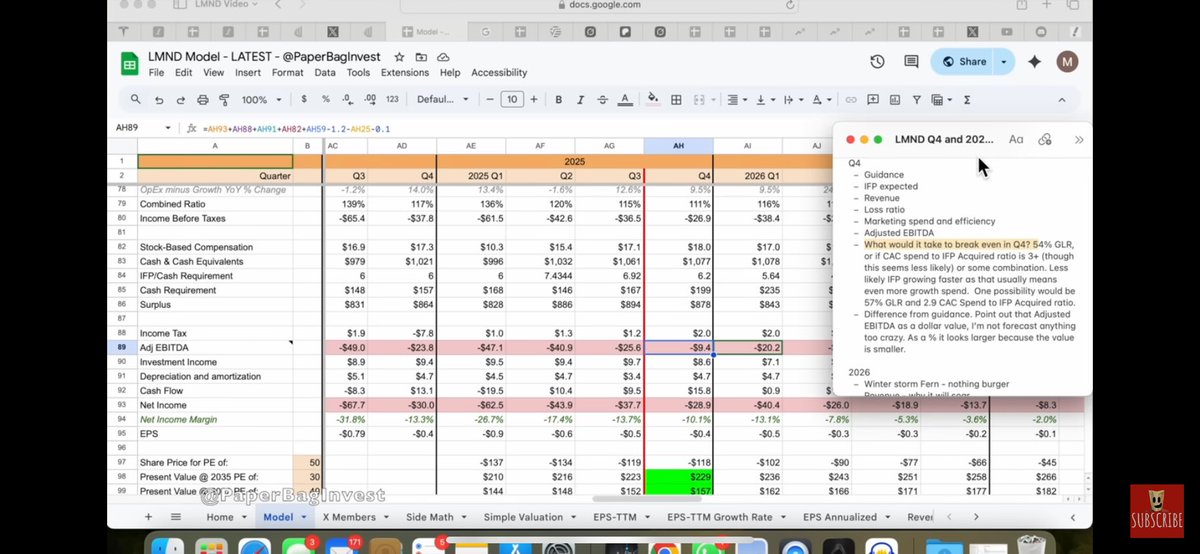
That awkward moment when you almost forget that Wall Street analysts don’t pour over @PaperBagInvest spreadsheet models 🤦🏼♂️
Looking forward to the FY 2026 EBITDA guide coming out in 1.5 weeks.
In the meantime I’m enjoying the opportunity to accumulate shares at less than 50% of NPV.
Cheers 🤗