As we welcome our 2026 PyTorch Foundation Ambassadors, get to know:
Ali Tavallaie (@AliTavallaie) · Armenia
Alpha Romer Coma · Philippines
Amr Osama Abdellatif · Egypt
Costin-Alexandru Deonise · Romania
“I believe using AI is like being given a fish; I want to teach people how to fish. PyTorch embodies the beauty of learning how to build and understand AI, and I’m excited to share that beauty with others.” - Ali Tavallaie
“I’m excited to build a Philippine ML community where architectures and ideas come first, and to bring the frontier of PyTorch to Manila through monthly in-person events.” - Alpha Romer Coma
“I am most looking forward to fostering a vibrant, collaborative AI community in the region and empowering the next wave of engineers to build cutting-edge systems on PyTorch.” - Amr Osama Abdellatif
“I believe the future of AI should be built in the open. I’m excited to contribute to the PyTorch community, share what I’ve learned, and help more people turn their ideas into real-world AI solutions.” - Costin-Alexandru Deonise
📣 Registration is NOW OPEN for #PyTorchDayChina, taking place December 12 at the Alibaba Beijing Chaoyang Science and Technology Park. This is a free, full-day event. Registration is required. Save your seat now and join us for technical talks and interactive discussions exclusively for the #PyTorch community >> https://t.co/h8iezM6WdS
Chris Lattner’s #PyTorchCon keynote is now on YouTube. @clattner_llvm covers running models across more hardware with Mojo and MAX, and building an open developer ecosystem with @Qualcomm_Dev and @PyTorch.
https://t.co/IUvwi7WjJ3
Watch all the #PyTorchCon North America 2026 sessions!
PyTorch Conference North America 2026 brought 3,500+ attendees to San Jose on October 20–21 for two days focused on accelerating open intelligence and exploring the impact of PyTorch Foundation projects like PyTorch, @vllm_project, @DeepSpeedAI, @raydistributed, Helion, and Safetensors.
View our playlist featuring 146 sessions from keynotes to technical deep dives spanning core framework development, model training, inference, applications, kernel engineering, responsible AI, and more.
Watch and share the videos with anyone who might be interested: https://t.co/IhnHdvqyVC
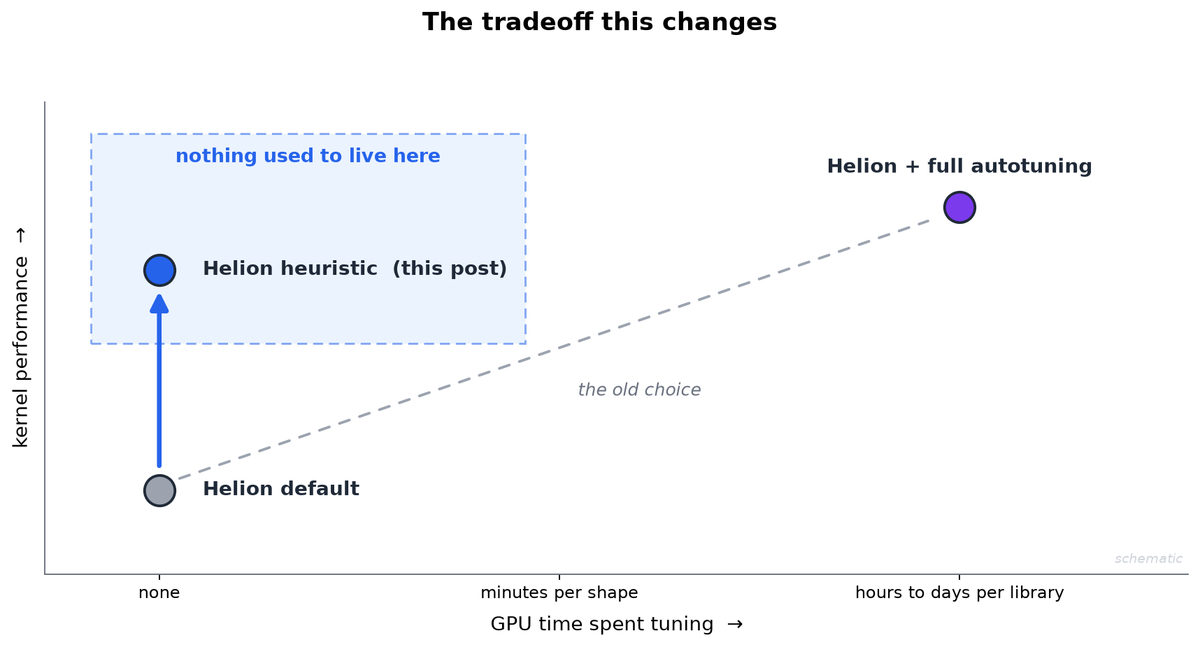
Fast kernels, without the tuning wait: Helion's new compile-time heuristics automatically choose high-performance configurations, with no autotuning required.
On H100 benchmarks, they beat handwritten Triton kernels for linear-attention forward passes by 18% and vLLM's handwritten CUDA reduction kernels by 27%.
Read the complete technical breakdown to learn more: https://t.co/Q6WZgcAYrW
Ron Kahn of @nvidia, Andrey Velichkevich of @Apple, Vara Bonthu of @awscloud, Ekin Karabulut of @nvidia, & Manabu McCloskey of @awscloud discuss powering the next era of cloud native AI with an open community at #KubeCon + #CloudNativeCon today, citing @kubeflow's @CloudNativeFdn graduation with shout outs to PyTorch Foundation projects - @PyTorch and @DeepSpeedAI. The importance of working across foundations is vital for a thriving ecosystem.
Live from the KubeCon + CloudNativeCon keynote stage: @kubeflow is now a CNCF Graduated project!
From distributed training with PyTorch and Spark Operator to the new Agents Working Group and Semantic Operator, Kubeflow bridges data, AI, and Kubernetes without vendor lock-in.
Explore the ecosystem: https://t.co/kNSq7Y2evs
#KubeCon #CloudNativeCon
With help from AI coding agents, SGLang was integrated with @IBM Spyre in under a week using a 1,500-line plugin. Reusing existing PyTorch Spyre support and SGLang extension points delivered roughly 3.6x the throughput of the reference torch-spyre implementation.
Performance matched vLLM across Granite 3.3 8B and Gemma 4 26B A4B workloads, with RadixCache prefix sharing working out of the box without hardware-specific changes. This shows how open source AI standards and modular architectures allow developers to bring new silicon online quickly and expand hardware choice across the stack.
Read the full technical breakdown: https://t.co/doMoB9xUSJ
@gal_bloch@RaghuGanti@mudhakar@alxnails
Thanks to PyTorch and TorchTitan, the Domyn Team successfully scaled up the training of a 1 trillion parameter MoE on Jupiter, a shared EuroHPC supercomputer, in the context of the European Frontier AI Grand Challenge
Per-GPU throughput on 384 GH200 GPUs per replica rose from 90 to ~1,300 tokens/s
Learn about all the details and the upstream contribution on PyTorch and TorchTitan: https://t.co/3Mo6vOF9Os
@domynai
You don't measure an open source ecosystem in GitHub stars. You measure it by who still shows up on the day Beijing gets its first snow.
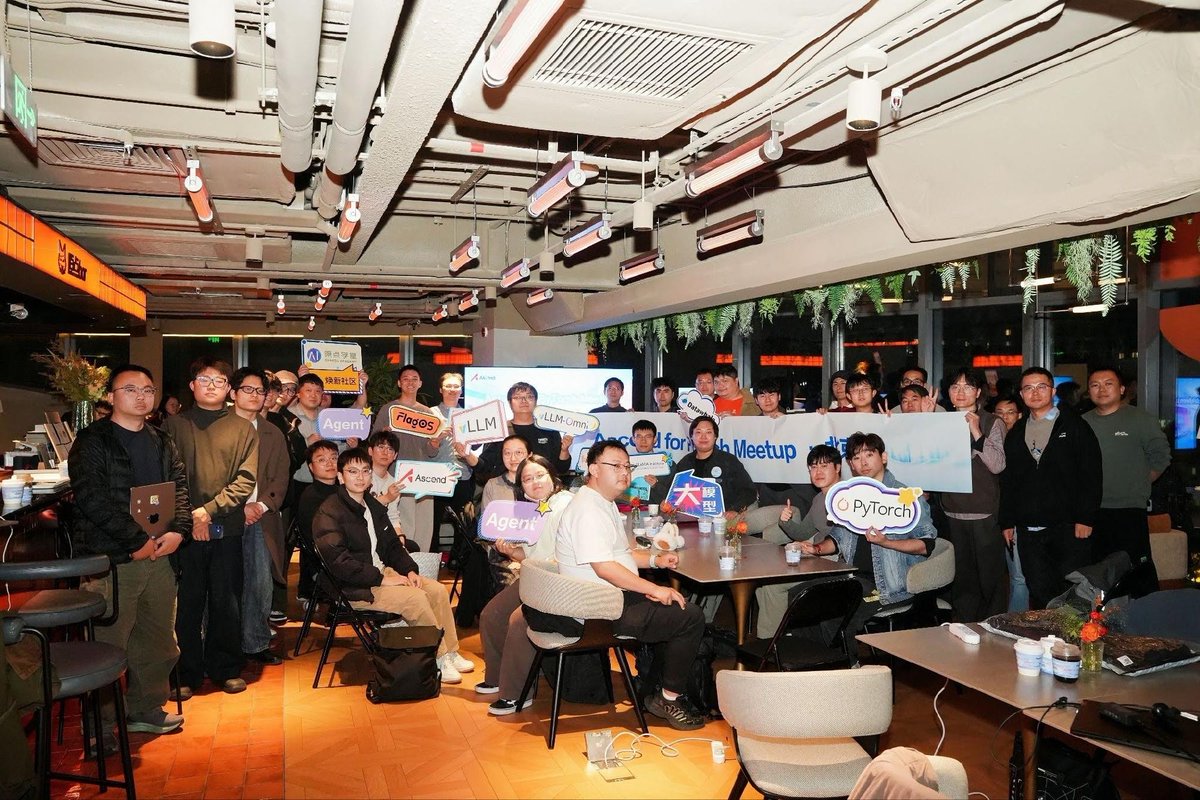
On Nov 7, Ascend for PyTorch Meetup brought maintainers from across the stack — PyTorch core and TorchNPU, @vllm_project and vLLM-Omni, MiniCPM / OpenBMB, LLaMA-Factory, PenguinHarness, FlagOS — together with more than a hundred developers in Beijing for a full day of talks, roundtables and hands-on work.
Morning: multi-backend integration, TorchNPU distributed training, vLLM-Omni inference, MiniCPM on-device models, FlagOS operators, Agent tooling.
Afternoon: an AI Infra roundtable, a contribution workshop walking through PR review to merge, an Agent build session — and 30+ community tasks opened on site.
At #PyTorchCon China this September, the Foundation shared what that energy is turning into: more than 250 organizations across China now contribute to Foundation projects including vLLM; Chinese developers now rank among the leading contributor groups on vLLM; and Chinese open-weight models went from 2% to 45% of OpenRouter token traffic between late 2024 and April 2026.
Enthusiasm is the starting point. Upstream commits are the proof.
That's why a vendor-neutral home matters: ANY MODEL · ANY CHIP · ANY CLOUD · ANY AGENT — so local energy feeds the global mainline instead of fragmenting into separate regional stacks.
We also want to recognize @Huawei for years of work growing this ecosystem. We're looking forward to more days like this, and to reaching even more developers who care this much.
To every maintainer and developer who gave up a cold, sleety Saturday for open source: thank you.
What should we build together next? Tell us in the comments.
🚀 Ready to explore what's next in open source AI? Join us at #PyTorchDayJapan 2026 on December 10 in Tokyo! Register today! https://t.co/uQnQMGUur8
5️⃣ reasons to attend:
- Explore AI innovations
- Learn from industry leaders
- Discover what's next in open source AI
- Get real-world insights
- Connect with the community
What can you test on one GPU before a big PyTorch training run? PyTorch core maintainer @ezyang (@Meta) explains in this clip from #PyTorchCon North America 2026.
He describes how a fake process group lets developers stub out distributed communication and check for crashes and GPU out-of-memory errors. He also discusses using SPMD types to look for numerical bugs without running a full-scale distributed test.
In the full keynote, PyTorch core maintainer @albanDesmaison (@Meta) discusses hardware backend integration and testing. @ezyang also covers activation checkpointing with torch_remat and discusses FlexShard.
Watch the full keynote: https://t.co/ghNexjcYUY
At @AIatAMD@AMD AI DevDay in Austin @sparkycollier spoke to a room full of developers on how the PyTorch Foundation is powering training, inference, and agents as the open source center of gravity.
ExecuTorch WebGPU, PyTorch models on the GPU, in the browser.
Running a PyTorch model in the browser has usually meant converting it to another framework's format first. With ExecuTorch's new WebGPU backend, you export once with torch.export, and the same .pte file runs in WebGPU browsers such as Chrome and Safari. Everything runs locally in the tab, so prompts, photos and audio never leave the device.
The backend already runs Llama 3.2, Qwen3, Gemma 3, SmolVLM, SAM 2, Depth Anything V2, D-FINE, Real-ESRGAN and Whisper, and supports LoRA and DiReFT fine-tuning on-device.
By Julian Ng-Thow-Hing (@hing3074), Siddartha Pothapragada, Stephen Jia, Digant Desai (@digant23), and Bilgin Cagatay (@BilginCatay).
Read the post: https://t.co/Cwd35vpnch
Try the models in the ExecuTorch WebGPU Playground: https://t.co/8sDhPAgrvK
With AI models scaling fast, seamless orchestration is key. Live from #KubeCon + #CloudNativeCon@robertnishihara announces AI & cloud-native ecosystem KubeRay joins @CloudNativeFdn as the Kubernetes-native lifecycle management, autoscaling, scheduling, reliability, and observability for Ray workloads. KubeRay is the standard way to run @raydistributed on Kubernetes & is the foundation of the managed Ray offerings from major cloud providers. Collaboration between CNCF and PyTorch Foundation is helping bridge the gap between large-scale distributed AI training/inference and robust Kubernetes infrastructure.
Great to see the open source community pushing inference performance forward on PyTorch:
A megakernel for Muse Spark Open on TPU v7 got 433 tok/s per user and up to 25.9K tok/s per chip on AgentX (1M context). All 62 layers of the 816B MoE run as one Pallas program on a single TPU v7 host, with SGLang on the TorchTPU PyTorch backend.
- 1.94x faster per token than our previous path
- DFlash2 speculative decoding: 2.0x per token
- fp8 KV, HiCache and session-aware eviction for long agent sessions
Read the full technical deep dive here: https://t.co/xmxOjlrZtK
@radixark