Senior Director of Engineering @GoogleCloud building the planet's best network for AI.
Previously @ToastTab, @Google Search, @Android, Linux kernel, author.
Breaking News: President Trump’s new press secretary, Katie Zacharia, was fired after less than a week on the job, according to people familiar with the matter. https://t.co/IDuom8hTtW
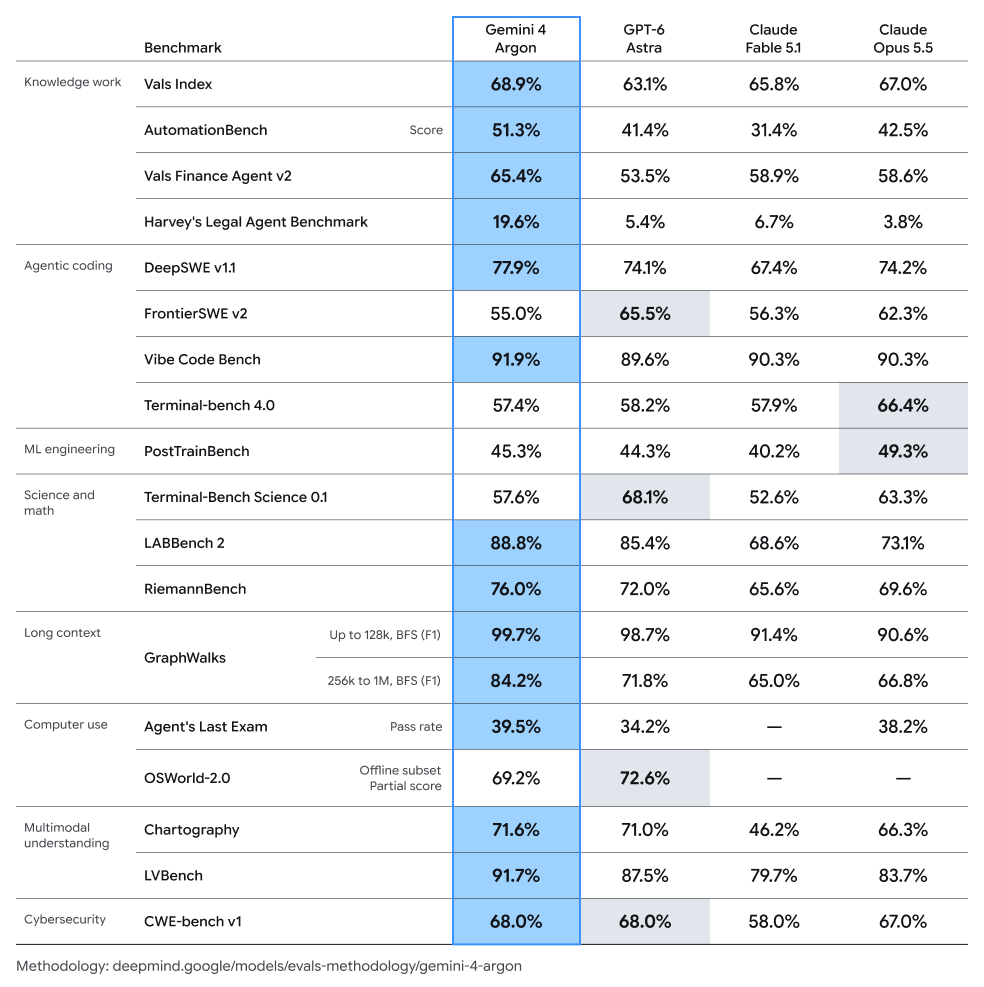
Gemini 4 Argon is now globally available.
Built to solve your hardest problems from start to finish, the model brings frontier capabilities across coding, enterprise workflows, and cyber defense.
Of course that's your contention. You're a first year AI hacker. You just got finished readin' some transformer paper — "Attention Is All You Need" probably — and so naturally that's what you believe until next month when you get to Sutton's "Bitter Lesson" and get convinced that scale was always gonna win and anybody could've seen it comin' back in 2012. That'll last until sometime next year, then you'll be in here regurgitating "Situational Awareness" about the post-AGI utopia and the capital-incinerating effects of GPU mobilization.
Ben Affleck reveals he writes Python, understands convolutional neural networks, worked extensively with GPUs, and used his celebrity status to get private looks at Google and OpenAI’s video models
“I’ve always been kind of into computers since I was young. Then, when film started to move from analog film to digital, I became more interested in that aspect of it. The visual-effects workflow for many years has included machine learning, so I can write pretty shitty Python scripts and stuff like that.
“With convolutional neural networks, which were the precursors to what the transformer can do, which is much more computation simultaneously, you would do things like look at what’s called a tensor. That’s the numerical translation of a visual image in numbers, like the batch number, the frame number and the red, green and blue values of each pixel in each frame. It’s just that simple. That numeric is called a tensor.
“You’d use a convolutional neural network to identify patterns that reveal what’s called edge detection or feature extraction, which is identifying patterns well enough to know, this is where the window ledge is, so we can more easily take the green-screen image out and replace it with something.
“That was familiar to me early on because, prior to Artists Equity, I had a small visual-effects company. I’ve worked with GPUs a lot too. The visual-effects guys said, ‘Hey, you should see. There are a couple: Google and this other company, OpenAI, are doing really interesting stuff with transformers in video.’
“I’ve learned that I can actually just call up and go, ‘Hey, it’s Ben Affleck. Can I come see what you’re doing?’ Sometimes people say yes, to my astonishment.”
I haven't posted in a while so here are 20 takes about AI, in no particular order.
1. It's very telling that the default question in tech and journalism is "how worried are you about X" and fighting over what to worry about. There's a deeply anxious cultural backdrop in Western Europe and North America that deeply affects how any technological development is interpreted; see for example https://t.co/OU8dEOn0tD. "Nervousness as seriousness" does seem to be a larger problem in tech/broader discourse at the moment. I think you can care about risks/externalities while remaining pretty optimistic about technology.
2. I'm tired of people who in private pretend to be uncertain or only care about tail risk but then go on media campaigns making all sorts of absolute claims. I think trying to stoke flames and get everyone to freak out is deeply unhelpful, and will come with costs. I also continue to think p(dooms) are bad, vibe-based measures: see https://t.co/ebzxGTqv6I. People who should know better ignore that because they do the standard shortcut of acknowledging the caveat as sufficient for handling it. And this is coming from someone who does think working on catastrophic risks is important!
3. I'm also disappointed that parts of the AI policy ecosystem has felt so comfortable with populism, and happy too sacrifice important norms/principles to advance their aims. I've said it before, but the totalizing nature of AI risk discourse means some people act exactly like the power seeking optimizers they fear. I am more concerned about the gradual decay of our institutions, world order, and liberalism than I am about AI killing everyone; and I think we should be wary of AI advocacy that contributes to this.
4. Some parts of AI safety discourse are basically just thought experiments. Variants of "Assuming everyone has a nuke in their pocket, then what do we do?" This can be very useful at times! But too many just overfit to edge cases as their main operating worldview, and ignore endogenous responses from society. It's like being in 2000 and saying "see all these viruses, spyware, and spam? Well tech progress means we'll only get infinitely more of this and no way to adapt." So I think it's important to avoid fatalism, and absolutlism whilst considering edge scenarios, and the inability to provide an ex ante list of solutions to every permutation of 'future models will be more capable' is not evidence that these problems are intractable.
5. Many critics of AI safety also fail to really engage honestly with the fact that there will, in fact, be all sorts of important risks as we decrease the barriers to entry to many activities that otherwise require some degree of expertise. This doesn’t mean we need to live in a constant Schmittian ‘state of emergency’ requiring extraordinary measures every time a new model drops, but it does mean we will need important state-led efforts on e.g. cybersecurity and biosecurity. I wish the progress-oriented or acceleration-adjascent crowd would provide more concrete proposals here.
6. Too much of the AI safety community is a giant homogenous blob of correlated views, who read the same stuff and have the same groups of friends. This means you have a lot of correlated errors. The social and financial ties means many of them don't call out the bad bits, or mostly stay silent instead of proactively calling out the more extreme parts of the community. They share many implicit assumptions and so converge on similar ideas. I think there's real demand in DC for safety work that doesn't come with heavy ideological baggage (or at least different intellectual lineages). This isn't because the rationalist/EA community is necessarily wrong, but because diversity of thought is desirable for its own sake.
7. On the other hand, I find some critiques of AI safety world that focus on whether they sincerely hold their beliefs a bit annoying. My concern has never been the good intentions or sincerity, but rather the beliefs themselves, and what I think the outcomes of their prescriptions will be. People should shun witch hunts, bullying, and personal attacks - this is not the way. Though I think it’s overall positive that people are scrutinizing things more.
8. I’ve been saying this for years, but I don't think alignment is something anyone can or will solve "once and for all" - it's a continuous process and much of it won't depend on just inculcating an ideology to a model. It's annoying that this remains the frame many people use - stop saying ‘solving’. Alignment is a mixture of engineering work, philosophy, decision theory, and more; framing it as something to solve is a bad frame. See also https://t.co/2gnheo3IMh and https://t.co/DbG0yUyYQ0
9. I'm surprised to see so little interest in character training, personas, isolating effects of RL, and training a large diversity of model personas beyond the "assistant" persona. I've been complaining about this for years but at least now there are some nascent signs of life (see for example https://t.co/paoOYiQUHt). I think we need a better ontology to describe model behaviour. I dislike when people talk about models behaviours as some sort of 'emergent' (mysterious!) phenomenon. However over time, I also expect this to become less important as we get better safety engineering - stuff like Jev but specific to AI control.
10. People who want to make a case for AI consciousness are right that epistemic uncertainty is important, and that categorical denials are overconfident. But they'll need to do much more work if they want any real movement on AI ‘welfare’, even if one acknowledges the uncertainty. I'm uncertain about alien life yet that's not sufficient to warrant any change in behaviour about them. I think Suleyman is also correct that there's a weird tautological thing going on where we train models to have certain inclinations (intentionally or not) and then rely on outputs as evidence. I also disagree that this will soon be a major societal divide - there is no great vegan ethical revolution among the masses, and they'll find the concern about consciousness even less compelling.
11. The recent HuggingFace incident and associated AISI ones are prosaically explainable by the training regime, poor evaluation envs, partial alignment training, bad engineering, confusing models on sim/real, and so on. None of this is evidence of models trying to take over, 'strong' instrumental convergence, or innate power-seeking drives stemming from higher capabilitiers or 'intelligence'. That doesn't mean these incidents are not problematic, or that we're not seeing a market failure - but it does mean we have plenty of agency and choice in mitigating them. In the coming year we should also expect continued sampling bias via ‘winner's curse’ sorts of mechanism: i.e. AI R&D will have lots of different candidate "training" with different RL environments and we will only notice/focus on the ones that go wrong.
12. "Pacing the frontier" feels a bit like the new "balancing risks and opportunities" - highly amorphous and too big of a tent to be actionable. Also can lead to reward hacking for humans, i.e. anything that slows down AI is good regardless of the costs or second/third order effects. Trying to modulate the speed of research seems a bit blunt to me, and inherits all the failures of Goodhearting too. Ultimately you want good governance, regulation, etc addressing specific problems because they are good on the merits - not because they merely correlate with slowing things down. See also: https://t.co/RkJF9kCgFd
13. There’s so much knowledge in all sorts of academic domains out there: social sciences, sociology, political sciences, management, contract theory, public choice, legal theory, jurisprudence, anthropology, game theory, etc. These fields hold many insights that the AI ecosystem often rediscovers from first principles (and sometimes that's fine!). We’ll need a lot more work for these worlds to collide: the AI side should be less dismissive of the ‘old world’ and the academic side should be less incurious/dismissive of AI progress. This is a boring take but I continue to think it's important and true.
14. It's a bit surprising that given how much philanthropic money there is in this space, how few orgs exist to actually write out standards - relative to how much is going towards advocacy and policy. For example it seems clear that we should want some robust best practices for an eval's ecological validity. Or how to design good sandboxes. On the other hand, given precedents of where professional standards have come from in the past, maybe we should expect that stuff to emerge via demand side from corporate buyers.
15. One slowly growing concern I have is banks being increasingly exposed to the AI build out. I'm very bullish about AI, but I think (a) every general purpose technology has seen a correction, historically; (b) this happens even if the financing side is sound, because once tech diffuses investors become more exposed and need to diversify; and (c) we seem to be over-indexing on scaling relative to diffusion. A recession will be extremely destabilizing, though I would be interested in someone unpacking the potential implications more.
16. Diffusion is good because (a) this is where the rubber hits the road and where a competitive deployment ecosystem generates consumer surplus; (b) it's directionally helpful to avoid concentration of power; and (c) it will help rebalance public opinion by making the benefits more tangible. Unfortunately it's entangled with decades long problems with our over regulated markets: clinical trials reform for example is long overdue. In general, this is far more of an issue in Europe than in the US though.
17. Relatedly, I think the "frontier lab eats everything" view is incorrect (just as the ‘singleton’ view was incorrect). I think models ultimately commoditize, efficiency goes up, costs go down, and while you'll always want frontier for certain domains, much of the economy will value many other things than "max capabilities" for tasks - e.g. control over data and efficiency/speed. The demand side will also continue to push for reducing dependency and maximising optionality, privacy etc so I'm bullish on things like mixture of models and routing. All of this is good for competition and diffusion of control.
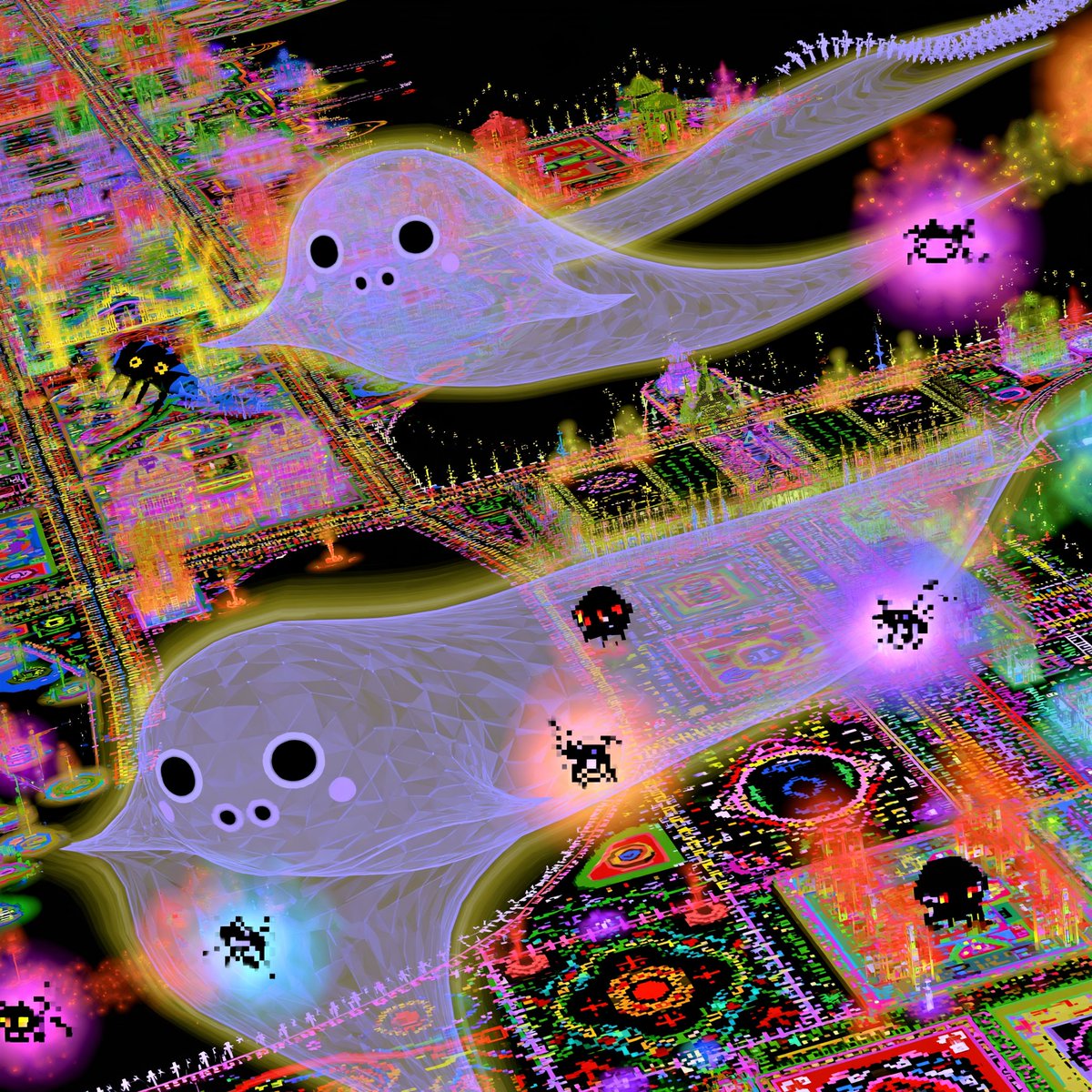
18. Philanthropists served as the primary benefactors funding Venice's rich art and architectural history. I want to see so much more support for arts and culture. I'm so tired of the Monster energy Bored Ape fake vintage maps matcha Greek statue soft-pastel slop. If rich tech people and philanthropy wants to support this, they should also donate pretty much unconditionally - i.e. I don't want them to act as filters. I sympathize with people who want to make the world more beautiful, but don't want this to be determined by people who only know Greek statues and pretend to care about virtue ethics. As usual, let a thousand flowers bloom.
19. Too many people treat AGI/ASI as something indistinguishable from a God. Any mention of bottlenecks, physical limits, control, adaptation etc are met with skepticism: "You don't really believe in ASI." It's been remarked on before, but the behavior of some people really feels quasi-religious in nature sometimes. It's underrated how unpopular this vibe is amongst the wider public. The silver lining is that this specifically will diminish those people's outsized current relevance.
20. It seems like a lot of people that get rich and leave tech/labs end up having some sort of crisis of meaning. They need something to believe in and fight for, or some equivalent of repentance, or go search for edgy counterintuitive ideologies (sometimes even pretty bleak/dark stuff). I think they should spend more time with people outside the Bay Area.
Introducing Gemini 4 Argon – our new frontier model.
It’s built for complex workflows across coding, enterprise knowledge work, and cybersecurity defense – rolling out today to a set of trusted testers through our Fairwind Program.
China has expanded overseas travel restrictions for top AI professionals in private firms to include the families of key personnel https://t.co/TUGxdBROBA
Today, @GoogleDeepMind and @GoogleResearch are introducing WeatherNext 3, our most advanced and accurate global weather AI model to date. It uses real-time satellite data to generate hourly high-resolution forecasts, precise precipitation forecasting, and clean energy variables.
Most AI weather models are trained on data from numerical weather prediction (NWP) models, which come with a six-hour data lag. But by training on real-world observations, WeatherNext 3 is able to bypass these traditional constraints — meaning more people can get more accurate predictions to help them plan ahead.
Starting today, WeatherNext 3 will power forecasts within Search, @GeminiApp, @GoogleMaps, Google Maps Platform Weather API and Google Earth Engine.
Introducing Gemini 3.8, our best reasoning & coding model yet.
By leveraging long-running agentic loops, we’re building on the momentum of 3.7 Flash from just three weeks ago to release two new 3.8 variants:
Meet Gemini 3.8 Flash and Gemini 3.8 Flash Cyber 🧵
@BasilHalperin@sebkrier What an exciting time to be an economist! (or an engineer)
I worry more about Fisher's debt-deflation in a post-AGI world than rising real rates. Also fascinated about the incoming crazy form of Baumol's cost disease. Significant research potential.
@BasilHalperin@sebkrier What an exciting time to be an economist! (or an engineer)
I worry more about Fisher's debt-deflation in a post-AGI world than rising real rates. Also fascinated about the incoming crazy form of Baumol's cost disease. Significant research potential.
The X Safety team conducted an investigation into suspected Chinese inauthentic accounts involved in influence operations:
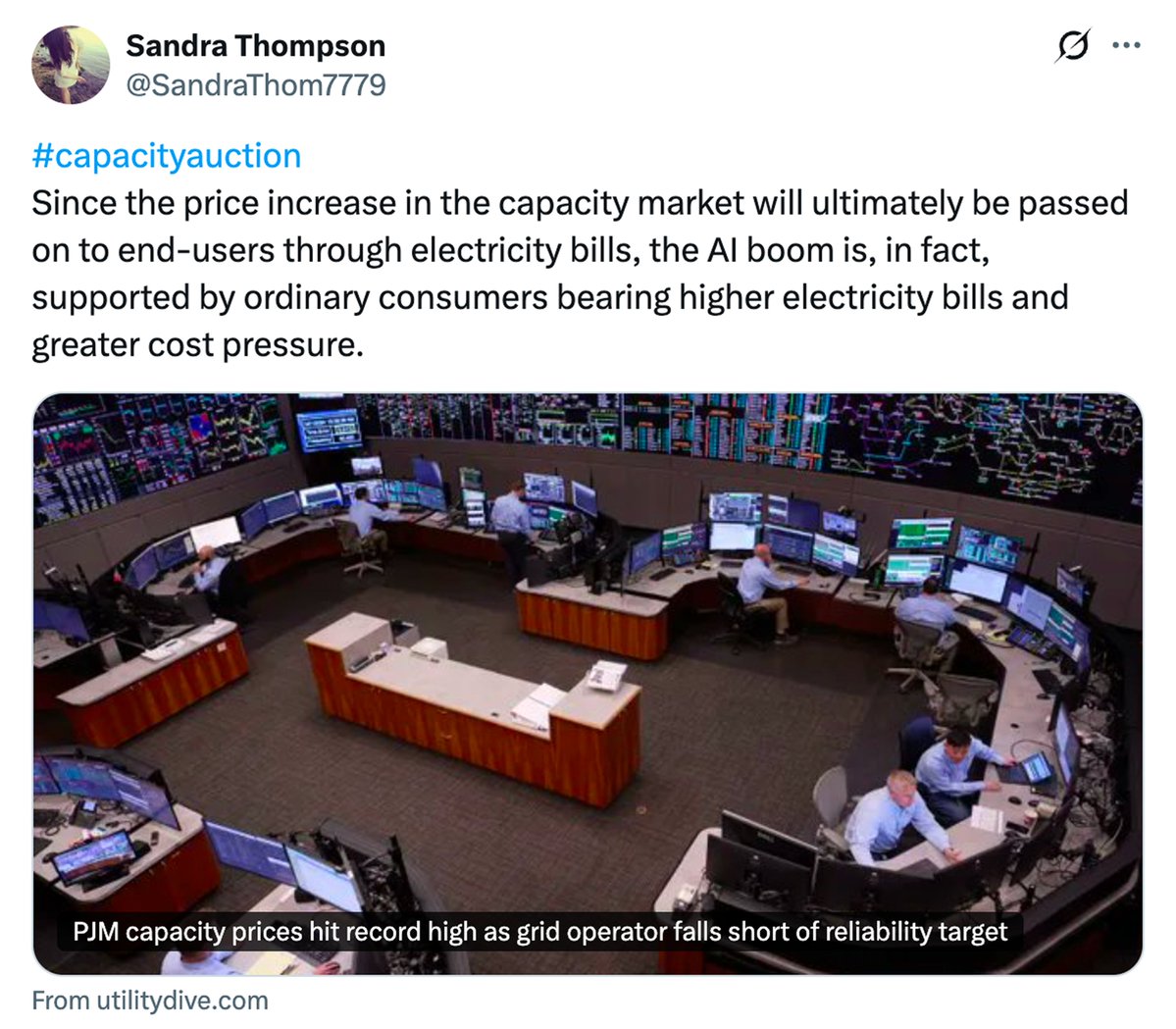
We identified a bot farm of approximately 200,000 accounts. Within this farm, we found 200 accounts posting in a manner that could manipulate a legitimate debate about American AI and energy policy.
These posts contained claims that AI data centers are driving up household electricity prices and straining the grid. Others included AI-generated cartoons that depicted data-center operators enriching themselves at the public's expense.
We remain committed to maintaining an open and authentic platform where people debate topics of public interest. We take seriously any attempts to undermine the integrity of the global town square and suspend accounts that violate our Authenticity policy.
@ModeledBehavior@tylercowen The biggest issue: You want data centers geographically diverse or at least bicoastal options to minimize latency to your users.
You also want some diversity to avoid network SPOFs.
All that said, godspeed to West Virginia.
The anti-datacenter psychosis sweeping through both sides of our national politics might be the worst mass movement I've seen in my lifetime. The magnitude of lies underpinning it, the threat it poses to our economy and civilization, and the sheer scale of its popularity are totally unprecedented. It should be an enduring national shame that the country that invented the airplane, landed on the Moon, and created the Internet is descending into superstitious panic at the very moment growth matters most
We should all be worried about "dynamic pricing."
That's when companies change their prices in real time.
If it's hot out, the cost of ice cream could go up.
If it's cold, tea bags could go up.
It's a way for giant companies to squeeze you even more.
Someone asked me recently why I’ve become interested in aesthetics after having spent most of my life more interested in STEM-adjacent topics. I hadn’t really considered the question consciously before, but I’m certainly thinking about aesthetics more than I used to. I think it’s a confluence of things:
• Many things today are ugly and far uglier than they used to be or need to be. Once you see this, it’s kinda hard to stop perceiving it. (Early twentieth century phone boxes versus modern phone boxes; old water fountains versus new water fountains; etc.) As someone with a naively meliorist assumption that most things should be getting better rather than worse, it’s all a bit perplexing: why did we stop doing things nicely? Is it a choice? Was there a malevolent spell cast upon us? This vein led me to think more about modernism and why much of art became more intentionally "challenging", grotesque, opposed to prettiness, rebarbative, dissonant, etc. Can or should anything be done about this? Is this just how things ought to be?
• Relatedly, much of modernism involved a kind of explicit repudiation of cultural continuity and represented a schism with prior practices. This is maybe most evident in American architecture, where the International Style exhibition in 1932 initiated the displacement of a rich tapestry of prior styles. This cultural break seems important and interesting to me, and I suspect that the rejection had important consequences outside of the aesthetic domain. Samuel Hughes has been exploring this question in his recent writing at @WorksInProgMag; @RuxandraTeslo is also pulling on this thread. Elaine Scarry wrote about how beauty inspires creation. If so, the inverse may also be true: ugliness inhibits it.
• It’s clearly the case that changes in the aesthetic domain can at least inspire progress in other places. Petrarch helped set some of the preconditions for the Renaissance which in turn fostered the scientific revolution and Enlightenment. Things like World Fairs (the 1851 Fair at the Crystal Palace recorded 6 million admissions when the population was 21 million) reflect the popular interdependency that used to exist between aesthetics and material development.
• @tedgioia and others have written about stuck culture and how so many domains seem to have ceased to straightforwardly advance in the way that they did up until the nineties or thereabouts. This is obviously peculiar and interesting. What changed, and what does it mean? Is it about the internet and fragmentation? Is it about a loss of supply? Is it just about having reached the zenith of various mediums?
• I’m generally interested in markets and the dynamics of creation. In aesthetics broadly, I find the reflexivity between supply- and demand-side factors to be very thought-provoking. There’s a natural desire to view satisfaction of individual preferences as the yardstick to measure market success, but things get interesting and even a bit unsettling when we start to think about how the supply might start to shape the demand. I often think about this in the context of food. Why is food so much worse in Germany than many of its neighbors? Germany certainly doesn’t have less material ability to produce good food; indeed, Germany is richer than the countries around it. There’s probably something about German food supply chains that is impoverished relative to France and Italy, but the Germans themselves don’t seem too upset about it. It just seems that the Germans are stuck in an objectively worse market equilibrium than their neighbors: the food is bad and they’ve gotten used to it. The obvious question then is where else these kinds of reflexive patterns apply, and where else we’re stuck in some objectively inferior equilibrium, even if preferences are in some superficial sense being sated.
• While this is an extremely banal and obvious point, I hadn’t until recently thought much about or internalized how much one can study reasonably objective things ("the status of women in society", say) through artwork. (Thanks to @_alice_evans for opening my eyes here.) In this vein, I’m pretty excited about the possibilities over the coming years in computational art analysis. I want something that’s conceptually similar to Google Ngram timelines but for the visual arts.
• We've always tried to do things well at Stripe. I've come to see that attempting to do them beautifully is often a helpful way to break out of standard practices and to do something with greater novelty and in a way that might have other benefits besides. (Also, excellent people want to do great work because it is intrinsically satisfying. Explicitly allowing aesthetic considerations to carry weight avoids having to justify every assessment with some kind of torturous empiricism.)
• In his Nobel Lecture, Solzhenitsyn said that, among the Platonic virtues of goodness, truth, and beauty, that beauty is special, for it possesses a unique kind of irrefutability. He notes that arguments, writing, and philosophical systems can all be predicated on misapprehensions, but that “a true work of art carries its verification within itself.” He proceeds to observe that when goodness and truth are threatened, the “ever surprising shoots of beauty will still force their way through.” There is a lot of specious and motivated reasoning in the world today and plenty of questionable value systems. I don’t think that beauty directly reflects any definitive trait, but I’m intrigued by the idea that it can be a marker of deeper metaphysical coherence.
One of my strongly held beliefs is that people generally come to various conclusions about the world almost purely emotionally, based on the particular individual's character and personality, and then back-chain logical arguments to arrive at that same conclusion "logically" (which is quite easy to do once you have already assumed the conclusion to be true). This is why changing anyone's mind about anything is basically impossible - the conclusion the person reached was essentially purely emotional, not logical, and so counter-logic has no power to influence anything.
It’s hard to compare the two periods because in the early Industrial Revolution economic growth was in a race with demographic growth. And progress was in fact feeding population growth rather than raising standards of livings (Ricardo’s iron law of wages).
Between 1750 and 1820, the population of England doubled. So a growth of 20% per capita corresponds to 140% in GDP. And nearly half that population was below 18.
AI will not have to feed the fall of child mortality and a population boom. It will need to offset the collapse of fertility and steady population decline.