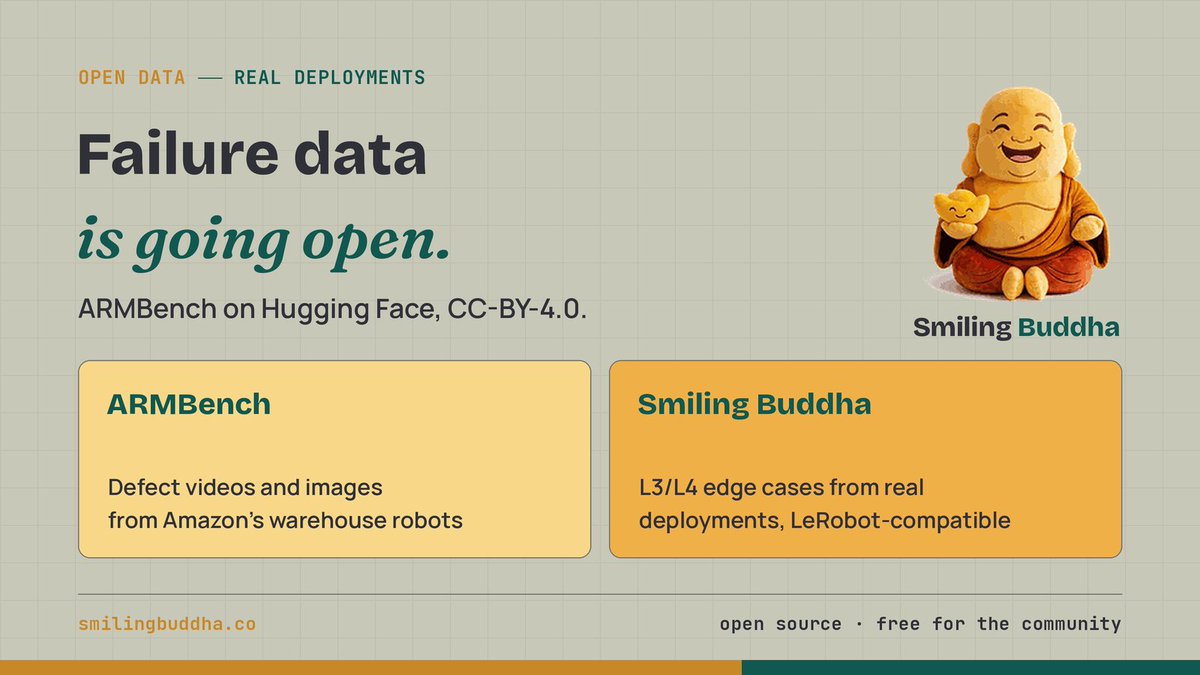
Robots don't fail in the lab. They fail in the field.
Smiling Buddha is an open, community-run initiative building the real-world data layer for physical AI: edge cases from real deployments, native to @LeRobotHF on @huggingface, free for the community.
https://t.co/kLALDgZXRx
Failure data is going open. @amazon has put ARMBench on @huggingface: defect videos and images from its own warehouse robots, CC-BY-4.0. That's the layer we care about too: L3/L4 edge cases from real deployments, free, in LeRobot-compatible formats. #PhysicalAI#LeRobot
@NVIDIARobotics Human demonstrations are the right starting point for the Cosmos Labs training-data path. Once those demos hit a real cell, do the slips and recoveries get packed into the same set, or do only the clean takes survive? #PhysicalAI#RobotLearning
@TheHumanoidHub The last few millimeters, where vision loses contact, is the residual a clean demo hides. For @Nimo_Robotics Interaction Episodes (force, audio, video aligned), are failed or recovered takes kept as a first-class split, or only the ones that make the one-day deploy? #PhysicalAI
@MarilynLiu97 Your real-to-sim point rings true: one reconstructed scene is easy, but contact physics and task-preserving variations are where real-to-sim breaks. Real deployment failures help ground it. Is tactile data or more real-robot hours the bigger lever there? #PhysicalAI#CoRL2026
@paigeinsf@dreamlabs_ai 500 real-robot demos taking Dream-1 from 8.5 to 22 is a strong signal. Curious where it still lost to Fable: were the memory and sorting misses mostly long-horizon drift, or rare edge cases mid-task? That split decides what data to collect next. #PhysicalAI
@muskan_kalra24 Ha, so true. Part of the fix is making real deployment data open by default: failures, recoveries, the weird edge cases, all inspectable on @huggingface. Curious what you think would make a lab trust a dataset it didn't collect itself? #PhysicalAI
@EricEncord@nvidia@anybotics Generating spills from real inspection imagery is the right order: start from a real edge case, then let synthetic scale it. Same idea behind our open, free Real-to-Sim edge case library. How do you check a synthetic spill is calibrated before training? #PhysicalAI
@yzhao010 Great tip. GSR-VLM's embodied AI topic is timely: spatial reasoning that looks solid on benchmarks often slips on real robots (occlusion, glare, a part a few mm off). Will the workshop welcome evals on real-deployment failure cases, not just curated scenes? #PhysicalAI
@lukas_m_ziegler@leggedrobotics The impressive part isn't the two-wheel stunt, it's that a 5-tonne machine with messy hydraulic delays transferred at all, @leggedrobotics. Trial-and-error is off the table. After sim-to-real, which delay or rough-ground edge still shows up on the real 332G? #PhysicalAI
@lukas_m_ziegler@MosaicoLabs Everyone talks about models; @MosaicoLabs is fixing the unglamorous bit: finding the rare case in data a fleet already has. Scaling laws only hold if that pedestrian-crossing stop comes back in seconds. After the €7.5M seed, is search still the break, or labeling? #PhysicalAI
@_varunnair Agree. Deployers carry the risk, so the tools that win cut the cost of each failure on site. If models and sims sell to deployment companies, should the edge cases those deployers collect stay proprietary, or flow back as open data that lifts everyone? #PhysicalAI
@jerryhuang01@EmbodiedCoX Only 7 of 170 in Deploy says a lot about where physical AI really is. As the integrator working with 200+ companies, which failure most often stalls a pilot before it scales: perception, odd parts, or site changes? #PhysicalAI
@YSenqiao A LEGO-like, open-source VLA framework at 4K stars, and agent-friendly, is the right way to ablate each piece. The test is swapping in a deployment failure (lighting, slip, a bad grasp) without rebuilding the stack. Which component breaks first off the lab bench? #PhysicalAI
@FutureStacked Agree: consistent delivery beats the demo. If Lightwheel and Unitree combine hardware with training, simulation and deployment so robots improve with every deployment, the loop only works if failures come back in. Which real-world miss is the first retraining signal? #PhysicalAI
@TheHumanoidHub $25B and a near-tripling in Q3 is the demand signal. The harder story is whether Jetson, Isaac and GR00T stacks are collecting the failure data that makes robots reliable off the keynote stage. Which real-world miss is still the bottleneck for that $25B landing? #PhysicalAI
@Builtin_Pb A bottle that tips 78° in sim, on the same grasp, is why leaderboard scores can mislead. If sim isn't modeling the contact it claims, policies will hack the score. After the fix, which other RoboDojo task still diverges most from the real world? #PhysicalAI