Two rigorous studies. Opposite conclusions. And neither told us the one thing needed to interpret them.
Two weeks ago Nature Medicine reported frontier AI models beating specialized clinical tools. Now a stronger study, 149 blinded specialty-matched physicians, reports OpenEvidence beating the same frontier models on real clinical questions.
The design is excellent. The problem is simpler than the statistics.
AI models have settings. Reasoning effort. Thinking time. Response length. Change the settings and the quality of the answer changes, the same way changing the dose changes the drug. This study did not report the settings.
One clue they mattered: GPT-5.5, the worst performer by far, produced answers about a third shorter than every other system. Short answers are typical of default settings. And the study's own analysis showed longer answers scored better.
To be fair, OpenEvidence also won its head-to-head comparisons against all three frontier models. The finding is valid. But what it means depends on settings we were never shown. Did the specialized tool beat the frontier models, or their factory defaults? The paper cannot answer that. Neither can we.
I raised the same issue with the Nature Medicine study, which never specified which OpenEvidence mode it tested. Same standard in both directions.
In medicine we would never accept a trial reporting that patients received "a beta blocker." Drug, dose, route, frequency. AI evaluation needs the same discipline. Model, settings, effort level, web search on or off.
Until studies report configuration the way trials report dosing, the honest headline for both papers is the same. This setup beat that setup on these questions. Nothing more.
I will be giving a talk at ASRT this year about this topic.
Especially how any radiation oncologist can implement an LDRT program at their center.
Join! 😀
This guideline is absolutely terrific. Evidence-based (though high-level evidence is scant), reasonable and practical for the clinic.
For truly curative-intent cases, I tend to favor hyperfractionation given the NPC data, but one must acknowledge the limitations in extrapolation.
Terrific work from an all-star panel.
Kobe on controlling the controllables:
🔮 Doubt is a waste of energy because it focuses on something you can't control: the future.
You don't control whether you'll win. You don't control whether you'll fail. You don't control what everyone else thinks about you. But...
✅ You CAN control your preparation.
✅ You CAN control your effort.
✅ You CAN control your response.
Whether you win or lose, you'll wake up the next morning and go back to work anyway. So why spend today negotiating with emotions that don't effect anything?
Leadership and Self-Leadership isn't about eliminating uncertainty. It's about becoming so committed to your process that uncertainty no longer changes your behavior!
Train relentlessly. Control what's controllable.
Trust that over time outcomes will migrate toward your habits.
Then let reality reveal that outcome. 💯
Missed ASTRO’s webinars on living with prostate cancer?
Both sessions, moderated by ASTRO President Neha Vapiwala, MD, FASTRO, and featuring Stacy Loeb, MD, MSc, PhD (Hon), are now available onDemand.
Purchase today and claim up to 2 AMA PRA Category 1 Credits™. @NehaVapiwala@LoebStacy
Available now: https://t.co/gwzMRshEcm
MRI shows PSMA "negative" nodules in the fossa and L vas deferens. Does this change your treatment?
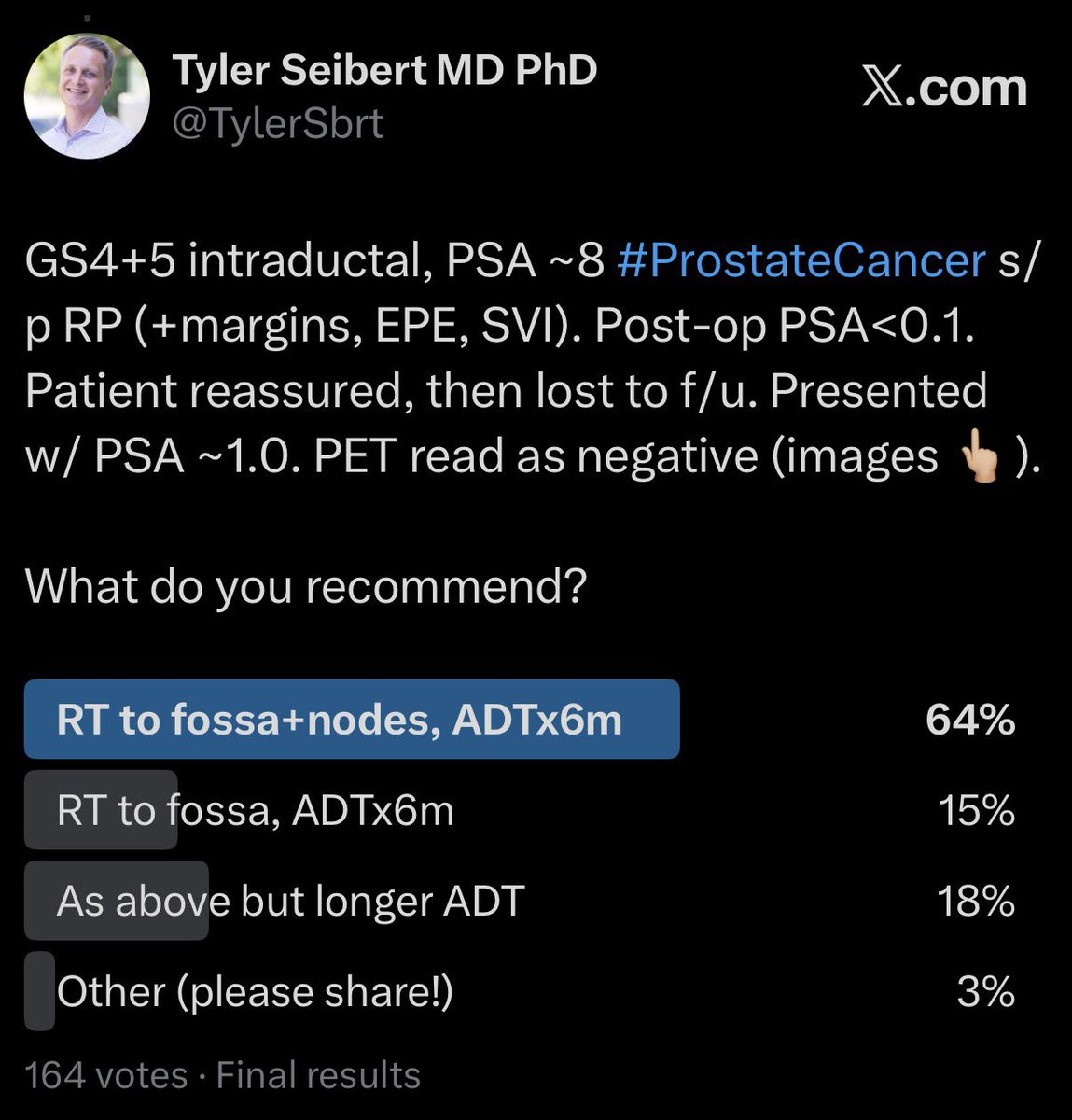
GS4+5 intraductal, PSA ~8, s/p RP (+margins, EPE, SVI). Post-op PSA<0.1. Patient reassured, then lost to f/u. Presented w/ PSA ~1.0. PET negative. MRI and PET images in replies.
Jennifer Doudna won the Nobel Prize for gene editing and went on Bloomberg to say the chatbots everyone is betting on cannot innovate at all. Every promise Silicon Valley is making about AI curing disease just hit the one person qualified to check it.
She has spent her whole career inside the actual frontier of curing disease.
So when she talks about what AI can and cannot do in biology, she is not guessing. She is reporting from inside the lab.
Her words were blunt. She is not seeing chatbots innovate. They summarize data. They write reports. They do not come up with a brand new idea nobody has ever had.
Then the interviewer pushed. So you're saying AI can't innovate?
Doudna did not flinch. She does not know if it can't. She just does not see it doing it right now.
This lands harder when you remember who is making the opposite case. Sam Altman says AI will eliminate disease within five years. Larry Ellison says AI will cure cancer in a 48 hour window.
An OpenAI executive even floated that the company should get a cut of sales on any drug discovered through ChatGPT. Doudna answered that in two words. Good luck.
Even the cancer specialists Altman is selling to keep warning that cancer is not one disease but hundreds, each needing its own cure, and that compute does not skip the years of lab work.
Her reason is simpler. Biology is hard. You cannot simulate your way to an understanding of the human body.
The people promising cures are the ones selling the tool.
The person who actually won a Nobel building them is telling you it has not happened yet.
Source: Bloomberg Originals
Watch the full video on their official channel.
STS Expert Consensus Document (2026) on Addressing Definition and Practices of Sublobar Resection in Non-small Cell Lung Cancer.
Read the article from Khullar et al👇
https://t.co/xafoonDWrG
Correspondence: Clusters of Concern — Spatial Link between Childhood Undervaccination and Measles Outbreaks in South Carolina https://t.co/ISglo3BdTI
#InfectiousDisease#PublicHealth
Fifty years ago today, Air France Captain Michel Bacos showed the world what true moral courage looks like.
When Flight 139 was hijacked by Palestinian and German terrorists and flown to Entebbe, the non-Jewish passengers were eventually released. Bacos and his crew were also offered their freedom.
However, Bacos, who also served in the French army under DeGaulle, refused to leave his Jewish passengers. All his crew also refused, without exception.
Instead, they chose to remain alongside the 94 Jewish hostages, fully aware of the danger they faced. As Bacos later said, abandoning his passengers was simply "unimaginable."
Days later, they were freed in the legendary Israeli rescue mission, Operation Entebbe, led by Yoni Netanyahu, who would die in the battle.
For his extraordinary courage, Bacos was honoured by both France and Israel. Yet his greatest legacy was not the medals he received, but the example he set: that decency, duty and humanity must never yield to terror or antisemitism.
Michel Bacos was a true hero. May his life, his courage and his memory forever be a blessing and an inspiration.